Hello to all dedicated parents out there! I’m SoCooly, and as a parent myself, I love researching and sharing insights to help make this beautiful, yet challenging, parenting journey a bit smoother.
The period from 6 to 12 months is often referred to as a time of “explosive growth”—and you’re probably seeing that first-hand! Your little one is rapidly moving from sitting and scooting to crawling, pulling up, and maybe even taking those exciting first steps. During this critical time, stimulating their five senses (sensory development) is paramount.
Are you looking for easy, safe, and fun activities you can do right at home? You don’t need complicated or expensive toys. Simple household items are often the best tools for developing your baby’s brain and body. Here are my top 5 simple sensory play ideas to encourage healthy development and joyful interaction between you and your baby.
👶 Why is Sensory Development Crucial at This Age?
A baby between 6 and 12 months is a natural explorer. They reach for objects, put everything in their mouth (tasting and feeling!), and shake things to hear the sound. This constant action is how they learn about the world through their senses.
- Touch: Experiencing different textures with their hands and mouth stimulates the brain’s sensory pathways.
- Sight: Tracking moving objects and distinguishing between colors and shapes sharpens their visual processing.
- Hearing: Responding to various sounds and locating their source improves focus and auditory skills.
- Fine/Gross Motor Skills: Play activities help them grasp objects (fine motor) and crawl or stand (gross motor), enhancing physical coordination.
Stimulating these senses lays the foundation for your baby’s cognitive development, language acquisition, and social skills.
🏠 Top 5 Sensory Home Activities for 6–12 Months
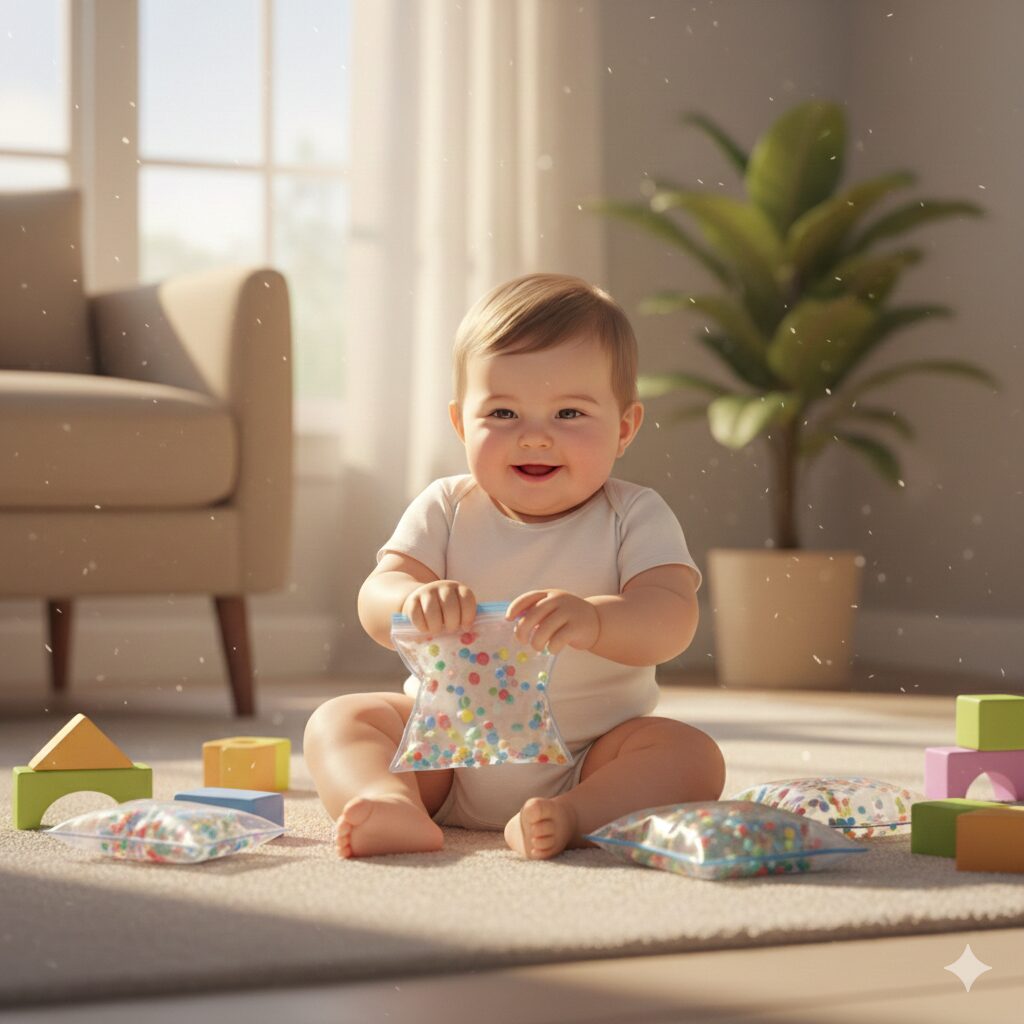
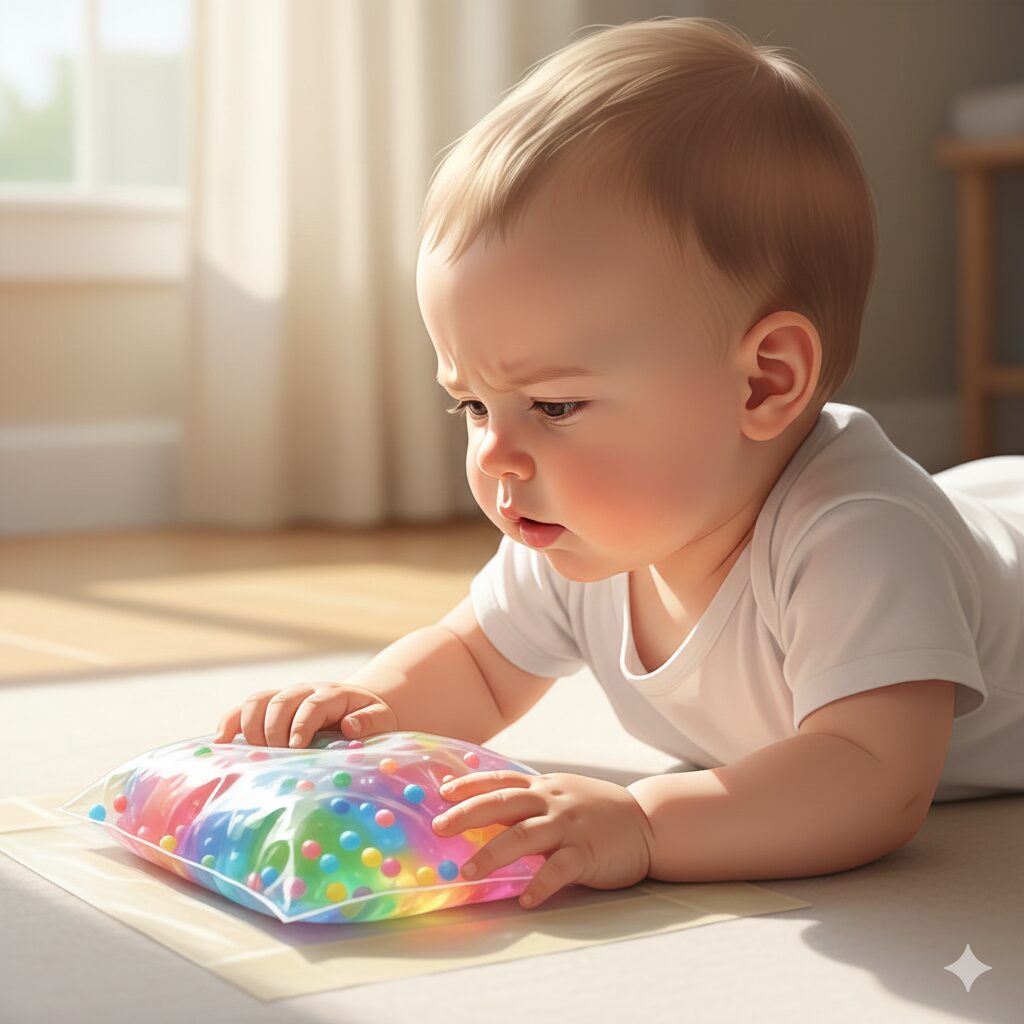
1. Colorful ‘Sensory Bag’ Exploration
When? When your baby is sitting or spending time on their tummy (6 months+)
How? A simple Ziploc bag transforms into a safe, mess-free tactile experience.
- Supplies: A sturdy, large Ziploc freezer bag, hair gel or cooking oil, various small sensory objects (buttons, beans, sequins, small toys—must be large enough not to be a choking hazard if the bag breaks), and strong duct tape.
- Creation: Fill the bag about two-thirds full with hair gel. Add the sensory materials. Squeeze out as much air as possible before sealing the zipper tightly.
- Safety First: Crucially, seal the zipper area completely with duct tape multiple times to prevent your baby from opening it.
- Play: Tape the finished bag securely to the floor or to your baby’s highchair tray. Let your baby push, squeeze, and prod the bag, watching the objects move through the gel.
Developmental Benefit: Pressing the bag stimulates the sense of touch (tactile). Tracking the moving objects inside improves vision and fine motor control.
2. The ‘Sound Hunt’ Discovery Game
When? When auditory focus is increasing (7–8 months+)
How? A game that boosts hearing and spatial awareness using sound.
- Supplies: Safe objects that make distinct sounds: rattles, maracas, bells, even simple pots and lids.
- Play 1 (Locating Sound): While your baby is sitting or crawling, hide yourself (or the sound source) slightly out of their sight and make a gentle noise. Encourage them to turn their head or crawl toward the source of the sound.
- Play 2 (Sound Discrimination): Shake one of the prepared objects and let your baby touch or point to it. Describe the sound to them, such as, “Listen! That goes tinkle, tinkle!” or “That’s a loud BANG!”
Developmental Benefit: Searching for the sound source not only develops hearing but significantly enhances spatial awareness and concentration.
3. The Classic ‘Peek-a-Boo’ for Emotional Growth
When? When the concept of Object Permanence begins to form (8 months+)
How? The simplest, yet most powerful, game for emotional security and stability.
- Supplies: Your face! Or a small baby blanket/towel.
- Play 1 (Face Peek-a-Boo): Cover your face with your hands and then quickly reveal it with an enthusiastic “Peek-a-boo!” Your baby will delight in the reappearance of the face that had seemingly vanished.
- Play 2 (Object Hiding): Partially cover a favorite toy with a blanket and encourage your baby to pull the blanket off to find it.
Developmental Benefit: Peek-a-boo helps a baby understand Object Permanence—the knowledge that something still exists even when they can’t see it. This is key to cognitive development and helps babies cope with separation anxiety.

4. The ‘Tunnel Exploration’ for Gross Motor Skills
When? When crawling skills are developing or established (8 months+)
How? An activity to boost physical movement and spatial reasoning.
- Supplies: A child’s play tunnel (If you don’t have one, use two or three chairs and a large blanket to create a safe, short, temporary tunnel).
- Play: Place your baby at one end and call their name from the other side, encouraging them to crawl through. If they are hesitant, try crawling half-way in with them or start with a very short tunnel.
- Cheer Them On: When your baby emerges, greet them with a huge smile and say, “Wow, you made it!”
Developmental Benefit: Crawling strengthens gross motor skills and is essential for developing bilateral coordination (using both sides of the brain). Navigating the tunnel fosters a sense of achievement and improves spatial awareness.
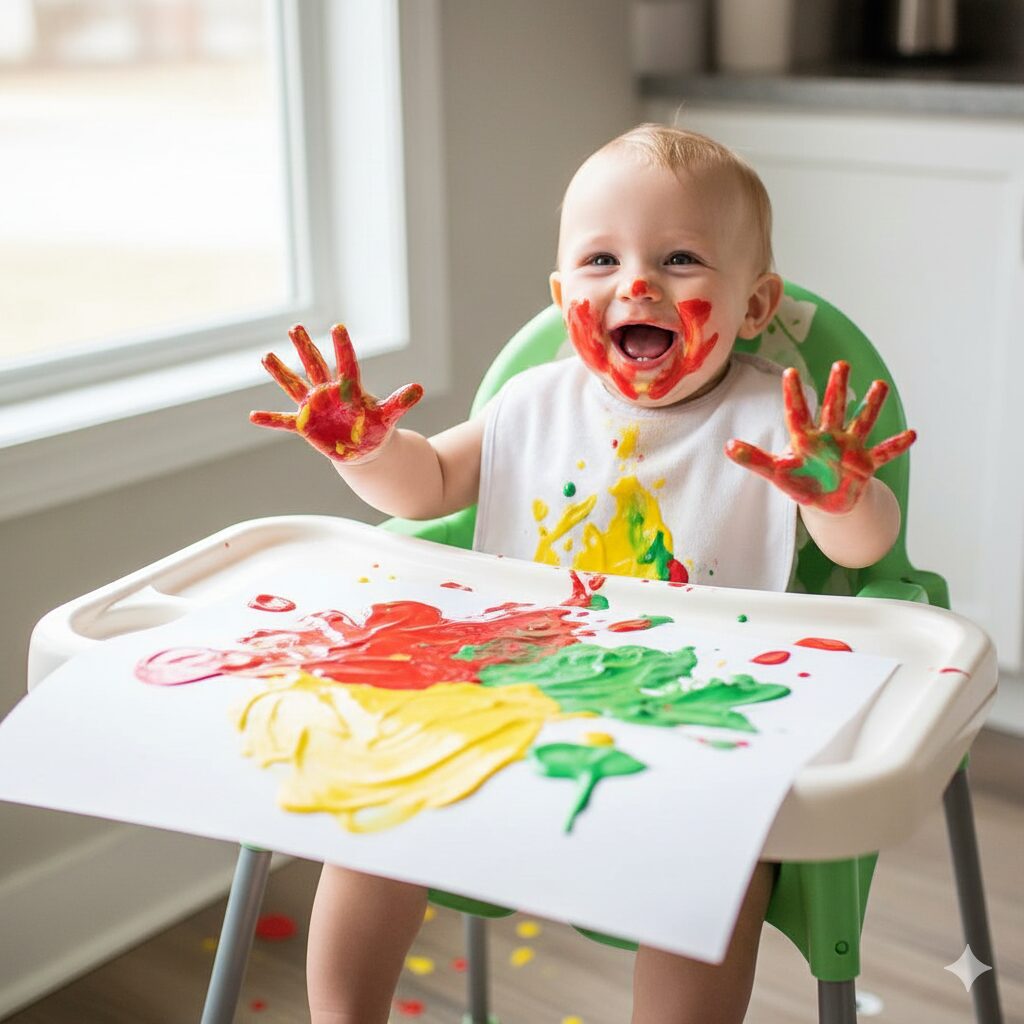
5. Safe ‘Edible Finger Painting’
When? When the urge to put everything in their mouth is strong (9 months+)
How? A worry-free art activity for parents concerned about chemical paints.
- Supplies: Plain yogurt, food coloring (natural vegetable powders like spinach or beet powder are highly recommended), a highchair, and large paper or a plastic mat.
- Creating the Paint: Mix the yogurt with the food coloring/powder to create several different colors of safe, edible paint.
- Play: Seat your baby in the highchair or in the bathtub. Lay out the paper or mat and let them freely dip their hands into the yogurt paint and smear it around. Since all the materials are safe to consume, you can relax and allow for maximum exploration.
Developmental Benefit: Touching and spreading the paint with fingers and palms provides excellent tactile input and boosts fine motor skills. Recognizing and using colors, along with the act of ‘creating,’ stimulates creativity.
✨ In Closing: The Power of Interaction
The most vital part of any activity at this age is the warm, responsive interaction from the parent. More than any expensive toy or complex activity, your eye contact, your empathetic reaction to their sounds, and your constant, gentle conversation have the greatest impact on their emotional and language development.
When engaging in play, please remember these three points:
- Safety First: Always supervise your baby closely to ensure they don’t put small, hazardous objects in their mouth or injure themselves.
- No Pressure: If your baby shows resistance, stop the activity immediately and try another time. Play should be fun and initiated by the baby’s interest.
- Positive Language: Acknowledge every small action with encouragement: “Good job reaching!” or “That feels cool, doesn’t it?”
Parenting is a journey without a strict map. I hope these simple activities bring lots of laughter and learning to your home. I’m rooting for you every step of the way! Keep up the great work! 💪

🔗 Useful Resources
- CDC (Centers for Disease Control and Prevention) – Milestones and Development Information (www.cdc.gov/ncbddd/childdevelopment/)
- American Academy of Pediatrics (AAP) – Parenting Information (www.healthychildren.org)