Hello everyone! It’s SoCooly here. Can you believe we’re already standing at the threshold of 2026? Time really does fly when technology is moving at the speed of light.
Lately, every time you turn on the news or scroll through social media, it’s “AI this” and “AI that.” But I have a feeling that what we’ve seen so far—the chatbots that write poems or summarize emails—is just the tip of the iceberg. As we head into 2026, we are entering a brand-new era. We’re moving away from AI that just “talks” to AI that actually “acts.”
The tech world is calling this ‘Agentic AI’ (AI Agents), and trust me, it’s going to change your daily routine more than the smartphone did back in the day. Today, let’s take a deep dive into what 2026 looks like with these digital doers, how they’ll change our jobs, and what we need to watch out for. Grab a coffee, and let’s step into the future!

Forget Everything You Knew About Chatbots: Meet the ‘Doers’
Until now, our relationship with AI like ChatGPT or Claude has been a bit like talking to a very smart, very fast encyclopedia. You ask a question, and it gives you a brilliant answer. You ask for a workout plan, and it gives you a list of exercises. But then what? You still had to find the gym, check your calendar, and buy the protein powder yourself.
In 2026, the AI Agent takes the wheel.
Think of an AI Agent not as a search engine, but as a Proactive Personal Assistant. It doesn’t just give you information; it completes tasks across different apps and websites on your behalf.
For example, imagine saying: “SoCooly AI, I want to run a marathon next November. Make it happen.”
Instead of just giving you a PDF of a training schedule, the AI Agent will:
- Scan your calendar to find the best times for morning runs.
- Search for local marathons, check the registration dates, and alert you when it’s time to pay.
- Compare the latest running shoes based on your foot type and budget, then put them in your shopping cart.
- Book a physical therapy session for a check-up before you start training.
This shift from “generative” (creating content) to “agentic” (taking action) is why major outlets like The New York Times and the BBC are calling 2026 the “Year of the Agent.” We are moving from a world of “Search” to a world of “Execution.”

The Workplace Revolution: From ‘Worker Bee’ to ‘Chief Strategist’
If you’re worried about AI taking your job, 2026 might actually offer some relief—if you know how to use the tools. Recent reports from Google Cloud and various global business journals suggest that the “AI Outsourcing” of mundane tasks is about to hit its peak.
1. The 40-Minute Miracle
Take the case of the Canadian telecommunications giant, TELUS. They’ve already deployed AI Agents to over 57,000 employees. The result? They are saving an average of 40 minutes per work interaction. This isn’t just about writing emails faster. These agents are analyzing complex customer data, updating internal systems, and filing reports that used to take hours of manual data entry.
2. No More “Data Fishing”
Remember the days of digging through endless Excel sheets or asking the IT department to run a complicated report? Suzano, the world’s largest pulp producer, used AI Agents to allow employees to ask questions in plain English rather than complex coding languages (like SQL). This reduced the time spent searching for data by 95%.
In 2026, your job description might shift. Instead of spending 80% of your time doing the work (formatting slides, checking data, scheduling meetings), you’ll spend 80% of your time reviewing and directing the work done by your AI Agents. You become the manager, and the AI becomes your highly efficient staff.
Shopping and Leisure: Your Personalized Digital Concierge
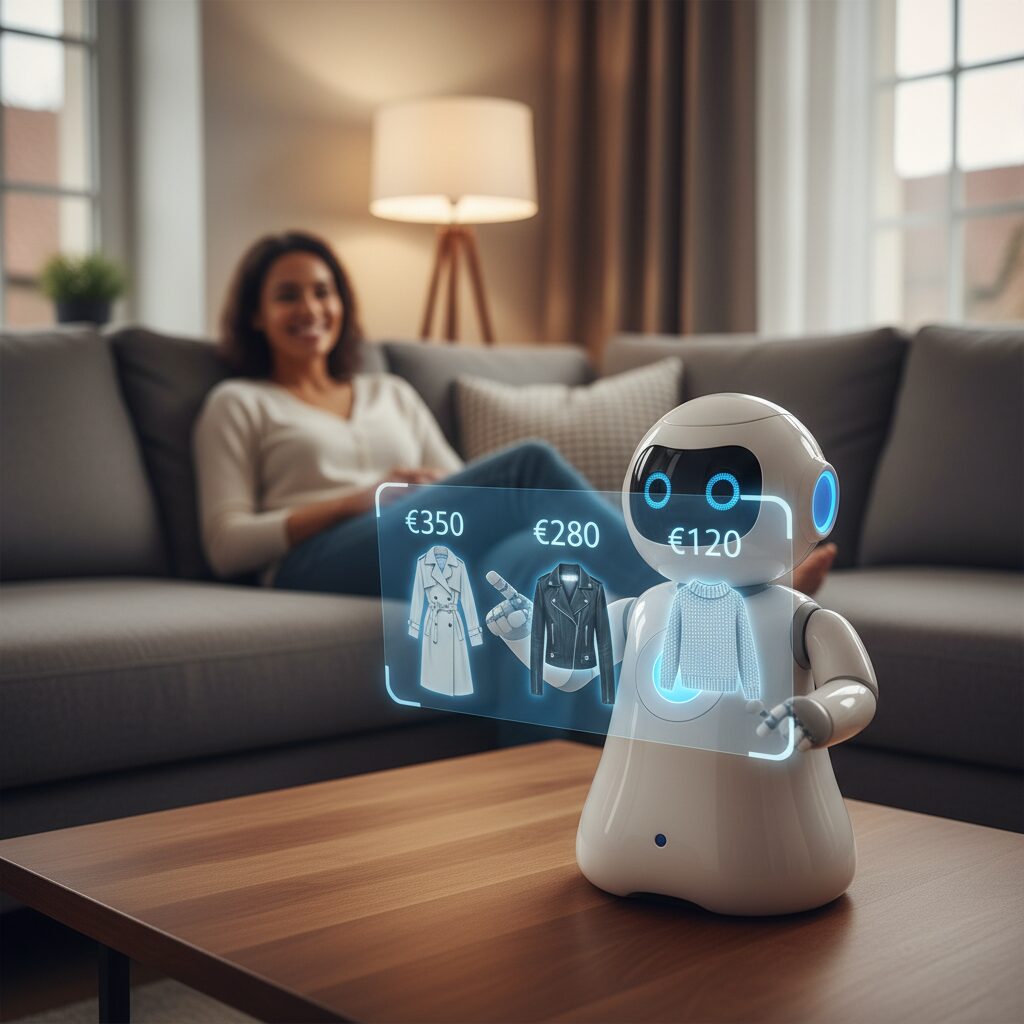
Shopping in 2026 won’t be about scrolling through endless pages of “Recommended for You.” It will be about outcome-based requests.
Currently, about 85% of consumers in the US and UK already use some form of AI during their shopping journey. But by 2026, your AI Agent will have what we call “Contextual Awareness.” It knows your shirt size, your favorite colors, your budget, and—most importantly—what is already in your closet.
- The Request: “I have a wedding in Italy next month. Find me an outfit that fits the ‘Tuscan Sunset’ theme, under $200, and make sure it arrives by Friday.”
- The Action: The AI Agent scans multiple retailers, checks for discounts, verifies shipping times, and presents you with the top two choices. Once you tap “Confirm,” it handles the payment and tracking.
This is made possible by something called A2A (Agent-to-Agent) communication. Your personal AI Agent will talk directly to the Retailer’s AI Agent. They “negotiate” the best price or the fastest shipping without you ever having to open a browser tab. It’s like having a private concierge that works 24/7.
The Reality Check: Privacy, Trust, and the “Human-in-the-Loop”
Now, I know what you’re thinking. “SoCooly, this sounds amazing, but also a little scary.” You’re right to feel that way. With great convenience comes great responsibility.
As we move into 2026, two major challenges will dominate the headlines:
1. The Privacy Trade-off
For an AI Agent to be truly helpful, it needs access. Access to your emails, your bank account, your location, and your personal preferences. After the various data leaks we’ve seen in recent years, trusting a single company with all this “digital DNA” is a big ask.
SoCooly’s Note: ‘Contextual Privacy’ is a term you’ll hear a lot in 2026. It refers to technology that allows AI to use your data to perform a task without actually “storing” or “seeing” it in a way that humans or other companies can exploit. Always look for “On-Device AI” features whenever possible!
2. The Accountability Gap
What happens if your AI Agent accidentally books a non-refundable flight for the wrong date? Or what if it sends a sensitive business document to the wrong person? Currently, the law is still catching up. Who is responsible—you, the software developer, or the AI?
This is why the concept of “Human-in-the-Loop” (HITL) is so important. Even in 2026, the most successful people will be those who use AI as a co-pilot, not an autopilot. You should always be the one to give the “Final Click” for anything involving money or important relationships.

Preparing for 2026: Stay Curious, Stay SoCool
The world is changing, but that’s not something to fear. It’s something to prepare for. The 2026 AI revolution isn’t about robots replacing humans; it’s about humans being liberated from the “boring stuff.”
Think about all the hours you spend every week on “digital chores”—paying bills, booking appointments, sorting through junk mail. If an AI Agent can take even 50% of that off your plate, what would you do with that extra time? Maybe you’d finally write that book, spend more time at the park with your kids, or just enjoy a quiet cup of coffee without checking your notifications.
My advice? Start playing with these tools now. Practice giving clear instructions. Learn how to “prompt” effectively. The better you are at communicating your intent, the more powerful your AI Agents will be in 2026.
I’ll be here to keep you updated on all the latest shifts and trends. Let’s navigate this brave new world together, one “SoCool” step at a time!