Hello to all dedicated parents out there! This is SoCooly. 😊
“Is my child talking late?” This worry resonates with so many parents. It was certainly one of the topics that made me most anxious while raising my own child. It’s easy to feel uneasy when the neighbor’s child is already speaking full sentences, and yours is still mostly babbling. But please don’t worry too much! There is a huge variation in the pace of language development among children. Today, I’ll help you clear up misunderstandings about language delay and offer practical, everyday parenting tips that can effectively open up your child’s world of words.

🤔 Is it a ‘Language Delay’? Understanding the ‘Normal Range’
Many parents fixate on benchmarks like ‘how many words a child should say by how many months.’ However, child development is like a marathon, and everyone runs at their own pace. Nevertheless, there are crucial developmental ‘milestones’ we should pay close attention to.
👶 Common Language Development Milestones by Age
| Age | Expected Language Abilities (Expression/Comprehension) |
| 12 Months | Babbling becomes varied; can say one or two meaningful words like ‘mama’ or ‘dada’. (Comprehension: Understands their own name) |
| 18 Months | Uses 5–20 meaningful words and understands simple commands (e.g., ‘Bring the ball’). |
| 24 Months (2 Years) | Uses 50+ words and begins combining two words into short phrases (e.g., ‘Mommy go,’ ‘More juice’). |
| 36 Months (3 Years) | Uses 3–4 word sentences and is understood by most people. |
Crucial Point! In language development, remember that ‘comprehension (understanding) develops much earlier and is more important than ‘expression (speaking)’. If your child doesn’t talk much but understands your instructions and reacts appropriately, you don’t need to rush things.
🚩 When to Consider ‘Language Delay’ and Seek Advice
Generally, if your child falls into the following categories, it’s worth seeking advice from a specialist, moving beyond just individual variation.
- At 18 months, uses fewer than 5–10 meaningful words.
- At 24 months, cannot link two words together to form a phrase. (e.g., knows ‘Mommy’ and ‘water’ but doesn’t say ‘Mommy water’).
- At 36 months, struggles to communicate clearly or use sentences.
- Refuses to speak or loses words they previously knew. (Regression).
📝 SoCooly’s Comment: Language acquisition involves complex elements like ‘listening (comprehension),’ ‘speaking (expression),’ and ‘social skills.’ The first step is to objectively observe your child’s current development without giving in to anxiety.

🧐 3 Common Reasons Why a Child Might Be a Late Talker
There can be various complex reasons why a child’s speech is delayed. However, here’s some encouraging news for parents: the vast majority of “late talkers” have ‘Expressive Language Delay’ with no underlying major issues.
1. Environmental Factors: Lack of Quality Interaction
The biggest influence on a child’s language development is the ‘quality of interaction’ they have with their parents.
- Passive Media Exposure: Screens (TV, tablets) only provide ‘passive listening’ without the necessary ‘question-answer’ interaction, which is less helpful for language development.
- Instruction-Only Dialogue: If conversations mostly revolve around commands like, “Hurry up and eat,” or “Put your toys away,” the child struggles to see language as a fun means of communication.
- Parent’s Quick ‘Spokesperson Role’: When a child points or whines, and the parent immediately responds with, “Oh, you want the candy!” the child doesn’t feel the need to use words themselves.
2. Auditory or Oral Motor Skill Issues
Rarely, late talking can be related to a physical issue.
- Hearing Problems: If a child cannot hear sounds accurately, speaking will naturally be difficult. Ensure you don’t miss regular hearing checks and observe whether your child reacts well to soft sounds.
- Oral Structure and Motor Skills: Difficulty in moving the tongue or lips can affect articulation. In these cases, a visit to a pediatrician or ENT specialist may be necessary.
3. Temperament and Genetics
- Slower Temperament: Children who are quiet, reserved, and prefer observing may start talking later. These children often show explosive growth once their speech opens up.
- Genetic Factors: If parents or close family members were late talkers, the child has a slightly higher chance of being one too.
💡 Magical, Everyday Tips to Spark Language Development
Stop worrying! Here are the most effective language stimulation tips you can start at home right now. The key is ‘fun interactions based on the child’s interest.’
1. Follow the Child’s Lead (FCL)
This is one of the core strategies emphasized by speech therapists.
- Observe First: Focus on what your child is looking at and interested in. If they are playing with a toy car, the parent talks about the car.
- Expand Their Language: If the child makes a ‘vroom’ sound, the parent responds by expanding it: “Wow, the car is going vroom vroom!”
- 🌟 Key: Describe Instead of Demand: When the child points to a cup for water, instead of demanding, “Say ‘water’!”, the parent should describe the situation: “Oh, you must be thirsty. Would you like some cool water?” The child learns that their need and language are connected through this process.
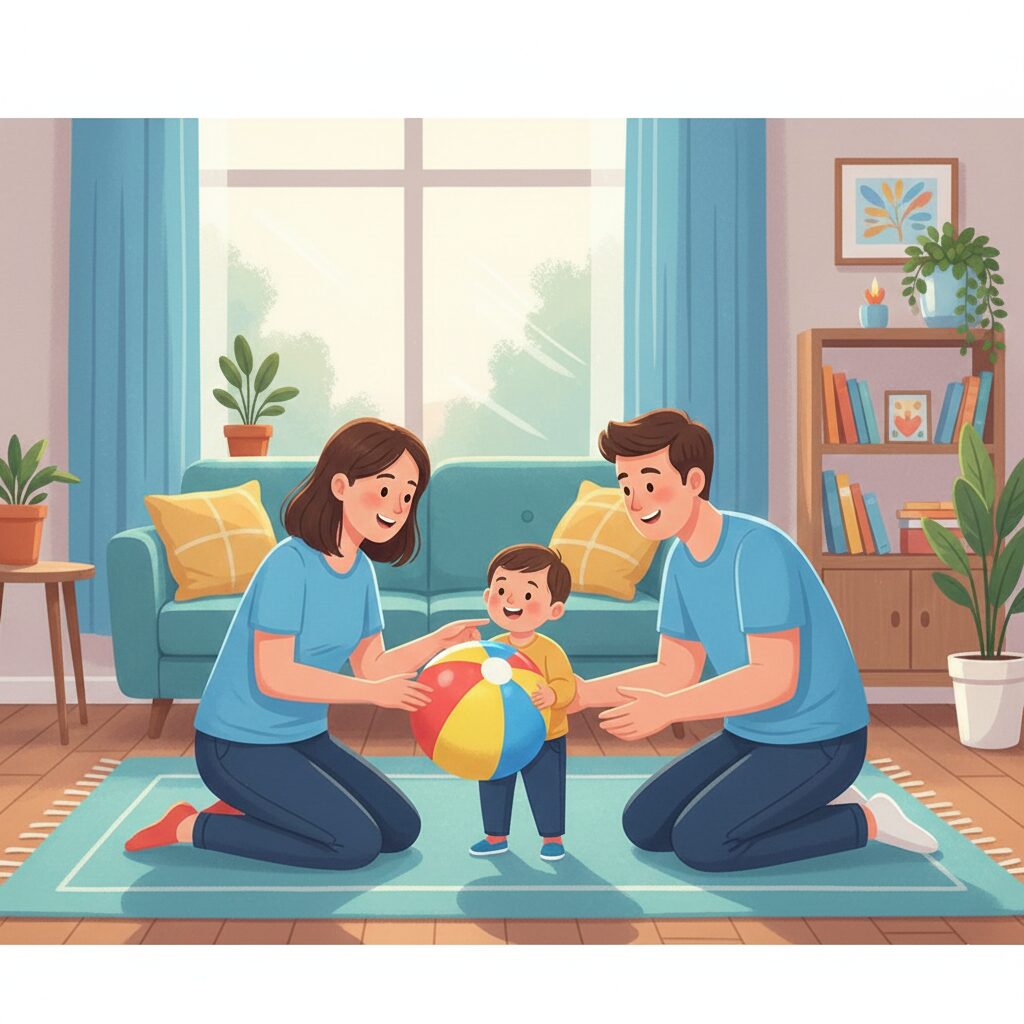
2. Use Exaggerated and Simple ‘Parentese’
When talking to your child, exaggerate your pronunciation and intonation, and use simple, short words.
- Using Onomatopoeia and Mimetic Words: Use words that express sounds and movements often: “Woof woof! The dog is eating its food chomp chomp!”, “The train goes chugga chugga!”, “The blanket feels so soft.” Children are more easily drawn to language this way.
- Repetition and Emphasis: When introducing a new word, repeat and emphasize it multiple times. “Apple! A red apple! A yummy apple!“
3. ‘Label’ Everything in Daily Life
Children are constantly learning new words in their daily environment.
- In the Kitchen: “I’m putting water in the pot and letting it boil boil.”
- While Out: “Look! A bird is singing tweet tweet. The sky is blue!”
- During Bath Time: “Let’s splash splash in the warm water! Washing with soap until we are squeaky clean.”
It’s important for the parent to be a constant commentator on the child’s activities. This is a secret to exponentially increasing your child’s vocabulary.

👨⚕️ Checklist for When to Seek Professional Help
In most cases, efforts at home are enough, but if your child meets the criteria below, do not hesitate to consult a specialist. The earlier, the better.
1. Comprehension Related
- If they are over 18 months and barely understand simple parental commands (e.g., ‘Sit down,’ ‘Come here’).
- If they seem uninterested in sounds or the environment, and rarely turn their head when their name is called.
2. Social and Non-Verbal Expression Related
- If eye contact is minimal, and emotional connection with the parent is difficult.
- If they rarely use pointing (to indicate what they want) (around 24 months).
- If they show little interest in joining play with others.
3. Articulation and Speech Related
- If you notice any form of ‘regression’ (e.g., forgetting words they used to say).
- If they are over 24 months and still primarily make babbling sounds, using few meaningful words.
💡 Advice: Speech therapy is less about a ‘speaking lesson’ and more about ‘learning the correct interaction methods between parent and child.’ Seeking professional help early on is not a disadvantage for the child; instead, it can greatly alleviate parental anxiety and help unlock the child’s potential.

💖 SoCooly’s Encouragement and Conclusion
Your child being a late talker is absolutely not your fault as a parent. Your child is diligently learning about the world at their own pace right now. The most important thing is to respect their developmental timing and create a warm, positive language environment, free from haste. Keep practicing the ‘Follow the Child’s Lead’ and ‘Descriptive Dialogue’ methods we discussed today. You will surely witness the miraculous moment when your child’s world of words bursts open.
Parenting is about direction, not speed. Parents, keep up the great work today! SoCooly is cheering you on!
[References]
- American Speech-Language-Hearing Association (ASHA) – Resources on speech and language development (https://www.asha.org)
- Centers for Disease Control and Prevention (CDC) – Developmental Milestones and Screening (https://www.cdc.gov/ncbddd/childdevelopment/index.html)