Hi there, fellow parents! Have you ever found yourself watching your child and wondering, “What is the secret to their future success?” We often get caught up in grades, piano lessons, or coding classes, thinking that intelligence—that classic IQ score—is the ultimate golden ticket. But what if I told you there is something much more fundamental, something that researchers at Harvard and top neuroscientists worldwide are calling the “real” key to a successful and happy life?
Today, I want to talk about the ‘Brain’s Air Traffic Control System’, scientifically known as Executive Function. If you’ve been feeling a bit overwhelmed by your child’s lack of focus or their “big emotions,” this might just be the most important thing you read today. As a parent who is constantly digging through research to find the best for my little ones, I was blown away by how much this one concept explains.
So, let’s grab a cup of coffee (or tea!) and dive deep into how we can help our children build a strong foundation for life.
What Exactly is the ‘Brain’s Air Traffic Control’?
Imagine a busy airport. There are planes taking off, others landing, and dozens taxiing on the runways. Without a central control tower to manage the timing and the tracks, there would be utter chaos. Our brains have a very similar system.
Executive Function is a set of mental skills that help us plan, focus attention, remember instructions, and juggle multiple tasks successfully. It’s the “boss” of the brain. When this system is working well, a child can filter distractions, prioritize tasks, set and achieve goals, and control impulses.
According to the Center on the Developing Child at Harvard University, these skills don’t just happen; we aren’t born with them. We are born with the potential to develop them. It’s like building a muscle—it requires the right environment and plenty of practice.
The three main pillars of Executive Function are:
- Working Memory: The ability to hold information in your mind and use it. Think of it like a mental sticky note. Your child needs this to follow a two-step instruction like, “Put your shoes away and then wash your hands.”
- Inhibitory Control (Self-Control): This is the “stop and think” button. It’s what helps a child resist the urge to grab a toy from a friend or stay in their seat when they really want to run around.
- Cognitive Flexibility: The ability to switch gears. If a plan changes or a toy breaks, can the child adapt? This is the root of creative problem-solving and resilience.
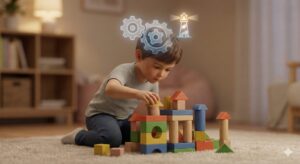
Why Executive Function Trumps IQ in the Modern World
For decades, we’ve been obsessed with IQ. But long-term studies, including the famous “Marshmallow Test” variations, have shown that children with high self-regulation and strong executive function skills fare much better in the long run. They tend to have better health, higher wealth, and fewer run-ins with the law as adults, regardless of their initial IQ or socioeconomic status.
In today’s digital age, these skills are more under threat than ever. We live in a world of “instant gratification.” High-speed internet, 15-second videos, and “on-demand” everything mean our children’s brains are rarely required to wait, to ponder, or to navigate boredom. This constant stimulation can actually bypass the “slow-thinking” executive circuits, making it harder for kids to develop the patience and focus they need for deep learning.
As a parent, I’ve noticed that when I give my kids space to be bored, they eventually find a way to entertain themselves. That “eventually” is where the magic happens. That’s where the brain starts building those vital connections.
Building the Muscle: Age-Appropriate Games and Activities
The best part about Executive Function is that it can be trained through play. You don’t need expensive tutors or high-tech apps. In fact, simple, old-school games are often the best “gym” for the brain.
The Early Years (Ages 0-3): The Foundation of Focus
For babies and toddlers, it’s all about “joint attention” and basic memory.
- Peek-a-Boo: This classic is actually a memory and anticipation workout. The baby has to remember you are still there even when they can’t see you.
- Imitation Games: “Follow the Leader” or simply clapping a rhythm for them to repeat helps build working memory and inhibitory control.
The Preschool Years (Ages 4-6): The Goldmine of Role-Play
This is the “sweet spot” for development.
- Imaginary Play: When a child plays “Store” or “Doctor,” they have to follow a set of rules. A doctor doesn’t just start dancing; they check the patient. This requires staying “in character,” which is a massive workout for inhibitory control.
- Red Light, Green Light: This is the ultimate self-regulation game. It forces the brain to switch between “go” and “stop” instantly.
- Storytelling: Ask your child to tell you a story. To do this, they have to plan a beginning, middle, and end, which builds their planning and memory skills.
School Age (7 and Up): Strategy and Sophistication
- Board Games: Games like Chess, Checkers, or even “Uno” require players to hold the rules in their minds, plan several steps ahead, and adjust their strategy based on what others do.
- Learning an Instrument: This is perhaps the most intense executive function workout. It involves reading music (memory), physical coordination (control), and emotional expression (flexibility) all at once.

The Secret Sauce: How We Talk to Our Kids
As much as games help, our daily interactions are the “hidden curriculum.” We can either be the external “executive function” for our kids, or we can be the coach that helps them build their own.
1. From “Giving Orders” to “Asking Scaffolding Questions”
When we see a messy room, our instinct is to bark: “Clean up your toys, put your books on the shelf, and get your pajamas on!” We are doing all the planning for them.
Instead, try scaffolding: “Wow, there’s a lot to do here. What’s the first thing we should tackle so we have space to walk?”
By asking “What’s next?”, you are forcing their “control tower” to activate and create a plan.
2. The Power of “Process Praise”
You might have heard of Carol Dweck’s Growth Mindset. It’s the idea that our abilities are developed through effort, not just innate talent.
- Instead of: “You’re so smart!” (Fixed mindset – focuses on a trait)
- Try: “I noticed how you kept trying different pieces until the puzzle fit. You didn’t give up even when it was hard!” (Process praise – focuses on the executive skill of persistence and flexibility)
3. Managing the “Big Emotions”
When a child has a meltdown, their “downstairs brain” (the emotional center) has hijacked the “upstairs brain” (the executive center). Shouting “Calm down!” never works because the control tower is literally offline.
We need to help them “name it to tame it.” Identifying the feeling (“I see you’re feeling really frustrated because the tower fell”) helps the executive brain start to process the emotion, bringing the system back into balance.
Environment Matters: Designing for Success
We can’t expect a child to have perfect self-control in a room full of temptations.
- Visual Schedules: Using pictures to show the morning routine (Brush teeth -> Get dressed -> Eat breakfast) offloads the “working memory” burden, allowing the child to feel successful in following a plan.
- The “Boredom” Zone: Ensure there are times in the day with zero screens. This forces the brain to engage in “inner speech”—the internal monologue we use to plan and solve problems.
- Sleep and Nutrition: Let’s not forget the basics. A tired or “hangry” brain has almost zero executive capacity. Prioritizing consistent sleep is the single best gift you can give your child’s developing brain.

A Final Word from SoCooly
If you’re reading this and thinking, “Oh no, I’ve been shouting ‘Hurry up!’ for years, have I ruined my child?”, please take a deep breath. The answer is a resounding no.
The brain is incredibly plastic, especially in childhood and adolescence. Every time you pause before reacting, every time you play a game together, and every time you ask “What do you think we should do next?”, you are laying down new neural pathways.
Parenting isn’t about being perfect; it’s about being a “co-pilot” while our children learn to fly their own planes. It takes time, there will be some bumpy landings, and sometimes the control tower will feel like it’s completely deserted. But with patience and a bit of playful practice, your child will develop the grit and the wisdom to navigate whatever skies they encounter.
I’m right there in the trenches with you, practicing my own “inhibitory control” when the living room is covered in LEGOs! Let’s keep supporting each other in this journey.
What’s one small way you can help your child “practice” their executive function today? Maybe a game of Simon Says before dinner? I’d love to hear your thoughts and stories in the comments!
Reliable Resources for Further Reading:
- Harvard University Center on the Developing Child: https://developingchild.harvard.edu
- Understood.org – Understanding Executive Function: https://www.understood.org
- Mindset Works (Carol Dweck’s research): https://www.mindsetworks.com
※ This post was developed with AI support for data gathering and initial structure, then extensively refined and verified by the author for quality and reliability.
👉 Related Posts
Is Your Child a Late Talker? Reality Parenting Tips to Reduce Anxiety and Spark Language Development
[Parenting Guide] Winning the Picky Eater Battle: 5 Positive Feeding Strategies & Dialogue Tips