Seeing your child’s body suddenly stiffen, their eyes roll back, and their limbs shake uncontrollably is perhaps one of the most terrifying experiences any parent can endure. I still remember the first time I witnessed it—my heart dropped to my stomach, and for a few seconds, the world seemed to stop. You find yourself asking, “Is this a seizure? Is my baby’s brain going to be okay?” The fear is overwhelming and instantaneous. But I want to start by telling you this: please don’t blame yourself, and try to take a deep breath. While it looks like a scene from a nightmare, in most cases, it is a common part of early childhood development. Today, I want to walk you through everything you need to know about febrile seizures so that if it ever happens again—or if you’re in the middle of processing it now—you can feel informed, calm, and prepared.
What Exactly Causes a Febrile Seizure?
To understand a febrile seizure, we first have to understand the unique nature of a child’s brain. A febrile seizure is a convulsion in a child caused by a fever, usually occurring between the ages of 6 months and 5 years. Statistics show that about 2% to 5% of all children will experience at least one febrile seizure. It’s more common than most people realize!
But why does it happen? The primary reason is that a child’s brain is still immature. Think of the brain’s nervous system like a complex electrical grid. In adults, the grid is well-insulated and can handle spikes in temperature. In young children, however, the “wiring” is still developing. When a fever causes the body temperature to rise rapidly, it can create a temporary “short circuit” in the brain, leading to a seizure.
Interestingly, recent medical research suggests that it’s not necessarily how high the fever goes, but how fast the temperature rises that triggers the event. If a child’s temperature jumps from 37°C to 39°C (98.6°F to 102.2°F) in a matter of minutes, the brain may react before the body can stabilize. There is also a strong genetic component; if you or your partner had febrile seizures as a child, your little one is more likely to have them too.

The Biggest Fear: Will This Cause Brain Damage?
This is the question that keeps every parent awake at night. Let’s address it directly: A simple febrile seizure does not cause brain damage, nor does it affect a child’s intelligence or future development. Most febrile seizures are “simple,” meaning they last only a minute or two, and almost always less than five minutes. Extensive clinical studies have shown that these brief episodes do not damage brain cells. Many parents worry that a seizure will lead to epilepsy (a chronic seizure disorder). While it’s true that children who have had a febrile seizure have a slightly higher risk of developing epilepsy later in life compared to the general population, the difference is very small. If your child is otherwise developing normally and the seizure was brief, they are likely to grow up perfectly healthy.
Once the seizure stops and your child regains consciousness, they might be sleepy or a bit confused for a while, but they will eventually return to their usual, playful self. Your child is much more resilient than you might think!
Step-by-Step: What to Do During a Seizure
When a seizure starts, your instinct will be to grab your child, shake them, or try to stop the shaking. However, the best thing you can do is to be a calm observer and a protector. Here is your emergency checklist:
- Place them on a safe surface. If they are on a bed or a couch where they could fall, gently move them to the floor. Clear away any hard or sharp objects nearby.
- Turn them onto their side (The Recovery Position). This is vital. During a seizure, a child may have excess saliva or may vomit. If they are on their back, they could choke. Side-lying ensures their airway remains clear and fluids can drain out of the mouth.
- Loosen tight clothing. Undo buttons around the neck or remove any restrictive clothing so they can breathe easily.
- NEVER put anything in their mouth. There is an old myth that people “swallow their tongues” during seizures. This is physically impossible. Putting a finger, a spoon, or a pacifier in their mouth can cause dental injuries, lead to them biting you, or—most dangerously—block their airway.
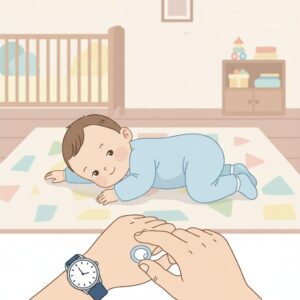
- Time the seizure. Look at a clock or your phone. Knowing exactly how long the seizure lasted is critical information for doctors. If possible, have someone else record a video of the episode; it provides invaluable diagnostic clues for pediatricians.
Wait! Should I Try to Lower the Fever During the Seizure?
This is a common mistake born out of love and desperation. You see your child burning up and shaking, and you want to cool them down immediately. However, do not attempt to give medicine or use cold water while the seizure is happening.
If you try to pour liquid antipyretics (like Tylenol or Motrin) into the mouth of an unconscious or seizing child, the liquid can go straight into their lungs, causing aspiration pneumonia or choking. Similarly, shocking the body with cold water or ice baths can actually be counterproductive. It causes shivering, which can raise the internal body temperature even higher, and the intense physical stimulus might even prolong the seizure.
Focus entirely on safety and breathing during the seizure. You can manage the fever with medication and lukewarm sponging only after the seizure has stopped and the child is fully awake and alert.
When Is It an Emergency? When to Call the ER
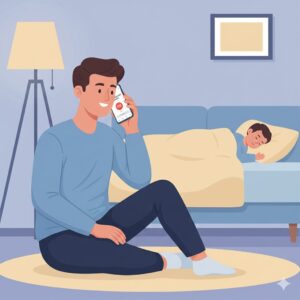
While most febrile seizures are harmless, some situations require immediate medical intervention. Call emergency services (911 or your local emergency number) if:
- The seizure lasts longer than 5 minutes. A prolonged seizure is a medical emergency that needs medication to stop.
- The child doesn’t wake up after the seizure. If they remain unresponsive or unusually lethargic for a long period, they need to be evaluated.
- Another seizure occurs within 24 hours. This is classified as a “complex” febrile seizure and requires a deeper investigation.
- The seizure is localized. If only one arm or one side of the face is twitching rather than the whole body, it could indicate a different underlying issue.
- There are signs of breathing difficulty. If their lips turn blue (cyanosis) or they seem to be struggling for air, seek help immediately.
Should We Visit the Doctor Even If the Seizure Stops?
If this was your child’s first-ever febrile seizure, the answer is a definitive YES. Even if the seizure lasted only 30 seconds and your child is now smiling and playing, you must see a doctor.
The reason isn’t necessarily the seizure itself, but the cause of the fever. While most fevers are caused by common viral infections like the flu or a cold, a seizure can also be a symptom of more serious infections, such as meningitis or encephalitis (infections of the brain or spinal cord lining). A pediatrician needs to perform a physical exam to rule out these dangerous conditions. If it’s during the day, call your pediatrician; if it’s late at night, a visit to the pediatric emergency room or urgent care is the safest bet.
Can We Prevent Febrile Seizures?
As parents, we want to control everything to keep our kids safe, but unfortunately, there is no guaranteed way to prevent a febrile seizure. Many parents ask, “Can I prevent it by giving fever reducers at the first sign of a warm forehead?”
Medical studies have shown that giving antipyretics (fever-reducing medicine) does not prevent febrile seizures. Remember, it’s often the speed of the temperature rise that causes the “short circuit,” and that rise often happens before you even realize the child has a fever.
The best approach is to manage fevers for your child’s comfort—giving fluids, keeping them in light clothing, and using medication as directed by your doctor—but realize that if a seizure is going to happen, it is a physiological response that you likely couldn’t have stopped. Most children outgrow this tendency by age 5 or 6 as their brain matures.
Note: Complex Febrile Seizures
Unlike “simple” ones, a complex febrile seizure is one that lasts longer than 15 minutes, recurs within 24 hours, or affects only one part of the body. These require more detailed testing, such as an EEG or imaging, to ensure there are no underlying neurological issues.

I hope this information brings some peace to your heart. If you’ve been through this, you are a brave and dedicated parent. Watching your child go through a seizure is a trauma for the parent, even if the child won’t remember it. Take time to care for yourself, too. “This is just a part of their growth, and it will pass”—remind yourself of this. You are doing an amazing job, and your child is lucky to have you looking out for them.
SoCooly will always be here to share information and walk with you through the ups and downs of parenting. Wishing all our little ones health and happy smiles!
Reliable Resources for Further Reading:
- Mayo Clinic – Febrile Seizures: Symptoms & Causes
- American Academy of Pediatrics – Febrile Seizures Information for Parents
- CDC – Febrile Seizures Following Vaccination (Fact Sheet)
※ This post was developed with AI support for data gathering and initial structure, then extensively refined and verified by the author for quality and reliability.
👉 Related Posts
Infant Fever Without Cold Symptoms? A Complete Guide to Urinary Tract Infection (UTI) for Parents