📍 Quick 3-Line Summary
- For infants under 12 months, giving over-the-counter (OTC) multi-symptom cold medicines is strictly discouraged due to the risk of serious side effects; always consult a pediatrician first.
- Nighttime coughs are often caused by dry air and “post-nasal drip,” which are best managed through humidity control and slight upper-body elevation rather than drugs.
- Fever management should focus on the baby’s overall comfort and hydration rather than just the number on the thermometer, but any fever in a baby under 3 months requires an immediate ER visit.
You should strictly avoid giving over-the-counter multi-symptom cold medications to babies under 12 months without a doctor’s specific order, as the clinical risks of respiratory suppression and other side effects far outweigh any minor relief the medicine might provide.
Raising children is a journey filled with moments where you feel like the world is crashing down. For me, that moment happened when my firstborn was just 6 months old. It was 2 AM, and I heard a terrifying, raspy barking sound coming from the crib. Now that I’m raising a 7-year-old and a 4-year-old, I’ve become a bit more seasoned, but the memory of that sheer panic—staring at a bottle of baby cold syrup and wondering, “Is this safe?”—is still crystal clear. 🤒
“What if my baby can’t breathe?”, “Will this small dose hurt him?”
If you’re currently holding your phone in a dark room, searching for answers while your little one coughs, I’ve been exactly where you are. Let’s talk about why those “magic syrups” can be dangerous and what you can actually do to help your baby get through the night safely.
The Mystery of the Midnight Cough: Why Does it Get Worse at Night?
It’s a classic parenting mystery: your baby seems fine during the day with just a few sniffles, but the second the sun goes down, the coughing fits begin. After many sleepless nights and deep dives into research, I realized it’s not just bad luck.
- The Post-Nasal Drip Factor: Babies have tiny nasal passages. When they lie flat, mucus from the nose drips down the back of the throat. This is the #1 trigger for nighttime coughing.
- Dry Night Air: Humidity levels usually drop significantly at night. Sensitive infant airways react instantly to dry air, causing the protective lining of the throat to become irritated.
- Airway Narrowing: Naturally, our airways narrow slightly at night due to changes in the parasympathetic nervous system. While we adults don’t notice it, for a 6-month-old, it makes breathing just a little bit harder.

The “Fail Case” I Learned the Hard Way: Why Cold Meds are Risky
When my first child was sick, I almost reached for a store-bought cough syrup. I thought, “It says ‘Children’s’ on the box, so a half-dose must be fine, right?” I was wrong. That was a mistake that could have ended poorly if I hadn’t called a nurse friend first.
1. The Danger of “Multi-Symptom” Formulas
Most OTC cold medicines contain antihistamines to stop runny noses and antitussives to stop coughs. In infants under 12 months, these ingredients can actually suppress the “drive to breathe” or even cause seizures. Their little livers and kidneys aren’t ready to process these complex chemicals yet.
2. Thickening the Mucus Trap
Here is something I learned from experience: medicines that dry up a runny nose often make the mucus in the lungs thicker and stickier. This makes it harder for a baby to cough it out, which can lead to complications like pneumonia. Experts agree: “At this age, the goal isn’t to stop the cough; it’s to help the body clear the infection naturally.”
| Medicine Type | General OTC Cold Syrup | Fever Reducers (Acetaminophen/Ibuprofen) |
| Recommended Age | Generally 4+ years (Avoid under 2) | Safe for 3-6+ months (Consult doctor) |
| Common Side Effects | Respiratory depression, sedation, rapid heart rate | Low body temp, stomach upset (if overused) |
| The Rule of Thumb | Never give without a prescription | Use for fevers over 101.3°F (38.5°C) + discomfort |
3-Step Real-World Guide: What to Do When the Cough Won’t Stop
Forget the medicine cabinet for a moment. Here is my tried-and-true Step-by-Step manual for managing an infant cold at home.
Step 1: The Humidity Siege — Aim for 60%! 💧
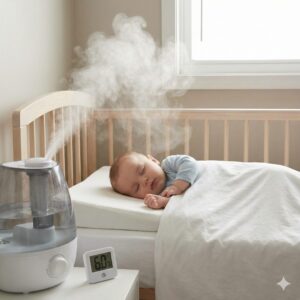
If you have a humidifier and your baby is still coughing, check the placement. It needs to be near the baby’s head, not across the room. I found that keeping the humidity between 50-60% is the “sweet spot.” Sometimes I’d even turn the shower on hot and sit with the baby in the steamy bathroom for 15 minutes before bed. It works wonders for loosening gunk!
Step 2: Gravity is Your Friend — Elevate the Upper Body ⬆️
To stop the post-nasal drip, your baby needs a slight incline. Since putting pillows in the crib is a SIDS risk, I used to slide a rolled-up towel under the mattress to create a gentle 15-degree slope. This keeps the nose draining forward rather than backward.
Step 3: Saline and Suction (The “Nose-Hose” Method) 🍼
A baby who can’t breathe through their nose will cough more. Use saline drops to soften the mucus, wait two minutes, and then use a suction bulb or a “NoseFrida.” I always did this right before a feeding and right before bed. It’s a game-changer.
When the Fever Hits: Numbers vs. Behavior
“The thermometer says 101°F! Panic mode!”
We’ve all been there. But I’ve learned that the number matters less than the “vibe.” * The Comfort Goal: You aren’t trying to win a war against the fever. You are trying to help your baby feel well enough to hydrate. If the baby has a slight fever but is still smiling and drinking milk, you might not even need medicine.
- Tepid Sponge Baths? Skip them: Modern pediatrics actually suggests avoiding these. They often cause shivering, which actually raises the internal body temperature. Stick to light clothing and a room temp of 72-74°F (22-23°C).
- The Caution with Alternating Meds: While some parents switch between Tylenol and Motrin, I found this incredibly confusing to track at 3 AM. For babies under 12 months, sticking to one type (usually Acetaminophen) every 4-6 hours is much safer for their kidneys.
The Red Flags: When to Stop Googling and Start Driving (ER Guide)
Sometimes, “wait and see” is the wrong move. If you see any of these, get to the hospital immediately:
- Fever in a Newborn (Under 3 Months): Any fever over 100.4°F (38°C) is an emergency. No exceptions.
- Retractions (Struggling to Breathe): Look at your baby’s chest. Are the muscles pulling in sharply between the ribs or at the base of the neck? This is a sign of respiratory distress.
- Dehydration: If your baby hasn’t had a wet diaper in over 6-8 hours or has a “sunken” soft spot on their head, they need IV fluids.
- The “Croup” Bark: If the cough sounds like a seal barking or a high-pitched whistling (stridor) when they breathe in, they need medical intervention.

SoCooly’s Glossary: Breaking Down the Hard Words 🔍
- Post-Nasal Drip: When extra mucus from your nose and sinus runs down the back of your throat. Think of it as a “leaky faucet” in the back of the head.
- Respiratory Suppression: A dangerous state where breathing becomes too shallow or slow to provide enough oxygen.
- Stridor: A high-pitched, wheezing sound caused by a narrow airway. If you hear this while the baby is inhaling, call the doctor.
Final Thoughts: Trust Your Parental Instincts
To all the parents staring at the monitor tonight: you are doing a great job. I know it’s exhausting, and I know the guilt of “not being able to do more” is heavy. But remember, you are the best advocate for your child.
Don’t let anyone pressure you into “just giving a little medicine” if your gut (and science!) says no. A humid room, a clean nose, and your warm embrace are the most powerful tools in your nursery. This cold will pass, the sun will come up, and soon enough, you’ll be the one giving advice to a new parent.
Do you have a question about a specific symptom? Drop a comment below! How is your little one holding up tonight? —
Frequently Asked Questions (Q&A)
Q1. Can I use “Natural” or “Homeopathic” cough syrups?
Be careful! Many “natural” syrups use honey as a base. Never give honey to a baby under 12 months due to the risk of infant botulism, a rare but paralyzed-causing illness. Always check the ingredient list for honey or excessive sugar.
Q2. My baby’s hands and feet are freezing, but their head is burning hot. Why?
This usually means the fever is still on its way up. The body pulls blood away from the hands and feet to the core to fight the infection. Rub their hands to keep them comfortable, but don’t over-wrap the body, or the fever will spike too high.
Q3. How long does a typical infant cold last?
It feels like forever, but most peak on day 3 or 4 and start to fade by day 7. However, a lingering cough can last up to 2 weeks. If it goes past 10 days without improvement, call the pediatrician.
Reliable Resources for Parents
- American Academy of Pediatrics (HealthyChildren.org)
- CDC – Common Cold in Infants and Children
- Mayo Clinic – Fever and Cold Guide for Babies
👉 Related Posts