Why does your 8-month-old only sleep while nursing? 3 practical steps to stop the nurse-to-sleep habit tonight
┌ ┐
- The nurse-to-sleep habit turns breastfeeding into a psychological sleep trigger rather than just a source of nutrition.
- Breaking this cycle requires a strict physical and temporal separation between feeding and sleeping (Eat-Play-Sleep).
- Success hinges on the father taking the lead to neutralize the mother’s scent and provide a new, consistent sleep cue.└ ┘
Yesterday at 3 AM, the silence of our home was broken not just by our baby’s familiar whimper, but by my wife’s sharp, stifled gasp of pain. As our 8-month-old latched on for the fourth time that night, I saw her wince in the dim glow of the nightlight. Her nipples were cracked, sore, and bleeding. What we thought was a convenient way to soothe our baby to sleep had turned into a nightly ritual of physical agony for her.
My heart skipped a beat. I felt a wave of guilt wash over me. I had been too passive, thinking she was just “tired,” when in reality, she was enduring searing pain every couple of hours just to keep the peace. We realized that our baby didn’t need the milk; he needed the “latch” to fall back asleep. It wasn’t hunger; it was a deep-seated habit. That was the moment we decided to end the “nurse-to-sleep” cycle once and for all. We spent the last 24 hours implementing a survival strategy that actually worked, and I want to share the raw, unfiltered details of how we did it.
Why your baby screams for the breast, and it’s not because they’re hungry 🍼
Many parents fall into the trap of thinking a crying baby at night equals a hungry baby. I was one of them. But by 8 months, most healthy infants are physically capable of sleeping 10 to 12 hours without a calorie top-up. So why the obsession with nursing? It’s what experts call a Sleep Association.
Think of it like this: if you fell asleep with your head on a pillow, but woke up at 2 AM with the pillow gone and your head on the cold floor, you’d freak out. You’d be wide awake, looking for that pillow. For our baby, the breast is the pillow. Every time he hits a light sleep phase (which humans do every 45-90 minutes), he checks for his “entrance ticket” to sleep. If it’s not there, he sounds the alarm. Stopping the habit isn’t about denying food; it’s about teaching them how to find the “pillow” within themselves.
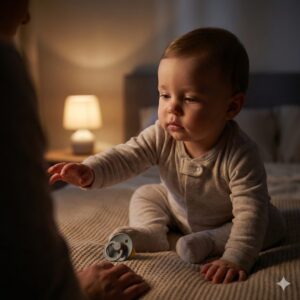
The “What Not To Do” list: Our personal failures ❌
Before I tell you what worked, I have to be honest about what failed miserably. We made every mistake in the book so you don’t have to.
Our first failure was “The Cold Turkey Trap.” We tried to just stop one night without any preparation. Our son screamed until he literally threw up, and my wife ended up crying harder than he did. We gave in within 20 minutes. Lesson learned: you can’t just take away a coping mechanism without offering a new one.
Our second failure was the “Inconsistent Pacifier.” We tried to swap the breast for a silicone nipple, but our 8-month-old was too smart for that. He realized the difference immediately and felt insulted by the substitute. He threw the pacifier across the room like a tiny, angry gladiator.
The third failure was the “Mom-in-the-Room” approach. As long as my wife was the one trying to soothe him without nursing, the scent of her milk was a constant taunt. It was like trying to go on a diet while someone waves a hot slice of pizza under your nose. It was cruel to both of them.
The 3-Step Strategy we used to reclaim our sleep 🏃♂️
After doing some deep-dive research and talking to other parents who survived this, we developed this 3-step plan. Last night was the first time it actually bore fruit.
Step 1: The Great Wall between Feed and Sleep
We stopped nursing in the bedroom entirely. The last feed of the night now happens in the living room with the lights on. If he starts to get “the heavy eyes” while nursing, I gently tickle his toes or talk to him to keep him awake. We want him to finish his meal and then have a 10-15 minute gap involving a book or a song before he even sees the crib. The goal is to make sure he is “drowsy but awake” when he hits the mattress.
Step 2: The Dad Defense (Neutralizing the Scent)
This was the game-changer. My wife stayed in the living room with noise-canceling headphones, and I took over the bedtime routine. Since I don’t smell like milk, the “expectation” for nursing was lowered. When he started to cry—and he did cry—I didn’t leave. I stayed by the crib, whispered “I’m here, it’s time to sleep,” and offered my physical presence without the one thing he was demanding.
Step 3: Establishing the “Rhythmic Pat”
Instead of the nipple, I introduced a new sensory cue. I patted his bottom in a steady, 1-2-3-4 rhythm while humming a low, repetitive melody. This gave his brain something else to focus on. The first time, it took 45 minutes of protest. But eventually, the rhythm won. He realized the breast wasn’t coming, but he also realized he wasn’t alone.
Comparison of the New vs. Old Routine
| Feature | The Old Nurse-to-Sleep Way | The New Independent Way |
| Feeding Location | Dark bedroom, on the bed | Bright living room, on the sofa |
| State of Awareness | Asleep or semi-conscious at latch-off | Fully awake during and after feeding |
| Primary Caregiver | Mom (suffering from pain) | Dad (the “Neutral” party) |
| Sleep Trigger | Sucking/Nursing | Rhythmic patting and white noise |

Unexpected obstacles we encountered 🌡️
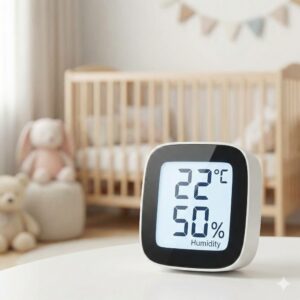
The hardest part wasn’t the baby’s crying—it was the spike in his body temperature. When babies protest hard, they get hot. We realized that a warm room (which we thought was cozy) was actually making him more frustrated. We turned the AC down to 21°C (약 70°F) and dressed him in a very light, breathable cotton sleep sack. The cooling sensation seemed to help regulate his nervous system much faster.
Also, the “False Victory” is real. He fell asleep at 8 PM, but woke up at 11 PM looking for the old habit. You have to be just as consistent at 11 PM and 2 AM as you were at 8 PM. If you give in once at 3 AM because you’re tired, you reset the clock on the whole process.
Frequently Asked Questions (Q&A) ❓
Q: Is it okay to let them cry even if they seem terrified?
A: There is a difference between “protest crying” (I’m mad you changed the rules!) and “distress crying” (I am in pain or unsafe). If he’s just angry, stay nearby and comfort him with your voice and touch. Your presence ensures he doesn’t feel abandoned, even if he’s unhappy with the new routine.
Q: How long does this transition usually take?
A: For most 8-month-olds, the first night is the hardest (45-60 mins of crying). The second night is usually half that. By the third or fourth night, most babies begin to accept the new “rhythm” as the new normal. Consistency is your only friend here.
Q: What if I’m a single parent and can’t use the “Dad Defense”?
A: If you have to do it alone, wear a high-necked shirt or even a sweatshirt that masks your scent as much as possible. Avoid the nursing position. Sit the baby up or lay them in the crib and use your hands to soothe them from a distance so they don’t instinctively reach for the breast.
Wishing you a night of healing and independent sleep 🌙
Last night, after 40 minutes of patting and shushing, my son let out a long sigh and closed his eyes. He didn’t wake up again until 5:30 AM. My wife woke up this morning with a look of pure relief. Her physical pain is finally starting to heal, and our son has taken his first big step toward independence.
Breaking the nurse-to-sleep habit is an act of love for everyone involved. It’s about protecting the mother’s body and giving the child the gift of self-regulation. It’s going to be a rough few nights, I won’t lie. But the version of you that wakes up after 6 hours of uninterrupted sleep will thank the version of you that stayed strong tonight. How are your little ones sleeping? Are you currently in the trenches of the 8-month regression? Drop a comment below—let’s support each other through the long nights!
Reference Sites:
- American Academy of Pediatrics – Helping Your Child Sleep
- La Leche League International – Nighttime Nursing and Sleep

👉Related Posts
Newborn White Noise Guide: Best Sleep Training Tips and Vital Safety Precautions