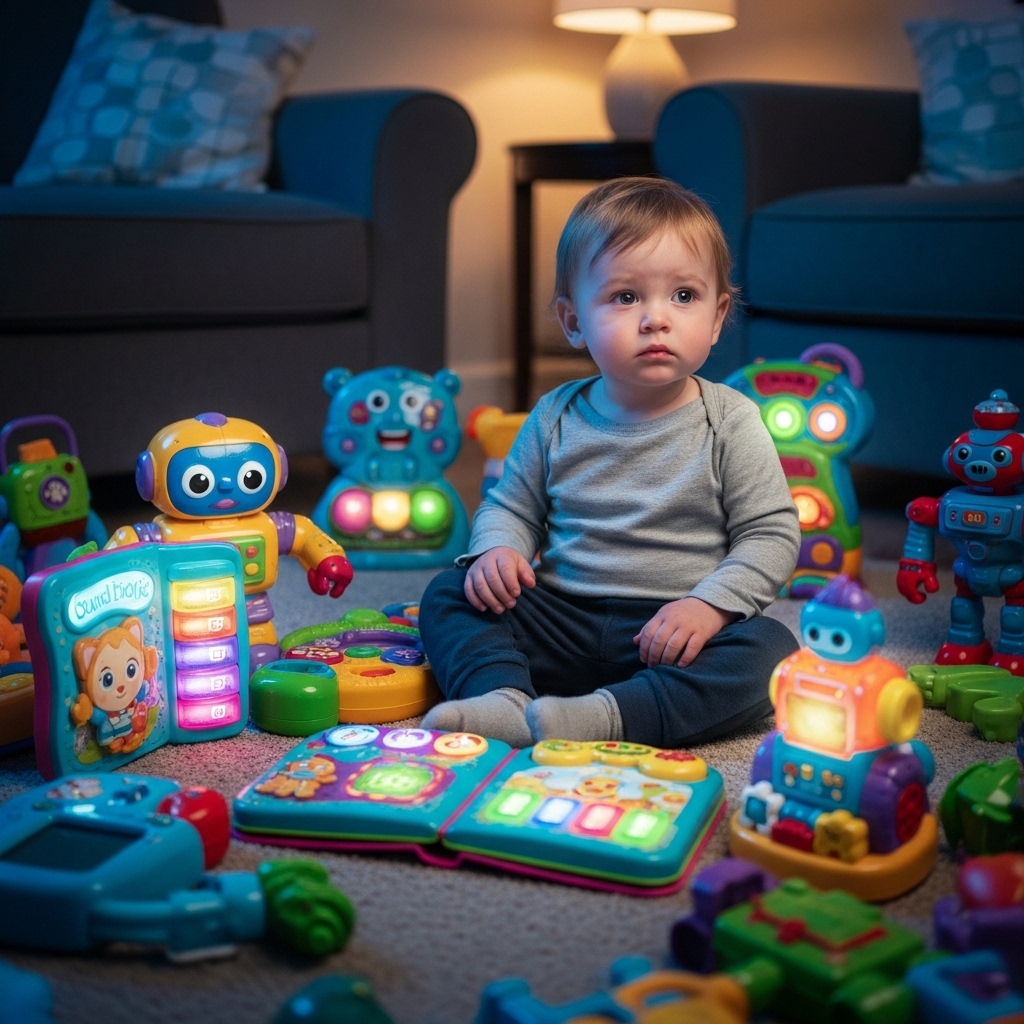
If you walk into a typical 24-month-old’s playroom today, you’ll likely hear a symphony of electronic beeps, robotic songs, and high-pitched plastic voices. It looks like a paradise of learning, doesn’t it? But here is a hard truth I realized just yesterday while watching my own child sit silently amidst all that noise: all those expensive, “educational” toys might be the very reason your child isn’t talking yet.
The core of the problem isn’t a lack of stimulation; it’s a lack of necessity. When a toy does all the talking, singing, and dancing, your toddler becomes a passive spectator rather than an active communicator. They don’t need to find the words for ‘apple’ when a button says it for them in three different languages.
[ Key Highlights of This Post ]
- Why “smart” toys often lead to “silent” toddlers by removing the need for social interaction.
- The specific list of items to clear out of your living room to break through a speech plateau.
- How to create a “communication gap” that encourages your child to use their voice out of necessity.
Yesterday afternoon, I felt a knot in my stomach. I was watching my child press a button on a fancy AI-powered robot. The robot asked a question, answered it itself, and then performed a little dance. My child just stared, mesmerized but silent. It hit me like a ton of bricks—my child wasn’t playing; he was being entertained. And entertainment is a one-way street.
I’ve spent months worrying, comparing him to the neighbor’s daughter who already speaks in full sentences about her breakfast. I thought more toys meant more learning. I was wrong. After stripping back the gadgets and going back to basics, I saw more progress in three days than I had in three months. Here is the unconventional guide to helping your late talker find their voice.
The Three “Speech Killers” Hiding in Your Playroom
We buy these things because we want the best for them. We see the “STEM” or “Language Development” labels and think we’re giving them a head start. But for a 24-month-old struggling with speech, these are often obstacles.
- The “Auto-Pilot” Sound BooksThese books are a staple in every nursery. You press a picture, and it plays a sound. Simple, right? But I noticed that instead of looking at me to share the excitement of a “Moo,” my child was just obsessively pressing the button over and over. It becomes a repetitive sensory habit, not a communication tool. The book replaces the parent’s voice, and the child loses the chance to watch your lips move and mimic your sounds.
- Responsive AI and Robotic CompanionsThese toys are designed to “talk” to your child. The problem is they are too predictable. Real conversation is messy, unpredictable, and requires effort. When a toy provides a guaranteed response every time, the child doesn’t learn the subtle social cues—the waiting, the eye contact, the changing pitch—that make human speech work.
- The “Babysitter” TabletWe’ve all been there. You just need 15 minutes to cook dinner without a meltdown. But those “educational” videos are incredibly fast-paced. They flood the developing brain with dopamine through bright lights and rapid scene changes. Compared to that, a parent’s face talking about a boring old wooden block just can’t compete. It’s what experts call “popcorn brain,” where the child becomes desensitized to normal, slower human interaction.
Why “Perfect Parenting” is Sabotaging Their Speech
Here is something I do differently than most “expert” advice you read in books. Most manuals tell you to “narrate everything” and “be responsive.” I tried that. I became a 24/7 radio station, and I anticipated my child’s every move. If he looked at the fridge, I gave him milk. If he pointed at a shelf, I gave him the bear.
I realized I was being too good at my job.
By being a mind-reader, I removed my child’s “Why.” Why should he struggle to say “Milk” when he knows I’ll have it in his hand before he even opens his mouth? Communication is born out of a need to change your environment. If the environment is already perfect, silence is the result.
[ Table: Electronic Toys vs. Interactive Daily Objects ]
| Category | Electronic Gadgets (Sound Books, AI) | Open-Ended Tools (Boxes, Spoons, Cloth) |
| Role of the Child | Passive Observer | Active Creator |
| Social Requirement | None (Plays alone) | High (Needs a partner to make it “fun”) |
| Vocabulary Growth | Repetitive & Limited | Dynamic & Contextual |
| Brain Engagement | High Visual/Auditory Stimulation | High Cognitive/Creative Effort |
The “Silent Living Room” Strategy: A Step-by-Step Guide
If you’re ready to see a change, you have to be brave enough to change the scenery. This isn’t about punishment; it’s about clearing the static so they can hear the music.
Step 1: The Great Battery Raid
You don’t have to throw everything away. Just take the batteries out. When the toy stops “doing” things for the child, the child has to start doing things with the toy. Watch how they react. They might bring the silent toy to you to “fix” it. That is a communication win! They are seeking you out to solve a problem.
Step 2: Introduce “Boring” Objects
Swap the plastic kitchen for a real cardboard box and a wooden spoon. Yesterday, we spent forty minutes with a single silk scarf. We hid under it (Peek-a-boo!), we used it as a blanket for a stuffed dog, and we turned it into a “cape.” Because the scarf didn’t make a sound, I had to provide the sounds. And because it was fun, my child started trying to copy those sounds.
Step 3: The 5-Second Wait Rule
This is the hardest part for any parent. When your child wants something, wait. If they point at the juice, look at them, hold the juice, and wait for five seconds. Don’t say “Say juice.” Just wait. Look expectant. Usually, they will make a sound—any sound—to get your attention. When they do, celebrate like they just won a marathon. “Oh! You want the juice! Here you go!” You are rewarding the effort of vocalizing.

My Biggest Failure: The “Repeat After Me” Trap
I used to be that parent who would hold up a flashcard and say, “Say Ball. Ball. B-a-l-l.” My son would just look away or get frustrated and cry. I felt like a failure. I thought he was stubborn.
Then I stopped being a teacher and started being a playmate. I realized that for a child, “Ball” isn’t a word on a card; it’s the thing that bounces and makes Daddy fall over and act silly. Once I stopped demanding he speak and started making the world worth talking about, the words started leaking out. Not perfectly, and not all at once, but they came.
If you are feeling the pressure of daycare reports or comparisons with other kids at the park, take a deep breath. Your child’s worth is not measured in their vocabulary count at age two. Speech is a journey, not a race.
Frequent Questions from the Playroom (Q&A)
Q1: My child is 24 months and only has about 5 words. When should I actually worry?
The “official” milestone is usually 50 words and joining two words together. However, “Receptive Language” (how much they understand) is often a better predictor of future success. If they can follow a two-step command like “Pick up your shoes and put them in the box,” their brain is processing language just fine. The “Expressive” part (speaking) often just needs a little push. If you’re truly concerned, there is no harm in a professional evaluation for peace of mind.
Q2: Is it okay to use some screen time if I sit with them?
Yes, but change the way you use it. Don’t let it be a “trance.” Treat the TV like a book. Point at the screen and say, “Look at the big blue dog! Do you see him?” Turn it into a conversation rather than a distraction.
Q3: What if my child just gets angry and hits when I don’t give them what they want immediately?
Communication frustration is real. If they get angry during the “5-second wait,” shorten it. Give them the word they are looking for so they don’t feel hopeless. “Oh, you’re frustrated! You want the cracker. Cracker!” You’re still giving them the language they need without making it a battle of wills.

Your living room should be a place of connection, not a noisy showroom. Tomorrow morning, try turning off the background music and the electronic toys. Sit on the floor, wait for your child to look at you, and just be there. You might find that in the silence, your child finally finds the space to speak. 🥦🌡️
What is the one toy in your house that drives you crazy with its noise? Are you brave enough to take the batteries out today? Let’s talk about our “silent” victories in the comments!
References for your journey:
- American Speech-Language-Hearing Association (ASHA) – Toddler Development: http://www.asha.org
- Zero to Three – Early Language and Literacy: http://www.zerotothree.org
- Centers for Disease Control and Prevention (CDC) – Language Milestones: http://www.cdc.gov/ncbddd/actearly
👉 Related posts
Is My Baby a Late Walker? Milestones, Checklists, and When to Seek Help
Is Your Child a Late Talker? Reality Parenting Tips to Reduce Anxiety and Spark Language Development