- The Shift: Families are moving away from high-stimulation, rapid-cut content toward “Slow Cinema”—films that prioritize atmosphere, patience, and visual storytelling.
- Cognitive Benefits: Engaging with slower media helps reduce digital fatigue and improves focus, offering a necessary contrast to the constant notifications of modern life.
- Implementation: You don’t need to watch a four-hour masterpiece in one sitting; the goal is to curate a viewing experience that emphasizes quality and intentionality over passive consumption.
The most effective way to reclaim your family’s downtime in a world of 15-second viral clips is to intentionally seek out films that demand patience, reflection, and stillness. You have likely noticed it yourself: after a day of managing Slack notifications, school emails, and the relentless hum of the “urgent” tasks that define life in your 30s and 40s, the idea of sitting through a fast-paced, high-octane blockbuster can feel less like entertainment and more like an extension of your workday.
This is where the rise of “Slow Cinema” in family households comes in. It isn’t just an aesthetic trend for film buffs; it is becoming a practical survival strategy for parents who are exhausted by the “infinite scroll” culture. By choosing films that trade rapid-fire editing for deliberate pacing, you aren’t just watching a movie—you are creating a dedicated space for your brain to slow down.
What Exactly Is ‘Slow Cinema’ and Why Does It Matter Now?
In the film industry, Slow Cinema is a term typically reserved for art-house productions characterized by long takes, minimal dialogue, and a lack of traditional “three-act” narrative structure. Think of the works of directors like Andrei Tarkovsky or Yasujirō Ozu. While these might sound intimidating, the *philosophy* behind them is what is currently catching on in mainstream family homes.
At its core, Slow Cinema is about the “un-rushed” experience. In a typical modern animated feature, there is a visual or auditory “event” every three to five seconds. This is designed to keep a child’s attention locked, but it also keeps their nervous system in a state of high arousal. For parents, this constant stimulation can exacerbate the feeling of being “over-stimulated” by the end of the day. Slow Cinema offers an alternative: it respects the viewer’s intelligence and, more importantly, it respects their need to breathe.
When you introduce your family to films that prioritize environment, mood, and character development over constant action, you are effectively teaching your children—and yourself—how to sit with a thought. You are creating a “media-free” zone within the media itself.
The Cognitive Contrast: Why Your Brain Craves Slower Pacing
To understand why this shift is happening, we have to look at the concept of “Cognitive Load.” Every day, you are juggling a massive amount of data. Between work, household management, and the emotional labor of parenting, your prefrontal cortex is working overtime. When you switch on a high-stimulation movie, you aren’t really resting. Your brain is still processing information at a high velocity.
Slow Cinema acts as a palate cleanser. It allows for what psychologists call “soft fascination.” This is the state of mind where you are engaged by something that is interesting but not overly demanding. Think of the difference between trying to solve a complex spreadsheet and watching a fire crackle in a fireplace. One drains your battery; the other helps you recharge it.
| Feature | Fast-Paced Content | Slow Cinema Approach |
|---|---|---|
| Pacing | Rapid cuts, high energy | Deliberate, long takes |
| Focus | External action/events | Internal character/atmosphere |
| Audience State | High arousal/Alert | Calm/Reflective |
| After-Effect | Digital fatigue | Mental restoration |
By incorporating these films, you are lowering the barrier to entry for a “quiet” evening. You aren’t forcing a meditative state; you are simply removing the noise that prevents it.
Practical Challenges: How to Actually Watch Long Films with Kids
One of the biggest pushbacks I hear from parents is: “My kids won’t sit for a two-hour movie, let alone one that moves slowly.” And honestly, that is a valid concern. We have been conditioned to expect instant gratification. However, the goal isn’t to force your children into a rigid, academic film marathon. It is about changing the *context* of consumption.
The first step is to break the “binge” habit. You do not need to watch a 180-minute film in a single sitting. If you are watching a film that prioritizes atmosphere, treat it like a chaptered book. Watch 30 or 40 minutes, discuss the visuals, and pause. The next night, pick up where you left off. This turns the film into a shared project rather than a passive “distraction” tool.
Another common mistake is choosing the wrong environment. If you try to watch a thoughtful, slower film on a tablet while sitting in a noisy car, it will fail. These films rely on immersion. You need to dim the lights, put the phones in another room, and make the experience feel like an event. Even with children, the ritual of “setting the stage”—popcorn, blankets, turning off the main lights—signals to the brain that it is time to shift gears.
Selecting the Right Content for a Family ‘Slow’ Night
You don’t need to dive into the deep end of experimental, avant-garde cinema to enjoy these benefits. Many modern animated films, particularly those from studios like Studio Ghibli, are masterclasses in slow, deliberate storytelling. They emphasize the beauty of nature, the importance of silence, and the value of small, mundane moments.
When selecting a film, look for these markers:
- Visual focus: Does the trailer emphasize environments and landscapes rather than just explosions or quick gags?
- Pacing: Are the scenes allowed to breathe, or does the camera cut every two seconds?
- Dialogue: Is the film reliant on constant quippy banter, or does it use silence to convey emotion?
If you find that your family is struggling to adjust, start with nature documentaries. They are the ultimate “Slow Cinema” entry point. They are visually stunning, educational, and naturally paced. Once your children are accustomed to sitting with a beautiful, un-rushed image for 10 minutes, moving to a feature-length narrative film becomes much easier.
The Role of Physical Media in a Digital-First World
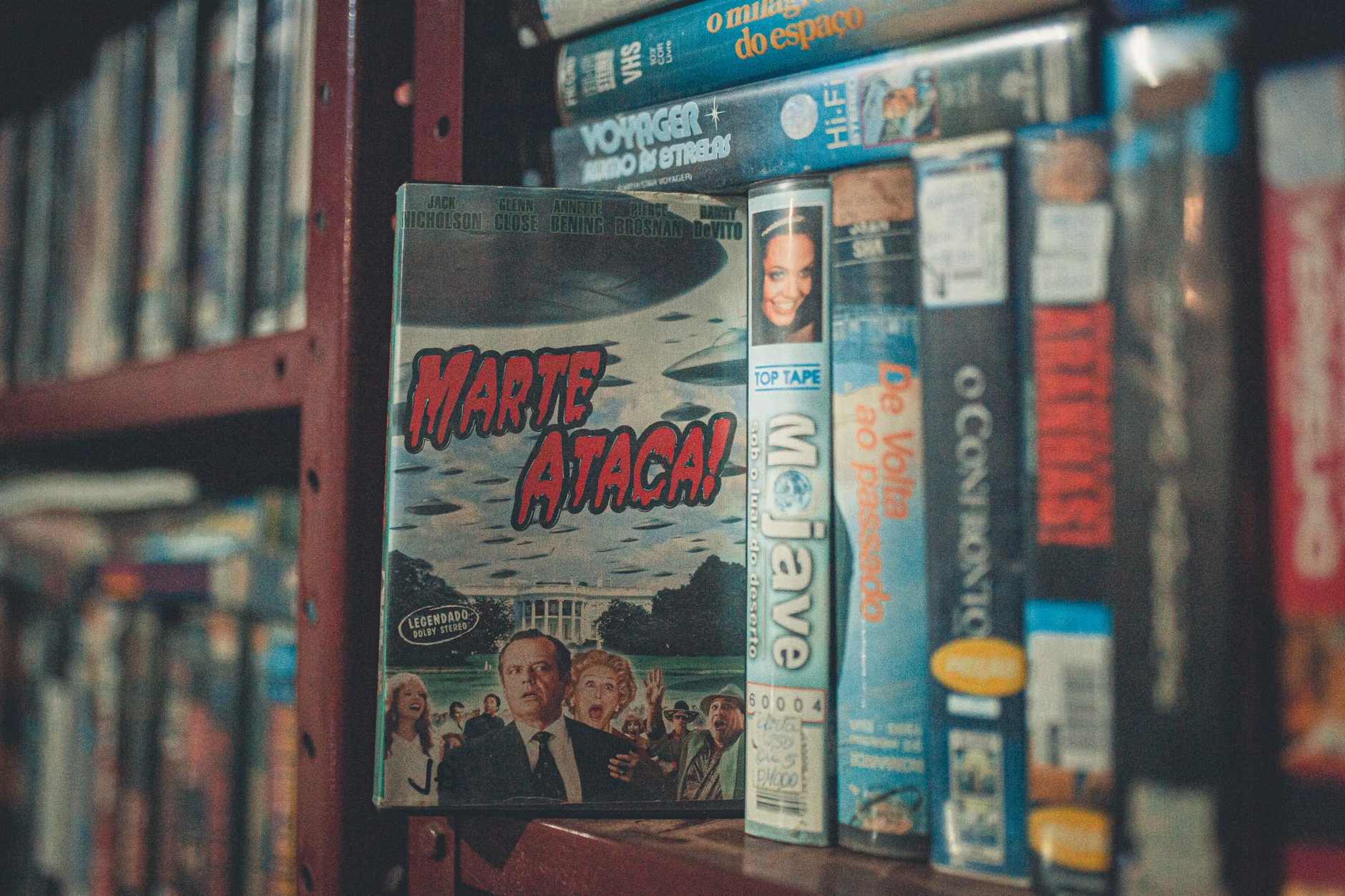
There is a peculiar connection between the rise of Slow Cinema and the resurgence of physical media. Streaming services are designed for the “next episode” autoplay feature. They are built to keep you moving. When you hold a physical disc or a specific digital file that you have curated, you are taking control of the experience.
In our house, we have started moving toward a “curated library” approach. Instead of scrolling through a streaming service’s algorithm for 45 minutes—a practice that often leads to decision fatigue and eventual frustration—we have a small list of “slow” films we want to watch. This eliminates the “choice paralysis” that plagues most parents. By making the *selection* part of the ritual, you are already halfway to a more mindful evening.
Why This is More Than Just a Trend
We are living through an era of extreme fragmentation. Our attention is being harvested by platforms that benefit from us being as distracted as possible. Choosing to sit down for a two-hour film that doesn’t constantly demand your immediate reaction is, in a way, a rebellious act. It is a way of saying, “My time and my focus are mine to control.”
For parents, this is especially important. Your children are watching how you interact with media. If they see you constantly checking your phone while a movie plays in the background, they will learn that media is just “background noise.” If they see you engaging with a film—pausing to talk about a scene, enjoying the silence, or appreciating the cinematography—they will learn that media can be a source of genuine connection and rest.
This doesn’t mean you have to abandon fast-paced action movies forever. Everything has its place. But by balancing your family’s media diet with slower, more artistic content, you are building a resilience against the constant “ping” of the digital world. You are creating a home environment that prioritizes depth over width.
Implementation Checklist for Your Next Slow Movie Night
If you are ready to give this a try, here is a simple framework to ensure it goes smoothly:
- The 48-Hour Rule: Choose the film two days in advance. This builds anticipation and prevents the “what do you want to watch?” argument that happens on Friday nights.
- The Phone Basket: Place all smartphones in a basket in another room. The “second-screen” habit is the enemy of Slow Cinema.
- The “Pause” Permission: Explicitly tell your kids, “We are going to pause this if we want to talk about something.” This removes the pressure to finish the film in one go and encourages engagement.
- The Ambient Check: Ensure the room is dark and the sound system is clear. These films rely on atmosphere; if you can’t hear the wind in the trees or the subtle score, you lose half the experience.
It is important to remember that this isn’t about being “high-brow” or pretentious. It is about your personal wellbeing. If a film is too slow or you simply aren’t enjoying it, stop. The point is not to force yourself to finish a “critically acclaimed” movie. The point is to find the pacing that works for your family’s recovery.
Addressing Potential Pitfalls and Misconceptions
The most common mistake parents make is assuming that “slow” means “boring.” There is a difference between a film that is slow because it is contemplative and a film that is slow because it is poorly made. Don’t be afraid to read reviews from sources that prioritize storytelling over box-office success. Look for films that are described as “atmospheric,” “visual,” or “character-driven.”
Another potential issue is the “boredom spike.” About 20 minutes into a slower film, your kids might get restless. This is normal. It is the moment their brains are adjusting from high-stimulation to lower-stimulation. Instead of immediately switching to something else, try engaging them with a question. “What do you think that character is feeling right now?” or “Look at the colors in this scene—why do you think the director chose them?” This redirects their energy from “I’m bored” to “I’m observing.”
Finally, be patient with yourself. You have been trained by algorithms to expect constant changes. It will take time to re-learn how to sit with a long, slow narrative. Treat it like a muscle you are strengthening. After a few weeks of mindful viewing, you will find that you are less prone to the “scroll-fatigue” that makes modern parenting so exhausting.
Moving Forward with Mindful Media
The rise of Slow Cinema is a symptom of a larger cultural need: the need to disconnect from the frantic pace of the digital age and reconnect with the quiet, deliberate beauty of storytelling. By intentionally choosing these films, you are providing your family with a necessary sanctuary. You are showing them that it is okay to be still, that it is okay to wait for a payoff, and that there is immense value in the things that don’t shout for our attention.
As you navigate the next few months, don’t feel the need to overhaul your entire life. Start with one “slow” movie night every two weeks. See how it changes the mood in your home. Observe how you feel the next morning. You might find that the quiet, lingering images of a well-crafted film stay with you much longer than the chaotic, high-energy clips that disappear from your memory the moment you close the app.
This is your permission to slow down. The world will keep spinning, the notifications will keep arriving, and the emails will still be there tomorrow. For now, just focus on the screen, the story, and the quiet moments you are building with the people who matter most.
Frequently Asked Questions
1. Does ‘Slow Cinema’ mean the movies are black and white or in a foreign language?
Not necessarily. While many classic examples of slow cinema are foreign-language or older films, there is a wealth of modern, English-language, and animated films that utilize the same deliberate pacing. It is about the *technique* of filmmaking, not the language or the era.
2. How do I keep my kids from getting distracted during long, quiet scenes?
Engagement is the key. If you see them getting restless, don’t ignore it. Ask them a question about the scenery, the music, or the character’s choice. By making the viewing experience interactive, you keep them engaged with the film’s atmosphere rather than letting them drift toward their own distractions.
3. Can I still watch my favorite action movies if I start watching ‘Slow Cinema’?
Absolutely. The goal is balance, not replacement. Think of your media diet like your food diet. You can enjoy a fast-paced “junk food” movie occasionally, but you shouldn’t rely on it for every meal. Integrating slower, more substantial films helps ensure you aren’t constantly over-stimulating your brain.
For further reading on the impact of media pacing on cognitive health, you can explore resources from the American Psychological Association or research on digital wellbeing and screen time management through the Common Sense Media framework.