If you feel like your monthly bank statement is being death-by-a-thousand-cuts, you aren’t alone; the most effective way to reclaim your family budget is to shift away from recurring subscription models toward sustainable, one-time-purchase software.
- Subscription fatigue is a real financial drain, often totaling hundreds of dollars per year for basic utility apps.
- “One-time-purchase” or “perpetual license” software offers long-term savings and prevents sudden price hikes.
- Focusing on open-source alternatives or legacy-style software can provide a more stable, distraction-free environment for family tasks.
We’ve all been there. You download a simple app to track your grocery list or organize the kids’ extracurricular schedules, and it’s free for a week. Then, before you know it, you’re locked into a $9.99-a-month plan that you forgot to cancel. Over a year, that “small” fee adds up to over $120—the cost of a decent family dinner or a new pair of sneakers. This is the reality of the “SaaS” (Software as a Service) economy. While it offers constant updates and cloud syncing, it also creates a permanent tether between your bank account and a service you might only use sporadically.
The Hidden Cost of the “Subscription-First” Mindset
The tech industry has shifted aggressively toward recurring revenue. For companies, this is a dream: predictable income. For families, it’s a logistical nightmare. Every month, you aren’t just paying for one utility; you are paying for photo storage, cloud backups, task managers, note-taking apps, and streaming services. When you add these up, the “subscription-first” model often feels like a utility bill that never stops growing.
Beyond the money, there is the mental load. Managing subscriptions requires constant vigilance. You have to remember which apps you’re paying for, check for price increases, and navigate the “cancellation obstacle course” that some apps force you through. It’s an unnecessary cognitive burden on parents who already have enough to juggle.
One-time-purchase software, often referred to as perpetual licensing, offers a different path. You pay once, you own the version of the software, and you use it for as long as your hardware supports it. It’s a return to the “tool” mindset—you buy a hammer, you own the hammer. You don’t pay the hardware store a monthly fee to keep using the hammer.
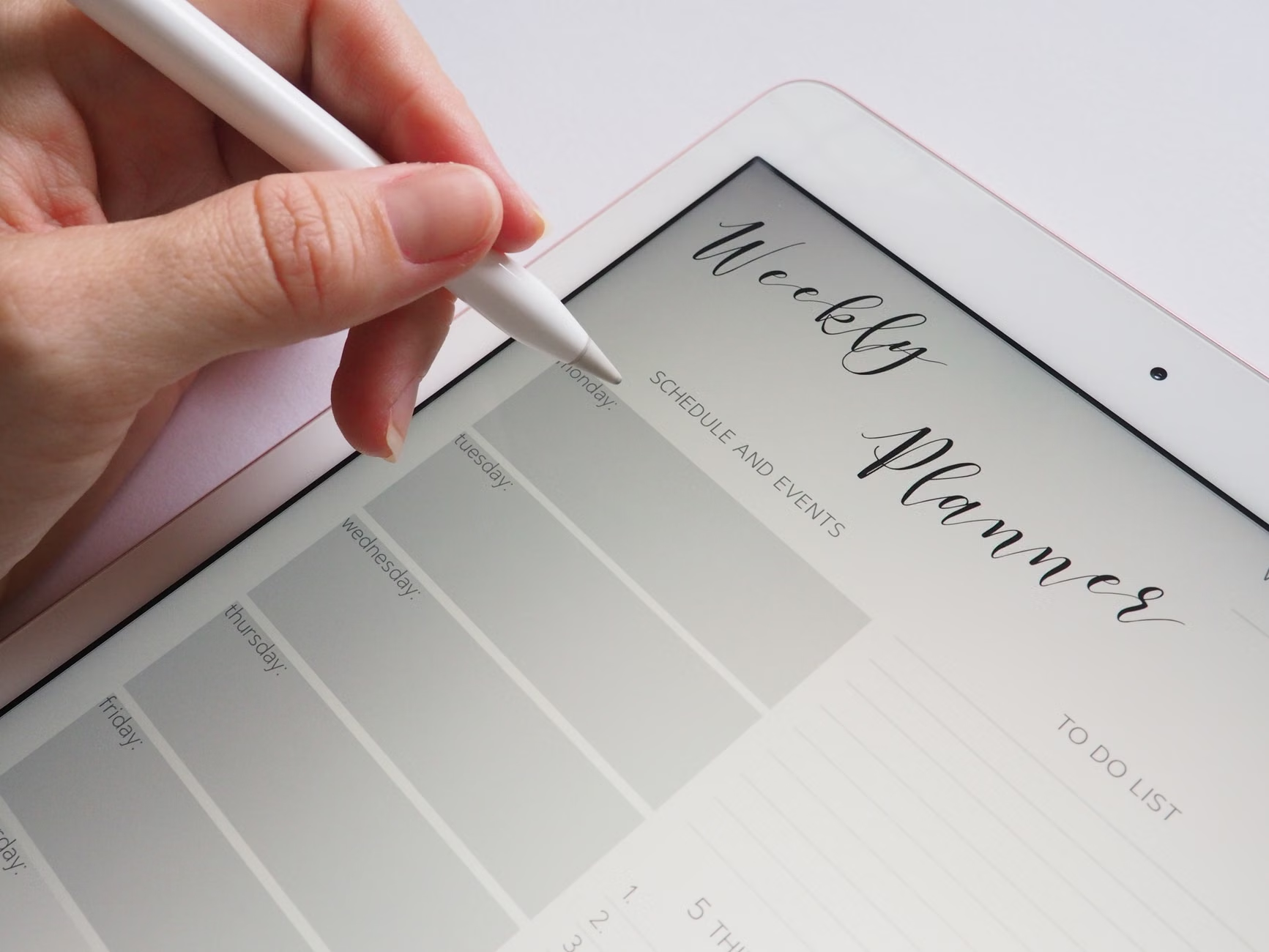
Why “Perpetual” is Making a Comeback
There is a growing movement—both from users and independent developers—to move away from the subscription model. Many people are realizing that they don’t need the latest AI-driven features in their simple to-do list app. They just need a list that works. This has led to the resurgence of software that prioritizes stability over constant, disruptive updates.
When you opt for a one-time purchase, you gain a sense of ownership. You aren’t “renting” your workflow. If the company goes out of business or pivots their business model, your local copy of the software often continues to function. This is particularly valuable for family tasks like budgeting, document scanning, and photo organization, where continuity is more important than having the “latest” cloud-integrated feature.
However, it’s not all sunshine. The trade-off is usually a lack of seamless cloud syncing. If you want your data to follow you from your phone to your tablet to your laptop, subscriptions are often the easiest way to achieve that. For families, the question becomes: Is the convenience of instant cloud syncing worth $100 a year? For many, the answer is increasingly becoming “no.”
Strategic Evaluation: When to Buy and When to Rent
Not every software category is ripe for a one-time purchase. To manage your family’s digital life effectively, you need a framework for deciding where to spend your money. Use the following table as a guide for your next software purchase decision.
| Category | Subscription Reason | One-Time Buy Reason |
|---|---|---|
| Photo Storage | Large scale cloud backup/AI search | Privacy and local hard drive control |
| Task/Project Mgmt | Team collaboration features | Personal focus and data ownership |
| Creative Tools | Constant asset updates/templates | Core functionality remains stable |
If you find yourself using a tool for a specific, isolated task—like editing a family video once a year or managing a small spreadsheet—a one-time purchase is almost always superior. You pay once, and it’s there for you whenever you need it, without the guilt of paying for a service you aren’t actively using that month.

The Role of Open-Source in Your Family Toolbox
One of the best-kept secrets for families looking to save money is the open-source community. Open-source software is free, community-maintained, and rarely relies on a subscription model. Because it is built by developers for the sake of utility, it often eschews the “bloatware” that plagues commercial apps.
Think of open-source as the “digital equivalent of a public library.” You aren’t paying a monthly fee to access the books; the infrastructure is supported by a community. For families, this is a goldmine. You can find robust note-taking apps, document editors, and even photo management tools that are completely free of charge. The only cost is your time—it might take you 30 minutes to set up a tool like LibreOffice or Obsidian, but once it’s installed, it’s yours forever.
The “cost” of open-source is usually a steeper learning curve. Unlike a slick, $9.99-a-month app that guides you through every step with friendly animations, open-source tools expect you to be a bit more hands-on. For a busy parent, this might sound intimidating, but consider it an investment. Learning one powerful, free tool can replace three different paid subscriptions that you’re currently juggling.
Managing the Migration: A Step-by-Step Approach
You don’t need to cancel everything today. A sudden shift can cause more stress than it saves. Instead, follow a systematic approach to auditing your family’s digital footprint.
- The Audit: Export your credit card or bank statements for the last three months. Highlight every recurring charge related to software or digital services.
- The Usage Test: For each item on your list, ask yourself: “Did I use this in the last 30 days?” If the answer is no, cancel it immediately.
- The Alternative Search: For the remaining apps, search for “one-time purchase alternative to [App Name]” or “open-source alternative to [App Name].”
- The Trial Period: Download the alternative. Don’t delete the old app yet. Use the new one for two weeks to see if it meets your needs.
- The Cut-Over: Once you are comfortable with the new tool, cancel the subscription to the old one.
This process isn’t just about saving money; it’s about regaining control. When you choose your software, you are defining how your family manages information. Don’t let a subscription model dictate your workflow for you.

Common Pitfalls and How to Avoid Them
As you transition to subscription-free tools, there are a few common mistakes to watch out for. The most frequent one is “feature creep.” You might find a one-time purchase app that looks perfect but is missing one tiny feature you liked in your subscription app. Before you give up and go back, ask yourself if that feature is actually necessary. Often, we subscribe to apps because they have “nice-to-have” features that we never actually use.
Another pitfall is security. When you move away from big-name subscription services, you might be tempted to download “cracked” or “pirated” versions of expensive software. Do not do this. Pirated software is the fastest way to introduce malware to your family computer. If you cannot afford the one-time purchase price of a premium app, stick to legitimate open-source alternatives. They are safer, more reliable, and you won’t be putting your family’s data at risk.
Finally, consider the longevity of the file formats. One of the biggest risks of subscription software is that if the company disappears, your data might be trapped in a proprietary format. One-time purchase software, especially open-source, often uses standard formats (like .txt, .csv, or .jpg) that ensure your family photos and documents will remain accessible for decades, regardless of what happens to the specific app you used to create them.
Integrating Stability into Your Digital Life
The beauty of a one-time purchase is that it creates a “set it and forget it” environment. You install the software, you learn the interface, and that interface stays the same. You don’t wake up one morning to find that an update has moved all your menus or changed your workflow. For a parent, this kind of stability is precious. You have enough changes in your life—your software shouldn’t add to the chaos.
When you stop paying for software, you stop being a “user” and start being an “owner.” This shift in mindset changes how you approach digital tasks. You become more deliberate about what you store and how you store it. You stop treating your digital space like a rented apartment and start treating it like a home you own.
There is also a profound sense of satisfaction in finding a tool that works for you and sticking with it. It’s like finding a favorite pair of jeans or a reliable kitchen knife. You know how it works, you trust it, and it does the job without any fuss. That is the true value of subscription-free software. It’s not just about the money you save; it’s about the simplicity you gain.
As you move forward, keep an eye on the independent developer community. Many small, one-person software shops are returning to the “pay once, own forever” model because it builds better relationships with customers. By supporting these developers, you are voting for a future where we aren’t all constantly paying rent for the privilege of using our own computers.
Looking Ahead: The Future of Your Digital Budget
While the subscription model shows no sign of disappearing entirely, the pendulum is beginning to swing back toward a more balanced approach. Consumers are becoming more savvy, and businesses are beginning to realize that “subscription fatigue” is causing churn. We are likely to see more “hybrid” models where basic features are one-time purchases and advanced, cloud-heavy features are optional add-ons.
For your family, the goal is simple: prioritize utility and longevity. Before you click “subscribe” on the next app that promises to organize your life, pause. Ask yourself if there is a simpler, one-time purchase alternative. You might be surprised at how much you can do with a tool that you own outright. It’s a small change in habit, but over the course of a decade, it can save you thousands of dollars and, more importantly, a significant amount of mental energy.
If you feel overwhelmed by the transition, start small. Replace one monthly subscription at a time. It’s a marathon, not a sprint. By the end of the year, you’ll have a leaner, more stable, and more personal digital environment for you and your family.
Frequently Asked Questions
Q: Will I lose my data if I cancel my subscription software?
A: It depends on the app. Most services allow you to export your data in standard formats (CSV, PDF, JSON). Always perform a full export before canceling any subscription. If an app does not allow data export, consider it a warning sign and migrate your data to a more open platform as soon as possible.
Q: Are one-time purchase apps less secure?
A: Not necessarily. Security is about how the software handles your data, not how you pay for it. In fact, many one-time purchase apps are more secure because they store your data locally on your device rather than in a cloud server where it could be subject to data breaches.
Q: Is open-source software too difficult for non-techies?
A: While some open-source projects have a learning curve, many have become incredibly user-friendly in recent years. If you can navigate a modern website or a standard mobile app, you can likely use most major open-source tools. Start with well-documented projects like LibreOffice or VLC Media Player to see how intuitive they have become.
For further reading on digital ownership and the economics of software, you can explore resources from the Free Software Foundation, which advocates for the rights of users to control their own computing.
Taking control of your digital tools is a small but powerful step toward a more intentional life. Don’t be afraid to step off the treadmill of monthly payments; your wallet and your peace of mind will thank you.