Key Takeaways for 2026 Homeowners
- Tax Credits vs. Rebates: Know the difference; tax credits reduce your tax bill directly, while rebates act as point-of-sale discounts or cash-back incentives.
- Prioritize Efficiency: Focus on “envelope” improvements (insulation, windows) before spending heavily on high-tech gadgets to get the best return on investment.
- Documentation is Everything: Keep every receipt, contractor certification, and product performance label, as the IRS and local authorities require proof for all claims.
If you are planning to renovate your home in 2026, you are likely looking for ways to make your space more comfortable while keeping a close eye on the budget. The good news is that the push for sustainable, energy-efficient housing has moved from a “nice-to-have” to a financially savvy decision. By 2026, government incentives and tax frameworks have matured, making it easier than ever to offset the costs of upgrades like heat pumps, insulation, and high-efficiency windows.
But let’s be honest: navigating tax codes and rebate programs can feel like a full-time job. Between managing school runs, work deadlines, and the endless laundry pile, who has time to read thousands of pages of government policy? I’ve done the heavy lifting for you. Here is how you can approach your 2026 home improvements to ensure you aren’t leaving money on the table.
The Evolution of Green Incentives: What’s Different in 2026?
The landscape for green energy incentives has shifted from experimental pilots to standardized, long-term programs. In previous years, many rebates were “first-come, first-served” and vanished before the year was out. By 2026, the focus has shifted toward stability. Most major economies have transitioned to a dual-track system: federal tax credits that you claim when filing your annual return, and state or local-level rebates that you often receive at the point of purchase.
Think of it like this: Tax credits are a reward for your patience at the end of the year, while rebates are an instant discount that makes the initial price tag look less intimidating. Understanding this distinction is the first step in your planning process. You shouldn’t be choosing between a new HVAC system and a family vacation if you can leverage these incentives to make the upgrade affordable.
The “Envelope First” Strategy: Why Insulation Matters More Than Gadgets
When we think of “green energy,” our minds often jump to flashy tech like solar panels or smart home systems. However, the most effective way to save money—and to maximize your tax benefits—is to start with your home’s “envelope.” This refers to the physical barrier between the conditioned air inside your home and the outside world.
If your roof is leaking heat or your walls are drafty, buying a fancy, high-efficiency heat pump is like trying to fill a bathtub with the drain open. You’re just paying for more power to do the same amount of work. In 2026, many rebate programs now require an energy audit before you can qualify for larger system upgrades. This audit is actually a gift; it tells you exactly where your money is best spent.
The ROI of Upgrading Your Insulation
Upgrading your insulation is rarely as exciting as installing a smart thermostat, but it offers some of the highest returns on investment. Many local governments in 2026 offer direct rebates for adding insulation to attics, walls, and crawl spaces. Because this is a structural improvement, it often qualifies for both tax credits and utility-provider rebates simultaneously.
Windows and Doors: The Silent Energy Thieves
Are your windows from the era when your house was built? If you’re living in a home built before 2010, your windows are likely the single biggest source of energy loss. Tax credits for high-performance windows are essentially a subsidy for your future comfort. When shopping, look for the “Energy Star” rating that is specific to your climate zone. A window that works perfectly in a desert climate might not be the most efficient choice for a snowy, northern region.

Heat Pumps: The 2026 Gold Standard
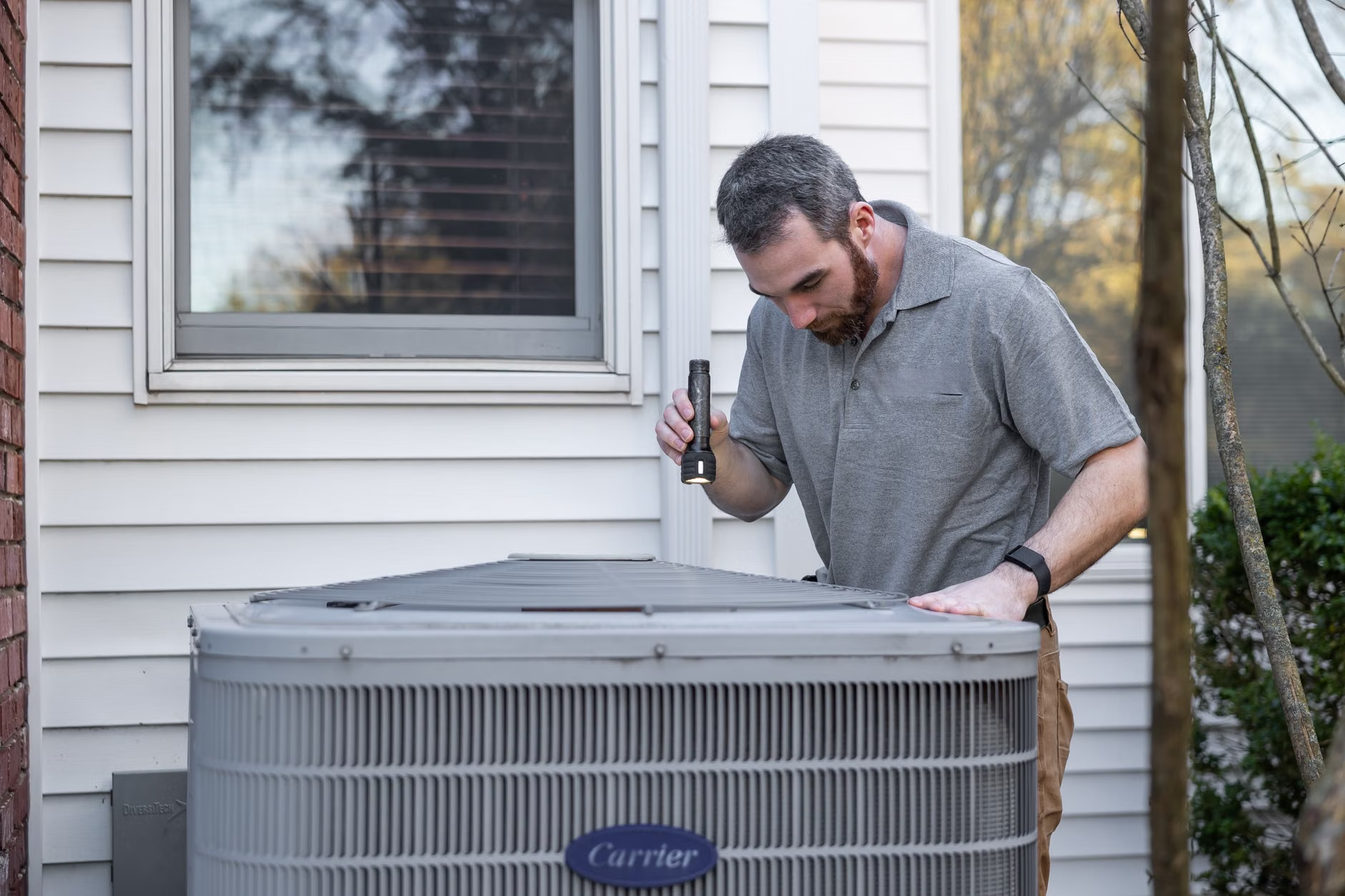
If there is one piece of technology that defines the 2026 renovation landscape, it is the heat pump. If you’re still relying on a traditional furnace or boiler, you are likely missing out on significant tax credits. Heat pumps are incredibly efficient because they don’t “create” heat—they move it. By shifting heat from the outside air into your home (even in cold weather), they use a fraction of the electricity required by traditional resistive heating.
Many homeowners in their 30s and 40s are intimidated by the price tag of a full-home heat pump system. However, the federal tax credit for heat pumps has been optimized to cover a substantial percentage of the installation costs. When you combine this with the reduced monthly utility bills, the break-even point for these systems has dropped significantly compared to five years ago.
Common Pitfalls When Choosing a Heat Pump
- Sizing for the Future: Don’t let a contractor “oversize” your unit. A unit that is too large will cycle on and off too frequently, wearing out the compressor prematurely and wasting energy.
- Installation Quality: A high-end heat pump installed poorly will perform worse than a low-end unit installed correctly. Always check for certified installers who have experience with the specific brand you are purchasing.
- Ignoring Ductwork: If your current ductwork is leaky or poorly designed, the efficiency gains of your new heat pump will be lost. Factor in a duct-sealing project as part of your overall renovation.
The Financial Checklist: How to Keep Your Records
The most heartbreaking part of the tax season is realizing you missed out on a credit because you didn’t have the right piece of paper. The IRS and equivalent tax authorities worldwide are strict about documentation. If you are claiming a credit for an energy-efficient upgrade in 2026, you need a “paper trail” that would survive an audit.
| Document Type | Why You Need It |
|---|---|
| Itemized Contractor Invoice | Proves labor and materials were paid. |
| Manufacturer’s Certification | Confirms the equipment meets energy standards. |
| Energy Audit Report | Required for certain deep-energy retrofits. |
| Photos of Installation | Useful for verifying insulation thickness. |
Create a dedicated folder—digital or physical—the moment you start planning. I recommend scanning all receipts immediately using a phone app. Thermal paper receipts fade within months, and you don’t want to find yourself in April with a blank piece of paper where your $5,000 heat pump receipt used to be.

Understanding the “Stacking” Rule
One of the most frequent questions I receive is: “Can I use a state rebate AND a federal tax credit?” The answer is generally yes, but with a catch. You usually cannot use two federal tax credits for the exact same expense. However, you can often “stack” a local utility rebate on top of a federal tax credit.
For example, if your local electric company offers a $500 rebate for a smart water heater, you can take that, and then claim the federal tax credit on the remaining out-of-pocket cost. This is where the real savings happen. Check your local utility company’s website—they are often the most overlooked source of “free money” for homeowners.
Living with the Renovations: A Reality Check
Let’s be grounded for a moment. Renovating while parenting is chaotic. You have to balance the noise of construction with nap schedules, zoom calls, and the general mess of everyday life. If you are planning a major energy project, try to time it during a period where you have some flexibility.
Don’t try to install a new HVAC system during the peak of summer or the heart of winter when demand for contractors is at its highest. Not only will you pay a premium for labor, but the quality of the work might suffer as crews rush to get to the next job. Late spring and early autumn are usually the “sweet spots” for scheduling major home improvements.
Common Mistakes to Avoid
The biggest mistake is assuming a product is “green” just because it’s marketed that way. Always look for official certifications, such as the Energy Star label or local government-backed efficiency ratings. Marketing departments love to use words like “eco-friendly” or “sustainable,” but these terms are often unregulated. Rely on data, not the packaging.
Another common error is failing to check for permit requirements. Many energy-efficient upgrades, especially those involving electrical work or structural modifications, require municipal permits. If you skip this, you might not only fail a future home inspection when you decide to sell, but you could also be disqualified from claiming your tax credits.
The Long-Term View
By 2026, the energy efficiency of your home is directly tied to its resale value. Prospective buyers in the 2030s will be looking for homes that don’t cost a fortune to heat and cool. Every dollar you spend today on high-quality, energy-efficient upgrades is an investment that will pay dividends when you eventually list your home. It’s not just about the tax credit you get today; it’s about the marketability of your home tomorrow.
Take it one step at a time. You don’t have to turn your home into a net-zero laboratory overnight. Start with the “low-hanging fruit”—LED lighting, smart thermostats, and basic weather-stripping. Once you see the impact on your monthly utility bills, you’ll have the confidence and the budget to tackle the bigger, more impactful projects. You’ve got this.
Frequently Asked Questions
Q: Do I need a professional energy auditor to qualify for all 2026 rebates?
A: Not necessarily for all, but for many of the larger incentives, it is highly recommended. Some state-level programs require an audit to establish a baseline for your home’s energy usage. Even if not required, an audit provides a roadmap to ensure you aren’t wasting money on upgrades that won’t provide the best ROI.
Q: What happens if the tax credit exceeds my total tax liability for the year?
A: Most federal energy tax credits are “non-refundable,” meaning they can reduce your tax bill to zero, but they won’t result in a cash refund for the excess. However, some credits allow you to carry the unused portion forward to future tax years. Always check the specific rules for the credit you are claiming, as policies can vary by region.
Q: Are DIY energy improvements eligible for tax credits?
A: Generally, yes, for materials purchased. If you buy insulation or high-efficiency windows yourself, you can often claim the credit on the cost of the materials. However, keep in mind that many professional installation rebates require proof of a licensed contractor to ensure safety and compliance with building codes.
For more information on specific energy policies in your region, please visit your national energy department’s official website or your local utility provider’s portal. Always consult with a tax professional before making significant financial decisions based on tax credits.