The most effective way to foster a lasting bond with your children is to shift from the role of a “manager” of their activities to a “partner” in a shared pursuit. By engaging in a hobby that both you and your child find genuinely interesting, you move past the transactional nature of daily parenting—homework, chores, and schedules—and into the realm of collaborative experience.
Key Takeaways:
- Shift the dynamic: Move from “parent-as-instructor” to “partner-as-collaborator” to reduce resistance.
- Focus on process, not output: The goal is sustained interaction, not achieving perfection or high-level skill.
- Low-stakes consistency: Small, frequent shared moments outweigh infrequent “big” trips or expensive experiences.
If you are in your 30s or 40s, you know the feeling of the “second shift.” You finish your workday, commute, handle household logistics, and then attempt to squeeze in “quality time” with your children. Often, this results in a forced activity where you are watching them play or supervising their screen time while you mentally check your emails. It’s exhausting, and worse, it feels hollow.
The “Shared Hobby” model isn’t about sacrificing your interests for theirs or forcing them into your adult interests. It is about finding the intersection point—the Venn diagram where your curiosity meets their developmental capacity.
Why the “Quality Time” Myth Fails
We are often told that children need “undivided attention.” In reality, children—especially those moving out of early childhood—often find direct, intense eye contact and constant questioning from parents to be performative or even intimidating. When you sit across from your child and ask, “How was school today?” you are essentially conducting an interview. It’s a high-pressure environment that usually yields one-word answers.
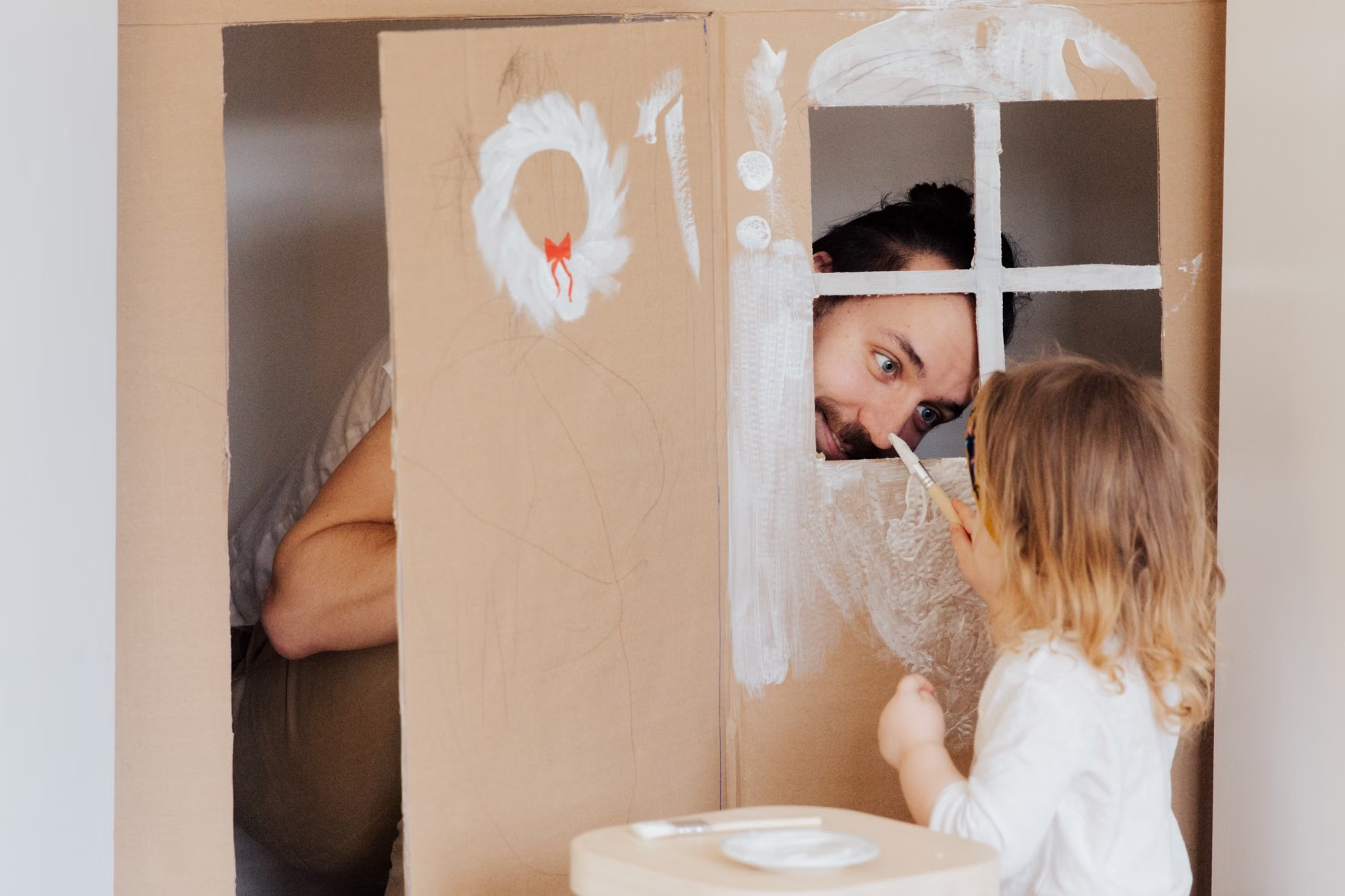
Shared hobbies provide a “side-by-side” dynamic. When you and your child are both focused on a third object—a garden bed, a model kit, a sourdough starter, or a coding project—the pressure to perform disappears. You aren’t staring at each other; you are both staring at the problem or the task. This side-by-side positioning is biologically and psychologically more conducive to open conversation and trust building.

Not every hobby is suitable for a shared model. To be successful, the hobby must meet three specific criteria:
| Criteria | Why it matters |
|---|---|
| Low Barrier to Entry | You shouldn’t need a month of training just to get started. |
| Incremental Progress | There should be visible steps that allow for “small wins” every time you engage. |
| Autonomy | Both parties should be able to contribute meaningfully without one person doing all the work. |
If you try to teach your child high-level professional photography before they understand lighting, you will both end up frustrated. Instead, look for hobbies that allow for “parallel play” with shared goals. For example, if you are into fitness, don’t force them to do your HIIT workout. Go for a hike where you are both navigating the trail, or try a sport like pickleball where the learning curve is shallow and the focus is on movement.
The “Skill-Gap” Trap
A common mistake parents make is choosing a hobby where the skill gap is too wide. If you are a master woodworker, do not try to build a complex cabinet with a seven-year-old. You will inevitably take over the tools to “fix” their mistakes. This destroys their sense of ownership. Instead, choose a project where their mistakes don’t matter—perhaps building a birdhouse or carving simple shapes out of soap. The objective is to share the experience, not to produce a masterpiece.
Practical Implementation: A Step-by-Step Approach
Transitioning to a shared hobby model requires intentionality. You cannot simply announce, “We are going to do this now.” It must be an invitation, not a mandate.
Phase 1: The Observation Period
Before suggesting anything, spend two weeks observing what your child naturally gravitates toward. Do they like sorting things? They might enjoy collecting stamps or organizing a digital music library. Do they like destroying things? They might enjoy learning how to take apart old electronics to see how they work. Aligning the hobby with their inherent temperament is 80% of the battle.
Phase 2: The “Low-Stakes” Trial
Propose the hobby as an experiment. “I’ve been curious about learning how to bake bread, and I think it would be more fun if I had a partner. Do you want to try it with me this weekend?” This framing gives them an out if they aren’t interested, and it positions you as a learner rather than an authority figure.
Phase 3: Setting the Rules of Engagement
Establish a few boundaries early on to prevent the hobby from becoming another chore. Use a “no-criticism” rule. If you are building a model, the goal is the process, not the aesthetic finish. If they want to paint the model bright purple when it should be metallic gray, let them. If you criticize, you signal that your standards are more important than their participation.
Even with the best intentions, the shared hobby model can hit roadblocks. The most common is “interest drift.” Your child might be obsessed with building Lego sets for three months, and then suddenly stop. This is normal. Children are developmentally wired to explore and move on. Do not view this as a failure of the model; view it as the conclusion of a chapter.
Another challenge is the “distraction factor.” In a world of notifications and instant gratification, a hobby that requires patience—like gardening or playing a musical instrument—can feel slow to a child. You can mitigate this by breaking the hobby into “sprints.” If you are gardening, don’t spend three hours weeding. Spend 20 minutes, then take a break for a snack or a different activity. Keep the engagement window shorter than their attention span.
The Role of Failure in Bonding
One of the most valuable aspects of the shared hobby model is the opportunity to model how to handle failure. If you are cooking and the dish tastes terrible, or if the electronics project doesn’t turn on, use it as a teaching moment. Don’t get angry or frustrated. Say, “Well, that didn’t work. Let’s look at the manual and see where we went wrong.”
When your child sees you handle a setback with curiosity instead of shame or anger, they learn that failure is not a disaster. It is simply data. This builds resilience in your child and fosters a relationship where they feel safe bringing their own failures to you later in life.

The “Digital” Hobby Dilemma
Many parents in their 30s and 40s are concerned about screen time. While it is easy to view technology as the enemy, there are ways to use it within the shared hobby model. If your child loves video games, don’t just ban them. Learn to play the game with them. Ask them to teach you the controls. When you are the “student” and they are the “teacher,” the dynamic shifts entirely. You are no longer the gatekeeper of their screen time; you are a participant in their world.
However, be cautious about the “passive consumption” trap. If you are both just sitting on the couch scrolling through TikTok, that is not a shared hobby. That is shared consumption. A hobby must involve active creation or active participation.
Sustainable Hobby Ideas for Busy Families
If you are struggling to find a starting point, consider these low-overhead options:
- Urban Foraging/Nature Walks: Use an app to identify local plants or birds. It turns a boring walk into a scavenger hunt.
- Meal Prep/Cooking: Focus on a specific category, like “International Street Food Fridays.” Each week, pick a simple recipe from a different country.
- Repair Culture: Keep a “fix-it” box. When something small breaks, work on it together before throwing it away.
- Strategic Board Games: Move beyond luck-based games. Look for cooperative board games where you play against the board, not against each other.
The Long-Term Impact
The beauty of this model is that it builds a “language” between you and your child. Over the years, these shared activities create a library of inside jokes, common failures, and successes that you can refer back to. When they are teenagers and communication becomes more difficult, you will still have these shared touchpoints to fall back on.
Remember that the goal is not to create a mini-me or to turn your child into a prodigy. The goal is to be present. In our hyper-scheduled lives, shared hobbies are a way to carve out a sanctuary of time where the only thing that matters is the task at hand and the person standing next to you.
Frequently Asked Questions
What if my child loses interest after only a few sessions?
That is perfectly fine. The goal of the shared hobby model is to provide opportunities for connection, not to force a lifelong commitment to a specific activity. If they lose interest, pivot to something else or take a break. The flexibility is what makes it sustainable.
How do I balance this with my own need for personal downtime?
Do not mistake a shared hobby for your own personal downtime. You still need time for your own interests. The shared hobby is a specific “bucket” in your schedule. If you try to make your child’s hobby your primary form of relaxation, you will eventually resent it. Treat it as a social engagement, much like a dinner date, but with your child.
Is it okay to use YouTube tutorials to learn a hobby together?
Absolutely. In fact, it’s recommended. Watching a tutorial together is a great way to learn a skill from scratch. It frames the learning process as something you are both doing, which reinforces the “we are a team” mentality.
For further reading on child development and the importance of play-based connection, you can refer to resources from organizations like the National Association for the Education of Young Children (NAEYC), which provides extensive research on how cooperative activities foster emotional intelligence. Additionally, the Psychology Today archives offer deep dives into the “side-by-side” communication theory, which confirms that indirect interaction often leads to more authentic disclosure in children.
Ultimately, the shared hobby model is about showing up. It’s about being there, present, and engaged, even when you’re tired. Start small, keep your expectations low, and focus on the interaction, not the result. Your future relationship with your child is being built in these small, quiet moments of collaboration.