The most effective way to reduce sibling friction is not through policing their arguments, but by providing structured opportunities where their success depends on working together.
- Shared Goals vs. Individual Tasks: Cooperation flourishes when children share a single, tangible outcome that neither can easily achieve alone.
- The Power of Role Definition: Assigning specific, complementary roles prevents power struggles and ensures each child feels valued for their unique contribution.
- Process Over Perfection: Shift your focus from the final product to the communication and negotiation skills used during the project.
If you have spent your afternoon breaking up arguments over who gets the better seat, who controls the remote, or whose turn it is to choose the game, you are not alone. It is a classic parenting ritual. We often view these conflicts as inevitable personality clashes, but psychologists suggest that sibling rivalry is frequently a competition for resources—whether that resource is parental attention, physical space, or a sense of agency.
When children are constantly vying for dominance, their baseline relationship becomes one of competition. By introducing shared projects, you effectively reframe the dynamic. You are moving them from a “me vs. you” mindset to a “we” mindset. It is a shift that requires patience, but it is one of the most reliable ways to build a foundation of mutual respect that lasts well into adulthood.
Why Collaboration Often Fails (And How to Fix It)
Before we dive into the projects, we need to address the elephant in the room: why do kids fight even when you tell them to “work together”? Usually, it is because the structure of the task is flawed. If you ask two children to “clean the room together” without specific parameters, you are essentially creating a vacuum for conflict. One child might feel they are doing more work, while the other might feel micromanaged.
True cooperation requires interdependence. In social psychology, this is known as the “Jigsaw Method” in a family setting. If Child A has the glue and Child B has the paper, they are forced to negotiate. If you give both of them glue and paper, they will simply work in parallel—or worse, compete to see who can finish first. To foster cooperation, you must design tasks where the contribution of each child is essential for completion.
Consider the following table to evaluate whether a task is truly collaborative or merely parallel:
| Feature | Parallel Play (Avoid) | Cooperative Project (Encourage) |
|---|---|---|
| Resource Allocation | Each has their own set of tools. | Tools must be shared to proceed. |
| Outcome | Two separate results. | One unified, larger result. |
| Communication | Minimal or competitive. | Constant negotiation and feedback. |
1. The “Mega-Structure” Engineering Challenge
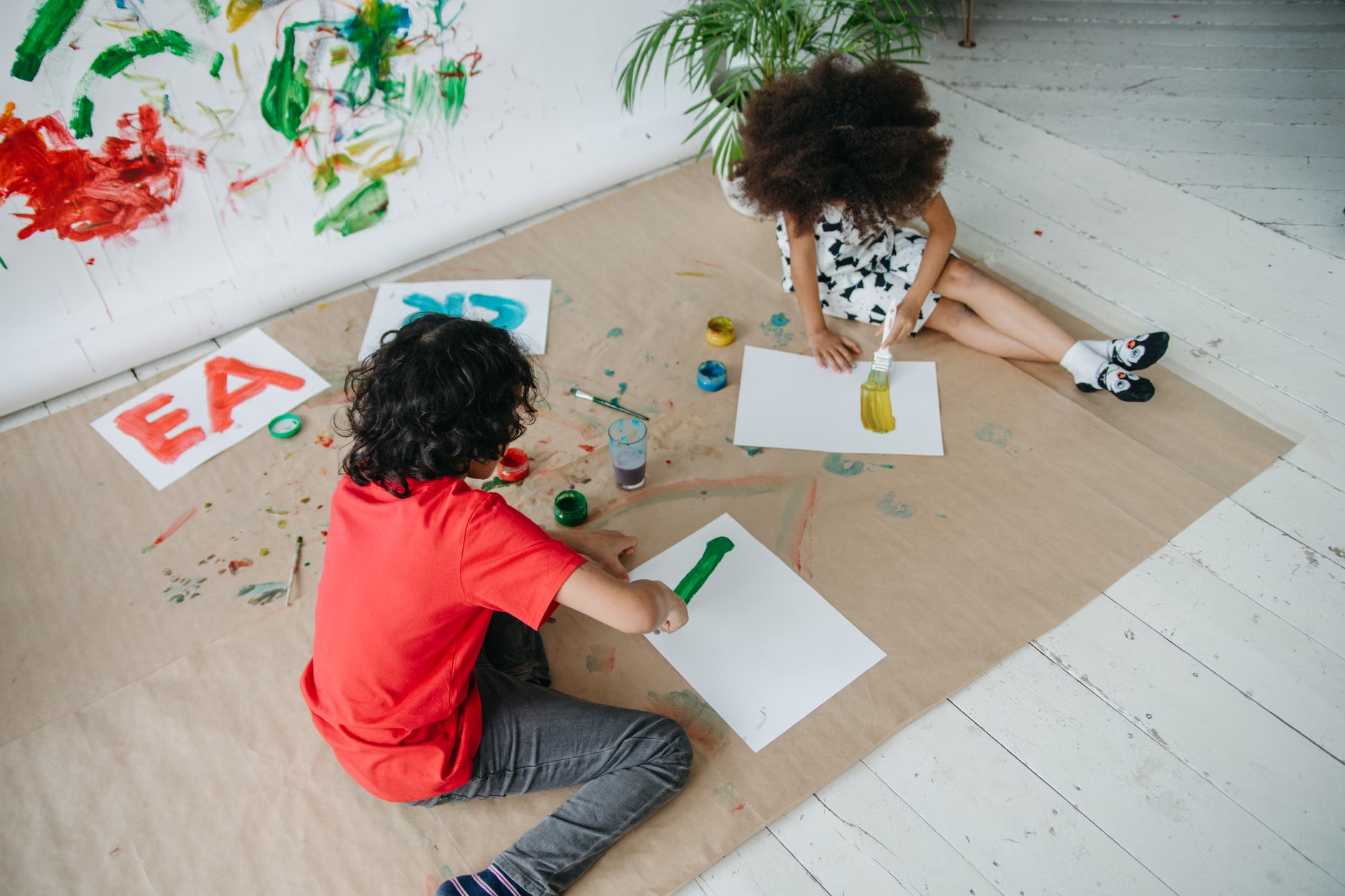
Engineering challenges are excellent because they have clear, objective goals. Whether it is building a massive cardboard castle, a complex marble run, or a bridge out of spaghetti and marshmallows, these projects require planning. When you set the stage, emphasize that the structure must be large enough that it requires two pairs of hands to assemble.
For example, if you are building a cardboard fort, one child can be the “architect” (planning the layout and taping) while the other is the “engineer” (structuring the supports). The key here is to rotate these roles. If your children are prone to fighting, let them decide who does what, but provide a 5-minute “negotiation period” where they must agree on the roles before they touch any materials.
If they reach an impasse, do not solve it for them. Simply state: “I see you both have different ideas. I will leave the materials here, and you can let me know when you have agreed on a plan.” This forces them to realize that their conflict is actually delaying the fun, providing a natural, non-punitive consequence for their inability to cooperate.
2. Culinary Collaboration: The “Two-Step” Recipe
Cooking is a high-stakes environment for children, which makes it a perfect laboratory for cooperation. To make this work, choose a recipe that has distinct, sequential phases that require coordination. Baking is often better than cooking on a stove because it is slower and less chaotic.
A “two-step” recipe might involve one child being responsible for the “wet” ingredients and the other for the “dry” ingredients. They then have to come together to combine them. If one child rushes the process, the result suffers. This teaches them that their individual actions directly impact the collective outcome. It also introduces the concept of quality control—if the batter is too thin or too thick, they have to work together to troubleshoot the solution.
Warning: Avoid recipes that are too complex. The goal is not a gourmet meal; it is the act of working through the recipe without blaming one another for a spilled cup of flour. If a spill happens, frame it as a “team maintenance” event rather than a “someone messed up” event.
3. The Backyard Ecosystem Project
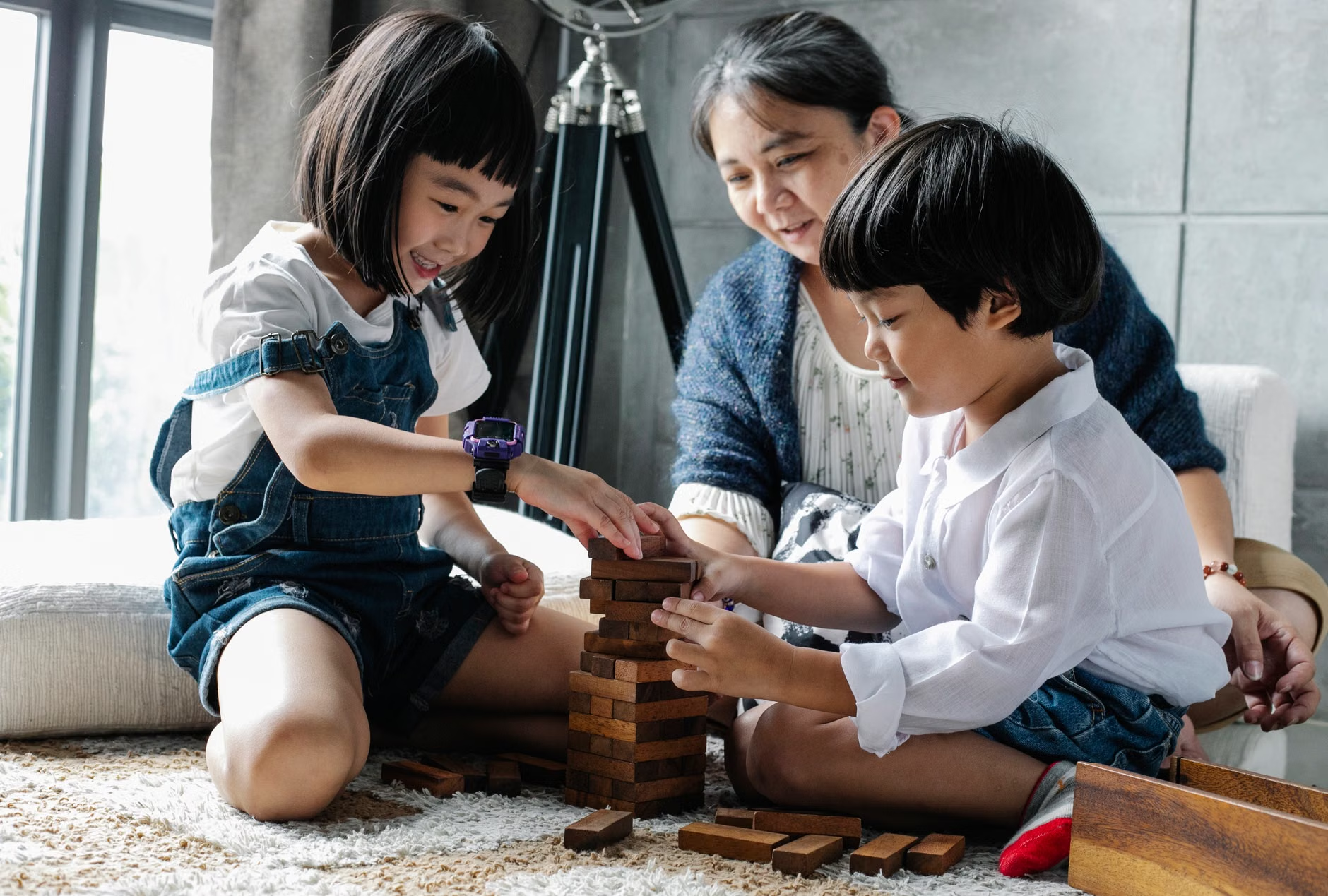
Gardening, or even just maintaining a window-sill herb garden, is a long-term project that requires consistent, shared responsibility. Unlike a craft project that ends in an hour, a garden requires daily attention. This is a fantastic way to build a shared sense of “ownership” over something that exists outside of themselves.
Assign specific zones or tasks. Perhaps one child is the “Hydration Specialist” (watering) and the other is the “Growth Monitor” (tracking height and removing weeds). Because the plants are living, they require a level of care that encourages empathy. When they see a plant thriving because they both did their part, it reinforces the value of their partnership.
If one child forgets their duty, the other will naturally notice. This is a teachable moment. Instead of letting them fight, encourage the child who noticed the problem to use “I” statements: “I am worried our basil plant is dry. Can you help me water it?” This shifts the focus from blame to problem-solving.
4. Collaborative Storytelling and Illustration
For children who are more inclined toward creative play, a collaborative storybook is a low-cost, high-engagement project. Take a stack of printer paper and fold it into a booklet. The rule is simple: one person writes one sentence, and the other person illustrates it. Then they switch.
This structure ensures that neither child can dominate the narrative or the art. It forces them to listen to the other person’s ideas and build upon them. If the story takes a weird turn, they have to negotiate how to bring it back to a coherent plot. This is an excellent exercise in active listening—a skill that is often missing in sibling arguments.
By the time they finish, they have a tangible product that represents their joint effort. You can then display this “book” in a prominent place, signaling to them that their cooperation has produced something of value that the family appreciates.
5. The “Home Improvement” Task
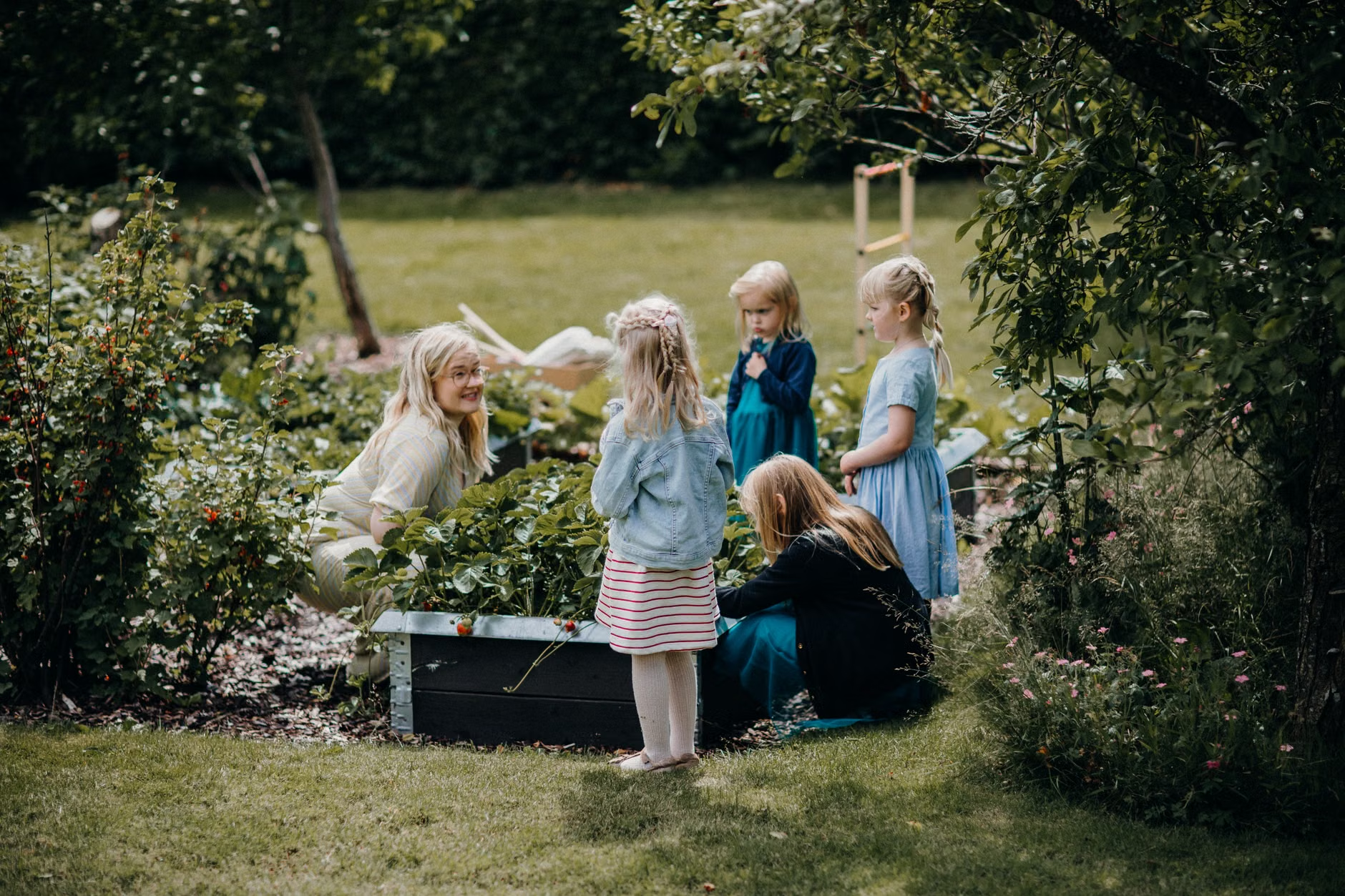
We often think of chores as individual duties, but household maintenance can be turned into a cooperative mission. Instead of saying, “Go clean your room,” try, “The playroom needs a total reset. You two are the ‘Playroom Team.’ I need you to organize the toy bins and clear the floor. I will check back in 20 minutes to see how you have organized it.”
Giving them a clear, time-bound mission with a shared reward (like extra screen time or a special snack) incentivizes them to work together. The key here is the “team” framing. By treating them as a single unit, you encourage them to divide the labor in a way that makes sense to them. You might be surprised to find that they naturally gravitate toward each other’s strengths—one might enjoy sorting the Legos while the other prefers stacking the books.
If they complain that it is “unfair,” ask them to propose a system that feels fair to both of them. This puts the responsibility of justice back onto their shoulders, where it belongs. It stops you from being the arbiter of “fairness” and forces them to negotiate their own terms.
In our digital age, screens are often a point of contention. However, if used correctly, they can be a medium for cooperation. Games that allow for building, such as Minecraft or similar creative-mode sandbox games, can be powerful tools for collaboration.
Set up a private server or a local game where they are building a city or a house together. The constraint is that they must agree on the design before they build it. If they start destroying each other’s work, the “server” (you) gets shut down for the day. This provides a very clear, logical consequence: cooperation equals access; destruction equals loss of access.
The beauty of this is that it allows them to collaborate in a space they already enjoy. It bridges the gap between their interests and your goal of fostering a better relationship. It also provides a digital record of their work, which you can ask them to “present” to you, further validating their teamwork.
7. The “Time Capsule” Project
This is a project that focuses on shared history. Have your children work together to create a time capsule for their “future selves.” They need to agree on what items represent their current life and their family. This requires deep conversation and negotiation.
They will have to discuss why an item is important and whether it deserves a spot in the capsule. This is a form of value-based negotiation. It encourages them to see their sibling not just as a competitor for toys, but as a partner with a shared history and shared memories. It shifts the perspective from the present moment (who has the toy) to a long-term view of their relationship.
Even with the best planning, things will go wrong. One child will be bossy, the other will be passive. One will lose interest, and the other will feel betrayed. Here is how to handle the most common pitfalls:
- The “Bossy” Child: If one child is trying to dictate everything, step in and ask, “How can we make sure everyone’s ideas are included?” Do not tell them to stop being bossy; ask them how to facilitate the other person’s contribution.
- The “Passive” Child: If one child is checking out, give them a specific, high-status role. Make them the “Quality Control Officer” or the “Lead Designer.” Give them the authority to approve or deny the work, which forces them to engage with the process.
- The Age Gap Struggle: If the age gap is significant, focus on “asymmetrical cooperation.” The older child can handle the complex mechanical parts, while the younger child handles the aesthetics or the “finishing touches.” Both are essential for the project to be “done.”
Remember, the goal is not to eliminate all friction. Conflict is a natural part of human interaction. The goal is to provide them with the tools to resolve that conflict in a way that preserves the relationship. When they learn that they can get further by working together than by fighting, the incentive for rivalry significantly decreases.
Implications for Long-Term Relationship Building
The habits formed during these collaborative projects do not disappear when the project ends. You are essentially training their brains to look for common ground. Over time, this becomes a reflexive behavior. When they face a disagreement in the future—over a shared space, a family decision, or even as adults—the neural pathways for “cooperation” will be stronger than those for “conflict.”
Be patient with the process. You will not see a transformation overnight. There will still be days where they bicker. But by consistently providing these structured opportunities, you are changing the underlying dynamic of your household from a zero-sum game to a collaborative team.
If you find yourself getting frustrated, take a step back. The project is not about the result—it is about the interaction. If the tower falls, or the cake sinks, or the story is nonsensical, that is perfectly fine. The success is in the fact that they worked on it together. Praise the effort, highlight the moments of good communication you witnessed, and let the small failures be just another part of the shared experience.
Official Resources and Further Reading
For those interested in the psychological underpinnings of sibling dynamics, the following resources offer evidence-based insights:
- American Psychological Association (APA) – Sibling Relationships: Research on how sibling bonds influence social development and conflict resolution skills.
- ZERO TO THREE: Expert-backed resources on navigating early childhood social development and sibling interactions.
- Center on the Developing Child at Harvard University: Insights into how supportive environments foster executive function and cooperation.
Frequently Asked Questions
Q: What if my children are at completely different developmental stages (e.g., a 4-year-old and a 10-year-old)?
A: Focus on roles that match their abilities. The 10-year-old can handle the “strategy” or “construction,” while the 4-year-old handles the “decoration” or “sorting.” The key is to emphasize that the project cannot be finished without both roles being performed.
Q: Should I intervene when they start arguing during a project?
A: Try to wait 60 seconds before stepping in. Often, children will work through the tension themselves if they know the project depends on it. If you must intervene, act as a moderator—ask questions like, “How can you two solve this?” rather than dictating the solution yourself.
Q: How do I handle it when one child refuses to participate?
A: Do not force them. If one child wants out, the project effectively ends for that session. Let them know the project will be waiting for them when they are ready to participate as a team. This teaches them that their participation is a choice that affects the group outcome.
Parenting is a marathon, not a sprint. By focusing on these collaborative projects, you are investing in a future where your children view each other as teammates rather than adversaries. Stay consistent, keep the stakes low, and focus on the connection rather than the perfection.