Gamified fitness apps are currently the most effective way for time-poor couples in their 30s and 40s to bridge the gap between busy parenting schedules and personal health goals by transforming mundane exercise into a shared, rewarding experience.
- Shared Accountability: Gamification leverages the social bond of a relationship to maintain consistency when individual motivation wanes.
- Strategic Scheduling: These apps provide bite-sized, objective-oriented challenges that fit into the fragmented “pockets” of time typical of parents.
- Psychological Rewards: By utilizing streaks, badges, and leaderboards, these platforms hack the brain’s reward system to make movement feel like a game rather than a chore.
If you are in your 30s or 40s, you know the scenario all too well: the day starts with the frantic morning school run, continues through a blur of emails and meetings, and ends with the physical and mental exhaustion of dinner prep, homework supervision, and bedtime routines. By the time the house is quiet, the idea of going for a run or hitting the gym feels like an insurmountable task. You aren’t lazy; you are simply managing a cognitive load that leaves little room for “willpower-based” fitness.
This is where the rise of ‘gamified’ fitness apps comes in. These aren’t just glorified step counters. They are platforms designed to integrate behavioral psychology—specifically the mechanics of video games—into your daily movement. For couples, this offers a unique advantage: you are no longer exercising in isolation. You are playing a game with your partner, and that changes the stakes entirely.
The Psychology of Why Gamification Works for Busy Parents
Why do we find it easier to finish a level in a game than to finish a 30-minute workout? The answer lies in dopamine. Games are built on a feedback loop: you perform an action, you receive an immediate reward (a point, a level-up, a visual badge), and you are prompted to perform the next action to maintain that momentum. Traditional exercise, by contrast, is often “delayed gratification.” You work out today, but you don’t see the results for months.
For parents in their 30s and 40s, the “delayed gratification” model is a recipe for failure. You simply don’t have the luxury of waiting months to feel like you’ve achieved something. Gamified apps solve this by providing “micro-wins.”
When you use an app that tracks your movement alongside your partner’s, you are tapping into a concept called “social facilitation.” Essentially, the presence of a partner—even a digital one—increases your performance. It’s not just about competition; it’s about the shared narrative. When you and your partner are working toward a collective goal, such as “walking to the moon” (a common virtual challenge found in many apps), your individual steps become part of a larger, more meaningful story.
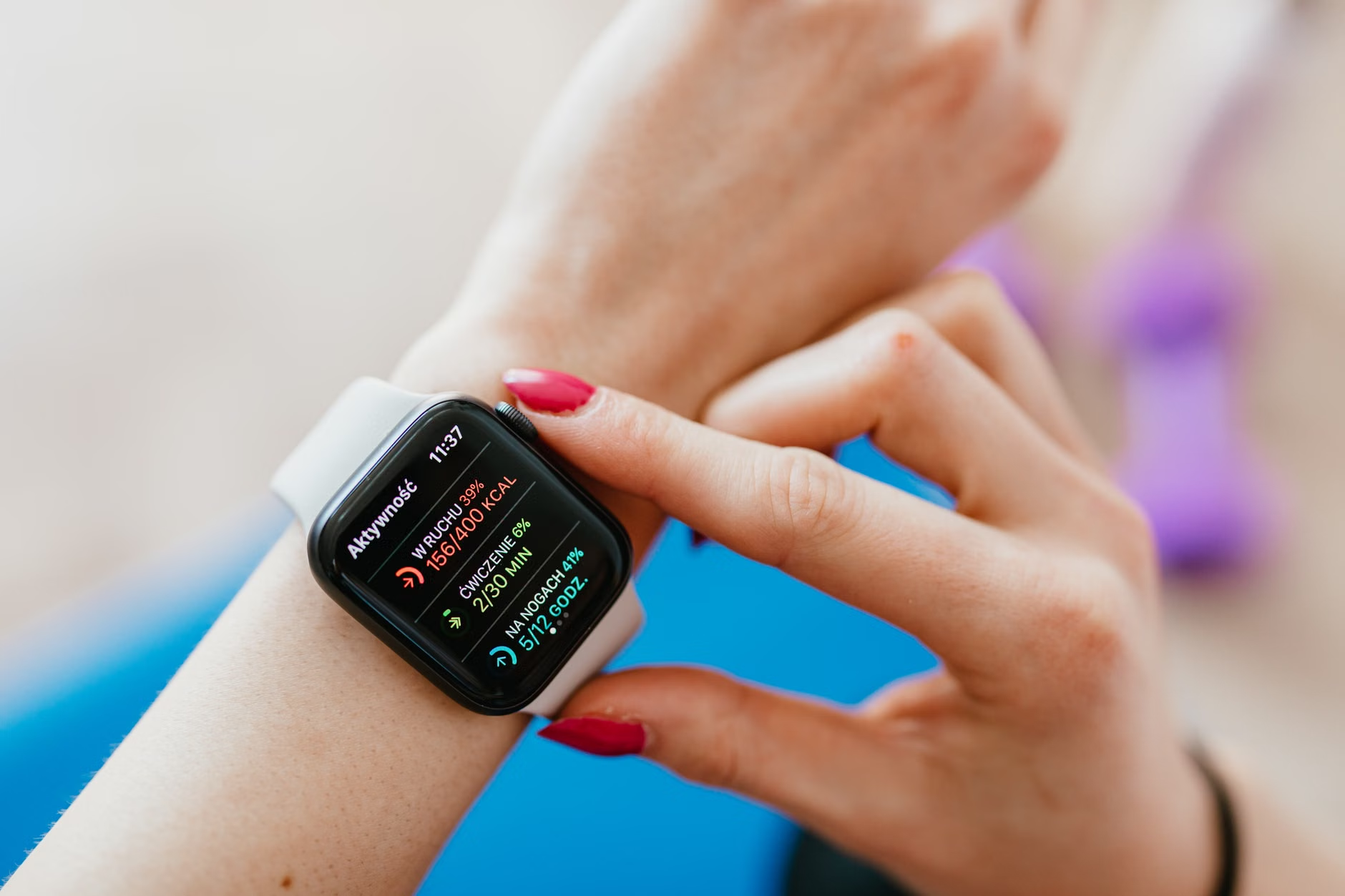
Selecting the Right Platform for Your Relationship
Not all fitness apps are created equal. Some are designed for elite athletes, while others focus on community and casual movement. When choosing an app as a couple, you need to look for specific features that cater to your lifestyle. Here is a breakdown of what to look for:
| Feature | Why It Matters for Couples |
|---|---|
| Shared Leaderboards | Provides a clear, non-confrontational way to track progress. |
| Cooperative Challenges | Focuses on team success rather than individual victory. |
| Customizable Goals | Allows for different fitness levels to contribute equally. |
| In-App Messaging | Keeps communication positive and encouraging throughout the day. |
When you are evaluating these tools, avoid apps that demand high-intensity, long-duration workouts every day. For a parent, those are rarely sustainable. Instead, prioritize apps that reward “consistency” and “movement volume.” If you can get your 10,000 steps while chasing a toddler or walking to the train station, that should be recognized by the app just as much as a formal gym session.
The Trap of Competitive Burnout
There is a fine line between a “fun challenge” and a “source of friction.” If you and your partner are highly competitive, gamification can quickly turn into a source of marital stress. If one person is naturally more active or has more free time, the other person may feel defeated by the leaderboard, leading to resentment rather than motivation.
To avoid this, set “handicap” rules. If one partner has a desk job and the other is on their feet all day, agree on a percentage-based goal rather than raw numbers. Or, focus on “streaks” rather than total volume. A streak rewards consistency—the simple act of showing up—which is the most important habit for long-term health.
Remember, the goal is to improve your health together, not to prove who is “better” at fitness. If the app starts to feel like an obligation that you have to “check off” to keep your partner happy, it has lost its purpose. Periodically check in with each other: “Is this still fun, or is it starting to feel like a chore?”

Integrating Fitness into the “Parenting Gap”
The “parenting gap” is that elusive window of time between dropping the kids at school and starting your workday, or that 20-minute window while they are occupied with a screen or activity. Gamified apps are excellent at filling these gaps because they don’t require a “get ready, go to the gym, shower, come back” workflow.
Consider the “Sync and Go” method. Both you and your partner install an app that allows for real-time tracking. If you have a quick 15-minute walk during your lunch break, log it. Your partner sees the notification and feels a small surge of motivation to get their own 15 minutes in. It’s a digital high-five that reinforces your shared commitment to health.
This approach also helps parents model behavior for their children. When kids see their parents using technology to celebrate movement, they perceive exercise as a natural, positive part of life rather than a punishment for eating too much or a chore that keeps parents away from home.
Technological Considerations and Data Privacy
Before you dive into any app, take a moment to consider the data. These apps track your location, your heart rate, and your sleep patterns. While this is necessary for the gamification to work, it is important to be aware of what you are sharing.
Look for apps that prioritize privacy by design. A good fitness app should allow you to:
- Control who sees your location data (only your partner).
- Export your data if you decide to switch platforms.
- Opt-out of data sharing with third-party advertisers.
Do not use apps that require you to link your social media profiles just to track a step count. Your health data is personal, and while sharing it with your partner can strengthen your bond, you don’t need the rest of the world to see your daily activity map.

Practical Steps to Launch Your Couple’s Fitness Journey
If you want to start today, don’t overcomplicate it. You don’t need expensive equipment or a subscription to a premium service. Start with these three steps:
- Choose a Platform Together: Spend 15 minutes on a weekend browsing the app store. Look for apps that have a “duo” or “group” feature. Download two or three and try them out for a week.
- Define Your “Why”: Are you doing this to have more energy for your kids? Are you doing this to lower your stress levels? Are you doing this to spend more time together? Knowing your “why” will keep you going when the “game” elements feel repetitive.
- Schedule a Weekly “Sync”: Once a week, look at your progress. Don’t just look at the numbers. Talk about how you felt during the week. Did the app make it easier to get out of the house? Did it help you feel more connected to your partner?
The beauty of gamification is that it makes the invisible visible. It turns the quiet, steady work of staying healthy into a tangible, shared achievement. For parents in their 30s and 40s, this isn’t just about weight loss or muscle tone; it’s about reclaiming a sense of agency over your own life. It’s about proving that even in the middle of a chaotic, demanding life, you can still find time to play, compete, and grow with the person you love most.
Cautions are necessary, of course. Always listen to your body before listening to an app. If a “streak” requires you to work out when you are injured or severely sleep-deprived, break the streak. Your health is the goal, not the app’s badge. Use the tool as a servant, not a master.
As you move forward, keep the spirit light. The most successful couples aren’t the ones who win every challenge; they are the ones who show up for each other, even on the days when the “game” is the last thing on their minds. Keep your goals realistic, your communication open, and your pace steady. You’re in this for the long run.
Frequently Asked Questions
1. Do we need expensive wearable devices to use these apps?
Not necessarily. Most modern smartphones have built-in pedometers and accelerometers that are surprisingly accurate. While wearables like smartwatches offer more precise heart-rate tracking, you can get started with just your phone. Most gamified apps are designed to sync with the health data already collected by your iPhone or Android device.
2. What if one of us is much fitter than the other?
This is a common concern. The best approach is to focus on personal goals within the app or use percentage-based targets. Many apps allow you to create custom challenges where the goal is a percentage improvement over your own baseline, rather than a total volume that favors the more athletic partner. This levels the playing field and keeps the focus on individual progress.
3. Will this add more screen time to our already busy lives?
It’s a valid concern. The goal of these apps should be to get you off the screen and into the world. The best apps are designed to be “check-in” tools—you open them to log your activity or check the leaderboard, and then you put the phone away. If you find yourself spending more time looking at the app than moving, it’s time to simplify your usage or set strict limits on your screen time.
For further reading on the science of gamification in health, you can explore resources from the World Health Organization regarding physical activity guidelines or research papers on digital health interventions available through the National Library of Medicine.