By 2026, the digital wallet on your smartphone will evolve from a simple place to store credit cards into a universal tool that acts as your primary ID, travel document holder, and secure gateway for global services, thanks to the massive push for interoperability.
- Universal Access: Interoperability means your digital credentials will soon work across different platforms, countries, and services without constant re-verification.
- Beyond Payments: The 2026 shift focuses on integrating government-issued IDs, health records, and travel credentials into one secure, portable environment.
- Security Priorities: As wallets become more powerful, decentralized identity standards and biometric encryption will be the primary defenses against data breaches.
If you are in your 30s or 40s, you probably remember the shift from physical leather wallets to carrying a few cards, and then to the current era where your phone handles most of your payments. But let’s be honest: it’s still a fragmented mess. You have a store card here, a boarding pass in your email, a government ID in your physical wallet, and a separate app for your insurance. It is a constant game of digital scavenger hunt.
The goal of the 2026 interoperability standard is to end this fragmentation. It isn’t just about making it easier to pay for your morning coffee; it is about creating a “digital handshake” between different systems so that your phone knows who you are, what you are entitled to, and where you are allowed to go, regardless of which app or service you are using.
Why 2026 Is the Turning Point for Digital Wallets
For years, tech companies and government bodies have operated in silos. Your bank’s app didn’t “talk” to the government’s identity portal, and your airline’s app didn’t recognize your digital health certificate. This lack of communication is what engineers call a lack of interoperability. It is like trying to use a power plug from one country in a socket from another without an adapter—it simply doesn’t fit.
The year 2026 is being marked as a milestone because of a convergence of international regulatory frameworks, such as the EUDI (European Digital Identity) Wallet initiative and similar efforts in North America and Asia. These frameworks mandate that digital wallets must be able to communicate using open standards. This means that if you have a digital ID issued in one jurisdiction, it will eventually be readable and verifiable by a secure reader in another, provided they share the same underlying technical protocols.
Think of it like the internet itself. Before we had standardized protocols for the web, computers couldn’t share information easily. Now, any browser can load any website. We are finally bringing that same level of “universal language” to your personal data.
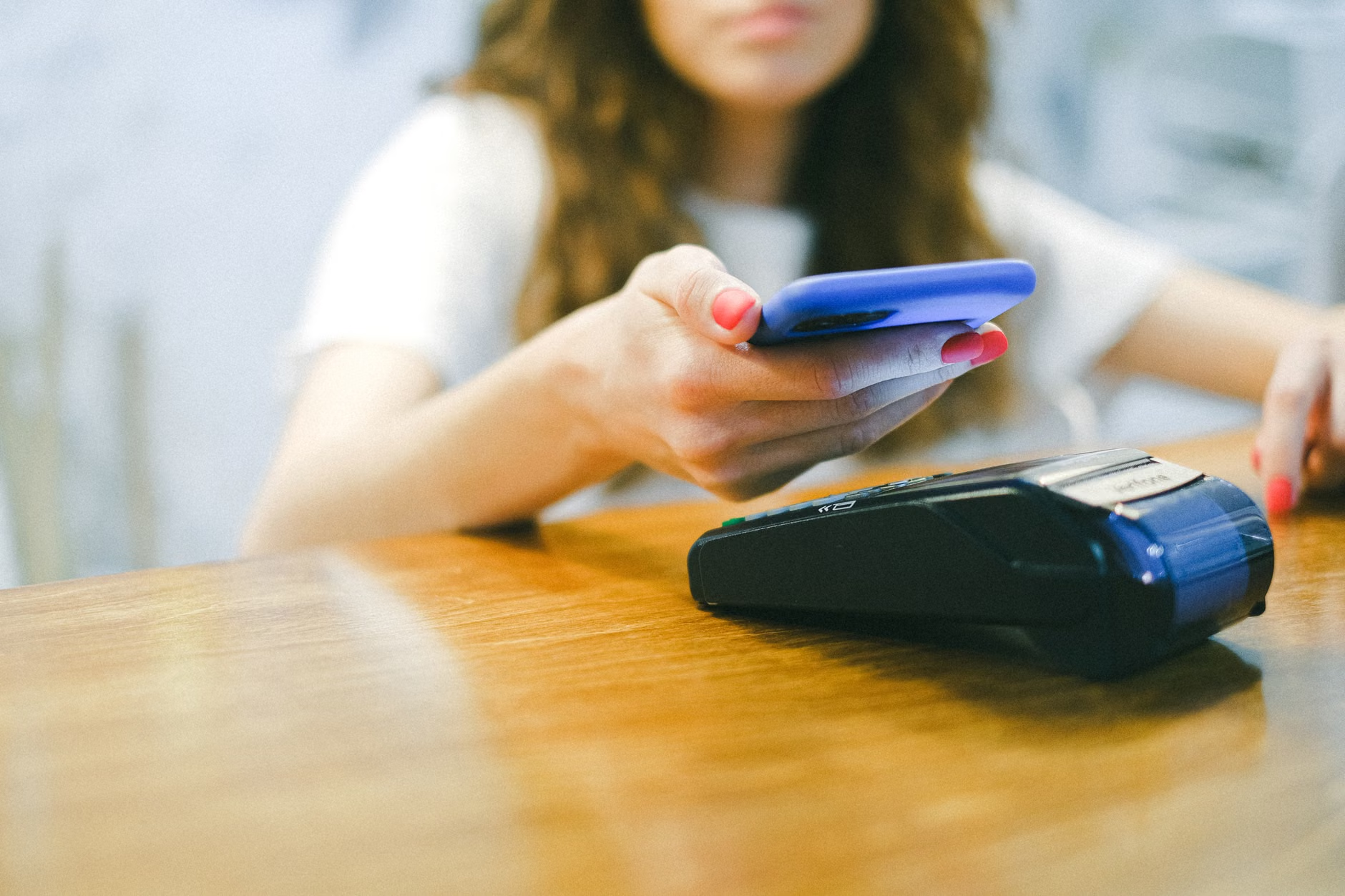
The Anatomy of a Truly Interoperable Wallet
To understand what this means for your daily life, we have to look at what actually goes inside this “new” wallet. Currently, your phone holds a tokenized version of your credit card. By 2026, the wallet will act as a container for “Verifiable Credentials” (VCs). These are digital versions of your paper documents that are cryptographically signed, meaning they cannot be forged.
1. Digital Identity and Government Services
Imagine showing up to a government office or an age-restricted venue. Instead of handing over a plastic driver’s license, you will tap your phone. The system will verify that you are who you say you are without revealing your entire life history. You could prove you are over 18 without disclosing your exact date of birth or your home address. This is called “selective disclosure,” and it is a massive leap forward for personal privacy.
2. Travel and Transit Integration
For those of us juggling family travel, this is a game-changer. Imagine a single digital wallet that contains your boarding pass, your passport data, and your hotel reservation. When you walk through the airport, the “interoperability” kicks in—the airline, the customs office, and the hotel shuttle can all verify your credentials through a secure, low-energy Bluetooth or NFC handshake. No more fumbling for passports at the bottom of a carry-on while your toddler is crying in the stroller.
3. Financial Fluidity
Interoperability also means that your digital wallet will be able to handle multiple currencies and asset types more seamlessly. If you are traveling abroad, the wallet will negotiate the exchange rate and the transaction type in real-time, ensuring that the merchant gets their local currency while you pay from your home account, all within a single interface that doesn’t feel like a complex financial instrument.
What This Means for Security and Privacy
When I talk about “interoperability” to friends, the first thing they ask is, “Is my data going to be everywhere?” It’s a valid concern. If your wallet is connected to everything, doesn’t that make it a single point of failure? The answer lies in a shift toward Self-Sovereign Identity (SSI).
In the current system, you often have to create an account with a third party just to prove who you are. You give your data to the service provider, and they store it on their servers. If they get hacked, you get hacked. With the 2026 model, the goal is to keep the data on your device. When you interact with a service, you are essentially sending a “digital key” that proves the data is valid without giving the service provider a copy of your underlying data.
| Feature | Traditional Wallet | 2026 Interoperable Wallet |
|---|---|---|
| Data Storage | Server-based (Centralized) | Device-based (Decentralized) |
| Identity Proof | Physical card/Paper copy | Cryptographic verification |
| Privacy | Full disclosure required | Selective disclosure |
| Scope | Payments only | Payments, ID, Health, Travel |

Practical Challenges: The “Growing Pains” of 2026
While the vision is bright, we have to be realistic about the implementation. Technology is rarely a “flip the switch” event. There will be significant hurdles that we, as regular users, will likely encounter between now and 2026.
Fragmentation of Platforms
Even with interoperability, there will be competing ecosystems. Apple, Google, and various national government initiatives are all building their own “wallets.” The challenge is ensuring that a wallet built by the government of Country A can talk to a commercial wallet built by a multinational tech company. If these systems don’t fully support the same open standards, we might end up with “walled gardens”—where your digital ID works great in one place but is invisible in another.
The “Analog” Gap
We are going to live in a hybrid world for a long time. You might have a perfectly interoperable digital wallet, but the rental car agency in a remote town might still require a physical piece of paper. The mental load of knowing when to use the digital version versus the physical version will be a source of frustration for a few years. My advice? Keep your physical documents in a safe place, even if you rarely use them, until the digital ecosystem is truly ubiquitous.
Device Dependency
What happens when your phone dies? Or when you lose it? The dependency on a single device for your identity and financial life is a major risk. We will need to see robust recovery mechanisms—like biometric-backed cloud backups that are themselves encrypted with keys only you hold. If you aren’t already diligent about securing your device with biometrics and a strong passcode, now is the time to start building those habits.
How to Prepare for the Future
You don’t need to be a tech expert to get ready for this shift. In fact, the best way to prepare is to focus on your “digital hygiene.”
- Audit Your Current Wallets: Look at the apps you use for payments, boarding passes, and loyalty programs. Start consolidating them into the primary wallet provided by your phone’s operating system (Apple Wallet or Google Wallet). These are the platforms most likely to lead the interoperability charge.
- Strengthen Your Biometrics: Since your phone will become your master key, ensure your FaceID or fingerprint authentication is set up correctly. Avoid using weak numerical passcodes that could be guessed by someone looking over your shoulder.
- Practice Selective Sharing: Get used to the idea of sharing only what is necessary. If an app asks for your full birth date when it only needs to know if you are over 18, look for settings that allow you to limit that data. The 2026 standards will emphasize this “data minimization.”
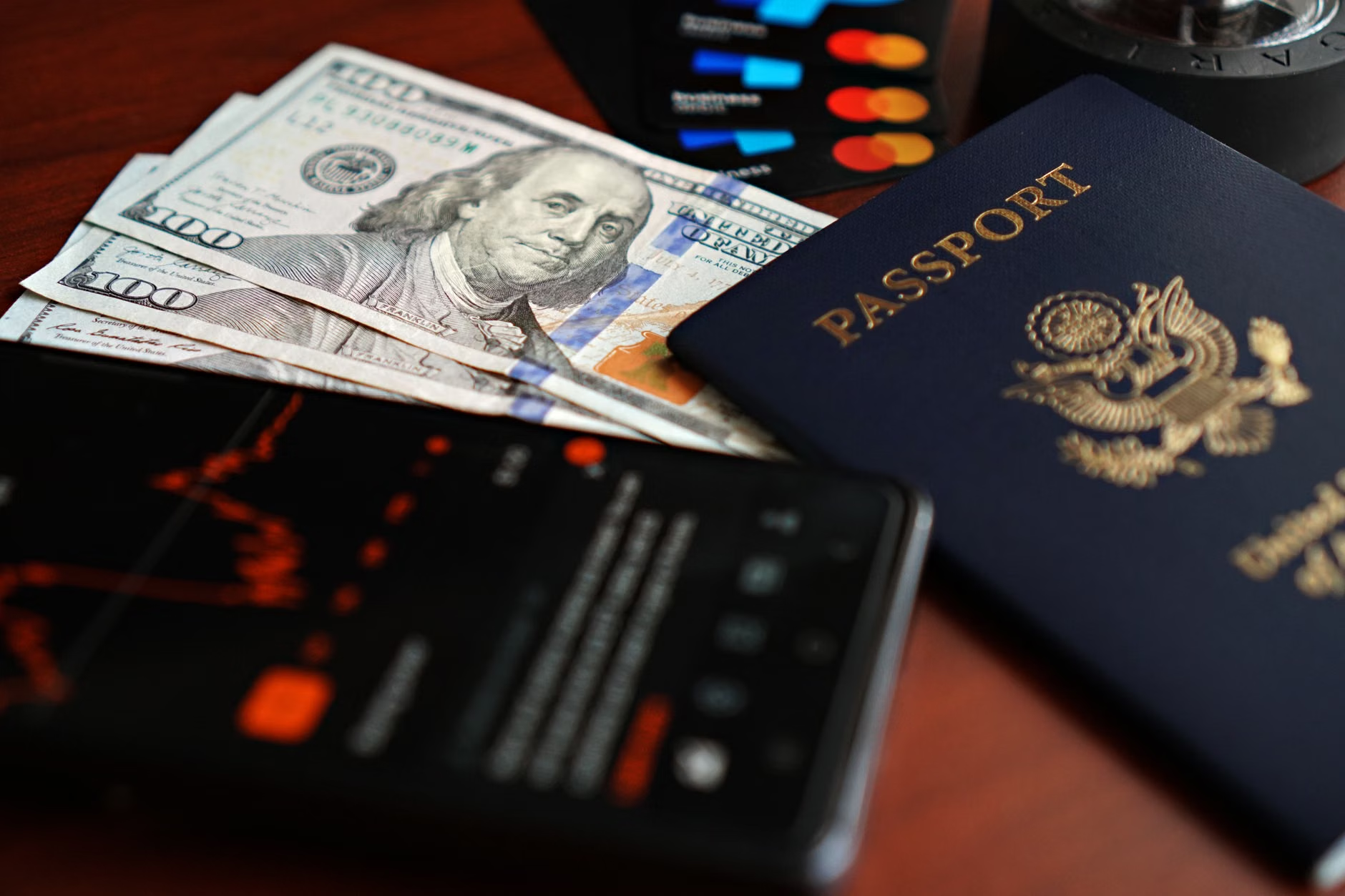
The Human Element: Why This Matters for Families
Think about the last time you traveled with kids. You have your phone, your partner’s phone, the kids’ tablets, and a physical folder of documents. You are constantly checking to make sure you have the birth certificates for the kids, the insurance cards, and the booking confirmations. The promise of an interoperable wallet is not just about “tech for tech’s sake”; it is about reclaiming that mental energy.
When you can delegate the “proof of identity” and “proof of payment” to a secure, unified system, you spend less time being an administrator for your own life and more time actually being present. It is the difference between standing at a kiosk for ten minutes trying to scan a QR code that won’t load, and simply tapping your phone and moving on.
Of course, this requires a degree of trust in the systems. We are essentially betting that the security protocols will hold up. The developers working on these 2026 standards are well aware of the stakes. They are using Zero-Knowledge Proofs—a fancy way of saying “I can prove to you that I am over 18 without telling you my birthday, and without revealing any other information about me.” It is a fascinating bit of math that makes this all possible.
Addressing Common Concerns: FAQs
Q: Will I be forced to use a digital wallet for everything by 2026?
A: No. While the move toward digital is accelerating, physical documents will remain a backup and a requirement in many places for years to come. Interoperability is about adding convenience, not removing your ability to use traditional methods.
Q: Is my privacy at risk if my government issues a digital ID?
A: This is the biggest debate in the field. The goal of the 2026 standards is to keep the data on your phone under your control. The government issues the “credential,” but they don’t necessarily track when or where you use it. However, it is essential to stay informed about the specific policies of your country as these wallets roll out.
Q: What happens if my phone is lost or stolen?
A: Because these wallets are tied to your biometric identity and encrypted, a thief cannot simply open your phone and access your credentials. Most systems will have a way to remotely revoke the “keys” stored on your device from another trusted device or a secure web portal, much like you can currently lock a lost smartphone.
Looking Ahead
The 2026 shift toward digital wallet interoperability represents a maturation of our digital lives. We are moving past the “Wild West” phase where every app was an island, and entering a period where our digital tools are finally starting to work together for our benefit. It won’t be perfect on day one, and there will certainly be bugs, confusion, and adaptation periods.
However, the direction is clear. As we juggle the demands of our 30s and 40s—balancing careers, parenting, and travel—these tools will become the infrastructure that keeps our lives moving efficiently. Keep an eye on the updates for your phone’s native wallet app, stay skeptical but curious, and remember that the ultimate goal is to spend less time managing your data and more time living your life.
For more detailed information on the evolving standards for digital identity and wallet interoperability, you can visit the official resources from organizations like the World Wide Web Consortium (W3C) on Verifiable Credentials and the European Commission’s EUDI Wallet initiative. These sites offer a deep dive into the technical frameworks that will power your digital future.