Is your child’s smartphone use one of your biggest concerns lately? Whether at a restaurant or during a long commute, we’ve all handed over a phone to calm our little ones, only to feel a heavy heart wondering if it’s doing more harm than good. With the term “Popcorn Brain” trending in parenting circles, those worries are only growing. Today, I want to ease that burden and share some wonderful sensory play stories that protect your child’s brain development while keeping both you and your child happy.

What exactly is “Popcorn Brain”?
“Popcorn Brain” refers to a phenomenon where the brain becomes accustomed to the intense, immediate stimulation found in digital media—much like popcorn popping. The vibrant visuals and rapid transitions of smartphones are incredibly powerful stimuli for young children.
When kids get used to this high-intensity input, they find it difficult to focus on the slower, calmer aspects of daily life, such as reading or learning. Since a child’s brain grows explosively during early childhood, this can significantly impact the development of the frontal lobe. However, rather than just saying “no,” the ultimate solution is gifting them the “world of senses,” which is far more engaging than any screen.
5 Simple At-Home Sensory Plays to Wake Up Your Child’s Brain
I’ve researched and shared these ideas with many parents, and they truly work like magic. Best of all, you don’t need fancy supplies!
1. Soft Flour Cloud Play
Flour is safe, easy to find, and incredibly versatile. Just spreading flour on a plastic sheet on the floor will make your child’s eyes go wide. Let them poke the dry powder first, then gradually add water to create sticky dough. The texture of flour slipping through fingers provides a 3D stimulus that a smooth smartphone screen simply cannot match.

2. Treasure Hunt in Ice
Freeze small figurines or beads in an ice tray. Give your child a dropper with warm water or a spoon and let them “rescue” the treasures by melting the ice. As they feel the cold transition to wetness and watch solids turn to liquids, their concentration reaches an all-time high.

3. Stress-Busting Paper Cup Towers
I highly recommend this for high-energy kids! Stacking dozens of paper cups helps develop balance and coordination. The ultimate joy of knocking it all down with a big “Whoosh!” is a fantastic stress reliever. This replaces the “strong stimulus” sought by a Popcorn Brain with a healthy, physical, and audible one.
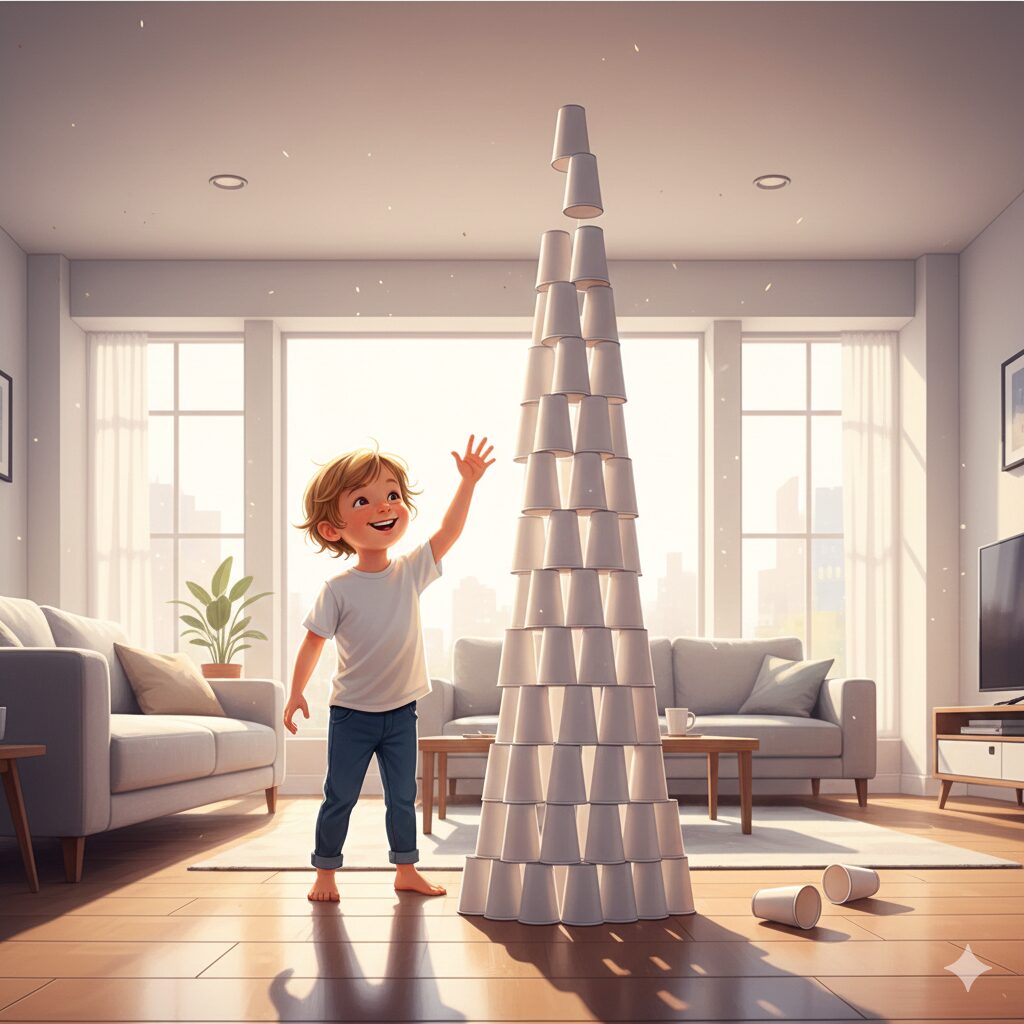
4. The Mystery Box Challenge
Cut a hole in the side of a shoe box and place various household items inside—a toothbrush, an apple, a sock, etc. Have your child put their hand in and guess what the item is purely by touch. By blocking visual information, the brain works extra hard to process tactile data, creating great mental exercise.
5. The Kitchen Orchestra
Bring out pots, plastic containers, and spatulas. Let your child drum away to their favorite nursery rhymes. Distinguishing between the “clang” of metal and the “thud” of plastic helps develop auditory discrimination. If you join in by clashing pot lids like cymbals, the fun doubles, and your child learns that playing with you is way better than any YouTube video.

Your Smile is More Important Than a Perfect Result
Before you start, remember to let go of “perfectionism.” If you’re constantly worried about the floor getting messy, your face will stiffen, and your child will sense that tension. Just tell yourself, “Let’s have a blast today and clean up together later!” That relaxed attitude is the most important part of play.
These activities aren’t grand educational projects. They are simply moments where your child can touch, smell, and hear the world at a slower pace. Why not start tonight with just a few paper cups or a bag of flour?
Your child might say they are bored at first. But remember, boredom is the starting point of creativity—it’s when they begin to invent their own fun. Let’s be patient and wait a little. I’m cheering for all the parents out there doing their best today!
Reference Sites
- National Center for the Rights of the Child: https://www.ncrc.or.kr
- Korea Institute of Child Care and Education (KICCE): https://www.kicce.re.kr
Note: Popcorn Brain – A term coined by Professor David Levy of the University of Washington in 2011. It describes a brain that has become so accustomed to the intense stimulation of digital devices that it becomes desensitized to the slower pace of real life.