The global shift toward “Right-to-Disconnect” legislation in 2026 means that for millions of employees, the expectation to respond to emails, messages, or calls after working hours is no longer just a personal boundary—it is becoming a protected legal right.
- Legal Protection: Legislation now mandates that employees are not penalized for ignoring work communications outside of designated contract hours.
- Cultural Shift: Companies are moving away from “always-on” availability toward results-oriented performance metrics.
- Personal Agency: You have the legal backing to reclaim your evenings, but success requires clear communication with your team.
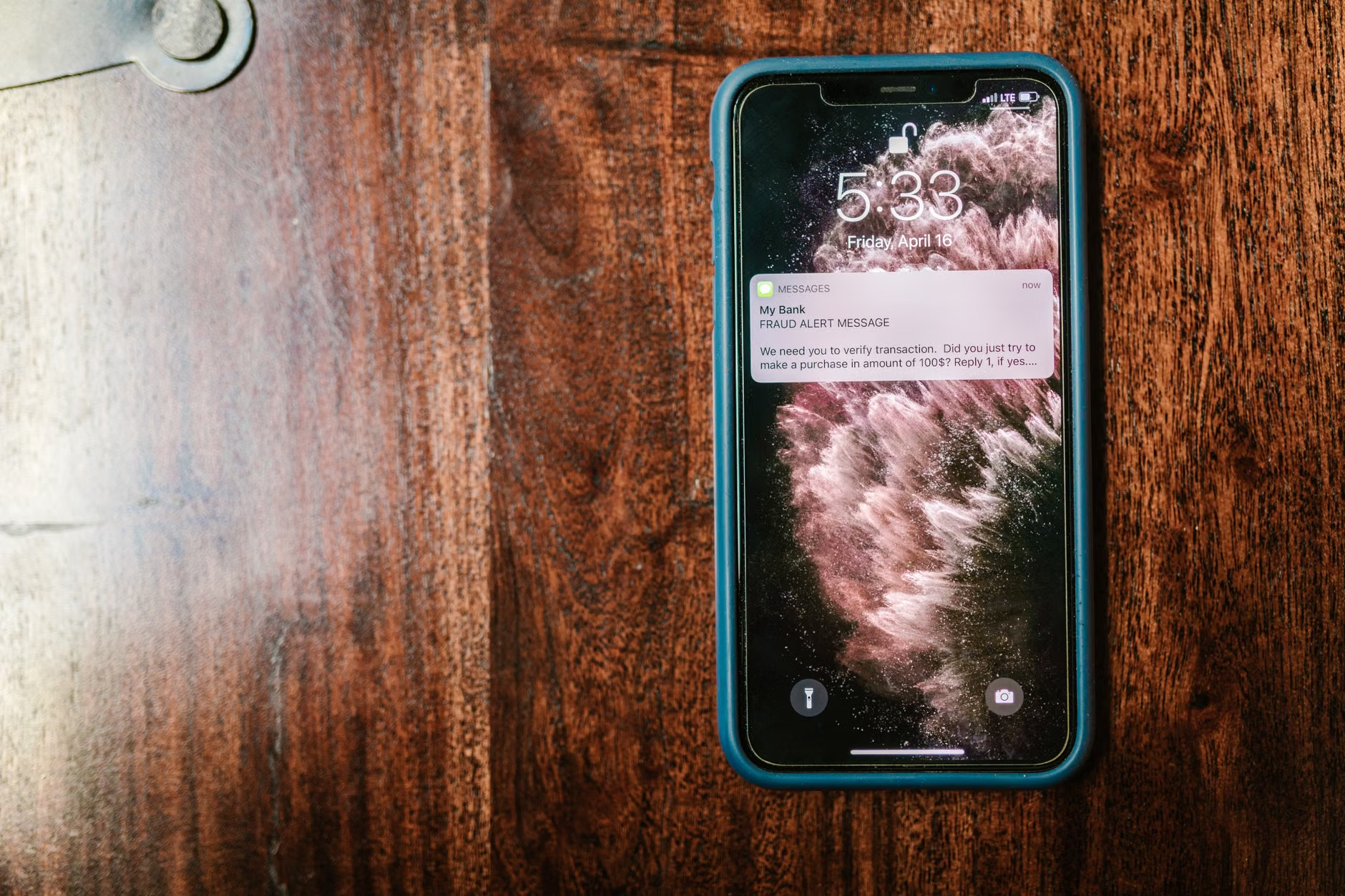
We have all been there. You are sitting at the dinner table, helping your child with math homework or just trying to enjoy a quiet moment with a partner, and your phone buzzes. It is a notification from a project management app or a “quick” email from a manager asking about a status update that could easily wait until morning. For years, we treated this as the “new normal” of the digital age. But as we move deeper into 2026, the global conversation has shifted from personal willpower to legislative mandate.
The “Right-to-Disconnect” is no longer a fringe idea discussed in academic labor papers; it is a concrete set of laws being adopted by major economies worldwide to combat the rising tide of digital burnout. Whether you are a parent trying to manage the chaotic transition from school pickup to dinner, or a professional who has felt the slow creep of work into every waking hour, these changes are designed to give you your time back.
The Evolution of the Always-On Culture
To understand why this legislation is happening now, we have to look at the last decade. The rise of smartphones and cloud-based collaboration tools turned every home into a potential satellite office. While this offered flexibility, it also effectively destroyed the “off-switch.” By 2024, studies consistently showed that the average knowledge worker was spending nearly 20% of their “personal time” checking or responding to work-related pings.
This “always-on” culture wasn’t just annoying; it was medically and psychologically taxing. Chronic stress, sleep deprivation, and the erosion of family time were becoming systemic issues. Governments, observing the decline in worker well-being and the subsequent impact on healthcare costs and productivity, realized that voluntary company policies were failing. When you tell a team to “manage their own balance,” the most ambitious or anxious employees will always choose to stay connected, creating a toxic competitive standard that everyone else feels forced to match.
By 2026, the legislative response has evolved into a multi-tiered approach. Some countries have opted for strict bans on after-hours communication, while others have mandated that companies establish “disconnection agreements” with their employees. These agreements aren’t just HR fluff; they are legally binding documents that define what constitutes an emergency and when an employee is truly “off the clock.”

What the 2026 Landscape Looks Like
If you are working in a region that has implemented these laws, your daily life is likely undergoing a transition. The implementation usually follows a specific framework. First, employers must clearly define working hours in employment contracts. Second, companies must implement technical safeguards—such as email servers that hold messages until the next business morning or automated “out-of-office” systems that are legally enforced.
However, the biggest change is the shift in liability. In many jurisdictions, if a manager repeatedly contacts an employee after hours, the burden of proof is now on the employer to show why that contact was essential. If they cannot justify it as an emergency, they may face administrative fines. This has forced companies to rethink their workflow. Instead of sending an email at 9:00 PM on a Tuesday, managers are now using “schedule send” features to ensure the message arrives at 9:00 AM on Wednesday.
The “Emergency” Clause: A Crucial Distinction
One of the most common concerns I hear from parents in their 30s and 40s is: “What if there is a real crisis?” The legislation recognizes this. Most laws include a “reasonableness” or “emergency” clause. These clauses typically allow for contact in situations that involve a genuine threat to life, safety, or critical infrastructure failure. The key, however, is that the definition of “emergency” is no longer determined by the manager’s whim. It is defined by the contract or the industry-standard code of conduct.
This distinction is vital for those of us with families. Knowing that you are legally protected from being bothered for non-urgent tasks allows you to engage with your children without the constant, low-level anxiety of checking your phone. It turns the “Right-to-Disconnect” from a political concept into a practical tool for parenting and mental health.
Practical Strategies for the Transition
Even with the best laws in place, a piece of paper in an employment contract won’t change your boss’s habits overnight. You still need to manage the transition personally. If you find that your workplace is slow to adapt, here is how you can navigate the 2026 environment effectively.
| Action | Purpose |
|---|---|
| Schedule Send | Prevents the “notification ping” that triggers anxiety in others. |
| Clear Boundaries | Explicitly state your hours in your email signature. |
| Digital Triage | Use focus modes to silence work apps during family hours. |
| Team Norms | Agree on what constitutes an “emergency” with your direct team. |
The most successful professionals I know in 2026 are those who actively communicate their boundaries. It is not about being difficult; it is about being predictable. When you tell your team, “I am offline from 6:00 PM to 8:00 AM, but I am fully available during my core hours,” you are creating a predictable environment. Predictability reduces anxiety for everyone involved.
The Hidden Challenges: Why Implementation Isn’t Perfect
It would be naive to suggest that these laws have solved everything. As with any major labor reform, there are unintended consequences. One of the biggest challenges is the “always-on” expectation being replaced by “hyper-productivity” during work hours. Some managers, frustrated that they cannot reach employees in the evening, have tightened the screws on what is expected during the 9-to-5 window. This can lead to a more intense, high-pressure work environment during the day.
Additionally, there is a cultural lag. In many high-performance industries, there is still an unspoken social pressure to be the “hardest worker in the room.” Even if it is legally protected to disconnect, some employees fear that doing so will limit their promotion prospects. This is where the role of leadership becomes paramount. If a manager stays late and sends emails, the team will follow suit, regardless of what the law says. Changing the culture requires leaders to model the behavior of disconnecting, proving that productivity does not require 24/7 availability.
Another issue is the global nature of work. If you work for a multinational company with offices in different time zones, the “Right-to-Disconnect” becomes complex. Does your right to disconnect apply to your local time or the time zone of your headquarters? In 2026, most courts are ruling in favor of the employee’s local time, but this remains a point of contention in international contracts. If you work in a global role, ensure your contract specifies which time zone governs your “off” hours.
Moving Forward: A New Era of Work-Life Integration
As we navigate the latter half of the decade, the goal is not to create a rigid wall between work and life, but to create a sustainable integration. We are moving away from the era of “work-life balance” as a buzzword and toward “work-life integration” as a functional reality. This means that work is a part of our lives, but it is not the entirety of our lives.
For parents, this is a game-changer. The ability to be present for a school play, a doctor’s appointment, or just a quiet dinner without the constant fear of an urgent Slack message is invaluable. It allows us to be better parents, better partners, and, ironically, better employees. When we are rested and have had the time to disconnect, we return to work with more focus and creativity.

If you feel like your workplace is still stuck in the 2020 mindset, do not be afraid to have a conversation. Refer to the local labor guidelines, but frame it in terms of performance. “I’ve noticed that when I am able to fully disconnect in the evenings, my output during the day is significantly higher and more focused,” is a powerful argument that any reasonable manager should understand. You aren’t asking for less work; you are asking for the conditions that allow you to do your best work.
Ultimately, the “Right-to-Disconnect” is a tool, not a magic wand. It provides the legal cover, but the personal discipline to actually put the phone down is still up to us. In 2026, that choice is increasingly yours to make, and the world is finally starting to support that decision.
Frequently Asked Questions
1. Does the Right-to-Disconnect mean I can ignore all work messages after 5:00 PM?
Not necessarily. Most legislation distinguishes between “non-urgent” and “urgent” matters. You are generally protected from being penalized for ignoring routine communications, but genuine emergencies—as defined by your contract or specific industry regulations—may still require your attention. Always check your specific local labor laws or company policy for the definition of an “emergency.”
2. Can my employer fire me for not answering my phone in the evening?
If you are in a jurisdiction with clear Right-to-Disconnect laws, it is illegal for an employer to retaliate against you for exercising this right. This includes firing, demoting, or penalizing you for not being available outside of your contracted hours. If you feel you are being targeted, keep a log of the communications and consult with your local labor board or HR representative.
3. How does this apply to remote workers or freelancers?
The application varies by region. Employees are generally well-protected, but contractors and freelancers often fall into a legal gray area. If you are a freelancer, your “Right-to-Disconnect” is usually governed by your client contract. It is highly recommended to include a “communication hours” clause in your service agreements to protect your time from the start.
Note: This article provides a general overview of global trends as of 2026. Labor laws vary significantly by country and state. Please consult your local government’s official labor department website or a legal professional for advice specific to your jurisdiction.
Useful Resources for further reading:
- International Labour Organization (ILO) – Global Labor Standards
- OECD Employment and Labour Market Statistics
Reclaiming your time is a journey, not a switch. Start small, set your boundaries, and remember that you are a person first and an employee second. You’ve got this.