Hello, fellow moms and dads! Are you having a wonderful, albeit slightly chaotic, day with your little ones? Raising a child is a series of breathtaking moments, but it’s also natural to feel a pinch of anxiety—especially when it comes to language. You might find yourself wondering, “Is my child developing at the right pace?” or “Why isn’t my little one talking as much as the toddler next door?”
I still remember the overwhelming emotion when I heard the word “Mommy” for the first time. It felt like a reward for all those sleepless nights! Today, I want to share a deep dive into early childhood language development stages, providing you with a practical checklist and actionable activities you can start today. Think of this as a friendly chat over coffee with a fellow parent who loves researching what makes our kids tick.

Understanding the Stages of Language Development
Language development isn’t a race, but it does follow a fascinating step-by-step progression. Here is a quick checklist to help you see where your child currently stands.
[Language Development Milestone Checklist]
- Stage 1 (0–6 Months): The Sound Explorers
- Does your baby startle at loud noises or calm down when they hear your voice?
- Do they turn their head toward the source of a sound?
- Are they making “cooing” sounds like “ah” or “oo”?
- Stage 2 (7–12 Months): The Word Comprehenders
- Do they look at you when you call their name?
- Do they understand simple commands like “No” or “Give it to me”?
- Are they “babbling” with consonants (e.g., “ba-ba-ba”, “ma-ma-ma”)?
- Stage 3 (13–24 Months): The Word Exploders
- Can they say 5–10 meaningful words like “Milk” or “Dog”?
- Can they point to body parts (nose, eyes, mouth) when asked?
- Are they starting to combine two words (e.g., “Mommy go”, “More juice”)?
- Stage 4 (25–36 Months): The Sentence Builders
- Do they use sentences with three or more words?
- Have they entered the “Why?” phase where they ask questions constantly?
- Can they say their own name or identify their gender?
The Truth About Screen Time and Speech
In this digital age, it’s nearly impossible to avoid screens. However, global research consistently shows that excessive screen time for infants under 24 months is closely linked to language delays.
The reason is simple: Language is built on interaction. A video is a one-way street; it doesn’t wait for your baby to respond. To learn to speak, babies need to watch your facial expressions, mimic your lip movements, and feel the thrill of you responding to their babbles. While a few minutes of “baby shark” at a restaurant might be a lifesaver, try to prioritize your voice over a digital one whenever you’re at home.

Golden Time Activities to Boost Speech
Want to help your child’s vocabulary bloom? Here are some simple, fun activities that I found incredibly effective:
- [0–12 Months] Mirror Play: Sit with your baby in front of a mirror. Exaggerate your mouth movements while saying “Ah,” “Oh,” or “Ee.” It helps them connect sounds with lip shapes.
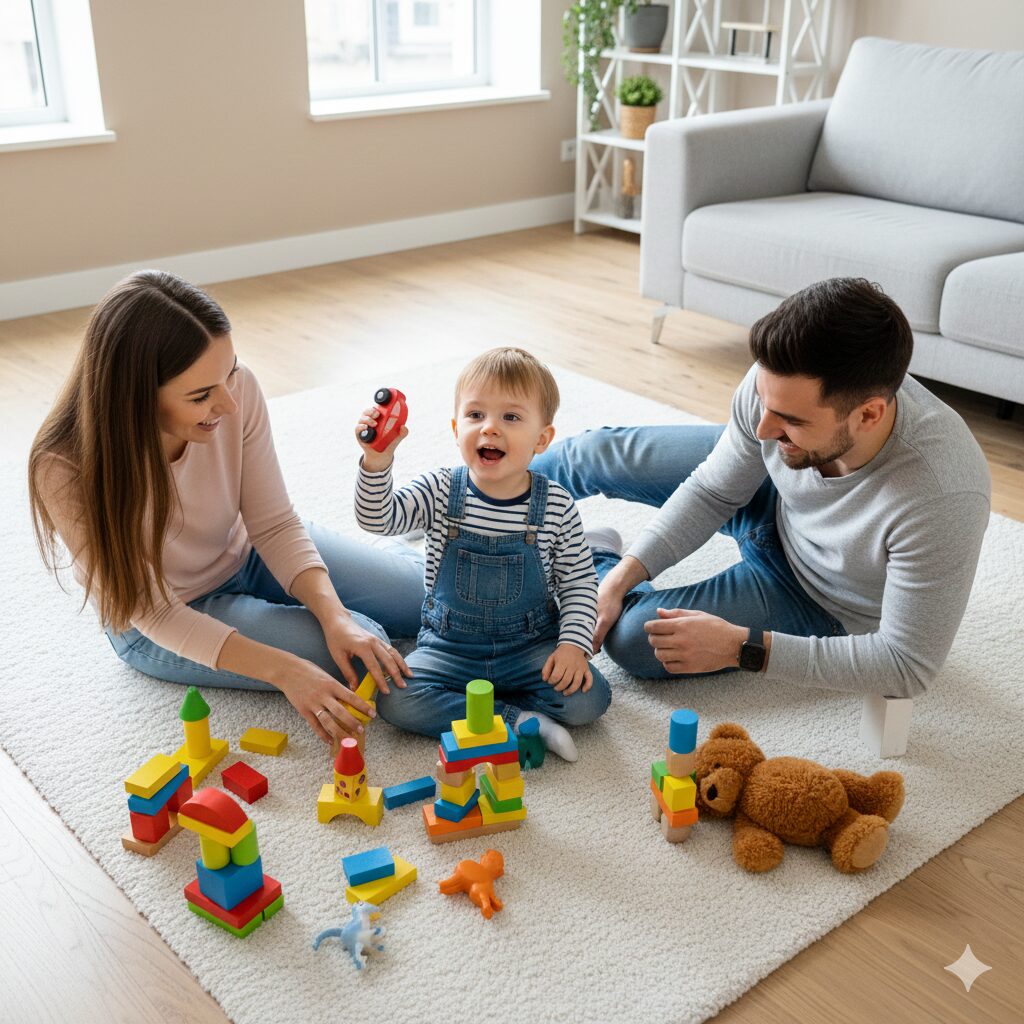
- [12–24 Months] The “What’s Inside?” Box: Hide favorite toys in a box. As you pull them out, narrate enthusiastically: “Look! A red car! Vroom vroom!” This associates objects with specific names and sounds.
- [24–36 Months] Role-Playing and Errands: Ask for simple help: “Can you bring me the teddy bear from the sofa?” During playtime, ask open-ended questions like, “The doll is hungry, what should we feed her?” to encourage sentence building.
- The “Live Stream” Method: Narrate your day like a sports commentator. “Now we are putting on your soft blue socks! One foot, two feet!” This constant exposure builds a massive mental library of words.
When Should You Seek Professional Advice?
Every child blooms in their own time. However, early intervention is key if you notice the following “red flags”:
- No eye contact or lack of response to their name by 12 months.
- No meaningful words by 18 months.
- Inability to combine two words (e.g., “Mommy water”) by 24 months.
Seeking help doesn’t mean something is “wrong.” Often, a little extra support during this Golden Time helps children catch up rapidly. It’s always better to get a professional’s “Everything is fine” than to spend months worrying in silence.
[Note] Screen Time: Refers to time spent watching digital screens (TV, smartphones, tablets). Experts generally recommend zero screen time for children under 18–24 months, except for video chatting with family.
Closing Thoughts: Trust the Process
Language development is like a flower; you can’t force it to grow faster, but you can provide the best soil and sunlight. Every word you speak and every story you read is being stored in your child’s brain.
The fact that you are reading this guide shows what an amazing, dedicated parent you are! So, don’t be too hard on yourself. Put down the phone, look into those little eyes, and start a silly conversation today.
Helpful Resources: