The secret to a successful beach vacation for families who find standard tourist hotspots overwhelming is not just picking a destination, but applying a rigorous, data-backed filter to how you evaluate your environment—the “Quiet-Beach” criteria.
- The 48-Hour Rule: Avoid any beach that requires a shuttle or is located within a 5-mile radius of a major resort complex to ensure lower noise levels.
- Topography Matters: Look for beaches with natural windbreaks or coves, which naturally dampen sound and reduce chaotic wave activity.
- Off-Peak Scheduling: The difference between a “chaotic” beach and a “sensory-friendly” one is often just three hours—aim for arrival before 9:00 AM.
We’ve all been there: you spend months dreaming of a peaceful seaside retreat, only to arrive and find yourself squeezed between a booming beach club and a cluster of jet-ski rentals. For parents, especially those traveling with children who have sensory sensitivities or simply those of us who value a low-stimulation environment, this isn’t just an annoyance—it can ruin the entire trip. If your idea of a “vacation” involves more noise than your average Tuesday at the office, you aren’t alone, and you don’t have to accept it as the status quo.
Finding a truly sensory-friendly destination requires moving beyond glossy travel brochures. It requires looking at satellite maps, checking wind patterns, and understanding the logistics of local tourism. Let’s break down the criteria to find your next quiet escape.

The Satellite-Map Strategy: Beyond the Brochure
Most travel sites highlight the “best” beaches, which is often code for the most crowded, most accessible, and most commercialized. To find a truly quiet beach, you have to ignore the “Top 10” lists and start acting like a scout. The most effective tool at your disposal is satellite view on mapping software.
When looking at a potential destination, zoom in on the access points. A beach that has a massive, multi-level parking structure directly adjacent to it is almost guaranteed to be a sensory nightmare. You are looking for “friction” in the travel path. Friction is good. Friction keeps the masses away.
Look for beaches that require a short walk from a small, limited-capacity parking lot, or those that are accessible only via a winding coastal road. These natural barriers act as a filter. If it takes even ten minutes of walking to reach the sand, you will immediately eliminate 80% of the casual beach-goers who are looking for convenience over solitude.
The “Resort Proximity” Calculation
How close is your accommodation to the water? If you can walk from a hotel lobby directly onto the sand, you are likely in a high-density zone. Sensory-friendly travel often requires a slight trade-off: stay a 10-to-15-minute drive away from the beach. This distance creates a buffer that prevents the “resort soundscape”—the constant hum of outdoor music, pool-side entertainment, and crowds—from bleeding into your beach time.
Furthermore, check the local zoning. Are there commercial docks nearby? Is there a designated “water sports” zone? Many municipalities have maps that designate where motorized watercraft are permitted. Avoid these like the plague. A beach located two miles down the coast from a jet-ski rental hub might look quiet on a map, but the ambient noise of engines will travel over the water, creating a persistent, low-frequency hum that is often more irritating than direct noise.
Understanding the Sensory Profile of Coastal Topography
Not all beaches are created equal when it comes to sensory input. The physical shape of the coastline plays a massive role in how sound and light behave. When we talk about “sensory-friendly,” we are talking about two main factors: auditory clutter and visual chaos.
Auditory clutter is the combination of human noise, mechanical noise, and the chaotic nature of the waves. Visual chaos is the density of umbrellas, bright colors, shifting crowds, and moving objects. You want to minimize both.
Look for “cove beaches” or beaches framed by rocky headlands. These natural features act as acoustic dampeners. They break up the wind—which can be a major sensory trigger—and they contain the sound, preventing the echo-chamber effect you get on wide, flat, open beaches. A beach sheltered by cliffs or dense vegetation will naturally feel quieter, even if there are other people around.
The Timing Algorithm: When to Go
If you cannot change where you go, you can absolutely change when you go. The “Quiet-Beach” criteria dictates that you avoid the peak-sun hours. Most families arrive at the beach between 11:00 AM and 2:00 PM. This is the absolute worst time for someone seeking a sensory-friendly environment.
The optimal window is the “Golden Morning.” Arriving at 7:30 AM or 8:00 AM gives you two to three hours of relative silence before the crowds arrive. The light is softer, the sand is cooler, and the sea breeze is usually gentler. By the time the beach starts to fill up at 11:00 AM, you have already had your fill and can retreat to a more controlled environment—like a private rental or a hotel room—for a midday rest.
| Time Block | Sensory Level | Recommendation |
|---|---|---|
| 07:00 – 09:30 | Low | Ideal for sensory-sensitive individuals. |
| 10:00 – 13:00 | High | Avoid; peak density and noise. |
| 13:00 – 16:00 | Medium | High heat, high visual glare. |
| 17:00 – Sunset | Low/Medium | Good for evening walks; fewer crowds. |
Building Your Sensory-Friendly Travel Kit
Even at the quietest beach, you cannot control everything. The wind might pick up, a seagull might squawk, or a distant boat might start its engine. Having a “sensory toolbelt” for your family allows you to adapt to the environment on the fly. This isn’t about hiding from the world; it’s about providing a safety net that keeps everyone regulated.
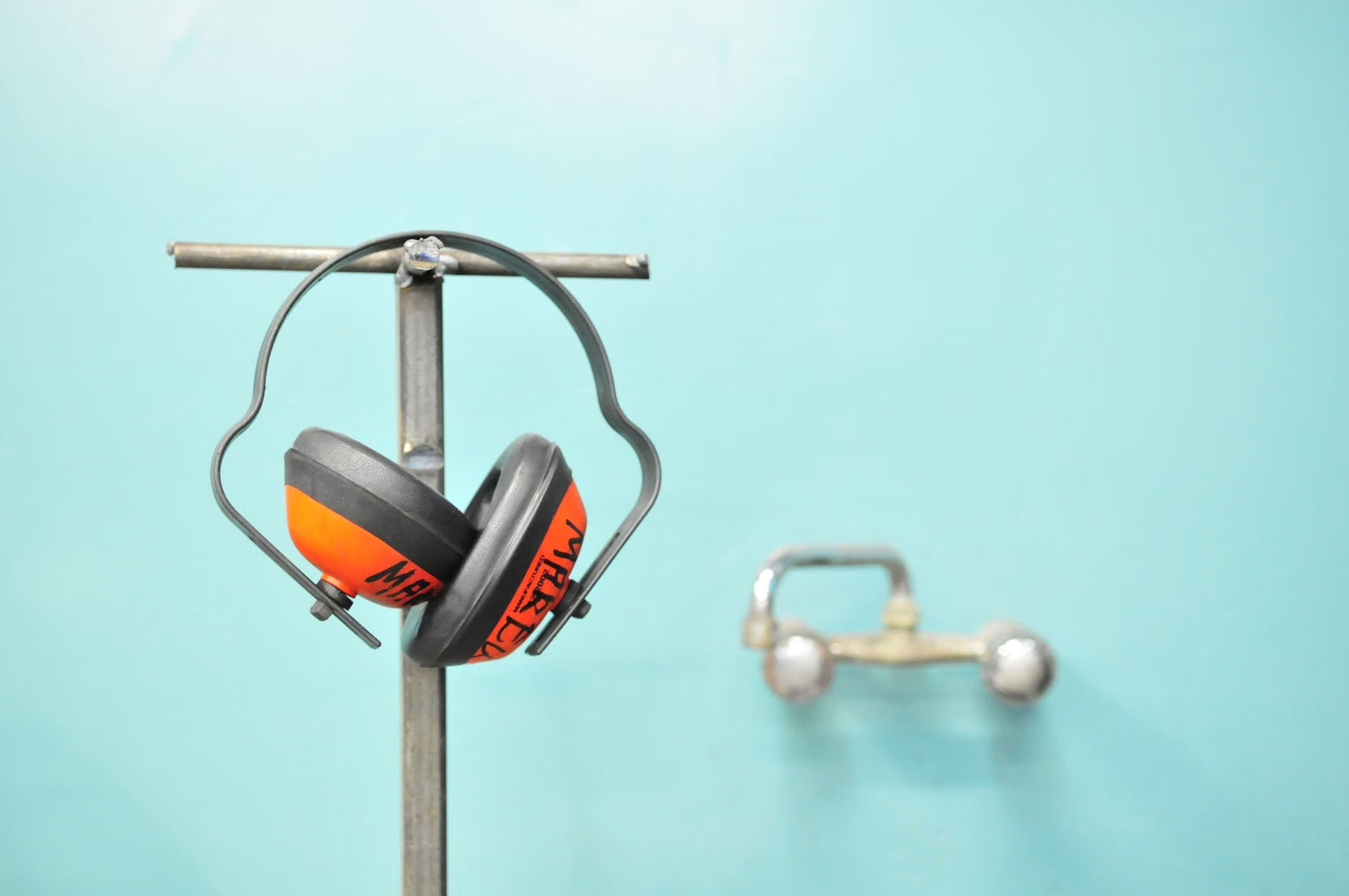
First, invest in high-quality, comfortable noise-canceling headphones for both adults and children. Look for models that are rated for water-resistance or are easy to clean. These are essential for moments when the environment becomes too much. Second, consider bringing a pop-up, UV-rated shelter. This creates a personal “safe zone” on the beach. It limits the visual field, which can be incredibly helpful for children who get overwhelmed by the vast, shifting horizon of a busy beach.
Finally, pack a “tactile comfort” bag. This might include smooth stones, stress balls, or even a soft, weighted blanket for when you are sitting in your shelter. The goal is to provide consistent, predictable sensory input to counteract the unpredictable input of the beach environment.
The Psychology of “Low-Stimulation” Destinations
Why do we feel so drained after a day at a busy beach? It’s not just the heat. It’s what psychologists call “sensory overload.” Our brains are constantly processing the sound of the wind, the crashing of the waves, the brightness of the sun, and the movement of the crowd. For a neurodivergent child or a parent who is already burnt out from the demands of daily life, this is exhausting.
By choosing a destination that aligns with the Quiet-Beach criteria, you are actively reducing the cognitive load on your brain. You aren’t just “finding a spot to sit”; you are curating your environment to allow for true rest. This is why it’s important to be honest about your limits. If you know that crowds trigger anxiety, don’t try to “push through it” by booking a hotel in the heart of the tourist district. Respect your sensory boundaries.
When you arrive at your destination, do a “sensory walkthrough.” Before you commit to a spot for the day, stand still for two minutes. Close your eyes. Listen. What do you hear? Is it the wind? Is it distant traffic? Is it the hum of an air conditioner? If you feel your shoulders tense up, that is a sign to move on. Trust your physiological response over the photos on a travel website.
Logistics: The Hidden Factors of Success
Beyond the beach itself, consider the logistics of the surrounding area. A beach might be quiet, but if the walk to get there involves a crowded boardwalk full of neon lights and loud speakers, you have already lost the battle. Look for “natural access” routes—paths that go through dunes, forests, or quiet residential side streets.
Check the “facility density.” A beach with a massive, bustling snack bar and public changing rooms will inherently attract more people. A beach with minimal facilities—perhaps just a single restroom and a small parking area—will naturally filter out the crowds who want an “all-inclusive” experience. Pack your own food and water. Being self-sufficient is the ultimate tool for sensory control. It means you never have to stand in a loud, crowded line for a snack.
Addressing Common Misconceptions
There is a persistent myth that “quiet” means “boring.” Many parents worry that if they take their kids to a remote, quiet beach, they will be miserable because there’s nothing to do. In reality, the opposite is often true. When you remove the distractions of arcades, loud music, and crowds, children often engage more deeply with the environment. They build sandcastles, hunt for shells, and observe the tide pools. The “boredom” is actually an opportunity for creative, self-directed play.
Another misconception is that you need to be a wealthy traveler to find these spots. In fact, many of the quietest beaches are the least “developed,” meaning they often have lower parking fees and no expensive resort amenities. By skipping the resort-focused beaches, you are often saving money while gaining peace of mind.
Practical Tips for Implementation
If you are planning your next trip, start by using the “5-mile radius” test. On a map, place a pin on your potential beach. Now, look for any major commercial centers, resorts, or theme parks within a 5-mile radius. If you find them, assume the beach will be busy. Look for areas where the nearest “major infrastructure” is at least 10 miles away.
Next, use local weather apps to check wind direction. If the wind is blowing from the land toward the sea, it will often carry sound from the city or road toward the beach. If the wind is blowing from the sea toward the land, the sound of the waves will act as a natural white-noise machine, masking the human noise behind you. This is a subtle but powerful way to optimize your experience.
Finally, communicate with your family. If you are traveling with children, explain the plan. “We are going to a quiet beach so we can hear the waves and find cool shells.” Setting expectations early helps everyone understand why you aren’t going to the beach with the big waterpark or the loud music. It turns the search for a quiet beach into a collective family mission.
Even with the best planning, sometimes things don’t go as expected. Maybe there’s a sudden event, or perhaps you misjudged the crowd levels. Don’t panic. Have a “Plan B” ready. This might be a nearby hiking trail, a quiet park, or a library in the nearest town. Knowing you have an exit strategy is often enough to keep your own stress levels down, which in turn helps keep the whole family regulated.
Remember that the goal is not to find a “perfect” beach, but to find a “manageable” one. If you find a spot that is 80% quiet, that is a win. Do not let the pursuit of total silence prevent you from enjoying the time you have. If you find yourself focusing more on the noise than on your family, take a break. Walk away. Sometimes, the best way to handle a sensory-heavy situation is to remove yourself from it entirely for a few minutes.
Ultimately, the “Quiet-Beach” criteria is about giving yourself permission to prioritize your sensory health. We live in a world that is constantly asking us to engage, to be loud, and to be present in high-stimulation environments. Choosing a quiet corner of the world, even for just a few hours, is a radical act of self-care. It’s a way of saying, “My family’s peace is more important than the convenience of a tourist hotspot.”
Final Thoughts and Encouragement
Finding a sensory-friendly beach is a skill that improves with practice. You will get better at reading maps, understanding the rhythm of local crowds, and knowing exactly what your family needs to feel comfortable. Don’t be discouraged if your first attempt isn’t perfect. The process of searching for these hidden gems is part of the adventure.
Be patient with yourself and your children. Some days will be easier than others, and that is perfectly okay. The most important thing is that you are creating space for your family to rest and connect in a way that feels safe and sustainable. Keep looking for those quiet stretches of sand—they are out there, waiting for you to find them.
For more information on sensory-friendly travel standards and accessibility, you can refer to resources like The Autism Society or local coastal management websites which often publish data on beach accessibility and usage patterns.
Frequently Asked Questions
Q: How do I know if a beach is truly sensory-friendly before I book my travel?
A: Use satellite maps to look for “friction” points like long walking paths, limited parking, and distance from major resorts. Also, check local forums or social media geotags for that specific beach to see how crowded it looks in user-uploaded photos.
Q: Are there specific countries or regions that are better for quiet travel?
A: Generally, countries with robust national park systems or protected coastal areas have more “quiet-friendly” zones. Regions that emphasize eco-tourism are also more likely to have restricted vehicle access to beaches, which naturally lowers noise levels.
Q: What should I do if my child still feels overwhelmed despite our best planning?
A: Always have a pre-planned exit strategy. Identify a nearby “low-stim” location like a quiet park, a shaded forest trail, or even a return to your accommodation. Sometimes, simply knowing you can leave at any moment is enough to reduce the anxiety of the situation for both you and your child.