The core of the minimalist-tech movement isn’t about ditching your devices entirely; it is about intentionally curating your digital environment so that technology serves your life rather than consuming your attention.
- Intentionality over abstinence: Minimalist-tech focuses on removing digital friction and useless apps, not living off the grid.
- The “One-In, One-Out” rule: For every new app or device you introduce, remove an existing one to prevent digital clutter.
- Physical boundaries: Creating “no-tech zones” in the home is the most effective way to improve family connection and mental clarity.
Do you ever reach for your phone to check a quick weather update, only to find yourself twenty minutes later scrolling through a feed of people you haven’t spoken to since high school? You aren’t alone. For those of us in our 30s and 40s—navigating the chaotic intersection of professional responsibilities and parenting—our devices have become a source of constant “background noise.”
The minimalist-tech movement is a response to this fatigue. It isn’t about Luddism or throwing your smartphone into the nearest lake. It is about applying the philosophy of physical minimalism to the digital world. If you wouldn’t keep a pile of junk mail on your kitchen counter for three years, why keep fifty unused apps on your home screen?
Understanding the Digital Clutter Crisis
To understand why we feel so drained, we have to look at the concept of “cognitive load.” Every app notification, every badge icon, and every unread email represents an open loop in your brain. When you have dozens of these loops competing for your attention, your ability to focus on high-priority tasks—like finishing a report or playing with your kids—is significantly diminished.
Minimalist-tech is not about being “tech-free.” It is about being “tech-intentional.” It is the practice of auditing your digital tools to see which ones add genuine value and which ones merely extract your attention for the benefit of advertisers.

The Psychology of the “Infinite Scroll”
Most modern applications are engineered using “variable reward schedules.” This is the same psychological principle used in slot machines. You pull the lever (refresh the feed), and you hope for a reward (a funny post, an update, a like). Because you never know what you’re going to get, your brain stays hooked. Minimalist-tech helps you break this cycle by introducing friction. When you make your phone less “rewarding” to look at, you stop reaching for it out of habit.
Practical Steps to Implement Minimalist-Tech
You don’t need a total digital detox to see results. In fact, drastic changes often fail because they are unsustainable. Instead, treat your digital life like a garden: prune it regularly.
| Action | Why it works |
|---|---|
| Disable non-human notifications | Only allow pings from actual people. Stop app alerts. |
| Switch to Grayscale | Removes the color-coded dopamine hits from icons. |
| The “Home Screen” Audit | Keep only essential tools (Maps, Notes, Calendar) on page one. |
The Notification Filter
Go into your settings right now. Look at your notification list. How many of those apps actually need to interrupt your day? If an app is designed to entertain you, it does not deserve a notification. If an app is designed to help you (like a banking app or a calendar), it might. Be ruthless. If you can live without the alert, turn it off. You will be surprised by how much quieter your day becomes.
The Grayscale Hack
This is perhaps the most effective “minimalist-tech” trick. By turning your phone screen to grayscale (black and white) in your accessibility settings, you strip away the bright, stimulating colors that designers use to grab your attention. Your phone suddenly becomes a tool rather than a toy. It makes checking social media feel significantly less satisfying, which is exactly the point.
Technology in the Parenting Context
As parents, we often feel guilty about our screen time, yet we use our phones to manage everything from school schedules to grocery lists. The goal of minimalist-tech for parents is to move the phone from being a “distractor” to a “utility.”
Consider the “Charging Station” strategy. When you enter your home, place your phone in a designated spot—like a tray in the hallway—and leave it there. If you need to check something, you can go to the tray. This creates a physical distance between you and the digital world, signaling to your children that your attention is focused on them, not on a screen.
Another strategy is “Single-Tasking.” If you are taking photos of your child, put the phone in “Do Not Disturb” mode first. Take the photos, put the phone away, and then engage. Don’t let the act of documenting the moment destroy the moment itself.
Managing the Digital Workspace
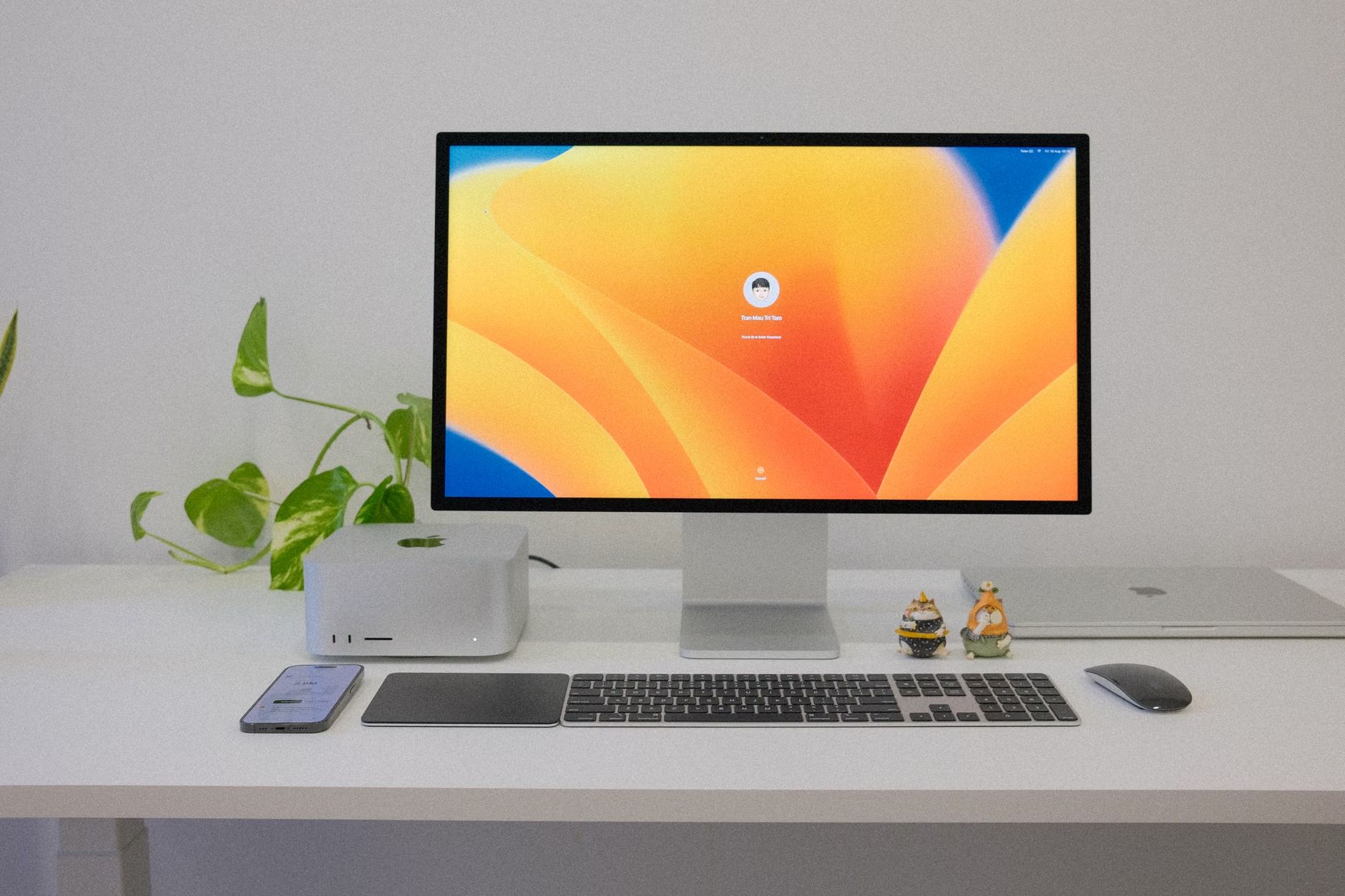
For those of us working from home or in offices, the “digital desktop” is often as cluttered as a physical desk covered in papers. A minimalist digital workspace reduces the mental energy required to start your day. If you have fifty icons on your desktop, your brain subconsciously processes every single one of them every time you minimize a window.
Start by clearing your desktop. Move files into folders. Use a simple, neutral wallpaper. If you are using a Mac or Windows, utilize the “Hide” features for your dock or taskbar. The goal is to have a clean slate that invites work, rather than a crowded one that causes anxiety.
The One-In, One-Out Rule
Apply the same rule to your software as you might to your wardrobe. If you download a new productivity tool, delete an old one. If you subscribe to a new newsletter, unsubscribe from two. This keeps your digital footprint manageable and prevents the “software creep” that leads to notification overload.

Common Pitfalls and How to Avoid Them
The biggest mistake people make when starting this journey is “purist syndrome.” They try to delete everything, realize they need their bank app or their work email, and then give up entirely. Minimalist-tech is not a race to the bottom. It is a process of optimization.
Common Pitfall: The “All-or-Nothing” approach. You might feel the urge to delete every social media app on a Monday morning. By Wednesday, you’re stressed, you feel disconnected, and you reinstall everything in a panic. Instead, start small. Remove one app per week. Observe how you feel. If you miss it, evaluate why. Was it the utility you missed, or the dopamine hit?
Common Pitfall: Ignoring the “Utility” aspect. Don’t delete apps that genuinely save you time. If a grocery delivery app saves you two hours a week, keep it. Minimalism is about removing what *clutters*, not what *helps*. If it provides value and doesn’t demand constant attention, it deserves a place in your digital life.
Creating Sustainable Digital Habits
Habits are the foundation of any lifestyle change. To make these changes stick, you need to build them into your daily routine. Try setting a “Digital Sunset.” One hour before bed, all devices move to their designated charging stations outside the bedroom. This does two things: it improves your sleep quality by reducing blue light exposure, and it prevents the late-night doomscrolling that ruins your morning productivity.
Another useful practice is the “Weekly Digital Review.” Spend ten minutes on a Sunday evening looking at your screen time report. Ask yourself: “Did I spend this time in a way that aligns with my values?” You don’t need to be perfect, but you do need to be conscious. If you spent four hours on a news app, ask if that information was actually useful or if it was just anxiety-inducing.
The Deeper Implications of Minimalist-Tech
Why does all of this matter? Because our attention is the most valuable resource we have. When you reclaim your attention, you reclaim your ability to think deeply. In an age of shallow, rapid-fire information, the ability to focus is a competitive advantage. It allows you to become better at your job, more present for your family, and more satisfied with your own thoughts.
Minimalist-tech is not about living in the past. It is about being a modern person who is in control of their tools. It is about recognizing that your phone is a powerful instrument, much like a hammer or a computer, and that you should put it down when the work is done.
If you feel overwhelmed, remember: you are the administrator of your digital life. You have the power to turn off the noise. You have the power to choose what gets your attention. Start with one notification, one app, one room, and one hour. The quiet you find on the other side is worth the effort.
Helpful Resources for Further Reading
- Digital Minimalism by Cal Newport (A foundational text on the philosophy of intentional technology use).
- Center for Humane Technology (Resources on how technology impacts our attention and ways to advocate for better design).
- Official Digital Health Guidelines (Understanding your device’s built-in tools for tracking usage).
Frequently Asked Questions
Not at all. Minimalist-tech is about using tools in a way that adds value to your life. If social media helps you connect with family or grow your business, keep it. The goal is to remove the “infinite scroll” aspect and the constant, unnecessary notifications that pull you away from your real-world priorities.
2. I need my phone for work. How can I be a “minimalist” while staying connected?
The key is to separate your “work” phone from your “personal” phone if possible, or to use “Focus Modes” (available on both iOS and Android). You can configure your phone to only allow work-related notifications during business hours and to silence everything else once you clock out. This creates a digital boundary that protects your personal time.
3. How do I get my family on board with a “no-tech zone”?
Start by modeling the behavior yourself. If you are constantly on your phone, it is hard to expect your partner or children to stay off theirs. Frame it as a positive experiment—”Let’s try having dinner without phones for one week to see if we enjoy the conversation more.” When people see the benefits of being truly present, they are usually much more willing to adopt the new habit.
Note: Minimalism is a journey, not a destination. Take your time, be kind to yourself, and don’t feel pressured to get it perfect on day one.