The secret to successful travel in your 30s and 40s isn’t about rigid planning or abandoning schedules entirely; it is the “Adaptive-Routine,” a framework that anchors your day in non-negotiables while leaving the rest open to the spontaneity of the road.
Key Takeaways
- Anchor Habits: Maintain 2–3 “non-negotiable” rituals (e.g., morning coffee, bedtime reading) to provide a sense of stability in unfamiliar environments.
- The 70/30 Rule: Allocate 70% of your day to planned activities and leave 30% as a “buffer zone” to accommodate transit delays, child meltdowns, or unexpected discoveries.
- Contextual Flexibility: Use digital tools to offload cognitive tasks like scheduling and navigation, allowing your brain to focus on the experience rather than the logistics.
If you are anything like me, the transition into your 30s and 40s changed your relationship with travel. Gone are the days of “winging it” with nothing but a backpack and a vague idea of where you might sleep. Now, you are likely balancing professional responsibilities, the logistical mountain of parenting, or simply a need for a vacation that doesn’t leave you more exhausted than when you started.
Many of us fall into a trap: we either over-schedule ourselves to maximize our limited time off, or we try to be so “go-with-the-flow” that we end up paralyzed by decision fatigue. The Adaptive-Routine is the middle ground. It is not a rigid itinerary; it is a portable framework that travels with you, ensuring you don’t lose your sense of self—or your patience—while navigating new time zones.
Why Your Brain Craves a Routine on the Road
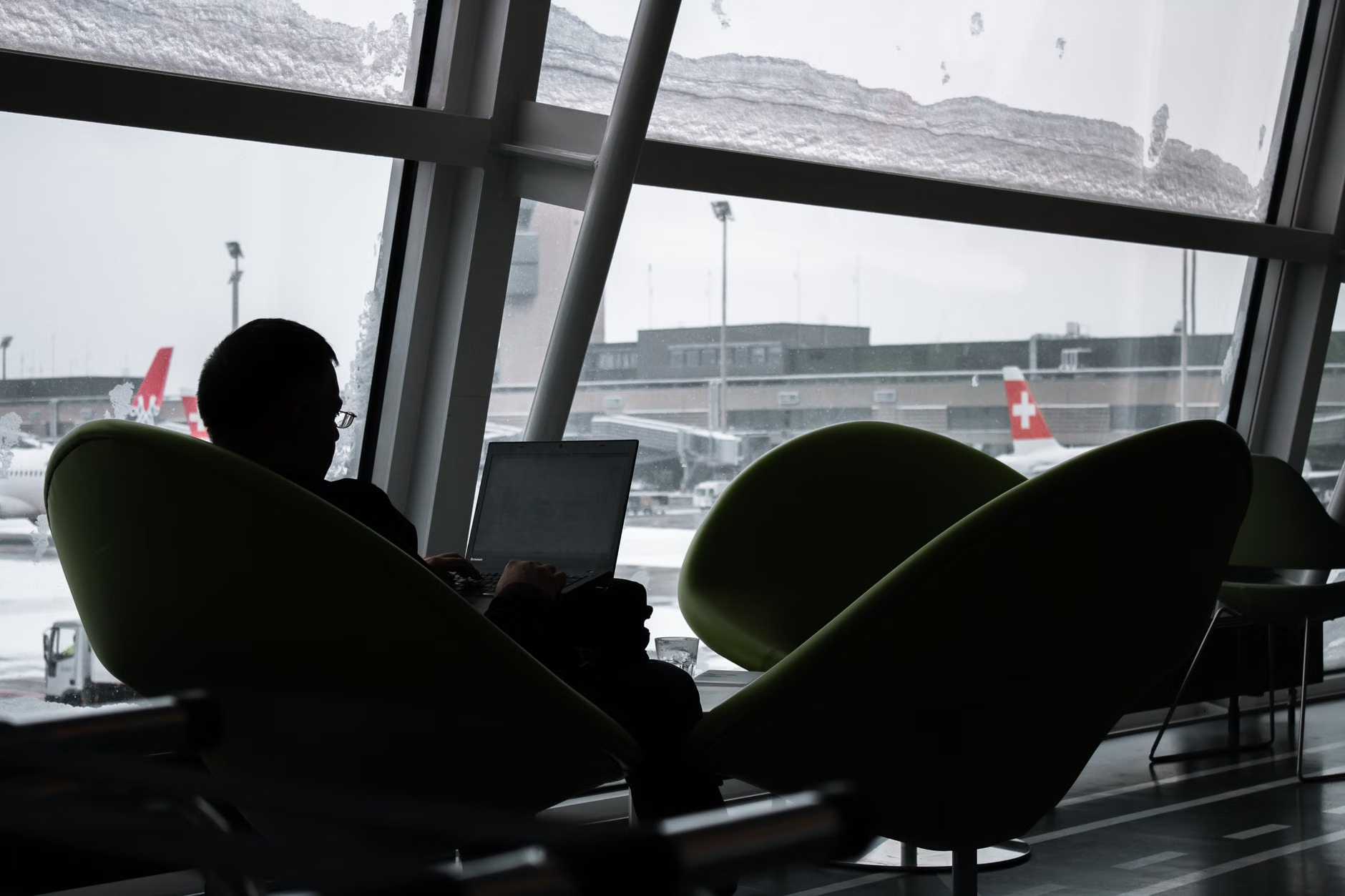
Travel is, by definition, a disruption of homeostasis. Our brains are hardwired to look for patterns to save energy. When you are in a new city, your cognitive load spikes because you are processing new sights, sounds, smells, and navigational cues. If you add the complexity of managing children or checking in on work emails, you are essentially asking your brain to run a marathon in a storm.
When we abandon all routines, we experience “decision fatigue.” This is the psychological phenomenon where the quality of our decisions deteriorates after a long period of decision-making. By the time you reach the hotel in the evening, you are so exhausted from choosing restaurants, routes, and activities that you end up ordering room service and scrolling through your phone, missing the point of the trip entirely.
The Adaptive-Routine functions as a “cognitive offload.” By keeping a few things constant, you free up mental bandwidth. If you know that your morning coffee ritual will happen regardless of whether you are in Tokyo or Tuscany, your brain has one less thing to worry about. This stability acts as a psychological anchor, reducing anxiety and making the “new” parts of your trip more enjoyable.
Building Your Personal Anchor Habits
An anchor habit is a small, repeatable action that takes less than 20 minutes. It should be something that makes you feel like “you,” regardless of your surroundings. For many, this is physical activity; for others, it is a quiet period of reading or a specific way to start the day with a hot beverage.
| Habit Type | Example | Why it works |
|---|---|---|
| Physical | 15-minute morning stretch | Physical movement signals safety to the nervous system. |
| Nutritional | Carrying a favorite tea/snack | Familiar flavors provide a sensory comfort zone. |
| Intellectual | Reading 5 pages of a book | Maintains continuity of thought across the trip. |
The key here is portability. If your home routine involves a complex espresso machine, don’t try to replicate that. Instead, find the travel-friendly equivalent, like a high-quality instant coffee or a small portable dripper. The goal is to minimize the friction of the routine while keeping the psychological benefit.
The 70/30 Rule: The Buffer for Real Life
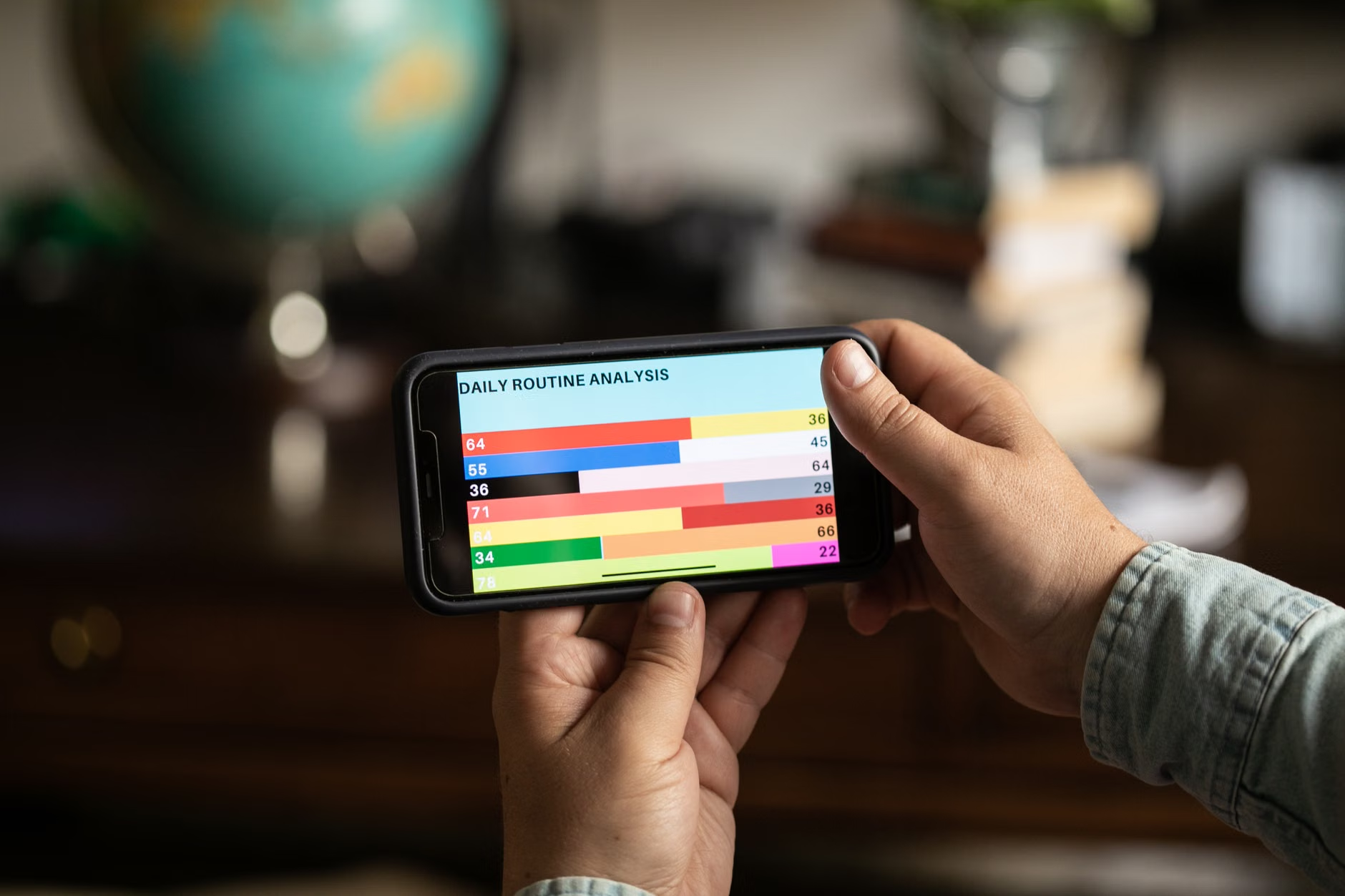
If you have ever traveled with children, you know that “The Plan” is a suggestion, not a law. The 70/30 rule is your insurance policy against the chaos of travel. You plan for 70% of your day to be occupied by intentional activities—museums, hikes, or planned meals—and you leave 30% completely unassigned.
That 30% is not “wasted” time. It is your buffer for the inevitable: the toddler who needs a nap, the train that is delayed, or the local bakery you stumble upon that looks too good to pass up. When you are operating at 100% capacity, every minor delay feels like a failure. When you are operating at 70%, a delay is just a shift in the schedule.
This approach requires a shift in mindset. Many of us feel like we are “losing out” if we aren’t doing something every waking hour. But in your 30s and 40s, the goal of travel should be restoration and connection, not just checking boxes on a list. By embracing the 30% buffer, you trade the anxiety of being “behind schedule” for the freedom of being present.
Technology as a Tool, Not a Master
We are currently living in an era where information is abundant, but wisdom is scarce. Use technology to manage the logistics so your brain can manage the experience. Use apps like Google Maps for transit, but download offline maps so you aren’t tethered to a data connection. Use shared digital calendars so everyone in your family or group knows the “anchor points” of the day.
However, be cautious of “over-optimizing.” I have seen travelers spend more time curating their Instagram feed or checking reviews for a 4.8-star versus a 4.7-star restaurant than they do actually enjoying the meal. Use technology to solve problems, not to create them. If you find yourself checking your phone every 15 minutes, you have moved from “using tools” to “being used by tools.”

Managing Family Dynamics and Expectations
When traveling as a family, the Adaptive-Routine becomes a collective effort. The most common mistake parents make is assuming that the children will adapt to the parents’ pace. In reality, the most successful trips are those where the routine is negotiated.
Start your day with a “briefing.” This doesn’t have to be formal. Over breakfast, ask, “What is the one thing you really want to do today?” and “What is the one thing we need to make sure we don’t forget?” This gives everyone a sense of agency. When children feel like they have a stake in the plan, they are far more likely to cooperate when things don’t go perfectly.
Also, recognize the difference between “adult-paced” and “family-paced” travel. If you are used to walking 10 miles a day, cut that expectation in half. The Adaptive-Routine is about finding the sustainable pace for the group. If the group is tired, the routine should naturally shift toward rest. Rigidity in the face of exhaustion is the fastest way to ruin a vacation.
Common Pitfalls and How to Avoid Them
One of the biggest hurdles is the “Re-entry Shock.” This is when you return from your trip and find yourself completely unable to function because your routine was so thoroughly dismantled. To counter this, build a “buffer day” into your return. Don’t plan to head straight from the airport to the office or a full day of chores.
Another pitfall is “The Comparison Trap.” You see others on social media having these perfectly curated, high-energy adventures, and you feel like your trip is “lesser” because you spent an afternoon reading in the hotel lobby. Remember that social media is a highlight reel. Your trip is a lived experience. If reading in the lobby is what you needed, then that was the most productive use of your time.
Finally, be wary of the “Sunk Cost Fallacy.” Just because you booked a tour or bought a ticket for an activity, you are not obligated to go if the circumstances have changed. If the weather is terrible or the kids are melting down, it is perfectly acceptable to cancel and pivot. The money is spent; don’t let it cost you your peace of mind as well.
The Science of Spontaneity
There is a growing body of research suggesting that our brains need a balance of “predictability” and “novelty” to feel happy. Novelty—traveling to a new place—stimulates the release of dopamine. However, too much novelty without the safety net of predictability leads to cortisol spikes (stress). This is why the Adaptive-Routine is so effective; it provides the predictability you need to safely enjoy the novelty you crave.
By keeping your sleep schedule relatively consistent and ensuring you have regular, nutritious meals, you are physically supporting your brain’s ability to process new information. It sounds boring, but the science is clear: a well-rested, well-fed brain is much better at appreciating the architecture of a cathedral or the beauty of a sunset than one that is sleep-deprived and running on caffeine and sugar.
Actionable Steps for Your Next Trip
To implement the Adaptive-Routine on your next journey, try this simple checklist before you leave:
- Identify your 2 non-negotiables: What are the two things you *must* do each day to feel like yourself? (e.g., exercise, reading).
- Set your 30% buffer: Look at your itinerary and ensure at least 30% of your time is unblocked.
- Communicate with your travel partners: Share your non-negotiables and ask them for theirs.
- Pack the “Anchor Kit”: Include the items that facilitate your habits (e.g., running shoes, a specific book, a travel mug).
- Prepare for the “Pivot”: Accept beforehand that things will go wrong and decide how you will handle those moments with grace.
The goal isn’t to create a perfect trip. The goal is to create a trip where you remain the captain of your own experience. When you stop fighting the reality of travel—the delays, the tired kids, the unexpected weather—and start working with it, you find that the journey becomes much smoother.
Frequently Asked Questions
What if my children are too young for a “routine”?
Children are actually the most routine-dependent travelers. Even if you can’t stick to a clock-based schedule, keep the sequence of events the same. For example: wake up, breakfast, outing, nap, snack, play. Keeping the order of operations consistent provides a sense of security for toddlers and infants, which in turn makes them less prone to overstimulation.
Is the 70/30 rule realistic for short weekend trips?
On shorter trips, the buffer zone is even more critical. Because you have less time, the pressure to “do everything” is higher, which leads to more stress. By intentionally leaving 30% of a weekend trip open, you prevent the feeling of needing a vacation from your vacation. It forces you to prioritize what truly matters.
How do I handle the pressure to see “everything” in a new city?
The “Fear of Missing Out” (FOMO) is the enemy of a good trip. Remind yourself that you cannot see everything. Use the 80/20 rule: 80% of the value of a trip usually comes from 20% of the activities. Focus on those few high-impact experiences and let the rest go. A deeper connection with one neighborhood is often more rewarding than a superficial scan of ten different tourist sites.
Travel is a privilege, but it is also a skill. Like any skill, it improves with practice and the right framework. By adopting an Adaptive-Routine, you are choosing to prioritize your well-being alongside your sense of wonder. You don’t have to choose between being a responsible adult and a curious traveler; you can be both, provided you give yourself the grace to be flexible. So, pack your bags, keep your coffee ritual, leave some room for the unexpected, and enjoy the trip.
For more insights on balancing life and travel, you can explore resources from the Travel Foundation regarding sustainable and mindful tourism, or look into the Psychology Today archives on the cognitive benefits of travel and routine.