What is the one phrase that strikes fear into the hearts of parents everywhere? It’s likely the dreaded: “Mom, Dad, I’m bored!” The moment those words are uttered, our parental instincts kick into overdrive. We feel a sudden pressure to entertain, to plan, and to solve the “problem” of their boredom. Often, in our exhaustion, we reach for the easiest solution: a smartphone or a tablet. Believe me, I’ve been there more times than I can count. It feels like a quick win for peace and quiet.
But what if I told you that “I’m bored” is actually the best signal your child’s brain can send? What if boredom isn’t a problem to be solved, but a gift to be unwrapped? Today, I want to share why we should celebrate those moments of quiet and how we can turn “nothing to do” into an explosion of creativity through simple, screen-free, analog play. Let’s dive into the magic of the “bored” brain and explore a treasure trove of activities that require almost zero budget but offer infinite value.

The Science of Boredom: Why Your Child’s Brain Needs It
We live in a world of constant stimulation. From colorful cartoons to rapid-fire apps, children’s brains are being flooded with external input. While this might keep them quiet, it doesn’t necessarily help them grow. Neuroscientists have discovered something fascinating called the “Default Mode Network” (DMN). This is a specific region of the brain that flickers to life when we aren’t focused on an external task—basically, when we are “bored” or daydreaming.
When the DMN is active, the brain starts connecting unrelated ideas, reflecting on memories, and practicing “autobiographical planning.” For a child, this is where original stories are born, where a cardboard box becomes a spaceship, and where they learn to solve problems without an adult’s help. By handing them a screen, we effectively “switch off” this creative engine. By letting them stay bored, we are giving them the space to become innovators.
1. Nature: The World’s Greatest Playground
You don’t need a national forest to experience the benefits of nature. Even a small backyard or a local park is a laboratory for the senses.
- The Leaf Gradient Challenge: Take a walk and collect fallen leaves. Encourage your child to find as many different shades as possible. Back home, arrange them from the brightest green to the deepest brown. It teaches them that no two things in nature are exactly alike, sharpening their observational skills and appreciation for detail.
- Stone Family Portraits: Collect smooth stones of various sizes. After washing them, use markers or acrylic pens to give them personalities. “This is Grandpa Pebble, and this is Baby Flint.” Creating characters out of inanimate objects is a foundational step in narrative thinking and empathy.
- The Sound Safari: Sit quietly in a park for three minutes. Ask your child to close their eyes and count how many different sounds they can hear. Is it the rustle of wind? A distant siren? The chirp of a specific bird? This practice of “deep listening” is incredibly grounding and helps with sensory processing.

2. Transforming Your Home into a Kingdom of Imagination
You’d be surprised how many “toys” are currently sitting in your kitchen cabinets or linen closet.
- The Epic Blanket Fort & Cushion Castle: This is a classic for a reason. Using chairs, clothespins, and every blanket in the house, create a secret lair. Inside, the rules of the outside world don’t apply. This “micro-environment” gives children a sense of agency and safety, where they can read by flashlight or plot their next “mission.” It develops spatial awareness and structural thinking.
- The Magic of Flour Dough: Forget expensive store-bought kits. Plain flour, water, and a bit of salt create a sensory experience that is unmatched. The squishy, sticky, and eventually firm texture of dough provides a “heavy work” sensory input that is very calming for children. Don’t tell them what to make; just let their hands explore the material.
- Paper Cup Engineering: A stack of 100 paper cups is one of the best investments you can make. Can they build a tower taller than themselves? Can they make a wall that spans the hallway? The inevitable “crash” when it falls is a lesson in gravity and resilience. “It fell! Let’s try a different base this time.” This is engineering in its purest form.

3. Roleplay: Stepping Into Someone Else’s Shoes
Roleplay is how children digest the world around them. It’s where they practice being brave, being kind, and being responsible.
- The ‘Invisible’ Shopkeeper: You don’t need plastic food. Use real apples, socks, or books. Have your child create “price tags” and “store currency.” Negotiating prices and taking turns being the customer builds social skills, basic math, and the ability to see things from another person’s perspective.
- Shoebox Puppet Theater: Cut a large hole in a shoebox and use old socks or even wooden spoons as puppets. The beauty of a puppet theater is that it allows shy children to speak through a character. It’s a wonderful way to build confidence and storytelling flow.
- The Invisible Obstacle Course: This is a great “no-prop” game. Tell the child that there is an invisible laser grid or a river of lava in the living room. They have to move, crawl, and jump to avoid these “imaginary” hazards. It’s a workout for both the body and the brain’s visualization centers.
4. Quiet Focus: Sensory Play for Emotional Regulation
Not all play needs to be loud and active. Sometimes, the best play is quiet and focused, helping children find their “center.”
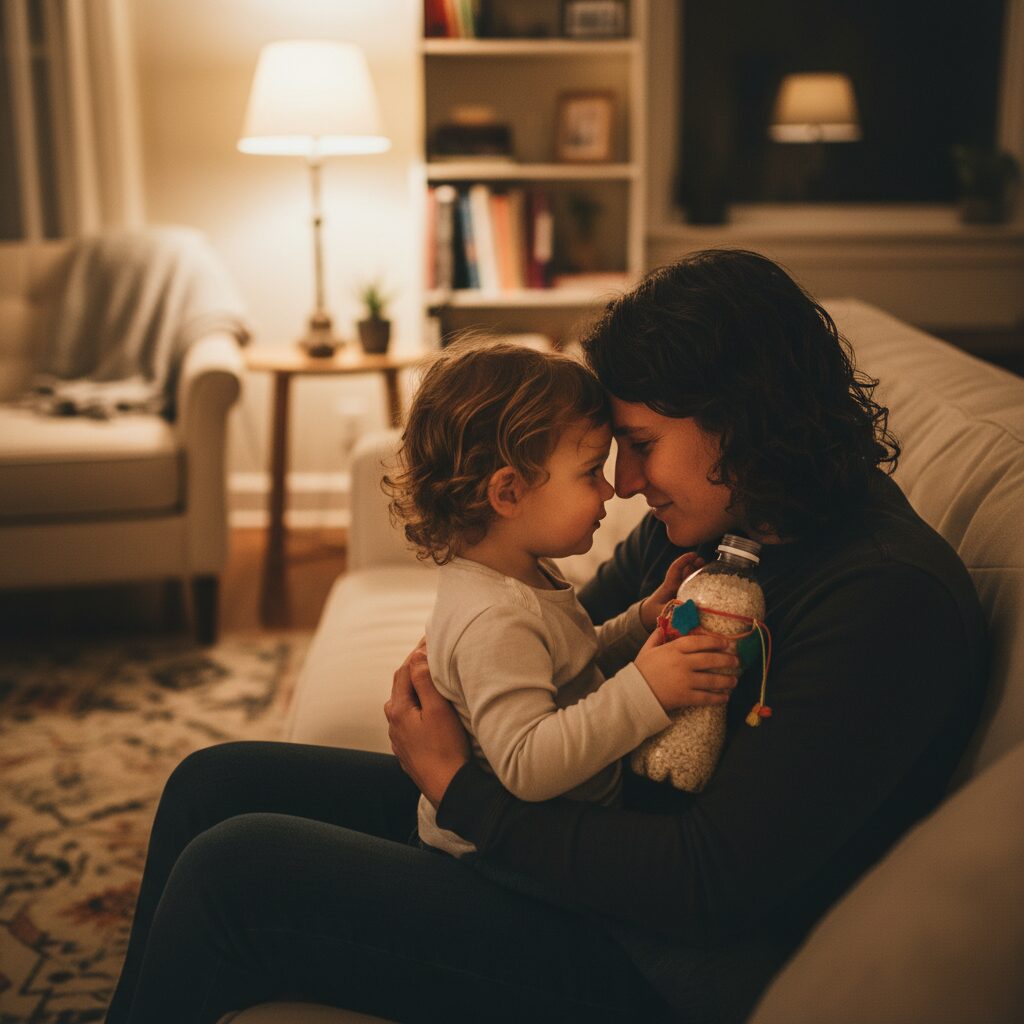
- The Grains of Sound: Fill empty plastic bottles with different materials: rice, dried beans, lentils, or sand. Each one makes a unique sound. Have the child close their eyes and try to identify which “instrument” is being played. This focuses the mind and refines auditory discrimination.
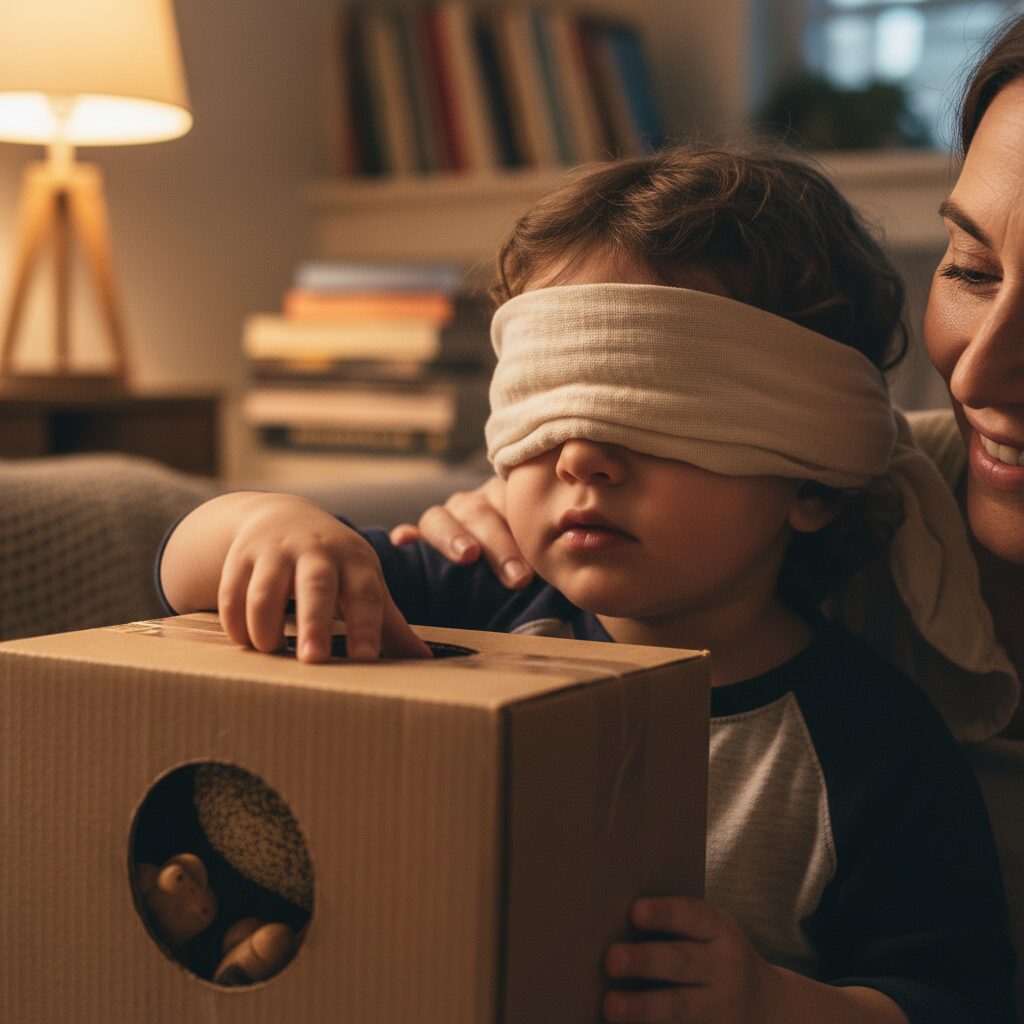
- The Mystery Box: Place a few everyday items (a spoon, a hairbrush, a pinecone) inside a box with a hole. Let the child reach in and describe what they feel before guessing the item. “It’s cold… it’s smooth… it has a long handle.” This builds descriptive vocabulary and tactile recognition.
- Shadow Puppets at Bedtime: Before sleep, turn off the lights and use a single lamp to make shapes on the wall. The simple act of using your hands to create a bird or a barking dog feels like pure magic to a child. It turns the “scary” dark into a canvas for fun.
5. Get Moving: Physical Analog Play
For kids with high energy, we need to provide “outlets” that don’t involve a high-score screen.
- The Masking Tape Maze: Use painter’s tape to create paths all over the floor. Zig-zags, loops, and straight lines. Tell the child they must stay on the “tightrope.” This develops balance and gross motor control. For an extra challenge, tell them certain colors of tape are “sticky” or “slippery.”
- Balloon Volleyball: A balloon moves slowly, giving children more time to coordinate their movements. It’s the perfect way to practice hand-eye coordination without the frustration of a heavy ball. Plus, trying to keep a balloon from touching the floor is an instant mood booster for the whole family!
A Note to My Fellow Parents
I want to be honest with you: the transition from “screen-time” to “analog-time” isn’t always smooth. If your child is used to high-octane digital stimulation, they might find these activities “boring” at first. They might even get a little grumpy.
That’s okay. Your job isn’t to be a 24/7 cruise director. Your job is to provide the environment and the “raw materials” (like the cups, the blankets, or the walk in the park) and then step back. Give them 15 or 20 minutes to sit with their boredom. Watch what happens. Usually, after the initial complaints, a tiny spark of an idea will form. They’ll pick up a spoon, they’ll look at a shadow, and suddenly, they are off into a world of their own making.
Your presence and your “wow, look at that!” are the only batteries these games need. You are doing a great job, and by giving your child the gift of boredom, you are giving them the gift of themselves.
Conclusion
Today, we explored how the simple state of being “bored” is actually a vital catalyst for a child’s brain.
- Boredom triggers the Default Mode Network, where true creativity lives.
- Analog play uses the five senses in a way that digital screens never can.
- Simple household items are more than enough to spark a day of adventure.
Next time you hear “I’m bored,” take a deep breath, smile, and say, “That’s wonderful! I can’t wait to see what your brain thinks of next.” You might be surprised at the magic that follows.
Reliable Resources for Play and Development
- UNICEF – The Power of Play: (https://www.unicef.org/parenting/play-and-learning) – Global insights on why play is a fundamental right and necessity for every child.
- Zero to Three: (https://www.zerotothree.org) – A leading authority on infant and toddler development, offering science-backed play ideas.
- HealthyChildren.org (AAP): (https://www.healthychildren.org) – Provided by the American Academy of Pediatrics, offering guidance on physical activity and creative play.