- The Definition: A ‘third space’ is any physical location outside of your home (the first space) and your workplace (the second space) that fosters casual, low-pressure social interaction.
- The Practical Benefit: Regular engagement in third spaces is statistically linked to lower stress levels and higher community trust, acting as an essential ‘social anchor’ for busy parents and professionals.
- How to Evaluate One: The best third spaces are characterized by accessibility, lack of a mandatory high cost of entry, and the existence of ‘regulars’ who create a sense of familiarity without requiring deep personal commitment.
If you are in your 30s or 40s, your life is likely a binary cycle: the commute (or the home office) and the household. We often refer to this as the ‘work-life balance’ struggle, but that framing is incomplete. It ignores the ‘third space’—the vital, non-commercial, or semi-public environment where you are neither an employee nor a parent, but simply a neighbor.
When was the last time you spent an hour somewhere that wasn’t your office, your living room, or a place where you felt pressured to spend a significant amount of money? If the answer is ‘I can’t remember,’ you aren’t alone. This isn’t just about needing a hobby; it’s about the erosion of the social fabric that keeps us grounded when the daily grind of parenting and professional responsibilities threatens to consume our identity.

What Exactly Is a ‘Third Space’ and Why Does It Matter Now?
The term ‘third space’ was coined by sociologist Ray Oldenburg in his 1989 book, The Great Good Place. He argued that for a society to be healthy, people need three types of places: the home, the workplace, and the ‘third space.’ These are anchor points of community life where people gather, talk, and relax.
In our current era, the definition has evolved. A third space isn’t just a physical location; it is a social necessity. For the demographic in their 30s and 40s, the challenge is that many traditional third spaces—like pubs or civic clubs—have either become too expensive or they don’t align with the reality of having young children or limited free time. You need a space that is flexible.
Why does this matter for your mental health? Research from the Journal of Personality and Social Psychology consistently shows that ‘weak ties’—the casual acquaintances you make at a park, a local cafe, or a neighborhood library—are just as important as your ‘strong ties’ (close friends and family) for feeling a sense of belonging. When you interact with the same ‘regular’ at a neighborhood spot, you are building a psychological safety net that makes your neighborhood feel like a community rather than just a place where you sleep.
The Criteria for a Functional Third Space
Not every public place qualifies as a true third space. If you go to a high-end restaurant, you are a customer, not a participant in a community. To evaluate whether a space in your neighborhood is a true ‘third space,’ consider these four benchmarks:
| Criteria | What to Look For |
|---|---|
| Low Barrier to Entry | Is it affordable? Can you stay for an hour without feeling pressured to keep ordering? |
| Accessibility | Is it within walking or short biking distance? If you have to drive 20 minutes, it’s an excursion, not an anchor. |
| The ‘Regular’ Factor | Do you see the same people there consistently? Familiarity is the foundation of community. |
| Neutral Ground | Is it a space where you can be yourself, regardless of your professional title or parenting status? |
If a location requires a membership fee that feels like a barrier, or if it’s designed exclusively for high-turnover consumption, it won’t provide the psychological benefits of a third space. You are looking for ‘low-stakes’ interaction. You want a place where you can be ‘alone together’—a concept where you enjoy the presence of others without the exhaustion of formal socializing.
Real-Life Examples: From Libraries to Pocket Parks
Let’s look at how this manifests in real life. Consider the difference between a high-end coworking space and a public library. The coworking space is a ‘second space’—it is transactional and work-focused. The public library, however, is a classic third space. It is free, quiet enough for work, but communal enough that you feel part of a neighborhood ecosystem.
For parents, the challenge is often finding a third space that is ‘kid-tolerant’ without being exclusively a ‘kid space.’ A play center is for the kids; you are just the chaperone. A community garden, however, is a shared space. You might be weeding a bed while your child explores nearby, and you strike up a conversation with an older neighbor who has been gardening there for a decade. That is the essence of a third space: it facilitates intergenerational and casual connection.
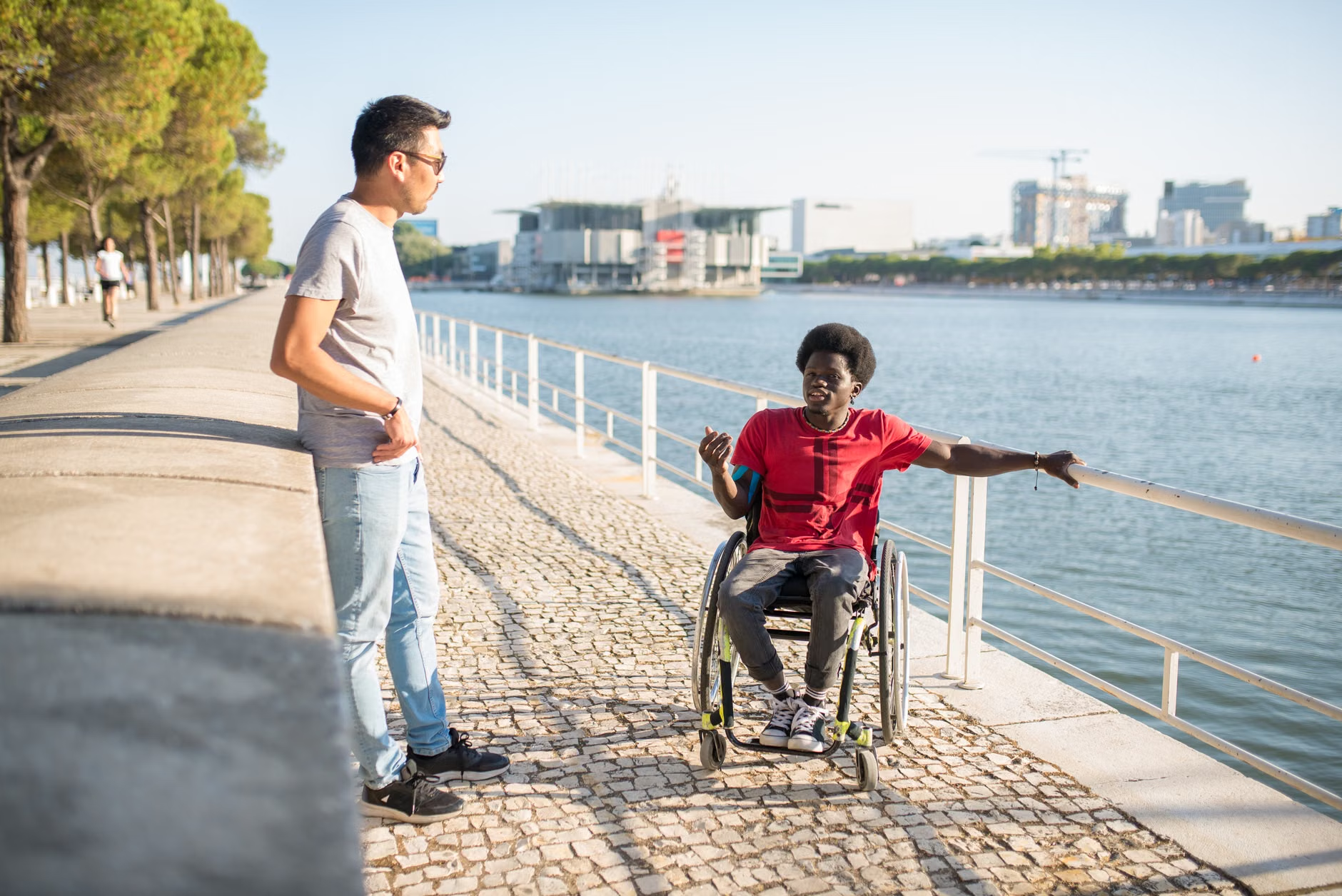
What about the local cafe? The secret to using a cafe as a third space is the ‘regular’ strategy. If you go at the same time on the same day—say, Saturday morning—you stop being a random customer and start becoming a face that others recognize. This small shift in behavior is what turns a commercial space into a community anchor.
Common Misconceptions and Hidden Trade-offs
One common mistake is expecting a third space to solve all your social needs. It won’t. It is not meant to replace deep friendships or family time. In fact, relying on a third space for deep emotional intimacy can be a mistake. These spaces are for light, low-pressure interactions. If you walk into a third space expecting to solve your life’s problems with a stranger, you will likely be disappointed.
Another misconception is that third spaces must be ‘vibrant’ or ‘exciting.’ Often, the best third spaces are boring. They are reliable, consistent, and predictable. If you are a parent with a chaotic work-life schedule, you don’t need excitement; you need a place where the environment doesn’t change, the staff knows your name, and the noise level is predictable. Predictability is the antidote to the anxiety of a modern, fast-paced life.
There is also the ‘cost of time’ trade-off. In your 30s and 40s, time is your most limited currency. Spending an hour at a third space feels like a luxury. However, consider the opportunity cost of not having one. Without a third space, your social life often becomes highly scheduled and demanding (dinner parties, playdates, organized events). A third space allows you to ‘socialize’ without the administrative burden of planning.
How to Integrate a Third Space Into Your Routine
If you don’t have a third space, how do you find one? Start by auditing your local area with a ‘neighborhood walk.’ Look for places that fit the criteria in our table above. Once you identify a candidate, follow this three-step process:
- The ‘Coffee-and-Book’ Test: Visit the space alone for 45 minutes. Do not check your email. Do not finish a work project. Just observe. If you feel comfortable enough to relax, it’s a candidate.
- Consistency is Key: Pick a slot—perhaps Tuesday evenings or Saturday mornings—and stick to it for one month. You need to be there long enough for the ‘regulars’ to notice you.
- The ‘Low-Stakes’ Greeting: You don’t need to be the life of the party. A simple nod or a ‘hello’ to someone you recognize is enough. The goal is to acknowledge the shared space, not to force a friendship.

If you find that your neighborhood lacks these spaces, consider the ‘Micro-Third-Space’ approach. This could be a shared neighborhood WhatsApp group that meets once a month for a park cleanup, or a small book exchange box on your street. You don’t always need a building to create a third space; you need a shared interest and a consistent time and place.
Addressing the ‘Parenting Barrier’
Parents often feel guilty for taking time for themselves in a third space. If you are a parent, reframe this: by participating in a third space, you are modeling community engagement for your children. When your child sees you talking to a neighbor or participating in a community project, they learn that the world is bigger than just their home and their school. It is a vital lesson in civic responsibility and social intelligence.
If you have young children, look for ‘Third Spaces with Benefits.’ A community garden, a public library with a children’s section, or a park near a coffee shop are ideal. They allow you to be ‘present’ for your children while still occupying a space that connects you to the wider community.
Final Thoughts: Why You Should Prioritize This
In the coming years, as our digital lives become more intense and our professional lives more tethered to screens, the value of physical, local, and low-pressure community will only increase. We are not designed to live in an endless loop of work and home. We are social animals who need the ‘third space’ to feel like we are part of something larger than our immediate responsibilities.
Don’t wait for your neighborhood to become a ‘vibrant hub’ before you start engaging. The hub is created by the people who show up. Start small, be consistent, and keep your expectations grounded in the joy of simple, low-stakes connection. Your mental health, and your sense of belonging, will thank you for it.
Frequently Asked Questions
Q: Can a coffee shop really be a ‘third space’ if I have to buy something?
A: Yes, as long as the ‘cost’ of being there doesn’t feel like an entry fee. If a cafe allows you to sit for an hour with a single drink and doesn’t make you feel rushed, it functions as a third space. The danger is when the commercial aspect overrides the social aspect.
Q: What if I am an introvert and find the idea of ‘socializing’ at a third space intimidating?
A: The beauty of a third space is that you don’t actually have to socialize. You can practice ‘civil inattention’—acknowledging others with a polite nod while remaining in your own world. The psychological benefit comes from the shared presence, not necessarily from deep conversation.
Q: How do I know if a space is ‘safe’ or ‘good’ for my family?
A: Trust your instincts. A good third space is one where you feel a sense of ‘passive surveillance’—where people look out for one another without being intrusive. If you feel relaxed and your children are engaged, it’s a good sign. If you feel like you are constantly on edge, look for a different anchor point.
For further reading on the sociology of community spaces, you can explore resources from the Project for Public Spaces, which offers detailed insights on how to foster better community-centered environments.