The “Right to Disconnect” in 2026 has evolved from a progressive HR buzzword into a tangible, legally enforceable standard in many jurisdictions, meaning you are no longer professionally obligated to respond to non-urgent digital communications outside of your contracted working hours.
- Legal Reality: In countries with active legislation, the Right to Disconnect is a protected labor right, not just a company policy; employers can be penalized for systemic after-hours demands.
- The “Urgency” Threshold: The law rarely bans all after-hours contact; it differentiates between “emergency operational needs” and “routine administrative requests.”
- Proactive Documentation: You are responsible for setting digital boundaries; using “scheduled send” features and documented communication preferences is your best defense against burnout.
If you are in your 30s or 40s, the “always-on” culture of the mid-2010s feels like a distant, exhausting memory. You remember when the ping of an email at 9:00 PM felt like a mandatory summons. Today, the landscape is shifting. As we navigate 2026, the global conversation has moved past “work-life balance” rhetoric and into the messy, practical application of the Right to Disconnect.
But what does this actually mean for your Tuesday evening dinner with your family? Does it mean you can ignore your boss, or will you be the “difficult” employee who isn’t a team player? Let’s break down the current state of these laws and how you can actually use them to reclaim your evenings.
Understanding the Legal Landscape: It Isn’t One-Size-Fits-All
The most common mistake people make is assuming that the Right to Disconnect is a universal, global law. It isn’t. As of 2026, we see a fragmented map of enforcement. In the European Union, the momentum is strong, with many member states enshrining this right into national labor codes. In Australia, recent legislative updates have solidified the right to ignore unreasonable contact, while in the United States, the concept remains largely within the realm of company-level collective bargaining agreements rather than federal statute.
If you work for a multinational corporation, your “rights” might be determined by the headquarters’ location or the specific employment contract you signed. Understanding your local jurisdiction is the first step. You need to verify if your country has an explicit “Right to Disconnect” law or if it falls under “General Duty of Care” workplace safety regulations.
For those in jurisdictions without specific laws, you are not powerless. You are simply operating in the realm of negotiated boundaries rather than statutory protection. This requires a different, more strategic approach to communication.

Defining “Reasonable” vs. “Unreasonable” Communication
The core of the 2026 debate is the definition of “unreasonable.” If a server goes down at 11:00 PM and you are in IT, that is an operational necessity. If your manager sends a Slack message asking for a status update on a project due next week, that is a violation of the spirit—and increasingly, the letter—of disconnect laws.
To navigate this, you need to categorize your communication. Not all pings are created equal. We can use a simple decision matrix to determine whether you are legally or professionally obligated to respond.
| Communication Type | Obligation Status | Action Strategy |
|---|---|---|
| Critical System Failure | High | Respond immediately; document time spent. |
| Client Emergency | Conditional | Assess if it can wait until morning; if not, log as overtime. |
| Non-Urgent Planning/Admin | Low/None | Schedule response for the next working day. |
Why does this distinction matter? Because if you treat every email as an emergency, you are effectively training your colleagues to view you as an “always-on” resource. By consistently responding to non-urgent requests at 9:00 PM, you are creating a self-imposed expectation that is hard to walk back later.
The Practical Toolkit for Enforcing Your Boundaries
You don’t need to be a lawyer to enforce your right to disconnect; you need to be a master of digital hygiene. In 2026, technology is both the problem and the solution. Here is how you can use the tools at your disposal to create a “digital wall.”
1. Master the “Scheduled Send” Feature
If you are a night owl or someone who gets their best work done after the kids are asleep, stop sending emails at 11:00 PM. Even if you don’t expect a reply, the notification on your colleague’s phone creates an implicit pressure. Use the “Schedule Send” function to have your email arrive at 8:30 AM the next day. This respects their boundaries and keeps your work visibility high without being intrusive.
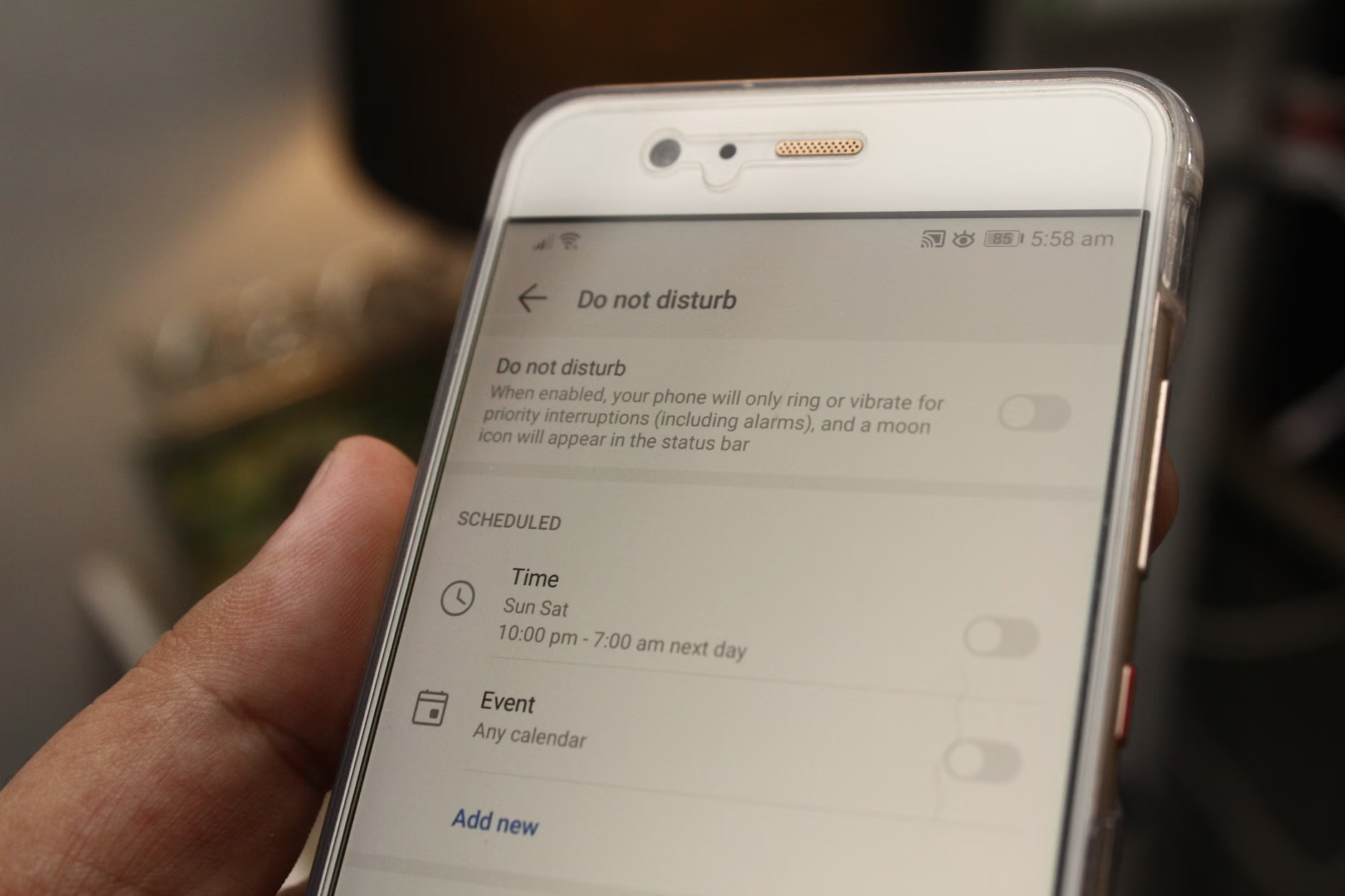
2. Customize Your “Do Not Disturb” Profiles
Modern operating systems allow for granular control. Set up a “Work Focus” mode that automatically kicks in at 6:00 PM. Configure it so that only calls from your direct manager or critical system alerts can bypass the block. Everything else goes to a silent notification center that you check on your own terms, not when the phone vibrates.
3. The “Communication Charter” Conversation
If you are in a leadership position, or if you have a good relationship with your manager, propose a “Communication Charter.” This doesn’t have to be a formal legal document. It can be a simple one-page agreement that states: “Our team aims to keep non-urgent communication within the 9-to-6 window. If something is truly urgent, please send a text or call, otherwise, email is fine for the next morning.”
This simple act removes the guesswork. It moves the conversation from “I’m being lazy” to “I’m being efficient and respectful of our collective output.”
Common Misconceptions That Lead to Burnout
There is a dangerous misconception that “Right to Disconnect” means “Right to be Unresponsive.” This is not the case. It is about the timing of the response, not the absence of one. If you completely ghost your team, you are not exercising a right; you are neglecting your professional duties.
Another common mistake is the “all-or-nothing” approach. You might think, “Well, the law says I can disconnect, so I will never check my email after 5:00 PM ever again.” That’s a noble sentiment, but if you work in a global team spanning three time zones, that approach will eventually lead to friction. Instead, aim for asynchronous communication. If you can’t be available when they are, ensure your documentation is so good that they don’t need to ask you a question in the first place.
The most overlooked variable in this entire conversation is managerial modeling. If your boss sends emails at midnight, you will feel pressured to respond, regardless of the law. If you find yourself in this situation, the most effective tool is a light, professional touch: “I saw your note from last night. I’ve scheduled my response for this morning so I could give it the focus it deserves.” This is a polite, firm way of saying, “I am not looking at my email at midnight.”

Why This Matters for Your 30s and 40s
Let’s be real: this is the decade where life gets complicated. You are likely balancing a career that requires your best output with personal responsibilities—be it parenting, caring for aging parents, or simply trying to maintain a semblance of a social life. The “always-on” culture is the single biggest threat to your long-term career sustainability.
Burnout isn’t just about being tired; it’s about the erosion of your ability to recharge. When your work is constantly bleeding into your home life, you never fully “power down.” Your brain stays in a state of low-level, chronic stress. By 2026, we have enough data to show that employees who successfully disconnect are more productive, more creative, and—crucially—stay in their roles longer than those who don’t.
The Right to Disconnect is not about doing less work. It is about doing your work within a structure that allows you to be a human being, not just a node in a corporate network. If you are in your 30s, this is the time to build these habits. If you are in your 40s, you are the person who can model this for the younger generation coming up behind you.
Actionable Steps for Tomorrow Morning
If you feel like your current work environment is encroaching on your personal time, don’t try to change the entire company culture in one day. Start with these three steps:
- Audit your notifications: Turn off all work-related push notifications on your personal phone. If you need to check, you will open the app. Don’t let the app demand your attention.
- Set a “Shutdown Routine”: Spend the last 15 minutes of your workday writing down the three most important things you need to do tomorrow. Clear your inbox of anything that doesn’t need an immediate response. Closing your laptop with a clear plan is the best way to signal to your brain that the workday is over.
- Communicate your hours: Add a small line to your email signature or Slack status: “I typically check and respond to emails between 8:30 AM and 5:30 PM. If your message is urgent, please call.” It’s a small, non-aggressive way to manage expectations.
Remember, the Right to Disconnect is a tool, not a shield. You have to pick it up and use it. If you allow your boundaries to be crossed repeatedly, you are signaling that they don’t matter. Stand your ground, be professional, and prioritize your longevity. You are the only one who can truly protect your time.
Frequently Asked Questions
Does the Right to Disconnect apply to remote workers differently?
Yes, often in practice, if not in law. Remote workers face a higher risk of “work-life blur” because the physical boundary of the office is gone. While legal protections are the same, remote workers must be more intentional about creating physical and temporal rituals—like “closing” the home office door or changing clothes—to signal the end of the workday to themselves and their housemates.
Can I be fired for not answering an after-hours email?
In jurisdictions with strict Right to Disconnect laws, it is illegal for an employer to terminate someone for refusing to perform work outside of their contracted hours. However, in regions without such laws, it falls under the “at-will” employment doctrine. This is why it is critical to frame your boundaries as a matter of productivity and professionalism rather than just a refusal to work.
What if my boss says that “everyone else” is working after hours?
This is a classic attempt to use social pressure to override your boundaries. The best response is to focus on your individual output: “I’ve found that I’m most effective when I can focus on deep work during my core hours, and I’ve structured my tasks to ensure all deadlines are met within that timeframe. I’m happy to discuss how we can better coordinate our workflows during the day to avoid the need for after-hours check-ins.”
For further reading on labor rights and workplace trends, you can refer to the International Labour Organization (ILO) for global standards or your specific regional labor department’s website for local statutes.