Hello! Today, I’d like to have a deep conversation about our children’s precious eyes. As parents, we often wonder, “Is my baby really looking at my face?” or “Is it okay if their eyes seem a bit out of focus sometimes?”
A child’s vision is something that, once the development window is missed, can lead to ‘amblyopia’ (lazy eye), where vision doesn’t improve even with glasses. Since children can’t express their discomfort, our careful observation as parents is more important than anything else. Today, I’ll walk you through everything from the vision development process and how to use mobiles, to critical symptoms like strabismus and epiblepharon.
The Wonder of Baby Vision Development
Actually, a newborn baby sees the world like a very blurry ink wash painting. At birth, their vision is only about $0.01$ to $0.02$, barely enough to distinguish brightness or the shapes of large objects. The reason newborns see the world mostly in black and white is that the cone cells responsible for distinguishing colors are not yet fully developed.
However, by around 2 months, they start to make eye contact, and by 3 to 4 months, they can distinguish primary colors and follow a moving rattle with their eyes. By age 3, vision is around $0.5$, and it’s not until age 5 or 6 that it reaches the adult level of $1.0$. Vision completes its development faster than you might think! This ‘golden time’ is when detecting issues can determine a child’s lifelong eye health.

Mobiles: Are They Really Effective for Vision?
The “must-have” parenting item: the mobile! If you thought it was just for distracting or soothing a baby, think again. A mobile is an excellent ‘visual training tool’ that connects a baby’s visual cells to their brain nerves.
- Black and White Mobiles (Birth to 3 Months): Clear contrast between black and white patterns maximizes retinal stimulation. At this stage, sharp contrast is more effective for development than flashy colors.
- Color Mobiles (After 3 Months): Once they start recognizing color contrasts, switch to mobiles with primary colors like red, yellow, and blue. This helps them learn depth perception and perspective.
💡 SoCooly’s Installation Tip!
It’s best to install the mobile about 20 to 30 cm away from the baby’s eyes. If it’s too far, they can’t see it; if it’s too close, it can cause ‘pseudo-esotropia,’ where the eyes look excessively crossed. Also, try moving the mobile slightly from side to side to help the baby use their eye muscles at various angles.
Eyes Turning In or Out? Watching for ‘Pediatric Strabismus’
Sometimes you might notice a baby’s pupils turning inward or outward. This is called ‘strabismus.’ It’s not just an aesthetic issue; it prevents the eyes from working together, leading to poor depth perception and, in severe cases, amblyopia.
- Pseudostrabismus: Many babies have a wide nasal bridge and low nose, where the skin near the inner eye covers the white part. This makes them look cross-eyed when they actually aren’t. It usually resolves as the bridge of the nose grows higher.
- Intermittent Exotropia: This is when one eye turns outward occasionally, often when the child is tired or daydreaming. This is quite common, so if your child is unusually sensitive to sunlight or squints frequently, keep a close watch.
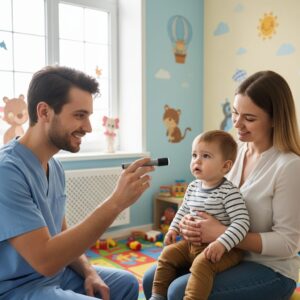
Watery Eyes? Could It Be ‘Epiblepharon’ (Ingrown Lashes)?
If your child frequently rubs their eyes or if they are often watery, you should suspect ‘epiblepharon.’ This occurs when a fold of skin and muscle pushes the eyelashes inward, causing them to rub against the cornea.
Constant scratching from eyelashes can cause wounds and inflammation, and in severe cases, it can lead to corneal scarring and vision loss. Fortunately, as a child’s facial structure changes and baby fat decreases, it often improves naturally. However, if the child is in pain or the redness is severe, you should consult an ophthalmologist for eye drops or a simple procedure.
When Is the Right Time for an Eye Exam?
Many parents think infant health checkups are enough, but for a more precise check, remember the ‘3-6-1 Rule’:
- 6 Months Old: The first gate to check eye alignment (strabismus) and congenital diseases.
- Age 3: Children can recognize numbers or pictures, allowing for relatively accurate vision measurement. This is the most critical time to detect amblyopia or refractive errors (nearsightedness, farsightedness).
- Before Elementary School (Age 6): Vision development is nearly complete. A final check is needed to ensure there are no obstacles to school life.

Daily Habits to Protect Your Child’s Eyes
- Avoid Smartphones: Try to avoid screen exposure for children under 2. Near-work strains the lens muscles and is a major cause of myopia (nearsightedness).
- Plenty of Outdoor Activity: Spending time in the sun helps release dopamine, which prevents abnormal growth of the eyeball. One hour of sunlight a day is a natural vision protector!
- Maintain Proper Distance: Keep a distance of at least 30 cm when reading or drawing, and keep the lighting bright enough so there are no shadows.
Children don’t say, “Mom, it’s blurry.” They adapt, thinking that’s just how the world looks. The power to protect a child’s lifelong vision starts with a parent’s ‘loving observation.’ Why not make eye contact with your child one more time today?
Reference Sites:
American Academy of Ophthalmology (AAO): (https://www.aao.org)
American Association for Pediatric Ophthalmology and Strabismus (AAPOS): (https://www.aapos.org)
Mayo Clinic – Pediatric Eye Conditions: (https://www.mayoclinic.org)
※ This post was developed with AI support for data gathering and initial structure, then extensively refined and verified by the author for quality and reliability.