Hello there! Today, we’re going to dive deep into a topic that keeps many parents up at night: those precious, long-awaited first steps. If you’ve been scrolling through social media and seeing other babies your child’s age—or even younger—galloping around while your little one is still contentedly sitting on the carpet, I want you to take a deep breath. You’re not alone, and in most cases, your child is just taking their own sweet time to explore the world.
As parents, it’s only natural to compare. We look at growth charts, milestone apps, and the “competition” at the playground. But walking is a complex skill, a culmination of months of strength-building and brain development. So, let’s unpack everything you need to know about the “late walker,” the milestones leading up to that big day, and how you can support your child without the stress.
👣 When Do Babies Usually Start Walking? The Global Reality
First, let’s talk about the “normal” range. While many parents believe the 12-month mark is a strict deadline, the reality is much broader. Most pediatric organizations, including the American Academy of Pediatrics (AAP) and the World Health Organization (WHO), suggest that babies typically start walking independently anywhere between 9 and 18 months.
Yes, you read 그게 right—up to 18 months! A child who starts walking at 17 months is still considered within the typical developmental range. Walking isn’t just about leg strength; it involves balance, depth perception, and the confidence to let go. Every baby’s internal “readiness” clock is set a little differently.
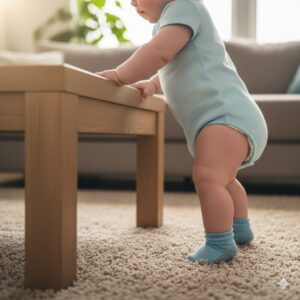
🌟 The Building Blocks: Stages Before the First Step
Walking doesn’t happen in a vacuum. It’s the final act of a long series of motor skill developments. If your baby is hitting these preceding milestones, they are likely on the right track:
- The Foundation (Tummy Time & Rolling): It starts here. Building neck and core strength is the first step toward eventually standing upright.
- Sitting Independently (6–8 months): This shows their trunk muscles are getting strong enough to support their weight.
- Crawling and Scooting (7–10 months): This is crucial for cross-body coordination—the brain learning to use the left and right sides of the body together.
- Pulling to Stand (9–11 months): This is a huge win! It means their leg muscles are ready to take on the force of gravity.
- Cruising (10–13 months): This is when your baby “walks” by holding onto furniture. They are practicing weight shifting and balance while having a safety net.
- Standing Alone (11–14 months): The “look Ma, no hands!” moment. This requires immense core stability and neurological maturity.
If your child is “cruising” along the sofa but won’t let go, they aren’t “failing”—they are simply practicing!
🧐 Is My Baby Truly “Behind”? A Parent’s Self-Checklist
While we want to be patient, it’s also our job to stay observant. If you’re worried, use this checklist to see if your baby’s development is progressing or if it might be time to have a chat with a professional.
✅ Developmental Progress Checklist
- Muscle Tone: Does your baby feel “floppy” when you pick them up, or are they extremely stiff? Most babies should have a “just right” feel to their muscles.
- Symmetry: Is your baby using both sides of their body equally? For example, do they crawl using both legs, or do they seem to “drag” one side?
- The 12-Month Milestone: By one year, is your baby at least pulling themselves up to a standing position?
- Engagement: Is your baby interested in moving toward toys or people? Sometimes a lack of walking is simply a lack of motivation!
- Weight Bearing: When you hold your baby upright with their feet on the floor, do they try to support some of their weight, or do their legs immediately collapse?

⚠️ A Special Note on “Bottom Shufflers”
Have you ever seen a baby who doesn’t crawl but instead scoots around on their bottom? Pediatricians often call them “bottom shufflers.” If your child is a shuffler, don’t panic! Research shows that bottom shufflers often walk later than crawlers—sometimes not until 18 to 20 months. Why? Because they’ve found a very efficient way to get around while keeping their hands free to play. They simply don’t feel the “need” to stand up as early as a crawler does.
🏃♂️ How to Encourage Those First Steps (The Low-Pressure Way)
As a fellow parent who has been through the “waiting game,” I know how tempting it is to buy every “walk-assist” toy on the market. But sometimes, less is more.
1. Let Them Go Barefoot! 🦶
This is one of the best pieces of advice I ever received. While those tiny sneakers are adorable, babies learn to walk best when they are barefoot. Their toes need to “grip” the floor, and the nerves in their feet send vital feedback to the brain about balance and texture. Save the shoes for outdoor protection only.
2. Create a “Cruising Circuit” 🏠
Arrange your furniture so there are small, safe gaps between the sofa, a sturdy chair, and a low table. This encourages your baby to let go of one “anchor” to reach for the next. Make sure the area is carpeted or has a soft mat to make falls less scary.
3. Ditch the Baby Walker 🛒
In many countries, traditional “sit-in” walkers are actually discouraged or even banned (like in Canada). They can be dangerous and, surprisingly, they don’t help babies walk faster. In fact, they can teach babies to walk on their tiptoes and prevent them from developing the necessary “fall-and-recovery” skills. A “push-toy” (like a toy grocery cart) is a much better alternative once they are already standing.
4. Positive Reinforcement (The “Cheerleader” Method) 👏
When your baby takes that first wobbly step and inevitably falls on their diaper, don’t gasp or look worried. If you act like it’s a disaster, they’ll think it’s a disaster! Instead, clap and say, “Whoa! You did it! Big try!” Making the process fun and low-stakes is key.

🩺 When to Call the Pediatrician: The “Red Flags”
Trust your gut, but also look for these specific indicators that might suggest a need for physical therapy or a medical evaluation:
- No standing or pulling up by 12 months.
- Inability to walk independently by 18 months.
- Consistently walking on tiptoes for several months (this can sometimes be a sign of tight Achilles tendons or other issues).
- A “regression” in skills—if they used to stand but now can’t or won’t.
- Extreme clumsiness that seems beyond the “toddler waddle” phase.
Most of the time, a few sessions of pediatric physical therapy can work wonders, giving your child the specific exercises they need to find their balance.
💖 A Final Word of Encouragement
I want to leave you with this: Your child’s walking age is not an IQ score. It’s not a reflection of your parenting. Some of the world’s most brilliant athletes and thinkers didn’t walk until they were nearly two years old.
Think of this time as your baby’s “quiet before the storm.” Once they start running, your life will change forever (and your cardio workout will begin!). Enjoy these last few weeks or months of them being relatively stationary. They will get there, and when they do, they’ll be so proud of themselves—and you’ll be right there to catch them.
Hang in there, parents. You’re doing a great job, and your little “late bloomer” is lucky to have you.
🔗 Reliable Resources for Global Parents
- CDC (Centers for Disease Control and Prevention) – Milestone Tracker: https://www.cdc.gov/ncbddd/actearly/milestones
- Pathways.org – Trusted Milestones for Every Age: https://pathways.org
- HealthyChildren.org (Powered by the AAP): https://www.healthychildren.org
※ This post was developed with AI support for data gathering and initial structure, then extensively refined and verified by the author for quality and reliability.
👉 Related Posts
Is Your Child a Late Talker? Reality Parenting Tips to Reduce Anxiety and Spark Language Development