Three Key Takeaways for Rail-First Travel:
- Reduced “Transition Friction”: Unlike air travel, rail travel eliminates the 3-hour pre-flight arrival, security queues, and cramped boarding, turning travel time into “living time.”
- The 4-Hour Rule: For any trip under 4 hours, rail is almost always faster and significantly less stressful than flying when door-to-door transit time is calculated.
- Cost-Efficiency through Planning: Booking rail tickets 8–12 weeks in advance often yields dynamic pricing that rivals budget airlines while offering significantly more legroom and baggage flexibility.
The smartest way to travel with a family in your 30s and 40s isn’t about finding the fastest flight; it’s about reclaiming the time you currently spend standing in security lines. The ‘Rail-First’ strategy is simple: evaluate the train as your primary mode of transport before even opening a flight comparison engine. For many families, this shift doesn’t just reduce carbon footprints—it fundamentally changes the quality of the vacation by removing the “airport scramble.”

Why Your Airport Routine is Costing You More Than Money
If you have kids, you know the “airport tax” isn’t just the price of the ticket. It’s the 3:00 AM alarm, the frantic liquid-bag sorting, the stress of the gate-check stroller, and the inevitable mood crash that happens somewhere between the baggage claim and the rental car counter. When we talk about the ‘Rail-First’ strategy, we are talking about mitigating “transition friction.”
Transition friction is the cumulative stress of moving from your home to your destination. In aviation, this friction is high. You have to arrive early, remove shoes, manage carry-ons, and navigate complex terminal layouts. By contrast, rail travel is linear. You arrive at the station, walk onto the platform, and sit down. The transit time is your time. You can read, play games, or even work without the constant interruptions of “fasten seatbelt” signs or turbulence.
Data consistently shows that for journeys under 500 kilometers (approx. 300 miles), the total time spent traveling by train—from city center to city center—is often lower than flying. When you account for the time spent traveling to airports (which are usually on the outskirts of cities), the math shifts heavily in favor of the tracks.
The 4-Hour Decision Rule: When to Choose the Rails
How do you decide when to stick to the rails? We use a decision rule called the “4-Hour Threshold.” If the train journey takes 4 hours or less, it is almost always the superior choice for a family. Why? Because a 4-hour flight actually consumes about 7 to 8 hours of your day once you factor in airport arrival, security, boarding, taxiing, and deplaning.
Let’s compare a hypothetical scenario: A family of four traveling from Paris to Lyon or New York to Washington D.C.
| Factor | Air Travel | Rail Travel |
|---|---|---|
| Commute to Hub | 60-90 minutes | 20-30 minutes (City center) |
| Pre-departure wait | 120 minutes | 15-20 minutes |
| Transit time | 60 minutes | 120-180 minutes |
| Post-arrival exit | 45 minutes | 5 minutes |
| Total Effort | High (Stressful) | Low (Relaxed) |
When you choose the train, you aren’t just saving time; you are saving your “emotional bandwidth.” By the time you arrive at your destination, you aren’t exhausted from the logistical nightmare of the airport. You are ready to start your vacation immediately.

Mastering the Logistics: A Step-by-Step Guide
Transitioning to a rail-first mindset requires a bit of planning. Unlike airlines, which are fairly standardized, rail systems vary wildly by region. Here is how to execute this strategy effectively.
1. Master the Booking Windows
In most countries (especially in Europe with operators like SNCF, DB, or Trenitalia, and in parts of Asia), tickets are released on a rolling basis, often 90 to 120 days out. Unlike airlines, which fluctuate prices based on cookies and demand, rail operators often use a tier-based system. The earlier you book, the lower the price. If you wait until two weeks before, you will pay the “last-minute” premium, which can be significantly higher than the early bird rates.
2. The “Seat Logic” for Families
Always look for “Family Zones” or “Club/Saloon” cars. Many modern high-speed trains (like the Shinkansen in Japan or the ICE in Germany) offer configurations that allow for groups of four to sit around a table. This is the “secret sauce” for family rail travel. It creates a dedicated space for meals, arts and crafts, or a quick nap for the kids. Always prioritize booking these seats as soon as the window opens; they are the first to sell out.
3. Luggage Management
One of the hidden benefits of rail is the lack of strict weight limits. However, don’t overpack just because you can. You are still responsible for moving your own bags through the station. Aim for the “one-bag-per-person” rule. If you have a stroller, ensure it is a lightweight, collapsible model. Most high-speed trains have dedicated luggage racks at the ends of carriages, but having a smaller bag that fits under the seat is vital for keeping your most essential items (snacks, electronics, medicine) within reach.
4. The “Station-to-Hotel” Connection
The biggest mistake travelers make is ignoring the “last mile.” Always check where the train station is in relation to your hotel. If you are arriving in a new city, map out the connection before you leave home. Is it walkable? Is there a metro line? Knowing exactly how you get from the station to your accommodation eliminates the stress of hunting for a taxi or an Uber with tired children in tow.
Common Misconceptions and Hidden Trade-offs
It’s important to be realistic. Rail travel isn’t a magical solution for every single trip. There are trade-offs you need to consider before committing.
The Cost Illusion: People often assume trains are more expensive than flying. While a last-minute train ticket can be pricey, when you add up baggage fees, airport transfers, and the cost of meals at the airport, the price gap often closes. Always calculate the Total Trip Cost, not just the ticket price.
Reliability Factors: In some regions, rail networks suffer from strikes or infrastructure delays. Check the operator’s website for their “Delay Compensation” policy. Most major rail lines have clear, automated processes for partial refunds if a train is significantly delayed—something that is often a nightmare to navigate with budget airlines.
Connectivity Issues: Don’t assume high-speed Wi-Fi will be available or reliable. If your kids rely on streaming for entertainment, download all movies and games to their devices before you leave. Treat the train as an “offline zone” where possible, and you’ll find it’s much easier to manage expectations.
Beyond the Comfort: The Developmental Benefits
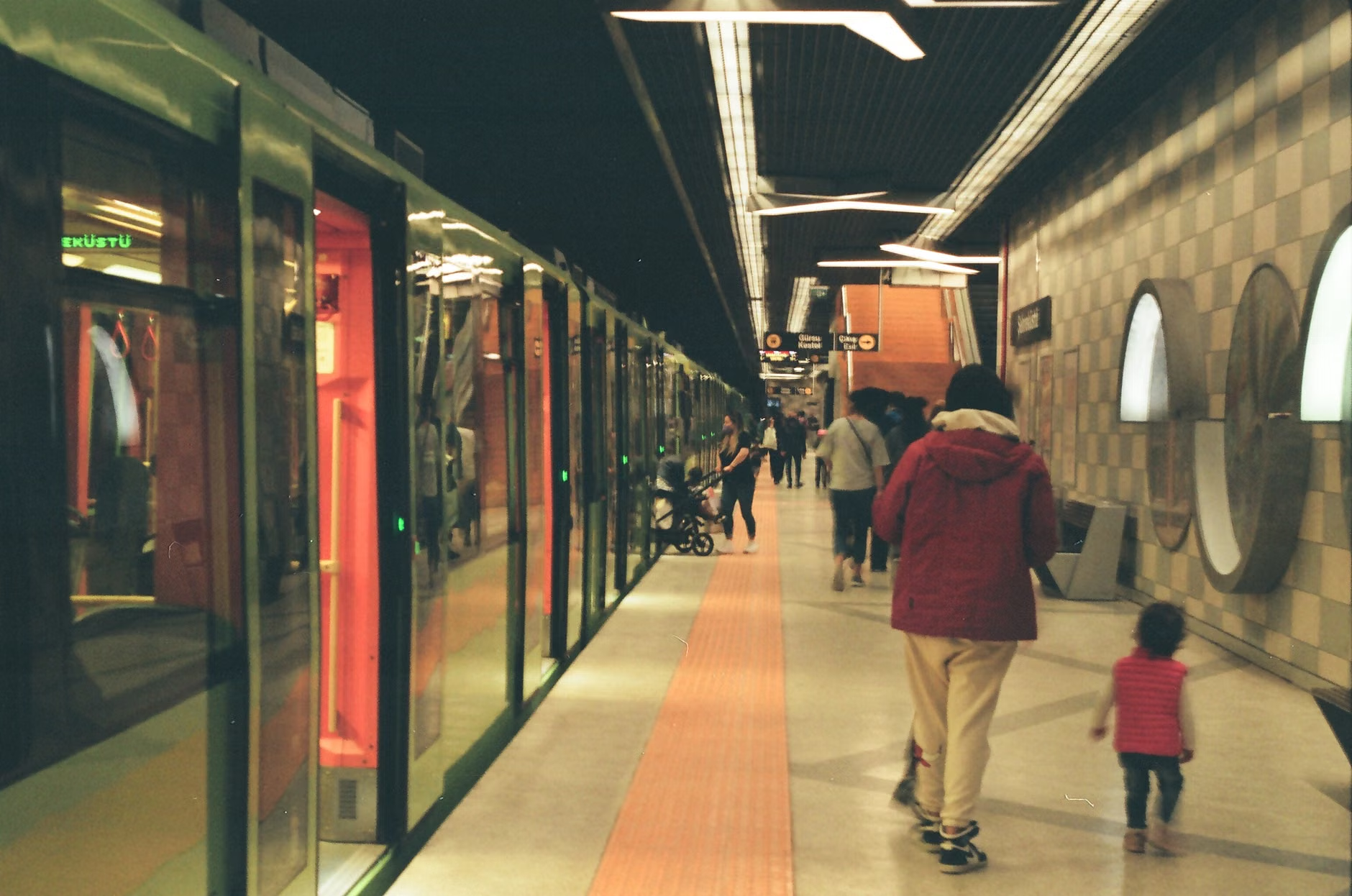
There is an overlooked variable in rail travel: the sensory experience for children. Flying is sterile and isolating. You are inside a pressurized tube with no connection to the outside world. On a train, the landscape changes. You see the transition of geography, architecture, and climate. For children, this is a geography lesson in real-time. It helps them understand the scale of the world in a way that “teleporting” via airplane simply cannot.
Furthermore, the social environment of a train is generally more relaxed. You are encouraged to walk around, visit the bistro car, and interact with the environment. This freedom of movement is a game-changer for parents trying to manage the energy levels of toddlers or pre-teens. It allows for a “rhythm” to the day that is impossible to achieve in a seat-belt-restricted environment.
Implementing the Strategy: A Checklist for Your Next Trip
To successfully transition to a rail-first family, follow this decision matrix for your next vacation:
- Check the distance: Is it under 600km? If yes, prioritize rail.
- Check the timing: Is the rail journey under 5 hours? If yes, the rail experience will likely be more pleasant than flying.
- Check the station location: Can you walk or take a single taxi/bus to your hotel? If yes, the convenience factor is high.
- Check the luggage: Can you manage your bags without assistance? If yes, you are ready for the platform.
If you find that the train journey is longer than 6 hours, or involves multiple complex transfers with heavy luggage, that is the moment to reconsider flying. Don’t be a purist—be a strategist. Use the train when it makes your life easier, and fly when the distance demands it. The goal is to reduce the friction of your life, not to make travel harder for the sake of an ideal.
Advanced Tips for Frequent Rail Travelers
Once you’ve mastered the basics, consider these “pro-level” tactics to make your family trips even smoother:
Use Multi-City Passes: If you are planning a trip through Europe or parts of Asia, look into regional rail passes (like the Eurail Pass or JR Pass). While these aren’t always cheaper than individual tickets, they offer “hop-on, hop-off” flexibility that is invaluable when traveling with kids. If a child is having a rough day, you can get off at a random station, explore a park for two hours, and catch the next train without having to buy a new ticket.
The “Picnic” Strategy: Airport food is notoriously overpriced and unhealthy. One of the best parts of rail travel is that there are no restrictions on bringing your own food. Visit a local market or a high-quality grocery store before you head to the station. Pack a “travel picnic” with fruits, cheeses, breads, and drinks. Not only does this save a significant amount of money, but it turns the meal into an event that the kids look forward to.
Download the Operator’s App: Every major rail system now has a dedicated app. This isn’t just for tickets. It’s for real-time platform updates, seat maps, and, most importantly, notifications about potential delays. Keep your notifications turned on for the day of travel. If a track change occurs, you’ll know before the rest of the crowd does, allowing you to reposition your family calmly.
The Long-Term Impact on Your Travel Life
When you shift to a rail-first approach, you aren’t just changing how you get from point A to point B. You are changing your relationship with travel itself. You stop viewing the journey as a “necessary evil” to be endured and start viewing it as a part of the holiday. The memories of playing cards, watching the sunset over the countryside, and sharing a meal while moving through the landscape become part of the trip’s narrative.
In your 30s and 40s, time is your most precious commodity. You don’t have time to waste in airport security or recovering from the stress of a cramped, delayed flight. By choosing the rail, you are choosing to prioritize your family’s peace of mind. It’s a small, practical adjustment that pays dividends in the quality of your time together.
Next time you start planning a weekend getaway or a summer vacation, don’t instinctively go to the flight search. Look at the map. Look at the rail lines. You might find that the best way to get there is already right under your feet.
Frequently Asked Questions
1. Is rail travel actually cheaper than budget airlines?
It depends on your booking window. If you book 8-12 weeks in advance, rail prices are often very competitive with budget airlines, especially when you factor in the “hidden” costs of flying, such as checked baggage fees, seat selection fees, and the cost of traveling to and from remote airports. Budget airlines often charge extra for everything, whereas rail fares usually include a standard level of comfort and luggage allowance.
2. What should I do if my kids get restless on a 4-hour train ride?
The beauty of the train is the ability to move. If the kids get restless, take a walk to the bistro car or simply walk to the end of the carriage and back. Most modern trains also have more space than planes, allowing for activities like card games or drawing at the table. We recommend a “travel kit” with new, small activities (stickers, coloring books, or a new small toy) that only come out once you are seated on the train to keep the novelty high.
3. How do I handle transfers between trains?
Always aim for at least a 30-minute buffer if your itinerary requires a transfer. While many rail systems are punctual, a 10-minute transfer is too stressful with children and luggage. If you have a choice, pick a direct route even if it’s slightly more expensive; the cost of a direct ticket is almost always worth the peace of mind of not having to navigate a busy platform with a family in tow.
For more information on planning your next rail journey, check the official resources for your region, such as Eurail for European travel, Japan Rail Pass, or Amtrak for North American routes.