The most effective way to reclaim your identity after years of dedicated parenting is to stop viewing “hobbies” as an optional luxury and start treating them as a non-negotiable maintenance task for your mental health.
- The “Identity Gap”: You aren’t losing your parenting skills; you are re-integrating the parts of your personality that were temporarily sidelined by the demands of early childcare.
- Micro-Habit Implementation: Don’t wait for a “free weekend.” Success in your 30s and 40s requires slotting activities into 15-minute windows rather than waiting for hours of uninterrupted time.
- The Feedback Loop: Choose hobbies that provide visible, tangible progress to combat the “invisible labor” fatigue that defines most modern parenting.
Moving Past the “Parent-Only” Mindset
If you are in your 30s or 40s, you likely spent the last few years operating in a state of high-alert, reactive living. When your primary job is keeping small humans alive, your brain naturally prioritizes efficiency and safety over exploration and creativity. This is a biological necessity, but it leaves a void once the intensity of the early years shifts. Many people wake up one day and realize they have no idea what they do for “fun” outside of scrolling social media or watching streaming services.
This isn’t just a lack of interest; it is a form of cognitive burnout. When your entire schedule is dictated by school runs, meal prep, and work deadlines, the idea of a “hobby” feels like just another item on an impossible to-do list. The mistake most people make is trying to jump back into a hobby with the same intensity they had in their 20s. You don’t need a four-hour block of uninterrupted time to be a painter, a coder, or a hiker. You need a strategy that acknowledges your current constraints.

Why Your Brain Needs a “Non-Productive” Outlet
In our current professional and domestic culture, we are obsessed with “optimization.” We want our exercise to be efficient, our reading to be educational, and our rest to be restorative. However, the true value of a post-parenting hobby lies in its lack of utility. If you take up photography, you aren’t doing it to become a professional; you are doing it to force your brain to focus on light, composition, and the present moment. This is a direct antidote to the “future-tripping” that parenting requires (e.g., “What’s for dinner tomorrow?” or “Did I sign that permission slip?”).
Research into “leisure-based identity” suggests that having a hobby that is entirely disconnected from your family role acts as a psychological buffer. It creates a space where you are judged only by your own standards. When you are a parent, you are constantly being evaluated by teachers, family, and society. When you are a hobbyist, the only person you need to satisfy is yourself. This autonomy is vital for emotional regulation.
The “Identity-Utility” Matrix
To choose the right hobby, you should categorize your potential interests based on the type of energy they replenish. Not all hobbies are created equal when you are already exhausted.
| Hobby Type | Primary Benefit | Best For |
|---|---|---|
| Crafting/Manual | Tangible output, reduced screen time | Those who work at a computer all day |
| Physical/Movement | Endorphin release, stress reduction | Those who feel “stuck” or sedentary |
| Learning/Intellectual | Cognitive stimulation, focus | Those who feel their brain is “mushy” from routine |
If you spend your day managing complex social dynamics at work or home, avoid hobbies that require constant social interaction. If you spend your day in isolation, look for communities or clubs. The goal is to provide a contrast to your daily grind.
How to Start Without Overwhelming Your Schedule
The most common failure point is the “equipment trap.” You buy the expensive DSLR camera, the high-end mountain bike, or the complete set of pottery supplies, and then they sit in the corner of your room, becoming a source of guilt rather than joy. This is the “sunk cost fallacy” in action. Instead, use the “Low-Friction Entry” method.
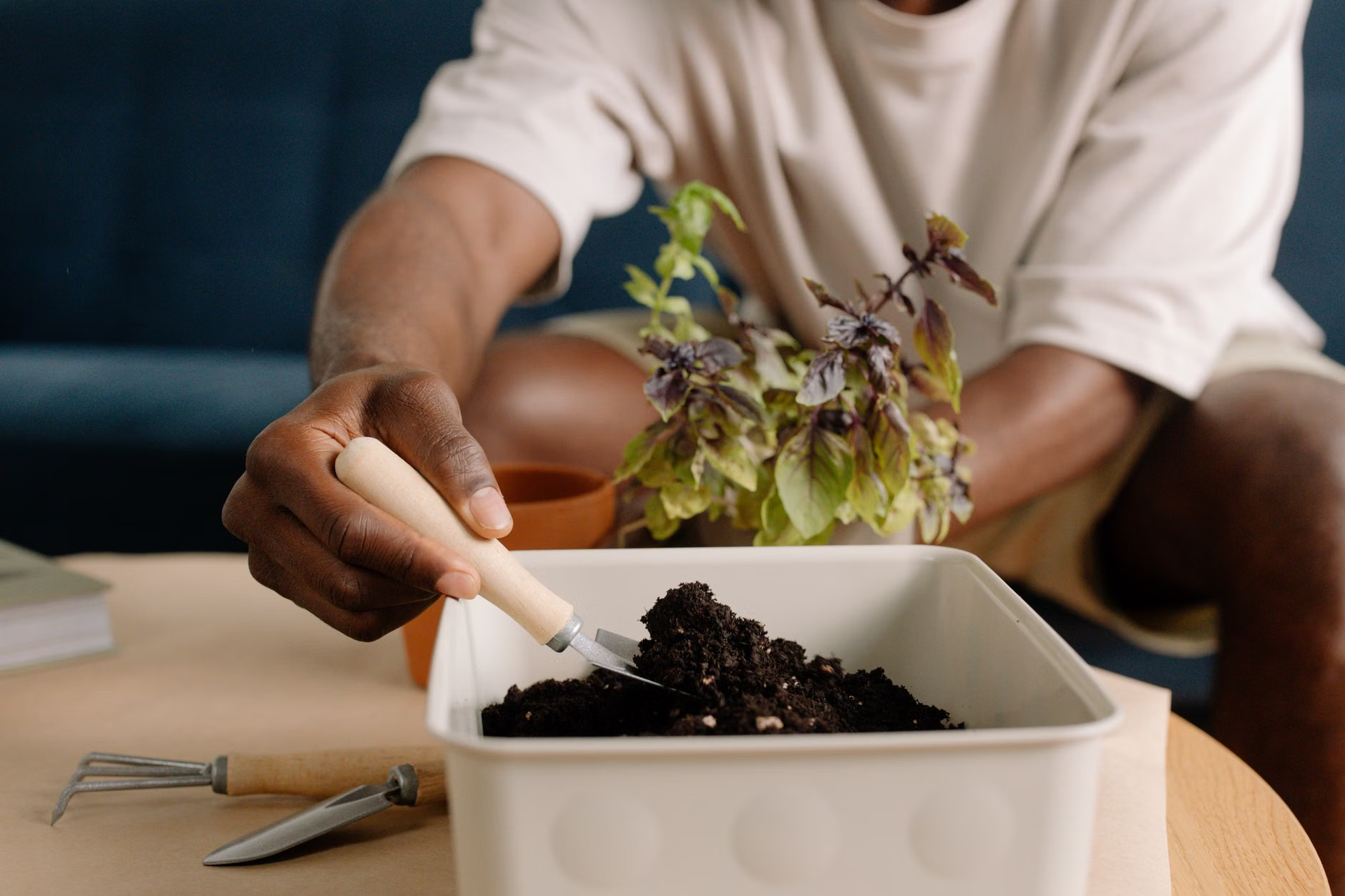
If you want to get into gardening, don’t start by tilling the backyard. Start by keeping one herb plant alive on your windowsill for a month. If you want to write, don’t start a novel; write one paragraph a day in a notebook you keep in your coat pocket. The goal is not to achieve mastery; the goal is to establish the habit of “me-time” within the architecture of your day.
Practical Steps for Re-Discovery
- Identify the “Flow State” Triggers: Think back to what you enjoyed before you had children. Did you like building things? Solving logic puzzles? Being outside? Don’t worry if you don’t have the same level of skill now.
- Set a “Micro-Goal”: Limit yourself to 15 minutes a day. If you can’t find 15 minutes, you likely aren’t looking for a hobby; you’re looking for an escape, which is a different conversation.
- Create a Dedicated Space (Even if it’s a Box): You need a physical anchor. If you don’t have a hobby room, have a “hobby box” that you pull out. When the box is out, you are in “hobby mode.” When it’s put away, you are back to “parent mode.”
A major pitfall to avoid is “hobby-hopping.” In your 30s and 40s, you might feel the urge to try everything at once. This usually leads to burnout. Pick one thing and stick to it for at least 30 days. It takes time for the brain to switch from “parenting brain” to “hobby brain.”
The Hidden Costs and Trade-offs of Re-engaging
It is important to be realistic about the trade-offs. Choosing to spend your free time on a hobby means you are choosing not to spend that time on something else. This might mean the laundry sits for an extra day, or you spend less time scrolling on your phone. Many parents feel guilty when they prioritize their own interests. This is a common, yet misplaced, emotion.
Your children do not benefit from a parent who has completely evaporated their own personality. They benefit from seeing a parent who is curious, engaged, and capable of finding joy outside of their caregiving role. This is a crucial lesson in self-worth for them to witness. If you can communicate that “this is my time to learn/create/move,” you are setting a healthy boundary that benefits the entire household.
Common Misconceptions
There is a persistent myth that hobbies must be “productive” to be valid. You might feel the need to turn your hobby into a side hustle or a way to earn money. Resist this urge. The moment you attach financial pressure to your hobby, you have simply created a second job. Keep your hobby sacred. Let it be something that doesn’t need to turn a profit or be shared on social media to be valuable.
Managing the “Parenting Guilt” Factor
When you start carving out time for yourself, you will inevitably encounter resistance—sometimes from your partner, sometimes from the children, and most often from your own internal monologue. We have been conditioned to believe that “good parents” are always available. This is a recipe for resentment. If you are struggling with the guilt of taking time away from family duties, consider the “Resource Allocation” perspective.
You are a finite resource. If you do not replenish your reserves, your capacity to be a patient, present, and supportive parent diminishes. A hobby is not a withdrawal from your family; it is a deposit into your own well-being, which ultimately benefits everyone around you. Frame your hobby time as “maintenance” rather than “leisure.” When you frame it as maintenance, it becomes a necessity, not an indulgence.
If you feel your partner might resent your time away, have a proactive conversation. Explain that you are not “taking time off from being a parent,” but rather “engaging in a practice that helps you be a more balanced person.” It is often helpful to negotiate a trade: “If I take Saturday morning for my cycling, I will take full responsibility for the Sunday morning routine so you can have your own block of time.” This turns a conflict into a collaborative system.
Evaluating Your Progress
How do you know if your hobby is working? You shouldn’t be looking for mastery; you should be looking for a shift in your baseline stress level. After a few weeks of engaging in your chosen activity, ask yourself the following:
- Do I feel less “on edge” during the daily routine?
- Am I looking forward to the time I spend on my activity?
- Do I feel a sense of accomplishment that is independent of my parenting or career?
If the answer is yes, you are on the right track. If you find yourself dreading the activity, it might be the wrong hobby, or the wrong time of day. Don’t be afraid to pivot. The goal is to find what works for your current life stage, not to force yourself into a role that doesn’t fit.
The Long-Term View
As your children grow and become more independent, the time you carve out for yourself will naturally expand. The habits you build now—the ability to find joy in small moments, the discipline to protect your personal time, and the willingness to pursue interests simply for the sake of curiosity—will serve you well into your 50s and beyond. You are building the foundation for the “post-parenting” chapter of your life, where your identity will be more than just “mom” or “dad.”
Start small, stay consistent, and remember that you are allowed to be a person who exists outside of your responsibilities. It is not just okay to reclaim your identity; it is necessary.
Frequently Asked Questions
Q: I feel so exhausted by the end of the day that I can’t even think about a hobby. What should I do?
A: If you are physically and mentally depleted, prioritize low-energy hobbies. Instead of high-intensity activities, try reading, listening to specialized podcasts, or basic stretching. Do not force yourself to “be productive” when you are in a state of exhaustion. The goal is to find something that doesn’t feel like a chore.
Q: How do I handle the feeling that I’m “wasting time” while my house is a mess?
A: Reframe the “mess.” A house is a living space, not a museum. The “mess” will always be there, but your mental health is a moving target. If you don’t take time to recharge, you will eventually burn out, which makes you less effective at everything—including keeping the house clean. Set a timer for 10 minutes of tidying, then move on to your hobby. The world won’t end if the laundry waits another day.
Q: Should I involve my children in my hobbies?
A: It depends on your goal. If your goal is to have “me-time” and reclaim your personal identity, then no, you should not involve them. Your children need to learn that you are an individual with your own life. If your goal is to bond, then yes, include them. But ensure you have separate time that is entirely your own, as that is essential for the identity-reclamation process.
For further reading on the psychology of leisure and mental well-being for adults, consider these resources:
- American Psychological Association: The Benefits of Leisure for Stress Management
- Mental Health Foundation: Why Hobbies Matter for Mental Health
Remember: The best hobby for you is the one that you actually do, not the one you think you “should” be doing. Start small today.