- Micro-community housing prioritizes shared amenities (kitchens, lounges, childcare areas) to offset the high costs of private square footage in major cities.
- For parents, the primary trade-off is between private space and “social infrastructure”—the built-in support systems that can reduce the mental load of household management.
- Success in these models depends on legal tenure (rental vs. ownership) and the strength of the community governance structure; always verify the “community agreement” before signing.
The dream of the “white picket fence” is increasingly hitting a wall of reality in major global cities. As property prices in hubs like London, New York, Singapore, and Sydney continue to outpace wage growth, the traditional single-family home has become an unattainable luxury for many in their 30s and 40s. Enter the “micro-community” model—a housing trend that asks a radical question: What if, instead of buying more space, we bought better access?
If you are currently juggling a career, a mortgage application, and the daily logistics of raising children, you have likely felt the “space squeeze.” It is not just about having an extra room; it is about the hidden costs of isolation. Micro-communities are designed to solve this by clustering private living quarters around high-quality, shared facilities. But is this actually a sustainable lifestyle for a family, or is it just a glorified dormitory?

Understanding the Mechanics: What is a Micro-Community?
At its core, a micro-community is a hybrid between a traditional apartment block and a co-living space. Unlike a standard condominium, where you might share a lobby and a gym, a micro-community integrates social and operational spaces into the daily flow. Think shared commercial-grade kitchens, co-working spaces, bookable guest rooms, and, crucially, managed communal childcare or play areas.
For a parent in their 30s, the “why” here is simple: Efficiency. In a standard apartment, you pay for a full kitchen you might only use for breakfast, a guest room that sits empty 90% of the year, and a home office that takes up precious bedroom space. In a micro-community, you rent a smaller, highly optimized private unit while gaining access to a larger “living room” for the entire building. You are effectively outsourcing your square footage to the building’s management.
However, we need to be clear about the distinction between “co-living” (often targeted at digital nomads) and “micro-community housing” (often targeted at families or long-term residents). The latter is typically regulated by local zoning laws and offers long-term lease structures, which is a vital distinction for those with children who need stability.
To determine if this model works for your family, you have to look at the math beyond the rent or mortgage payment. Most people look at the price-per-square-meter, which makes micro-housing look expensive. But that is the wrong metric. You should be looking at the Total Cost of Living (TCL).
Let’s compare a standard 80-square-meter apartment with a 50-square-meter micro-community unit:
| Expense Category | Standard Apartment | Micro-Community |
|---|---|---|
| Utilities/Maintenance | High (Individual bills) | Lower (Shared/Bulk rates) |
| Shared Amenities | None (or basic gym) | High (Kitchen, coworking, play) |
| Childcare Logistics | External costs | Integrated/Shared options |
| Social Capital | Low (Neighbors are strangers) | High (Built-in network) |
The “hidden cost” of the standard apartment is the time and money you spend duplicating services. If your micro-community building has a shared laundry facility that is professionally maintained, or a co-working space that saves you a commute, you are recouping value that doesn’t appear on a rent invoice. The real-life test is whether you value these services enough to trade off the square footage of your private living room.

The Parenting Trade-off: Convenience vs. Privacy
For families, the most common objection to micro-living is the lack of private space. Let’s be honest: when the kids are having a meltdown, you want walls, not a “shared communal lounge.” This is the primary point of failure for many families in this model. Before moving into a micro-community, you must evaluate the acoustic insulation and the “quiet hours” policy of the building.
However, consider the “Village Effect.” Many parents in their 30s feel the strain of raising children without nearby extended family. Micro-communities often foster a culture of “passive supervision.” When you have a dedicated, safe communal courtyard or play area, you can get work done or prepare dinner while your child plays within sight of other trusted parents. This is not just a housing feature; it is a mental health intervention.
Common Mistake: Treating the community as an automatic support system. It is not. You have to put in the social labor to build those relationships. If you move in expecting a built-in babysitting circle without contributing to the community culture, you will likely find yourself just as isolated as you were in a standard apartment, but with less room to spread out.
Evaluating the Legal and Operational Fine Print
Before you commit, you need to look at the governance. Is this a rental-only building run by a professional management company, or is it a co-op where residents own shares and make decisions together? Rental-only micro-communities provide more service but less control. Resident-owned co-ops provide more control but require significant time investment in meetings and maintenance.
In many jurisdictions, such as the UK or parts of the EU, there are specific “Build-to-Rent” (BTR) regulations that govern these types of buildings. Check if your prospective building adheres to local standards for space and natural light. In some cities, “micro” has become a code word for “substandard.” If the units lack natural light or proper ventilation, no amount of communal amenities will make up for the impact on your family’s physical health.
Decision Rule: If the building does not have a professional, on-site community manager, walk away. A micro-community without a facilitator is just a noisy apartment building. You need someone to mediate disputes, organize events, and maintain the shared equipment. Without that, the “community” part of the name quickly dissolves into a series of logistical headaches.
Practical Steps to Transitioning
If you are considering this move, do not jump in blindly. Start by “piloting” the lifestyle. Many modern co-living companies offer short-term stays. Spend a week in a similar facility in your city. Pay attention to the noise levels at 7:00 AM and 8:00 PM. Observe how the shared kitchen is cleaned (or not cleaned) by other residents.
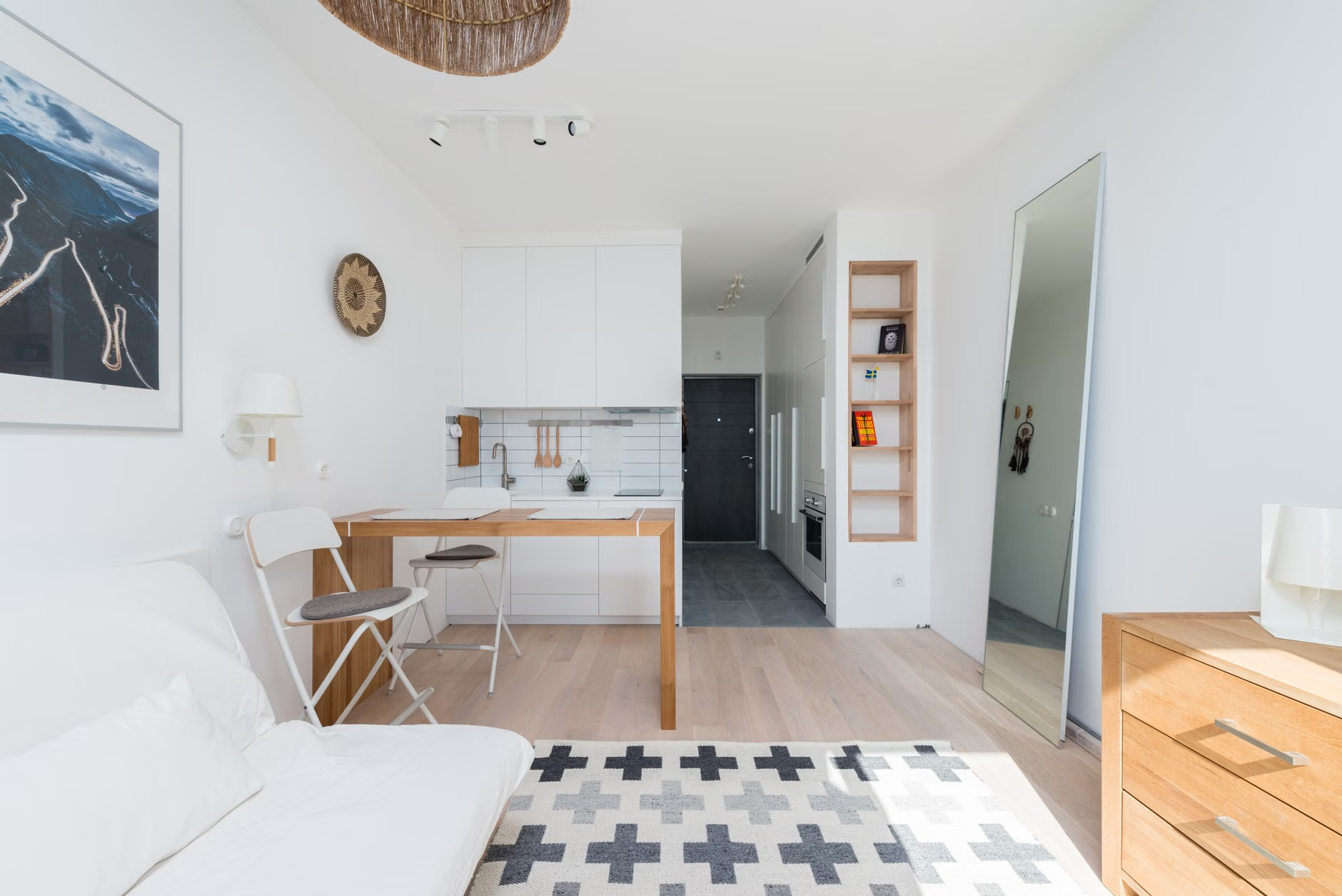
Next, audit your possessions. Moving from a traditional home to a micro-community requires a ruthless “de-cluttering” phase. If you are attached to a large collection of books, a massive dining table, or seasonal equipment you rarely use, this model will feel like a prison. You are shifting from a “storage-heavy” lifestyle to a “service-heavy” lifestyle.
Finally, look at the transition plan. If you have children, how will their needs change in three years? A toddler needs different space than a pre-teen. Look for buildings that offer flexible lease terms or the ability to “upsize” units within the same complex as your family grows. The best micro-communities are those that allow you to scale your private footprint without leaving your social network.
The Hidden Variables: What Most People Miss
There is an overlooked variable in the micro-community debate: Energy and Sustainability. Smaller, shared spaces are objectively more energy-efficient. They require less heating, less cooling, and fewer materials to build. For the environmentally conscious parent, this is a major selling point. You are effectively shrinking your carbon footprint by sharing resources.
However, be aware of the “maintenance trap.” If the building’s common areas are not well-maintained, your rent is essentially a tax on a service you aren’t receiving. Always ask for a tour of the back-of-house areas—the laundry rooms, the waste disposal, and the storage facilities. If those are messy or broken, the building management is failing, and the “community” will likely follow suit.
Also, consider the demographic mix. A building that is 100% students will have a very different social rhythm than a building with a mix of young professionals, families, and retirees. Ask the management about the “resident profile.” A good micro-community aims for a mix of ages and lifestyles to ensure that the building is not a ghost town during work hours or a party zone on weekends.
Final Verdict: Is it Right for You?
The micro-community model is not a panacea for the global housing crisis, but it is a viable, high-quality alternative for those who value time and social connection over square footage. It requires a mindset shift: you are no longer just buying a place to sleep; you are buying a place to live, work, and connect.
If you are someone who thrives on social interaction and can effectively manage a smaller, highly organized space, this model can significantly improve your quality of life. If you are someone who deeply values privacy, silence, and the ability to “shut out the world” at the end of the day, you may find the micro-community model claustrophobic, regardless of the amenities offered.
Start small, research the management, and be honest about what your family truly needs to function happily. The future of urban living isn’t necessarily bigger; it’s smarter, and it’s shared.
Frequently Asked Questions
1. Will living in a micro-community negatively affect my child’s development due to lack of space?
Research suggests that children benefit more from access to safe social spaces and consistent adult interaction than from the sheer square footage of a private room. As long as your child has a dedicated “quiet zone” for sleep and schoolwork, the increased social interaction in communal areas can actually build better social-emotional skills.
2. How do I handle conflicts with neighbors in shared spaces?
The best micro-communities have a clear “Community Agreement” or “House Rules” document signed upon move-in. Always check if there is a formal dispute resolution process. If you are in a building without clear, enforced rules regarding common area usage, noise, and cleanliness, you will likely encounter friction.
3. Are micro-communities a good investment for resale value?
This depends heavily on the local market and the legal structure of the building. In many cases, these units are purpose-built rentals. If you are buying a unit, ensure it is a “strata” or “condo” title. Note that these units can sometimes be harder to finance or sell because they are niche products. Always consult with a local real estate professional who understands the specific nuances of co-living or micro-unit developments in your city.
For more information on urban housing trends and policy, you can explore the Urban Institute or regional government planning portals, such as the UK’s Department for Levelling Up, Housing and Communities, to understand the zoning laws and standards in your specific area.