The most effective way to regain your cognitive bandwidth isn’t to throw your smartphone in a river, but to treat your weekends as a “low-bandwidth” zone using a structured, non-extremist protocol.
- The 48-Hour Threshold: You don’t need a total disconnect; replacing “passive consumption” (scrolling) with “active engagement” (hobbies/play) for 48 hours is sufficient to reset dopamine baseline levels.
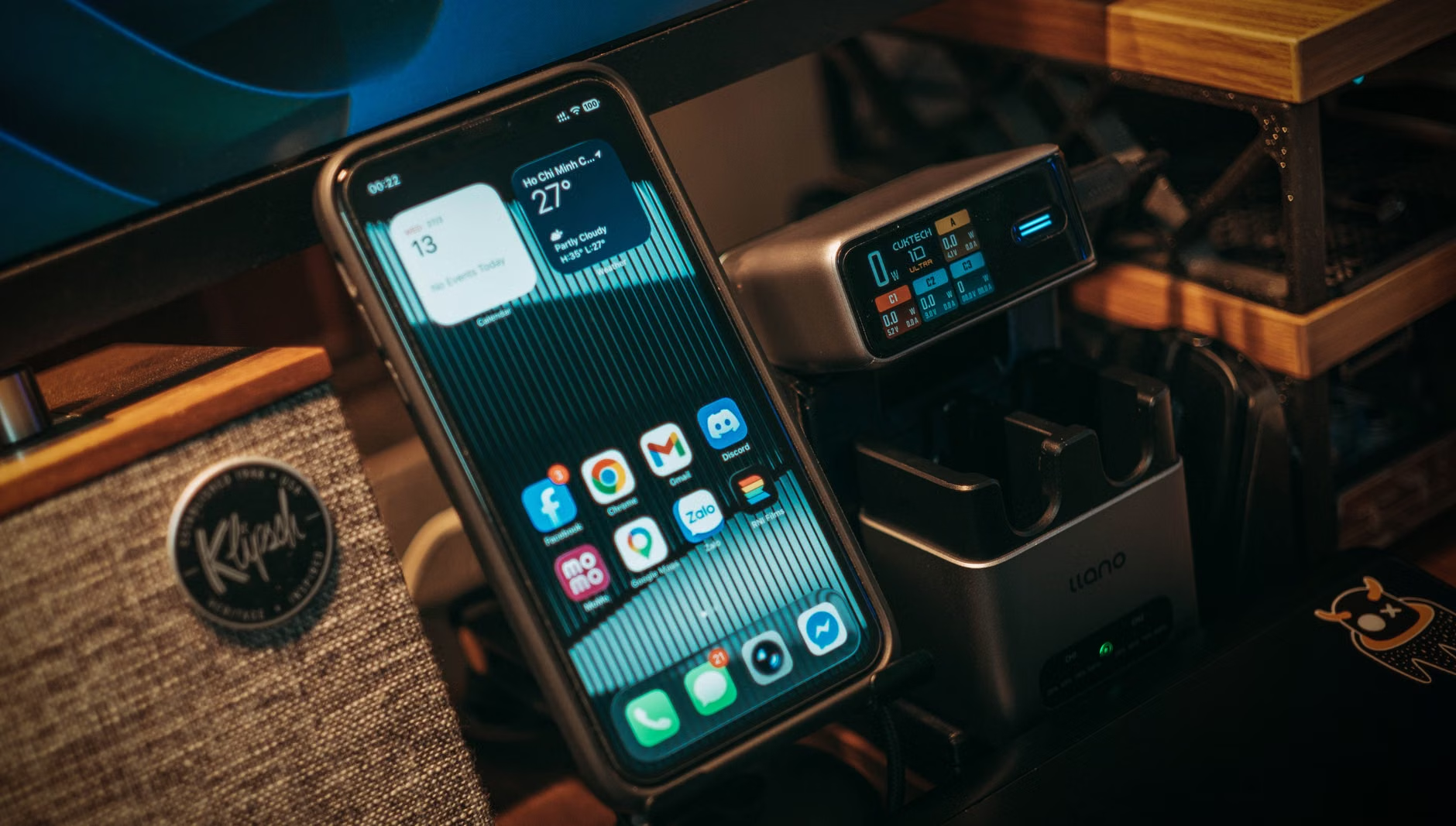
- The “Entryway” Rule: Digital boundaries fail when devices are physically accessible; keeping your phone in a dedicated “docking station” outside the bedroom and living area increases the friction required to check it, preventing impulsive usage.
- Asymmetric Communication: Informing your social circle that you are “offline for the weekend” isn’t social suicide—it sets a professional and personal precedent that improves your perceived value and availability during the work week.
If you are in your 30s or 40s, you likely feel the “constant hum” of digital life. Whether it is a Slack notification on a Saturday morning or the subconscious urge to check your email while your child is playing in the park, the barrier between “life” and “work” has effectively evaporated. You aren’t just tired; you are suffering from a fragmented attention span. The Analog-Weekend Protocol is not a Luddite movement; it is a tactical response to a reality where your attention is the primary currency being traded by tech giants.
Why Your Brain Needs a “Digital Reset” Every Week
The human brain is not designed for the level of multitasking that modern life demands. Research from the University of California, Irvine, suggests that it takes an average of 23 minutes to return to a deep state of focus after an interruption. If you are checking your email every 15 minutes, you are, by definition, never achieving deep focus. For the parent in their 30s, this manifests as “half-listening”—you are physically present with your children, but mentally, you are processing an unread message or a social media trend.
This is where the Analog-Weekend Protocol enters. It’s not about being “anti-tech.” It’s about restoring your agency. When you are constantly connected, your schedule is dictated by the arrival of notifications. When you adopt an analog protocol, you dictate the schedule. The goal is to shift from “reactive mode” (responding to pings) to “proactive mode” (choosing your activities).
The physiological benefit is profound. By reducing screen time during your time off, you allow your cortisol levels—the primary stress hormone—to stabilize. You aren’t just “relaxing”; you are allowing your prefrontal cortex to recover from the constant task-switching of the work week.
The Structural Framework: The “Three-Zone” Strategy
To make the Analog-Weekend work, you must define the physical and digital boundaries of your home. Most people fail because they try to rely on willpower. Willpower is a finite resource. Instead, use environmental design.
Zone 1: The “Digital Dock” (The Entryway)
Create a physical space, preferably in an entryway or a hallway, where phones, tablets, and work laptops live from Friday at 8:00 PM until Monday at 7:00 AM. This is not a “charging station” in the sense of convenience; it is a “parking lot.” If you need to check something, you must physically walk to the device, stand there, use it, and leave it there. You never bring the device into the living room, the kitchen table, or the bedroom.
Zone 2: The “Analog Core” (The Living Area)
This is the space where you and your family spend your time. It must be strictly devoid of screens. If you want to listen to music, use a dedicated radio or a record player—not a smartphone app that invites you to scroll through playlists and then check your messages. If you want to check the weather, look out the window or use a dedicated wall-mounted weather station. The goal is to remove the “gateway apps” that lead to infinite scrolling.
Zone 3: The “External Gateway” (Communication Management)
You cannot simply disappear without warning, especially if you have elderly parents or children in school. Use the “Asymmetric Communication” rule. Set an auto-responder on your work email and a status update on your messaging apps: “I am offline for the weekend to disconnect and recharge. I will respond to all non-urgent messages on Monday morning.” For your inner circle, provide a single, dedicated emergency number (a landline or a secondary “dumb” phone) that only rings for actual emergencies.

The most common mistake people make is trying to go from “100% connected” to “0% connected” overnight. You will experience withdrawal symptoms—the “phantom vibration” syndrome, where you feel your phone buzzing in your pocket even when it isn’t there. This is a real, documented phenomenon.
The “Gradual Implementation” Rule: If you find it impossible to go full-analog, start with the “Saturday Morning Block.” From 8:00 AM to 1:00 PM on Saturday, the devices stay in the dock. Once you master the five-hour block, expand it to the full day, and eventually the full weekend. Do not attempt a 48-hour blackout on your first attempt, as the anxiety of “what if I missed something” will likely cause you to break the protocol, leading to a cycle of failure and shame.
Another pitfall is the “boredom trap.” When you remove screens, you will suddenly be confronted with an abundance of time. In the beginning, this feels like an itch. You will want to reach for a device to fill the silence. This is the exact moment where the benefit of the protocol begins. That “itch” is your brain trying to return to a state of high-stimulation. Resist it by having “Analog Anchors” ready.
| Activity Type | Digital Default | Analog Alternative |
|---|---|---|
| Information Gathering | Google/Social Media | Physical books, library visits, or newspapers |
| Entertainment | Streaming Services | Board games, puzzles, or outdoor activity |
| Communication | Instant Messaging | In-person conversation or handwritten notes |
| Planning | Digital Calendars | Paper planner or wall calendar |
Why Paper Planning Beats Digital Apps for the Weekend
For those of us in our 30s and 40s, the “to-do list” is a source of constant anxiety. Moving this to a physical paper planner is a game-changer. When you write something down, you engage in “encoding”—the act of physically forming the letters helps your brain process the information more deeply than typing. Furthermore, a paper planner doesn’t have an “inbox” that pings you with new tasks while you are trying to review the old ones.
Consider the “Weekly Review” ritual. Every Sunday evening, sit down with your paper planner and look at the week ahead. By the time you are finished, your mind is clear. You aren’t checking your calendar app on Monday morning with a sense of dread; you already know exactly what the week looks like because you have manually mapped it out. This reduces the “cognitive load” that typically ruins the end of a weekend.

The Hidden Costs of Always-On Culture
Beyond the obvious loss of time, there is a hidden cost to the “always-on” culture: the erosion of your “internal compass.” When you are constantly consuming content from the internet, you are inadvertently outsourcing your opinions, your tastes, and your goals to algorithms. You start to think what the internet wants you to think.
The Analog-Weekend Protocol allows you to reconnect with your own internal monologue. Without the constant input of Twitter threads, Instagram feeds, or news alerts, you are forced to sit with your own thoughts. Initially, this can be uncomfortable. Many people find that they dislike what they think about when they aren’t distracted. But this is the only path to true self-awareness. If you can’t be alone with your thoughts for 48 hours, you have a much larger problem than screen time—you have a disconnection from yourself.
Actionable Steps for This Weekend
To begin this weekend, you don’t need to buy anything or sign up for any service. Follow this simple checklist:
- Friday Night Prep: Print out your schedule for the upcoming week or write it in a physical notebook. This removes the “I need to check my calendar” excuse.
- The Docking Setup: Choose a physical location for your tech. If you don’t have a dedicated dock, use a simple basket or a drawer.
- The “Emergency List”: Write down the phone numbers of 3-5 people who actually need to reach you. If the call isn’t from them, it can wait until Monday.
- The “Analog Anchor”: Choose one project that requires your hands—cooking a complex meal, gardening, fixing something in the house, or reading a physical book. Have this ready to go before the weekend starts.
The most important thing to remember is that this is a protocol, not a religion. If you have to break it to handle a genuine family emergency or a critical work crisis, do so. But do it with intention. The goal is to ensure that your life is not being managed by a machine, but by you. Reclaiming your weekend is the first step toward reclaiming your life.
Frequently Asked Questions
Q: What if my job requires me to be available on weekends?
A: Most “requirements” for weekend availability are based on cultural expectations, not contractual obligations. If your role truly requires 24/7 coverage, negotiate a “shift” system where you are on-call for one weekend and fully offline the next. If you are a freelancer or business owner, use the auto-responder to set clear expectations. You will find that most people are more respectful of your time once you define your boundaries clearly.
Q: Won’t I miss out on important news or social updates?
A: We live in an era of hyper-information. The truth is that 99% of what you see on the news or social media is noise that has zero impact on your actual life. If something truly earth-shattering happens, you will hear about it through your local community, neighbors, or the emergency contacts you’ve established. Missing the “latest” social media trend is not a loss; it is a gain in peace of mind.
Q: How do I handle the feeling of “missing out” when my friends are posting about their weekends online?
A: This is the essence of FOMO (Fear Of Missing Out). The irony is that by watching their posts, you are missing out on your own life. When you feel that urge, remind yourself that what you see online is a curated, edited highlight reel. Your real-life experiences—even the quiet, mundane ones—are infinitely more valuable than a digital image of someone else’s vacation or brunch. Focus on the sensory details of your own environment: the taste of your coffee, the sound of your kids playing, the texture of the book in your hands.
For further reading on the impact of digital technology on attention, you can refer to the research provided by the American Psychological Association regarding the mental health effects of constant connectivity. Additionally, consider exploring the Digital Wellness Lab for evidence-based strategies on managing screen time for families.
Start small, stay consistent, and remember that the goal is not to be perfect, but to be present. Your weekends are the only time you truly own; don’t let a screen take them away from you.