Hello, to all the parents who are fighting the battle for their baby’s “golden poop” today! We know the feeling—watching your little one strain until their face turns red, or seeing them cry over hard, pebble-like stools, is truly heart-breaking. You’d do anything to take that discomfort away yourself, wouldn’t you?
Today, we are launching the first part of our [My Child’s Food Prescription Series]. We’re going to talk about “Quick Relief for Baby Constipation” focusing on 5 natural “superfoods” that can work wonders before you reach for the medicine cabinet. We’ll also cover which foods might be making things worse and how to make these “prescriptions” taste delicious for even the pickiest eaters.
Why Does My Baby Have Constipation?
Before we dive into the kitchen, let’s talk about why this happens. A baby’s digestive system is still a work in progress. It’s delicate, sensitive, and easily thrown off balance.
Most babies encounter constipation when they start solid foods (around 6 months). Their bodies are learning how to process new proteins and fibers, and sometimes they don’t get enough water to keep things moving. Another common culprit is a transition from breast milk or formula to cow’s milk.
The key thing to remember is that constipation isn’t just about how often they go, but how they go. If the stool is hard and dry, or if your baby is clearly in pain or afraid to poop, it’s time for a food-based intervention!
🥦 5 Natural Superfoods for Smooth Bowel Movements
While there are many probiotics on the market, the most sustainable way to manage digestion is through “real food” rich in fiber and natural sugars. Here are five ingredients that are practically “magic” for baby’s gut health.
1. Prunes (The Undisputed Champion)
If there is a “king” of constipation relief, it’s definitely the prune (dried plum). Prunes contain a specific type of sugar called sorbitol.
- How it works: Sorbitol isn’t fully digested by the body; instead, it draws water into the large intestine, which softens the stool and makes it much easier to pass.
- The Fiber Factor: Prunes have about 12 times the fiber of an apple. It’s like a gentle broom for your baby’s intestines.
- Did you know? Recent studies show that prunes act as a “prebiotic,” meaning they feed the good bacteria already living in your baby’s gut, leading to better long-term digestive health.
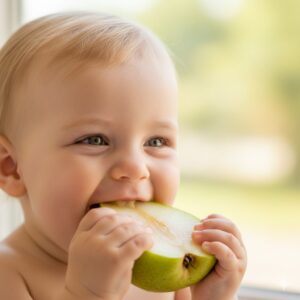
2. Pears (The Hydration Hero)
If your baby is struggling with hard stools, they likely need more hydration. Pears are about 85-90% water, making them an excellent natural source of fluid.
- How it works: Pears contain pectin and fructose, both of which stimulate the digestive tract.
- Pro Tip: Most of the nutrients and fiber are near the skin. For older babies, try to keep the skin on (finely blended or steamed). For younger ones, a smooth pear puree is a fantastic “first aid” food for a blocked tummy.
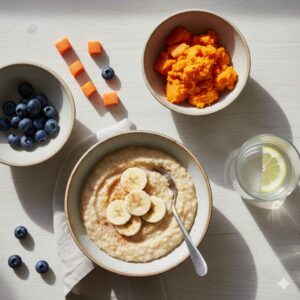
3. Oatmeal (The Fiber Powerhouse)
Many parents start with rice cereal, but rice can actually be quite binding for some babies. Switching to oatmeal can make a world of difference.
- How it works: Oatmeal is loaded with beta-glucan, a type of soluble fiber. It absorbs water and turns into a gel-like substance that helps waste slide through the digestive system more easily.
- Nutrition Bonus: Compared to white rice, oatmeal offers more protein and essential minerals, making it a superior choice for growing bodies.
4. Sweet Potatoes (Nature’s Laxative)
Have you ever noticed a sticky white sap when you cut a raw sweet potato? That’s jalapin.
- How it works: Jalapin is a natural compound that protects the stomach lining and promotes bowel movements. Combined with the high cellulose content of the potato, it’s a powerful tool for cleaning out the colon.
- Serving Tip: Since sweet potatoes can be a bit thick, always serve them with plenty of water or mixed with a bit of breast milk/formula to keep the texture easy to swallow.
5. Broccoli (The “Bulk” Master)
It might be a struggle to get some kids to eat their greens, but broccoli is worth the effort when constipation strikes.
- How it works: Broccoli provides “insoluble fiber,” which adds bulk to the stool. You might think “bulk” sounds bad, but the intestines actually need that volume to trigger the muscles to push everything out.
- Health Fact: It also contains sulforaphane, which helps protect the gut lining from inflammation.
🚫 The “Stop” Foods: What to Avoid
Just as important as what you add to the diet is what you take away during a constipation flare-up. Some “healthy” foods can actually act like glue in the gut.
- Unripe Bananas: A yellow banana is fine, but a slightly green one contains high levels of tannins and resistant starch. These slow down the digestive process and can lock things up tight. Wait for those brown “sugar spots” to appear!
- Excessive Cow’s Milk: High calcium intake from too much milk can lead to harder stools. Also, if a baby fills up on milk, they usually don’t eat enough fiber-rich solids. Try to stay within the recommended 16-24 ounces per day for toddlers.
- Cooked Carrots and Potatoes: While great for stopping diarrhea, these are “binding” foods. If your child hasn’t pooped in days, it’s best to skip the mashed carrots for a while.
- Refined White Flour: White bread, pasta, and crackers have had the fiber stripped away. They move slowly through the gut and can cause painful gas.
😋 “Yum!” Tips for Picky Eaters
If your baby refuses to eat “the green stuff” or “the wrinkly fruit,” try these simple, delicious combinations:
- The “Poop-Snoothie”: Blend steamed prunes with fresh apples. The sweetness of the apple masks the strong prune flavor, and the combo is a fiber double-whammy!
- Oatmeal Banana Pancakes: Mash a very ripe banana, mix with oat flour and an egg, and cook small silver-dollar pancakes. It feels like a treat, but it’s a fiber bomb.
- Sweet Potato Apple Mash: Mix steamed sweet potato with apple sauce. The moisture from the apple makes the potato less “choking” and much easier for the gut to process.
💡 One More Secret Tip: > Fiber is a sponge! If you give your baby fiber without enough water, it can actually make constipation worse because the fiber gets dehydrated and stuck. Always offer a few sips of water after a high-fiber meal to help that “sponge” do its job.

✨ Closing Thoughts: You’re Doing Great!
Watching your baby suffer is one of the hardest parts of parenting. It’s tempting to want an overnight fix, but remember that a baby’s digestive rhythm is a journey. By focusing on these natural “food prescriptions,” you are building a foundation for a healthy gut that will last a lifetime.
Think of it as a “rhythm” you are creating together. If your baby drank an extra cup of water or ate one prune today, that’s a huge win!
A quick safety note: If your baby hasn’t had a bowel movement in over a week, if there is blood in the stool, or if they have a hard, distended belly and are vomiting, please call your pediatrician immediately. Sometimes we need a little medical help to get things moving again, and that’s okay too.
Hang in there, parents. We’re rooting for you and your baby’s “golden” future!
Reliable Resources for Further Reading
- Mayo Clinic: Infant Constipation (https://www.mayoclinic.org)
- American Academy of Pediatrics: Constipation in Children (https://www.healthychildren.org)
※ This post was developed with AI support for data gathering and initial structure, then extensively refined and verified by the author for quality and reliability.
👉 Related Posts