You are not tired because you aren’t sleeping enough; you are tired because your sleep architecture—the structural integrity of your rest—has collapsed under the weight of modern parenting demands. Most parents in their 30s and 40s treat sleep as a passive activity, but if you want to function at a high level, you must treat it like a technical system that requires regular maintenance and auditing.
- Sleep Efficiency is King: Spending 8 hours in bed does not equal 8 hours of sleep; an audit helps you identify the “latency gaps” where you are awake but not resting.
- The 90-Minute Cycle Rule: Sleep occurs in cycles; understanding your personal chronotype allows you to align your wake-up times to avoid sleep inertia.
- Environmental Optimization: Most parental sleep disruption is caused by “micro-arousals” triggered by light, sound, or temperature fluctuations that can be fixed with simple, low-cost modifications.
Understanding the Mechanics of Your Nightly Recovery
When we talk about “sleep architecture,” we aren’t just talking about the number of hours you close your eyes. We are talking about the precise sequence of NREM (Non-Rapid Eye Movement) and REM (Rapid Eye Movement) stages that your brain cycles through every 90 to 120 minutes. For a parent juggling a career, school runs, and household logistics, the goal is to maximize the depth of these cycles rather than just extending the duration.
Think of your sleep like a high-performance computer. If you have too many background apps running—stress, blue light exposure, caffeine, or an inconsistent schedule—the “system” never enters a state of deep recovery. You might be “asleep,” but your brain is performing constant background tasks, meaning you wake up feeling like you haven’t rebooted at all. This is where the audit comes in. An audit is a systematic evaluation of your pre-sleep behavior, your sleep environment, and your biological markers to identify exactly where your “data” (rest) is being lost.
Many parents fall into the trap of “revenge bedtime procrastination”—staying up late simply to reclaim personal time. While understandable, this is the first thing an audit will target. By auditing your routine, you move from a reactive state of “I hope I sleep well tonight” to a proactive state of “I have engineered the conditions for optimal recovery.”

Step 1: The Baseline Log — Identifying Your Hidden Leaks
Before you can fix your sleep, you have to measure it. For seven consecutive days, you need to track three specific variables. Do not rely on memory; your brain lies to you when it is sleep-deprived. Use a simple notebook or a note-taking app to log the following:
| Variable | What to Track | Why it Matters |
|---|---|---|
| Sleep Latency | Time taken to fall asleep | Over 20 minutes suggests stress or poor “wind-down” signaling. |
| Wake-up Frequency | Number of times you wake up | Often caused by light, noise, or blood sugar crashes. |
| Subjective Quality | Scale of 1-10 upon waking | Correlates your routine to your actual energy levels. |
The most common mistake is tracking only the time you go to bed and the time you wake up. This ignores the 45 minutes you spent scrolling through emails at 2:00 AM or the fact that your bedroom temperature fluctuates because of a poorly positioned HVAC vent. If you find that your latency is high, your “pre-sleep” protocol is the issue. If your wake-up frequency is high, your “sleep environment” is the issue.
Step 2: The Environmental Audit — Eliminating Micro-Arousals
Your brain is evolutionary programmed to remain alert to potential threats, even while you sleep. In a modern household, those “threats” are the hum of a refrigerator, the blue light from a streetlamp, or the notification buzz of a phone. These are called “micro-arousals.” They aren’t enough to fully wake you up, but they pull you out of deep, restorative sleep and into lighter stages.
The Temperature Rule: Research consistently shows that the optimal temperature for human sleep is between 15.6°C and 19.4°C (60°F–67°F). If your bedroom is warmer than this, your body has to work harder to thermoregulate, which keeps you in a lighter, less restorative stage of sleep. If you don’t have smart climate control, simply cracking a window or using a fan can make a significant difference. Don’t underestimate the power of a “cool room, warm blanket” setup.
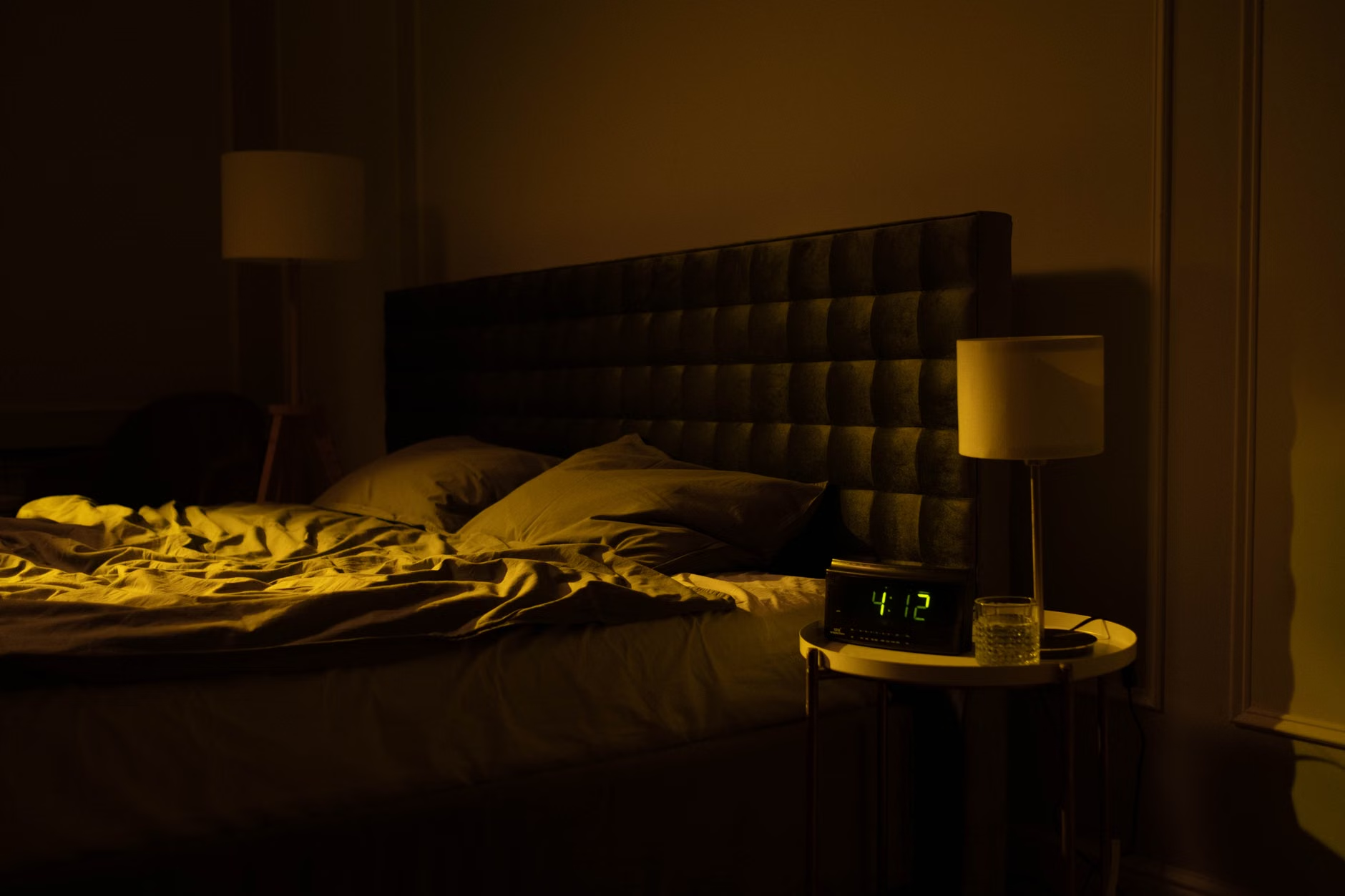
Light Pollution: Even a small LED light from a power strip or a clock can disrupt melatonin production. If you can see your hand in front of your face in the dark, your room is too bright. Invest in blackout curtains or, if that is not feasible due to rental restrictions or budget, a high-quality, contoured sleep mask. The goal is total darkness. This isn’t about luxury; it is about signaling to your brain that the high-stress environment of the day is officially over.
Step 3: The Pre-Sleep Protocol — Anchoring Your Circadian Rhythm
Your circadian rhythm is governed by light and time. If you spend your evening under harsh overhead lights and staring at screens, your body thinks it is still mid-afternoon. To optimize your sleep architecture, you must implement a “buffer zone” of at least 60 minutes before bed.
This buffer zone should be free of “high-arousal” activities. In the context of parenting, this is the hardest part. You finish putting the kids to bed, and you finally have a moment to yourself—so you check work emails, pay bills, or watch an intense thriller. All of these activities spike cortisol, the stress hormone that is the direct antagonist to melatonin. Instead, try the “dim-and-down” method: drop the lighting in the house by 50% one hour before bed, and switch to low-arousal activities like reading physical books or light stretching.
If you must use a screen, use blue-light blocking glasses or set your devices to “Night Shift” mode. However, the psychological stimulation of digital content is often just as disruptive as the light itself. If you find your mind racing when you hit the pillow, it is a sign that your buffer zone was not “low-arousal” enough.
Step 4: The Nutrient and Caffeine Audit
Caffeine has a half-life of roughly 5 to 6 hours. If you drink a cup of coffee at 4:00 PM, half of that caffeine is still in your system at 10:00 PM. For many parents, that afternoon coffee is a survival mechanism, but it is effectively sabotaging your sleep architecture by preventing you from entering deep sleep. The audit rule is simple: the 10-2-1 rule.
- 10 hours before bed: No more caffeine.
- 2 hours before bed: No more food (to prevent digestion-related sleep disruption).
- 1 hour before bed: No more work or screens.
If you are struggling with this, try a tapering strategy. If you currently have coffee at 4:00 PM, move it to 3:00 PM for a week, then 2:00 PM the next. Your sleep quality will likely improve within three to five days as your baseline adenosine levels—the chemical that makes you feel tired—begin to normalize.
Step 5: Analyzing the Data and Iterating
After you have implemented these changes, repeat the one-week log. Compare your new numbers to your baseline. Did your latency decrease? Did your wake-ups drop? If you are still struggling, look at your “Sleep Efficiency” score. This is calculated by dividing the time you spent asleep by the time you spent in bed. A target of 85% or higher is excellent. If you are in bed for 8 hours but only sleeping for 6, you are wasting two hours of your life in bed, which actually contributes to sleep anxiety.
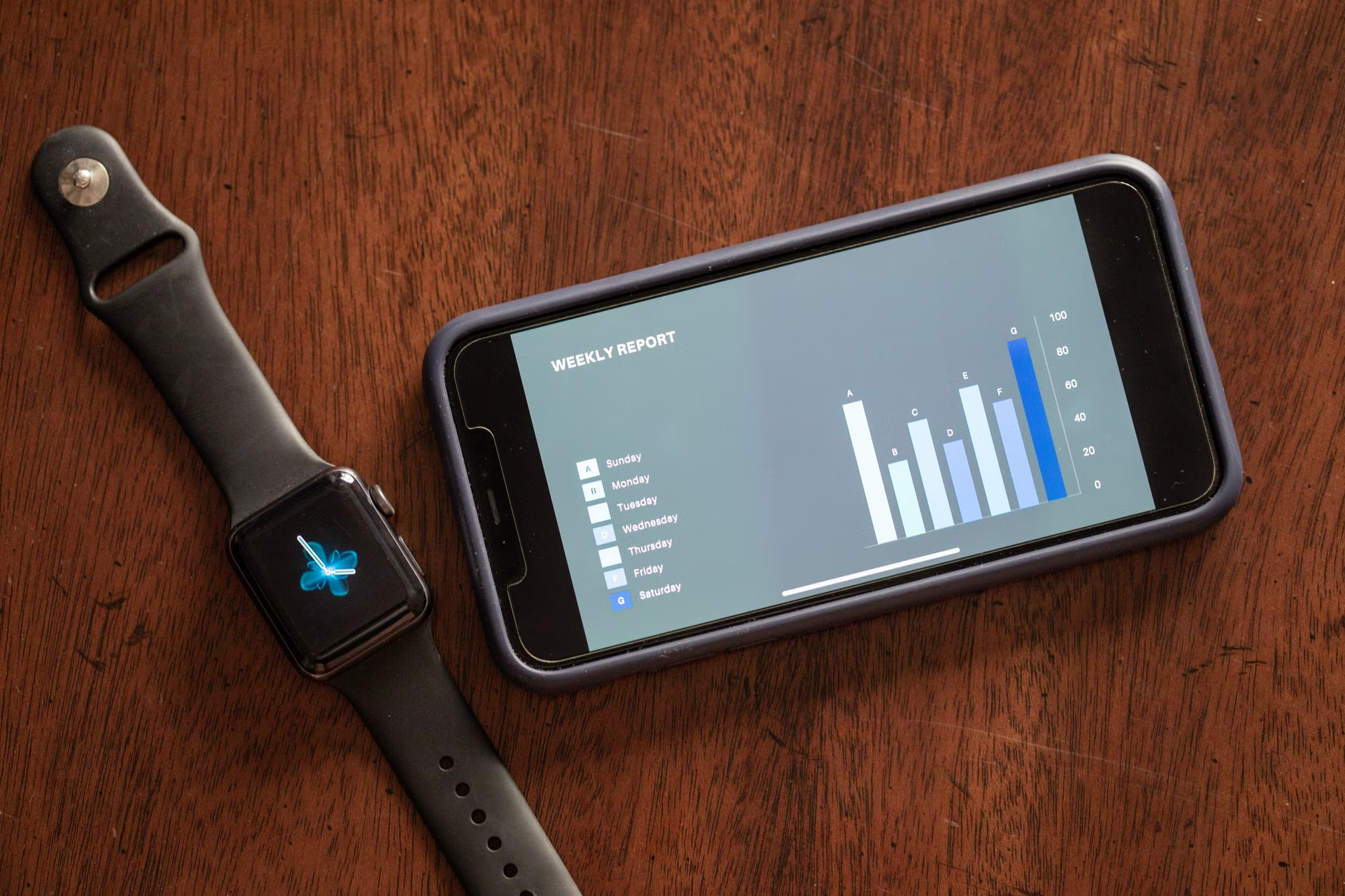
If your efficiency remains low, it may be time to look into wearable technology. Devices like Oura rings, WHOOP straps, or even advanced smartwatch sleep trackers can provide data on Heart Rate Variability (HRV) and Resting Heart Rate (RHR). These are objective markers of how your nervous system is recovering. If your HRV is consistently low, it means your body is still in a “fight-or-flight” state, and you need to prioritize meditation, breathing exercises, or physical movement earlier in the day to discharge that stress.
The Reality of Parenting and Sleep Limitations
It is important to be realistic. If you have an infant or a child who wakes up during the night, your sleep architecture will be fragmented. You cannot “optimize” your way out of a crying baby. However, the audit still serves a purpose. It helps you maximize the quality of the sleep you do get. When you only have four hours of broken sleep, those four hours need to be of the highest possible quality. By keeping your room cool, dark, and quiet, and by avoiding caffeine in the afternoon, you ensure that even your limited rest is as restorative as possible.
Common mistakes often involve trying to “catch up” on the weekend. This creates a “social jetlag” effect, where your body clock is constantly being shifted back and forth. Even if you are exhausted, try to keep your wake-up time within a 60-minute window of your weekday schedule. This anchors your rhythm and makes it easier to fall asleep on Sunday night, preventing the “Sunday Scaries” and the subsequent sleep-deprived Monday morning.
Another overlooked variable is the “bed-partner factor.” If your partner snores or moves around, you are being subjected to external stimuli that you cannot control. If the audit shows that you are waking up every time your partner moves, it is time to consider a “sleep divorce”—not a relationship ending, but simply using separate blankets or even separate rooms. Many successful, happy couples find that separate sleeping arrangements are the single most effective intervention for their relationship health and their individual sleep quality.
Advanced Considerations for the Stressed Parent
As you move deeper into your audit, consider the role of “sleep pressure.” Sleep pressure is the buildup of adenosine in your brain throughout the day. If you aren’t moving enough, you won’t build up enough sleep pressure to maintain a deep sleep state. A 20-minute walk in the morning sunlight does two things: it sets your circadian clock via light exposure, and it increases your physical energy expenditure, which helps build that necessary sleep pressure by the evening.
Furthermore, consider your evening “brain dump.” Many parents find it hard to sleep because their minds are running a checklist of tomorrow’s tasks. Keep a notepad by your bed. Before you get into the “buffer zone,” write down everything you are worried about or need to do tomorrow. Once it is on paper, your brain feels less “responsible” for holding onto that information. This is a simple cognitive hack that can shave minutes off your sleep latency.
Finally, avoid the “napping trap.” If you are exhausted, a nap might seem like a lifesaver. However, if you nap for longer than 20 minutes or after 3:00 PM, you will rob yourself of the sleep pressure you need for the night ahead. If you must nap, keep it to a “power nap” of 15–20 minutes. Any longer and you risk entering deep sleep, waking up with “sleep inertia”—that groggy, disoriented feeling—which can last for hours and ruin your evening productivity.
Establishing Your New Normal
The goal of this audit is not to achieve “perfect” sleep, but to achieve “consistent” sleep. Parenting is inherently unpredictable, and there will be nights where your sleep architecture is shredded by illness, emergencies, or work stress. That is okay. The audit provides you with a set of tools to return to your baseline as quickly as possible. When you have an optimized system, you recover faster from those inevitable disruptions.
Start by making one change at a time. If you try to overhaul your diet, your exercise, your light exposure, and your bedroom environment all at once, you will burn out. Pick the lowest-hanging fruit—perhaps it is moving your coffee time earlier or buying a better sleep mask. Once that becomes a habit, move to the next item on your audit list. You are playing the long game here. By treating your sleep as a vital component of your parental performance, you are not just helping yourself; you are ensuring that you have the patience, clarity, and energy to be the parent you want to be.
Remember that sleep is the foundation of your emotional regulation. When you are well-rested, you are more patient, less reactive, and more capable of handling the daily chaos of family life. This is not a luxury; it is a necessity for your long-term health and your family’s well-being. Take the time to audit your nights, and you will find that your days become significantly more manageable.
Frequently Asked Questions
Q: I have a young child who wakes me up multiple times a night. Is this audit still useful for me?
A: Absolutely. While you cannot control the child’s wake-ups, you can control the “re-entry” process. By keeping your room cool, dark, and avoiding blue light during those wake-ups, you can fall back asleep faster and maximize the quality of the sleep cycles you do get. The goal shifts from “getting 8 hours” to “getting the best possible quality out of every hour spent in bed.”
Q: Does the “10-2-1” rule mean I have to stop eating dinner early?
A: The “2 hours before bed” rule is about digestion, not necessarily skipping dinner. If you eat a heavy, high-fat, or high-sugar meal, your body spends the night digesting rather than repairing. Try to shift your main meal earlier, or choose lighter, easier-to-digest foods for your evening meal. It’s about reducing the metabolic load on your body so it can prioritize restorative processes.
Q: Is it okay to use a white noise machine if I’m sensitive to sound?
A: Yes, white noise machines (or pink/brown noise) are excellent for masking sudden, sharp sounds that trigger micro-arousals. The key is to keep the volume consistent and not too high. You want the sound to be a “blanket” that covers background noise, not a distraction in itself. If you find yourself waking up because of the machine, it is likely too loud.
Resources for Further Reading: