The most effective strategy for digital nomad parents in their 30s and 40s to reclaim their productivity is transitioning from “anywhere work” to “curated quiet work,” where dedicated membership spaces replace the unpredictability of home or café environments.
- Focus Priority: Quiet-work memberships provide an environment where professional silence is enforced, eliminating the cognitive load of multitasking between parenting and work.
- Cost vs. ROI: While memberships require a recurring fee, the hourly cost is often offset by the increased billable hours or project turnaround time compared to working from home.
- Boundary Setting: These memberships serve as a physical “off-switch” for parenting mode, allowing you to mentally transition into a professional headspace that is impossible to achieve in a shared living room.
If you are a parent working remotely, you know the specific, quiet desperation of trying to lead a Zoom call while your toddler finds a new way to express their independence in the background. Or perhaps it is the constant “work-creep,” where your professional life bleeds into the dinner hour because you never truly left your workspace. The “Quiet-Work” membership model is not just about a desk; it is about reclaiming the psychological boundaries that remote work often erodes.
Understanding the Rise of Quiet-Work Spaces
The term “Quiet-Work” refers to a specific subset of coworking environments that prioritize silence, deep focus, and professional decorum over the “cool” social atmosphere of traditional startup-focused hubs. Unlike the trendy, loud coworking spaces filled with ping-pong tables and networking mixers, these spaces are designed for the “deep work” era. For parents in their 30s and 40s, this is a critical distinction.
When you are in your 30s or 40s, your needs have shifted. You aren’t looking for a place to network for your next startup launch; you are looking for a place to finish your deliverables so you can go home and be present for your family. A quiet-work membership provides a controlled environment where the primary social contract is: do not disturb.

Why does this matter? Research consistently shows that “context switching”—moving between parenting duties and professional tasks—drains your cognitive battery. By physically separating these contexts, you reduce the mental fatigue that leads to burnout. You aren’t just paying for a chair; you are paying for the absence of interruptions.
The Economics of Professional Focus
Many remote workers hesitate to pull the trigger on a paid membership because they perceive it as an unnecessary expense when they “already have an office” at home. However, this is a common misconception that ignores the hidden costs of working from home. Let’s break down the actual investment versus the return.
| Factor | Home Office | Quiet-Work Membership |
|---|---|---|
| Interruptions | High (Frequent context switching) | Minimal (Enforced silence) |
| Mental Load | High (Blurring life/work boundaries) | Low (Physical “work mode” triggers) |
| Cost | Low (Directly) | Medium (Monthly fee) |
| Output Efficiency | Variable/Lower | Consistently Higher |
Consider the “hourly rate” of your time. If a membership costs $200 per month, and it allows you to complete your tasks 5 hours faster per week because you aren’t being interrupted, you are essentially “buying back” 20 hours of time every month. For a parent, those 20 hours are worth significantly more than $200. They are the hours you spend at the park, preparing a meal, or simply resting so you aren’t exhausted by the time your children wake up.
How to Choose the Right Space for Your Needs
Not all quiet-work spaces are created equal. When you are searching for a location, you need to look past the marketing photos. You are looking for a place that respects the “deep work” philosophy. Start by asking these three questions during your site visit:
- What is the policy on phone calls? A true quiet-work space will have designated phone booths for calls. If people are taking calls at their desks, it is not a quiet space; it is just a crowded office.
- What is the “peak noise” time? If the space is used for community events during the day, it might defeat the purpose of your membership. You want a space that remains professional and quiet throughout the 9-to-5 window.
- Is the infrastructure reliable? For digital nomads, high-speed, stable internet is non-negotiable. Don’t take their word for it—perform a speed test from the middle of the room during your trial day.

Another overlooked variable is the commute. If you are a parent, your time is a finite resource. A quiet-work space that is 45 minutes away is not a solution; it is a burden. The ideal space should be within a 15-to-20-minute radius of your home or your child’s school. This distance is the “sweet spot”—long enough to transition your mindset, but short enough to keep your day manageable.
The Psychological Shift: The “Commute” as a Ritual
One of the biggest struggles for remote workers is the lack of a “buffer” between work and home. When you work where you live, you are always “at work.” The quiet-work membership provides a forced, healthy ritual. The act of gathering your things, leaving your home, and entering a space designed for focus acts as a psychological trigger.
In your 30s and 40s, you have likely realized that willpower is a limited resource. You shouldn’t rely on willpower to stay focused while the laundry is piling up or the dishes need to be washed. By changing your environment, you change your brain’s state. You are essentially outsourcing your discipline to the environment. When you are in a room where everyone else is working silently, the social pressure to stay on task is immense—and that is a good thing.
This is particularly important for parents who struggle with “guilt-induced” work. When you are at home, you feel guilty for working instead of playing with your kids. When you are with your kids, you feel guilty for not finishing that project. By utilizing a dedicated quiet-work space, you create a compartmentalized schedule. You are “at work” fully, and then you are “at home” fully. This is the only sustainable way to manage the dual demands of a modern career and a family.
Common Pitfalls and How to Avoid Them
Even with the best intentions, it is easy to fall into traps. The most common mistake is using your quiet-work membership as a “social club.” While it is nice to meet other nomads, remember why you are there. If you spend your time chatting in the kitchen area, you are just recreating the same distractions you left at home.
Another mistake is failing to set boundaries with your employer or clients regarding your availability. If you are paying for a quiet space, you should be using that time for the most complex, high-value tasks. Use your “home-based” time for simpler, lower-stakes tasks that can tolerate the occasional interruption. By aligning your task difficulty with your environment, you maximize your efficiency.
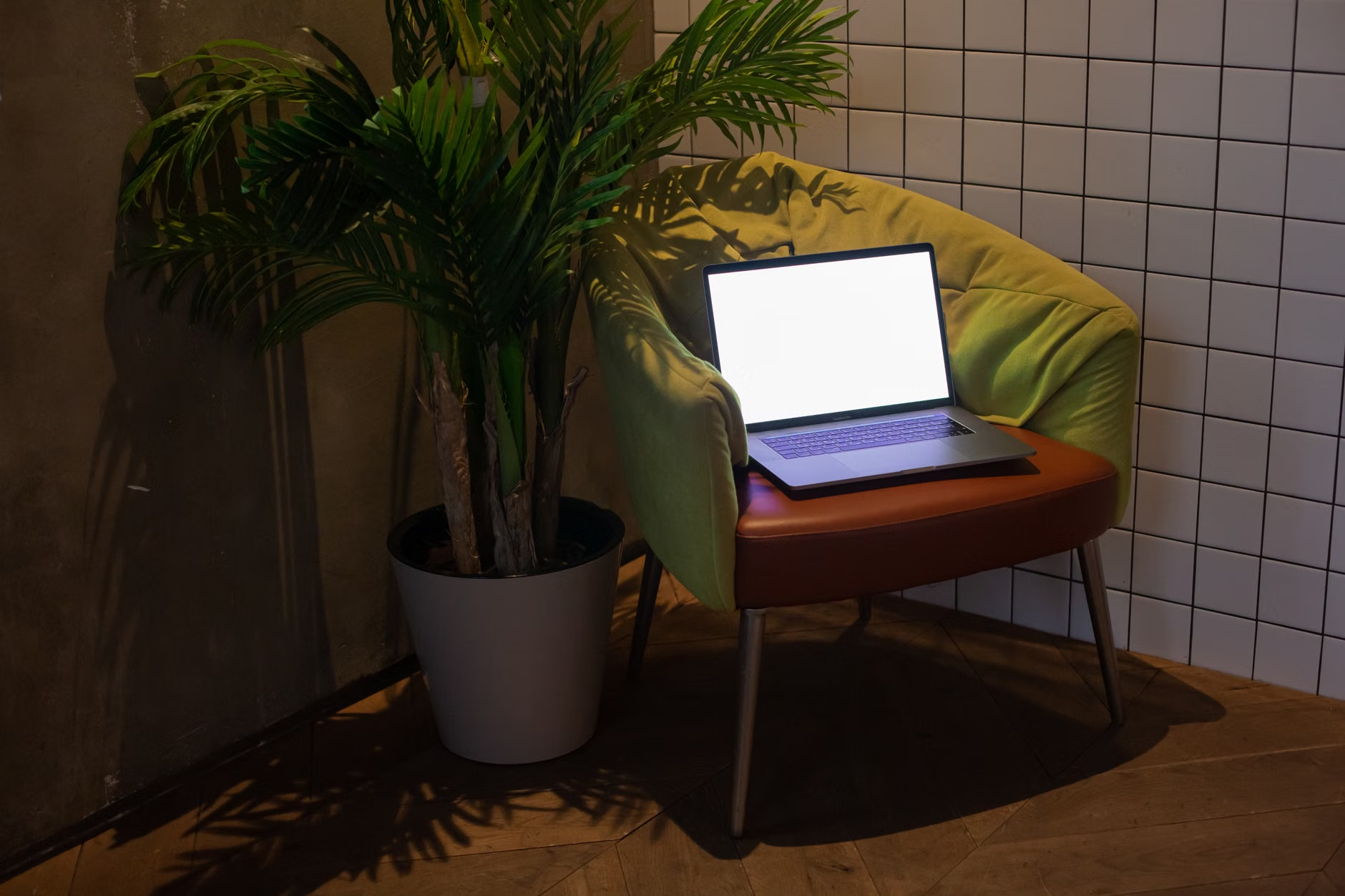
Lastly, be wary of “membership hopping.” It is tempting to try every new space that opens, but consistency is key. You want to build a routine where you know exactly where your desk is, how the coffee machine works, and which chair is most comfortable. The cognitive load of navigating a new space every few days will eat into your productivity. Find one that works, negotiate a long-term rate, and make it your “third place.”
Integrating Technology and Habits
To truly get the most out of your quiet-work membership, you need to treat it like a serious professional commitment. This means bringing the right gear. Noise-canceling headphones are a mandatory investment, even in a quiet space, because they act as a “do not disturb” signal to others. Additionally, use a dedicated bag for your “work kit”—laptop, charger, mouse, notebook, and whatever else you need—so you can leave instantly without forgetting essentials.
When you arrive, set up your space immediately. Do not check your emails first. Spend the first 10 minutes planning your day. Because you are in a space designed for focus, your brain will naturally lean into the work. Use this momentum to tackle your “Deep Work” task—the one project that requires your absolute best attention—before you even think about your inbox or Slack notifications.
Comparing Membership Tiers
Most coworking spaces offer different tiers. For a parent, the “hot desk” (where you sit wherever is available) might seem like the cheapest option, but it can be a source of stress. You arrive, only to find all the good spots are taken, or you are stuck next to a noisy group. If your budget allows, consider a “dedicated desk” or a “private office” tier. The consistency of having your own space, where you can leave your monitor or documents, is worth the extra cost in time saved alone.
If a dedicated desk is out of your budget, look for “quiet-only” memberships. Some boutique coworking spaces offer memberships that are significantly cheaper because they don’t provide the amenities like free coffee, printers, or networking events. These are often the best-kept secrets for parents who just need a quiet desk and high-speed Wi-Fi.
Final Considerations for the Digital Nomad Parent
Ultimately, a quiet-work membership is an investment in your mental health and your career longevity. By removing the friction of your home environment, you gain the clarity needed to be a better professional and a more present parent. It is not a luxury; it is a structural adjustment to the reality of modern work.
Start by identifying your “pain points.” Are you struggling with noise? Is it the lack of a professional atmosphere? Or is it the inability to separate your work from your home life? Once you identify the primary barrier, look for a space that solves that specific problem. Don’t get distracted by the “perks”—a high-end espresso machine is useless if the room is too loud to concentrate.
If you are still on the fence, most reputable spaces offer a “day pass.” Use it. Spend a full day there, observe the environment, and see how your brain reacts to the silence. You will likely find that the ability to focus for three hours straight without a single interruption is a transformative experience for your productivity.
The transition to quiet-work is a sign that you are taking your professional growth and your family time seriously. It is a mature, strategic move that sets you apart from the crowd who are still struggling to balance it all from a kitchen table. Take the step, find your space, and reclaim your focus.
Frequently Asked Questions
1. Is a quiet-work membership worth the cost if I only work remotely two days a week?
Yes, if you use those two days specifically for your highest-value, deep-focus work. If you treat those days as “protected time” to complete tasks that would take you double the time at home, the membership pays for itself in time saved and reduced stress. Many spaces offer “part-time” or “10-day” passes which are perfect for this frequency.
2. How do I handle emergency calls while in a quiet-work space?
Most professional quiet-work spaces are equipped with “phone booths” or sound-isolated pods. Before signing a contract, ensure they have enough of these for the number of members. If you anticipate frequent calls, look for a space that includes phone booth access in their base membership fee to avoid hidden hourly surcharges.
3. Can I use a quiet-work membership if I have a newborn at home?
While the goal is to separate work and home, having a newborn makes a quiet-work space even more essential. It provides a sanctuary where you are not physically present for the immediate demands of infant care, allowing you to focus on your professional output. However, ensure the location is close enough that you can return home quickly if an urgent family need arises, providing you with the peace of mind to focus while you are at the desk.
For more information on finding high-quality, professional coworking spaces globally, you can consult resources like the Coworker.com global directory or check local business listings in your specific city for “quiet workspace” or “deep work hub” designations.