- Sleep Architecture is the cyclical pattern of NREM and REM stages; understanding these cycles is more important for alertness than total hours spent in bed.
- The 90-Minute Rule: Humans cycle through sleep stages every 90 minutes; waking up at the end of a cycle, rather than the middle, is the key to avoiding “sleep inertia” or morning grogginess.
- The Audit Protocol: You can objectively measure your sleep efficiency by tracking your “latency” (time to fall asleep) and “fragmentation” (number of wake-ups) to identify if your environment or your biology is the primary disruptor.
If you are in your 30s or 40s, you have likely stopped asking “how do I sleep more” and started asking “why am I still tired after eight hours?” The reality for most parents is that we aren’t suffering from a lack of opportunity to sleep; we are suffering from a lack of architectural integrity in our sleep. Your brain doesn’t just “shut off”; it follows a complex, rhythmic blueprint of light sleep, deep restorative sleep, and REM dreaming. When this blueprint is interrupted—by a toddler’s cry, a late-night work email, or a room that is simply too warm—you aren’t just losing minutes; you are collapsing the entire structure of your recovery.
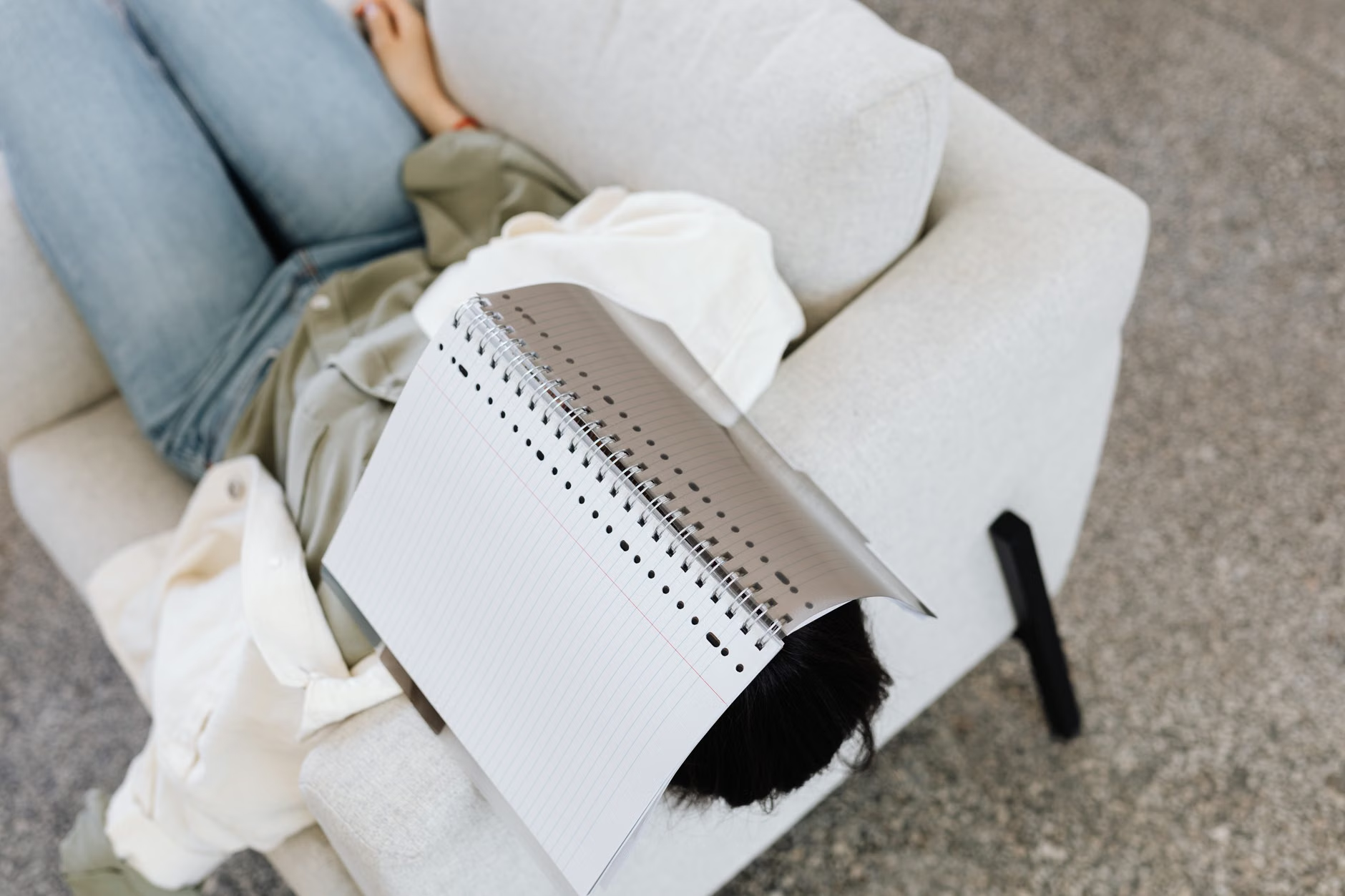
Performing a ‘sleep-architecture’ audit means treating your rest like a high-stakes project. It is time to stop blaming “being a busy parent” as a vague excuse and start identifying the specific, manageable variables that are fragmenting your nights.
Understanding the Blueprint: What is Sleep Architecture?
Sleep architecture refers to the structural organization of your sleep stages. A healthy adult typically cycles through four to six 90-minute periods per night. Each cycle consists of:
- N1 (Light Sleep): The transition phase where you are easily awakened.
- N2 (Baseline Sleep): Your heart rate slows and body temperature drops.
- N3 (Deep Sleep): This is the “repair” stage. Physical growth hormones are released, and your immune system is bolstered. This is non-negotiable for recovery.
- REM (Rapid Eye Movement): The stage associated with memory consolidation and emotional regulation. If you skip this, you feel “burnt out” and irritable.
Why this matters: If you are constantly interrupted during N3 or REM, you might be in bed for eight hours but only getting two hours of “real” restorative work. For a parent, this is the difference between having the patience to handle a morning tantrum and feeling like your brain is wrapped in cotton wool by 7:00 AM.
Most of us make the mistake of focusing on the total time in bed. Instead, we need to focus on cycle completion. If you wake up in the middle of N3, you will experience sleep inertia—that heavy, disoriented feeling that takes hours to shake off. If you wake up at the end of a 90-minute cycle, you are naturally primed to be alert.
The 4-Step Sleep Audit: A Tactical Framework
To audit your sleep, you need data. Don’t rely on “I feel tired.” Use a simple log or a wearable tracker for seven days. Your goal is to identify which of the following four pillars is failing you.
Step 1: Measuring Sleep Latency
Latency is the time it takes you to fall asleep once you hit the pillow. If it takes you less than 5 minutes, you are dangerously sleep-deprived. If it takes more than 30 minutes, you have a “psychophysiological” issue—your brain is still in “parent mode” or “work mode.”
The Fix: If your latency is high, you need a “cognitive buffer zone.” This is a 30-minute period before bed where you do absolutely nothing related to your responsibilities. No meal planning, no checking the school portal, no budget spreadsheets. Read fiction or do light stretching. You must signal to your nervous system that the “shift” is over.
Step 2: Tracking Fragmentation
Fragmentation is the number of times you wake up. For parents, this is often unavoidable due to children. However, the goal is to reduce unnecessary fragmentation. If you wake up because the room is too hot or because you checked your phone, that is a failure of your environment, not your child.
The Fix: Audit your environment. Is your room below 18°C (65°F)? Is it truly dark? If you wake up, do not look at the clock. Checking the time triggers a mental calculation (“If I fall asleep now, I get 4 hours and 12 minutes…”) that guarantees you will stay awake for another hour.
Step 3: Analyzing “Sleep Efficiency”
Sleep Efficiency is calculated as: (Total Sleep Time / Total Time in Bed) x 100. A healthy score is above 85%. If you are spending 10 hours in bed to get 6 hours of sleep, your efficiency is 60%. This indicates that your body has started to associate your bed with being awake, worrying, or scrolling.
The Fix: If your efficiency is below 80%, use “sleep restriction.” Get out of bed if you aren’t asleep within 20 minutes. Go to another room and do something boring. Only return when you are actually sleepy. This forces your brain to re-associate the bed with sleep, not restlessness.
Step 4: The Circadian Alignment Check
Are you a “night owl” trying to live a “morning lark” life? If you are biologically wired to be alert at 11:00 PM but forced to wake up at 5:30 AM for the school run, you are fighting a losing battle. While you can’t change your biology, you can manage your light exposure.
The Fix: Get 10 minutes of sunlight within 30 minutes of waking up. This “resets” your internal clock, making it easier to fall asleep earlier at night. It is the most effective, zero-cost tool for shifting your sleep architecture.

Common Pitfalls: What Most Parents Overlook
Many of us fall for the “weekend catch-up” trap. We sleep in on Saturday, thinking it will offset the weekday deficit. This is a myth. It creates “social jetlag,” which pushes your internal clock forward, making Monday morning significantly more difficult. Your body craves consistency more than it craves volume.
Another common mistake is the “wine-to-wind-down” strategy. While alcohol helps you fall asleep faster (reducing latency), it is a potent disruptor of REM sleep. Alcohol prevents your brain from completing the final stages of the sleep cycle, meaning you wake up feeling unrefreshed, regardless of how long you slept.
| Variable | The “Bad” Habit | The “Architectural” Fix |
|---|---|---|
| Bedtime Routine | Scrolling social media | Analog activity (reading/journaling) |
| Room Temp | Over 22°C (72°F) | 16-18°C (60-65°F) |
| Late Snacks | Heavy carbs/alcohol | Stop eating 3 hours before bed |
If you find that you are doing everything “right” but still waking up exhausted, consider the hidden variable: Sleep Fragmentation via Noise/Light. Even if you don’t “wake up” fully, small sounds or light leaks can push you from deep sleep (N3) into light sleep (N1). You won’t remember it, but your brain architecture will show the gap. Use white noise machines or blackout curtains to create a “sensory bunker.”
Practical Implementation: How to Start Your Audit Tonight
Don’t try to change your entire life at once. Start with a 7-day data collection phase. Keep a simple notebook next to your bed. Log these three things: Time you turned off the light, Estimated time you fell asleep, and Number of times you woke up.
After one week, look at the averages. If your latency is consistently over 30 minutes, your first priority is the “cognitive buffer zone.” If your fragmentation is high, your first priority is environmental control (blackout curtains, temperature, noise). If you feel “groggy” despite 7-8 hours, look at your wake-up time—try shifting it by 15-minute increments until you find the window where you wake up feeling naturally alert.
Remember, your goal isn’t to be a “perfect sleeper.” Your goal is to build a system that supports your life as a parent. When you have a solid sleep architecture, you aren’t just “resting”—you are actively repairing your capacity to handle the demands of the next day.

The Role of Technology: Friend or Foe?
We are in an era of wearable technology that tracks our sleep stages with surprising, though not perfect, accuracy. For many in their 30s and 40s, these devices can become a source of “orthosomnia”—the unhealthy obsession with achieving perfect sleep scores. If you find yourself feeling anxious because your watch gave you a “low readiness score,” remove the device for a week.
Technology should be used as a diagnostic tool, not a daily scorecard. Use your wearable for two weeks to identify patterns (e.g., “I always have high heart rate variability when I eat late”), then put it away. Trust your body’s internal feedback over a silicon sensor.
Final Thoughts: Moving Beyond the “Tired Parent” Identity
The “exhausted parent” trope is often treated as a badge of honor, but it is actually a health risk. Chronic sleep fragmentation in your 30s and 40s is linked to long-term cognitive and metabolic issues. By conducting a sleep-architecture audit, you are taking ownership of your health. You are moving from a passive victim of a busy schedule to an active manager of your biological recovery.
Start with the 90-minute cycle. Respect the rhythm. If you have a bad night—and you will, because life happens—don’t try to “fix” it with caffeine or a long nap. Just reset the architecture the next night. Consistency is the foundation upon which your energy is built.
For further reading on the science of sleep, the National Sleep Foundation provides excellent, evidence-based guidelines for adults: https://www.sleepfoundation.org/how-sleep-works. Additionally, the CDC offers practical tips on sleep hygiene that are backed by public health data: https://www.cdc.gov/sleep/about_sleep/sleep_hygiene.html.
Frequently Asked Questions
1. Does the 90-minute sleep cycle rule apply if I am a naturally short sleeper?
Yes. While some people need slightly more or less time to complete a cycle, the 90-minute structure is a biological constant for humans. If you feel fine after 6 hours (four cycles), you are likely a “short sleeper,” but the principle of waking up at the end of a cycle remains the most effective way to avoid morning grogginess.
2. What should I do if my child interrupts my sleep every single night?
If you cannot control the interruption, you must control the recovery. Focus on “sleep extension” whenever possible—meaning if you were awake for 45 minutes at 3:00 AM, try to shift your total time in bed to account for that loss, or prioritize a 20-minute “power nap” during the day that does not exceed 30 minutes (to avoid entering deep sleep and feeling worse upon waking).
3. Is it better to have a consistent wake-up time or a consistent bedtime?
Consistency in your wake-up time is significantly more important for regulating your circadian rhythm. If you have to choose one to be rigid about, choose the time you wake up. This anchors your biological clock and makes it easier for your body to naturally produce melatonin at the appropriate time in the evening.