The most rewarding travel experience for parents in their 30s and 40s isn’t found in a crowded airport terminal or a distant tourist trap, but rather in the overlooked corners of your own zip code. By shifting your perspective from “living in” a place to “exploring” it, you can turn a standard weekend into a hyper-local history walk that provides the same mental refreshment as a vacation without the logistical nightmare of travel.
- Hyper-local exploration removes the “travel stress” (packing, logistics, jet lag) that often makes family trips exhausting.
- Utilizing digital archives, local library databases, and historical society maps is the fastest way to turn a walk into an educational adventure.
- Focusing on “micro-histories”—the story of a single building, a street name, or a local park—prevents information overload and keeps children engaged.
Why the Hyper-Local Approach Wins for Busy Families
If you are balancing a career, a mortgage, and the constant demands of parenting, the idea of a “weekend getaway” often feels like more work than staying home. You spend hours researching flights, packing suitcases, and trying to keep kids entertained in transit. By the time you arrive, you’re already behind on sleep. This is why the hyper-local history walk is a game-changer.
A hyper-local history walk is simply an intentional, research-backed stroll through your immediate environment. It isn’t about finding the “biggest” or “most famous” monument. It is about understanding why the local library is built in a specific architectural style, why the main street has a slightly curved layout, or who the park down the road was named after. For parents, this is a low-stakes way to build curiosity in children without the pressure of a “perfect” vacation.
The mental benefit here is significant. Research into “micro-adventures” suggests that when we engage our environment with a sense of curiosity, our brains enter a state similar to travel—even if we are only two miles from our front door. You are effectively “hacking” your brain’s need for novelty by looking at your familiar surroundings with fresh eyes.
Step 1: Building Your Toolkit (The Research Phase)
Before you step out the door, you need a map—not just a GPS map, but a historical one. The most common mistake people make is wandering aimlessly and hoping to stumble upon something interesting. While that can be romantic, it rarely works when you have restless children or limited time.
Start by visiting your local municipal website or the archives of your regional library. Most cities have a “digital heritage” section. Look for:
- Historical Society Maps: Many cities have digitized maps from the 19th or early 20th century. Compare these to your current GPS to see what has changed.
- Plaque Databases: Almost every major city (and many smaller towns) keeps a registry of historical markers.
- Architecture Guides: A quick search for “[Your City] architectural styles” can tell you what to look for—Art Deco, Victorian, Brutalist, etc.
When you have this information, create a simple list of 3-5 “stops.” Do not make it a marathon. If you are walking with children, a 90-minute walk with three specific points of interest is far more successful than a three-hour hike through history.

Step 2: The “Micro-History” Technique
Once you are on the walk, the goal is to tell a story, not just recite dates. Dates are boring; stories are memorable. Instead of telling your child, “This building was built in 1902,” try, “Imagine that in 1902, the people who worked in this building didn’t have computers or electricity, so they had to build these huge windows to get enough sunlight to read their paperwork.”
This is the “what it is, why it matters” framework. For every stop, identify one physical detail that tells a story:
| Feature | Historical Context | Engagement Question |
|---|---|---|
| Old Brickwork | Local clay source or trade routes | “Why do you think these bricks are a different color than the ones on our house?” |
| Street Name | Former land owner or local hero | “If you could name this street, what would you call it and why?” |
| Empty Lot | Former site of a lost landmark | “What do you think used to be here before it became a park?” |
This table isn’t just for kids; it’s for you. It helps you focus your observations. If you can explain the “why” behind the “what,” you are no longer just walking; you are curating an experience.
Step 3: Avoiding the “Tourist Trap” Mindset
A common pitfall is trying to make your neighborhood feel “exotic.” Don’t do this. Acknowledge the grit and the reality of your area. If your neighborhood is industrial, look up the history of the factories. If it’s residential, look up the history of the families who first lived there. The beauty of a hyper-local walk is its authenticity.
If you find that your area has very little “official” history, look for “hidden” history. This includes the evolution of local street trees, the history of the local school system, or even the origins of the local supermarket chain. Everything has a history. The challenge is in the digging.

Step 4: Managing Expectations and Logistics
Let’s be realistic: kids get tired, and adults get hungry. A hyper-local walk requires the same logistical preparation as a trip to the zoo. Plan your route to end at a “reward” location—a park with a playground, a local bakery, or a cafe you’ve been meaning to try. This creates a positive association with the walk.
Common Mistakes to Avoid:
- Over-planning: Do not try to cover more than 1.5 miles. Your goal is engagement, not exercise.
- Ignoring the Weather: Check the forecast. If it’s too hot or too cold, the history walk becomes a chore.
- Forgetting the “Exit Strategy”: If you are walking in a city, know which bus or train line can get you home quickly if someone has a meltdown.
If you are walking with a partner, divide the roles. One person is the “navigator/historian” who holds the research, and the other is the “logistics manager” who handles snacks, water, and timing. Switching these roles keeps both adults engaged and prevents the “mental load” from falling on just one person.
The Hidden Value of Local Observation
Beyond the fun of the weekend, there is a deeper benefit to these walks. Known as “place-attachment,” this psychological concept posits that the more you know about your surroundings, the more you feel a sense of ownership and responsibility toward them. For parents, this is a powerful lesson to teach children. When they know the history of the park, they are more likely to respect it. When they know the story of their neighborhood, they feel more connected to their community.
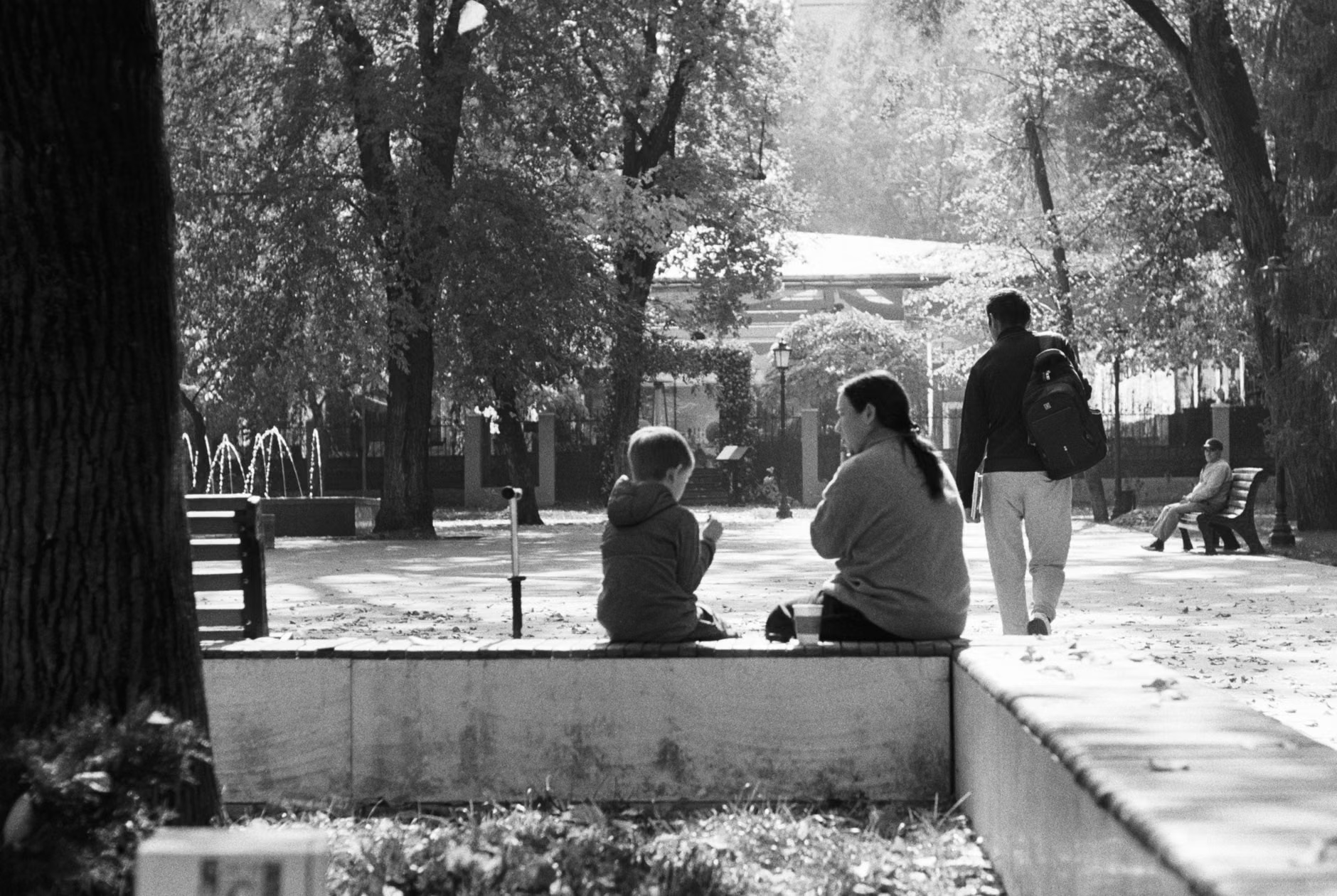
This isn’t just about nostalgia; it’s about informed citizenship. By understanding the layers of history beneath your feet, you see your neighborhood not as a static collection of houses, but as an evolving story that you are now a part of. You start to notice things that others miss—the old iron fence that survived a war, the ghost sign of a 1950s business painted on a brick wall, or the way the street grid was designed to accommodate horses rather than cars.
Advanced Exploration: Adding Layers of Depth
Once you’ve mastered the basic history walk, you can start adding layers of complexity. This is where the 30s-and-40s demographic often finds the most satisfaction. Consider these three “advanced” modes of exploration:
1. The Chronological Walk
Instead of mapping by location, map by time. Find three buildings from different decades (e.g., 1920s, 1950s, 1980s) and walk between them. Discuss how the materials, the size of the windows, and the intended use of the buildings changed over those decades. This is a practical lesson in economic and social history.
2. The “Ghost” Walk
Use platforms like Google Earth’s “historical imagery” feature or specialized local archives to look at photos of your street from 50 years ago. Then, go stand in the exact spot where the photo was taken. This is a powerful exercise in perspective, as it allows you to visualize the transformation of your own backyard.
3. The Sensory Walk
Focus on a specific theme, like “local flora” or “architectural details.” If you choose flora, look up which trees were native to the area before the neighborhood was built. See if you can find any “remnant” trees that might have been there before the houses were. This adds a layer of natural history to your human history walk.
Addressing Common Hurdles
What if your neighborhood is “new”? Many people living in suburban developments assume their area has no history. This is almost never true. Even if your street was a cornfield 20 years ago, that cornfield has a history. Who owned the land? Why was it developed when it was? What was the area like during the Industrial Revolution? The “newness” of a place is, in itself, a historical fact that tells you something about the growth of your city.
If you live in a place with a complicated or painful history, use the walk to address it with your family. History isn’t always pretty. Acknowledging the difficult parts of your local area’s past is a valuable way to teach children about empathy and the complexities of the world. It turns a simple walk into an opportunity for meaningful conversation.
Practical Next Steps for Your First Walk
To get started this coming weekend, follow this simple checklist:
- Choose a 1-mile radius: Keep it tight.
- Find one “anchor” point: This could be an old church, a library, a park, or a local landmark.
- Search the “Local Archives”: Spend 30 minutes on Friday night looking up the history of that anchor point.
- Prepare one question for each family member: Keep it light and open-ended.
- Go: Don’t wait for the perfect weather or the perfect plan. Just start walking.
The beauty of the hyper-local history walk is that it is infinitely repeatable. You can walk the same two blocks five times and notice something different every single time. It is a low-cost, high-reward activity that fits perfectly into the busy life of a modern parent. You don’t need a passport to be an explorer; you just need to be curious about where you stand.
Frequently Asked Questions
What if I can’t find any historical information about my neighborhood online?
If the internet comes up empty, go old-school. Visit your local branch of the public library. Librarians are often the best-kept secrets for local history; they have access to physical archives, local newspapers, and municipal records that aren’t indexed by Google. Alternatively, look for a local historical society. Even the smallest towns often have one, and they are usually run by passionate volunteers who love to share their knowledge.
How do I keep my children from getting bored during the walk?
Keep the walk short and gamify the experience. Instead of a lecture, turn it into a scavenger hunt. “Can you find a house with a date on it?” or “Who can find the oldest-looking tree on this block?” Give them a role, like the “official photographer” or the “map keeper.” When children feel like they have a job to do, they are much more engaged with the environment.
Is this really a “vacation”? Can it replace a real trip?
It depends on how you define “vacation.” If your goal is to escape the stress of daily life and find mental clarity, yes, it can absolutely provide that. While it won’t give you the experience of a different culture or climate, it provides the same benefits of mindfulness and novelty. Think of it as a “micro-vacation” that you can take every single weekend without the burnout of travel.
For more resources on local history, check out the Library of Congress Local History and Genealogy Reference Services or your country’s national archives website for tips on how to research a specific area.