If you are looking for a vacation that actually leaves you feeling refreshed rather than exhausted by a frantic itinerary, the answer for 2027 is heritage rail travel.
- Book 12-18 months early: Heritage lines often have limited capacity; for 2027, the best routes will sell out by mid-2026.
- Prioritize the journey, not the destination: Heritage rail is about the sensory experience of the train itself, not just getting from point A to B.
- Budget for “hidden” comfort: Unlike budget airlines, heritage rail pricing is often tiered by carriage luxury; prioritize private compartments if traveling with children under 10.
Let’s be honest: by the time you reach your mid-30s or 40s, the “adventure” of running through airports, wrestling with oversized luggage, and managing toddler meltdowns in a cramped economy seat has lost its luster. We are all craving a way to move through the world that doesn’t feel like a high-stakes endurance test. This is where the “Slow Travel” movement meets the romantic, mechanical precision of heritage rail.
Heritage rail isn’t just about old trains; it is about reclaiming time. When you board a restored steam or diesel locomotive, you aren’t just a passenger; you are a participant in a rhythm that hasn’t changed in decades. For families, this is a game-changer. You get to move, you get to see the landscape change at a human pace, and most importantly, you get to sit together without a screen being the primary mediator of your experience.
Why Heritage Rail is the Antidote to Modern Travel Burnout
Modern travel is designed for efficiency. We optimize for speed, cost, and connectivity. But in doing so, we strip the experience of any soul. Heritage rail does the exact opposite. It is inefficient by design, and that is its greatest strength.
When you are in your 30s or 40s, balancing a career and perhaps a household with children, your brain is likely in a perpetual state of “task switching.” You are constantly managing logistics. Heritage rail forces a singular focus. You are on a train. You are watching the trees pass. You are drinking coffee from a ceramic mug. There is no Wi-Fi, there is no boarding gate to rush to, and there is no “next step” to calculate.
The “Slow Travel” Philosophy: This isn’t just a buzzword. It is a decision to prioritize the quality of the journey over the speed of arrival. In 2027, as global tourism infrastructure struggles with over-capacity, heritage rail routes offer a quieter, more sustainable alternative. You aren’t just traveling; you are observing the geography of a region as it was meant to be seen—from the ground up, rather than from 30,000 feet.
Strategic Planning for 2027: The Logistics of Heritage Travel
If you decide to make heritage rail the centerpiece of your 2027 family vacation, you cannot approach it with the same spontaneity you might have had in your 20s. These are not mass-market transit systems. They are niche, historically significant operations that often rely on a limited number of rolling stock.
The 18-Month Rule: Most world-class heritage routes, such as the Jacobite Steam Train in Scotland or the various scenic lines in the Swiss Alps, operate on seasonal schedules. Because they are often run by non-profits or historical societies, they don’t have the “infinite” seat capacity of a major airline. If you want a specific compartment or a specific time of year, you need to be looking at their booking portals at least 12 to 18 months in advance.
Assessing Your Family’s Rail Readiness
Before you commit to a route, you need to evaluate if the “slow” aspect is actually going to work for your specific family dynamic. Heritage trains can be long. Some routes are 4-6 hours of continuous travel. For a child who needs constant stimulation, this can be heaven or it can be a nightmare.
| Factor | Heritage Rail Reality | Actionable Tip |
|---|---|---|
| Connectivity | Little to no Wi-Fi or cellular signal. | Download offline maps and entertainment beforehand. |
| Comfort | Vintage seating can be firm; limited ergonomic support. | Bring your own travel pillows or seat cushions. |
| Dining | Restricted menus; often fixed-time seatings. | Pack high-quality snacks; check if you can bring a picnic. |
The “hidden” cost of heritage travel is usually the lack of flexibility. If you miss the train, there isn’t another one in an hour. You have lost your seat for the day. This requires a shift in mindset: the train is the destination. If you arrive at the station two hours early and spend time in the local town, you are winning at slow travel.
Choosing the Right Route: A Comparative Analysis
Not all heritage rail experiences are created equal. Some are “tourist traps” that feel like a theme park ride, while others are authentic historical experiences that feel like time travel. When choosing for 2027, use these three criteria to filter your options:
- Authenticity of Equipment: Is the locomotive a genuine historical artifact, or a modern engine dressed up to look old? For the true “slow travel” experience, seek out lines that maintain authentic steam or early-era diesel engines.
- Geographic Context: Does the route traverse a landscape that is inaccessible by car? The best rail routes use tracks that were laid down before the modern highway system existed, providing views you literally cannot see any other way.
- Community Impact: Does the line support a local economy or preserve a dying piece of industrial history? Choosing these routes adds a layer of ethical satisfaction to your trip.

Managing the “Parenting Factor” on Long Journeys
Let’s address the elephant in the room: how do you keep kids happy on a train that doesn’t have a screen in every seat back? The secret is to lean into the “analog” nature of the trip. Heritage trains are sensory-rich environments. There is the smell of coal smoke, the rhythmic clatter of the wheels, and the constant change of scenery.
The “Journaling” Strategy: Give your children a dedicated travel journal. Instead of asking them to “behave,” ask them to document the journey. What color was the engine? What did the fields look like? What was the conductor wearing? This changes their role from “captive passenger” to “explorer.”
The “Snack Picnic” Rule: Heritage dining cars can be expensive and crowded. Bringing your own high-end picnic—think local cheeses, fresh bread, and fruit—turns a meal into an event. It also gives you control over timing, which is vital when dealing with younger children who might not be ready for a formal dining car service.
If you are traveling with a partner, try to trade off the “monitor” duty. One person handles the logistics and the kids for one hour, then you switch. This ensures that both of you get at least some time to actually look out the window and enjoy the landscape without feeling the weight of parental responsibility.
Common Mistakes to Avoid in 2027
The most common mistake people make is over-scheduling their arrival and departure days. Because heritage trains are often located in rural or remote areas, they are susceptible to delays. Never plan a high-stakes connection (like an international flight) on the same day you are taking a long-distance heritage train.
The “Last Mile” Problem: Many heritage rail stations are not connected to major public transport hubs. You will likely need to arrange a taxi or a rental car for the final leg of your journey. Do not assume that because the train is “historic,” the station will have modern amenities like Uber or high-speed Wi-Fi. Research the station facilities well in advance.
Ignoring the Weather: Heritage trains are often open-air or have older, less robust climate control. If you are traveling in a mountain region, the temperature inside the carriage can swing wildly. Always dress in layers. A common mistake is assuming that because it is warm at the station, it will be warm on the mountain pass.
The Financial and Ethical Trade-offs
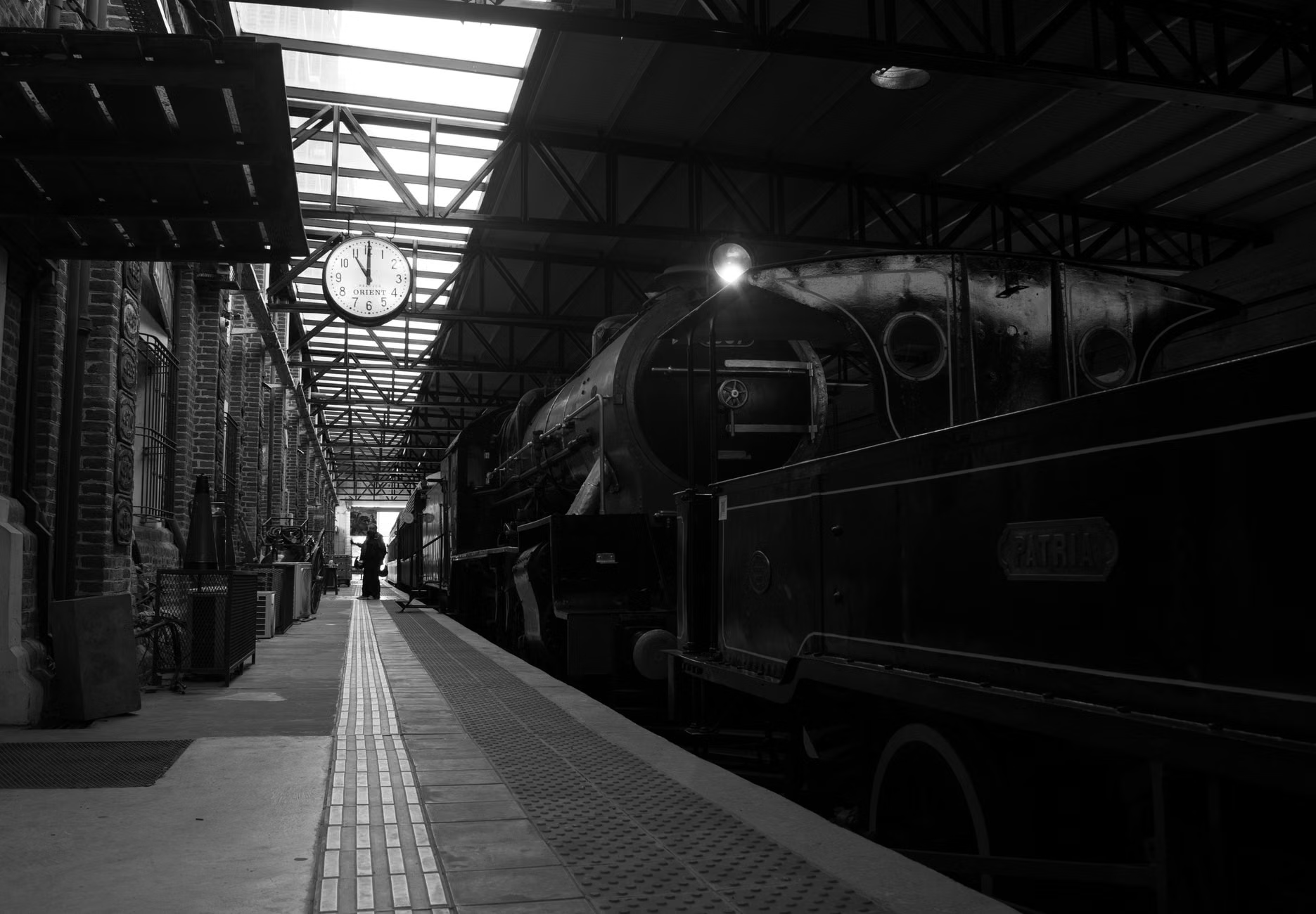
Heritage rail is not a budget travel option. Operating a 100-year-old steam locomotive is incredibly expensive. Maintenance, fuel, and specialized labor costs are high. When you pay for a ticket, you are often subsidizing the preservation of history. Understand that you are paying a premium for an experience, not just for transportation.
However, from a “value” perspective, compare this to a day at a major theme park. You are paying for a full day of entertainment, a unique historical education, and a lasting memory. When viewed through this lens, the price becomes much more justifiable.
Sustainable Tourism: By choosing rail over short-haul flights or rental car road trips, you are significantly reducing your carbon footprint. This is a tangible way to teach your children about sustainable choices. It isn’t a lecture; it is an experience that shows them that “slow” can be better than “fast.”
Finalizing Your 2027 Itinerary
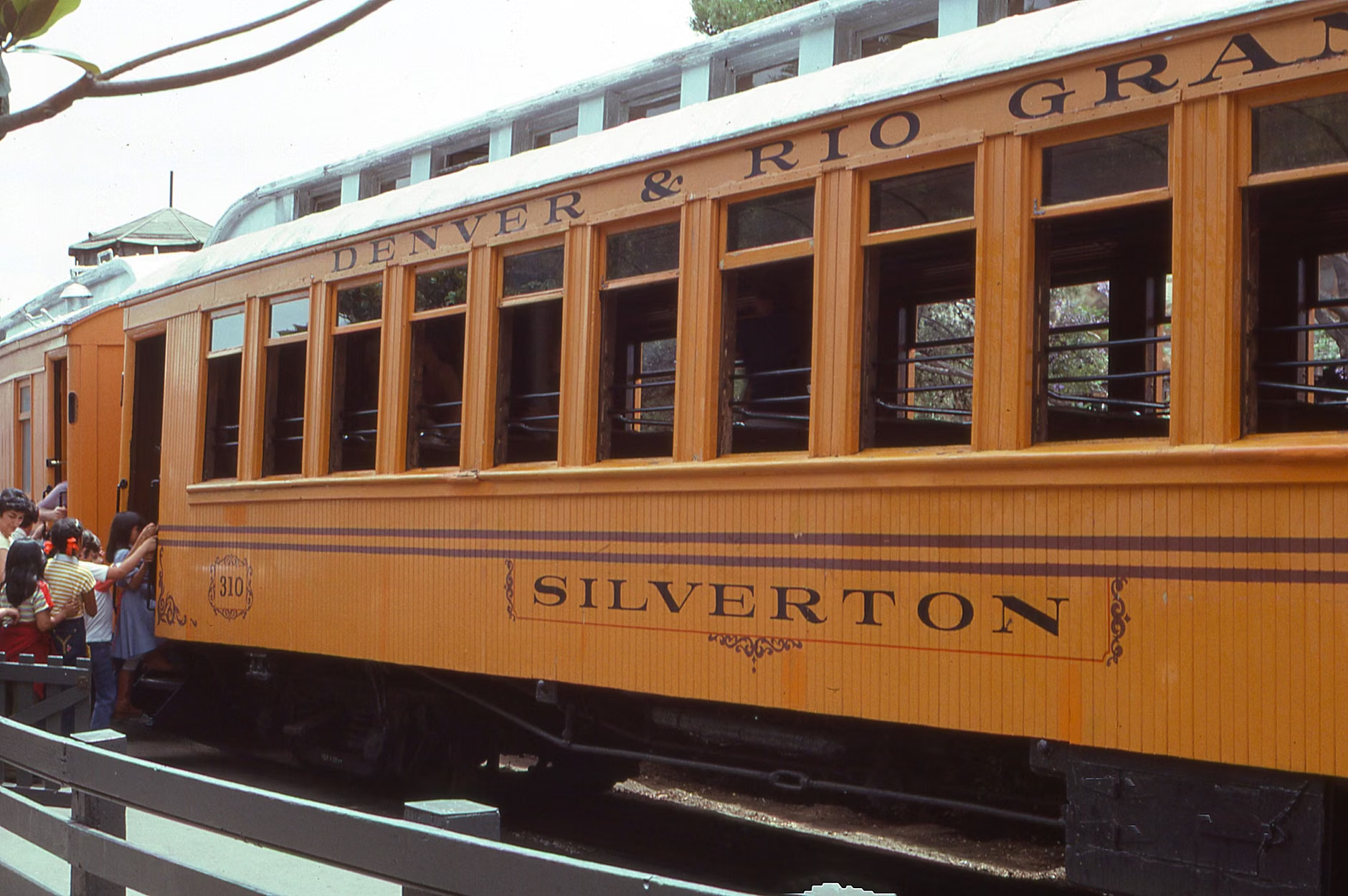
As you look toward 2027, start by identifying the “anchor” heritage rail route you want to experience. Don’t build the whole trip around the train, but make the train the highlight. If you are heading to the UK, look into the Ffestiniog & Welsh Highland Railways. If you are in the US, consider the Durango & Silverton Narrow Gauge Railroad. In Europe, the Bernina Express (while technically a modern route, it feels like a heritage experience) is a standard-setter.
Once you have your route, look at their official website. Do not rely on third-party aggregators. The best deals and the most reliable information come directly from the historical societies that operate the lines. Check for “special events,” such as themed days or evening dining services, which can add a unique flair to your trip.
Remember that the goal of this travel is to return home feeling as though you have actually lived, rather than just traveled. By slowing down, you allow yourself the space to be present with your family. That is the true luxury of 2027.
Frequently Asked Questions
Q: Are heritage trains safe for toddlers and young children?
A: Generally, yes, but with caveats. Older carriages may not have modern safety features like seatbelts or child locks on windows. You must supervise children closely, especially near the carriage connections, which can be noisy and uneven. Always check the operator’s specific age-related policies before booking.
Q: Can I bring a stroller on board a heritage train?
A: Most heritage trains have limited space. Large, non-collapsible strollers are usually not permitted in the carriages. You are best off using a baby carrier or a very compact, lightweight umbrella-style stroller that can be folded and stored in the luggage rack. Call the operator ahead of time to confirm their specific storage capacity.
Q: What happens if the weather is bad?
A: Heritage trains usually run in all weather conditions unless there is a severe safety risk (like high winds or track damage). The “bad” weather is often part of the charm—there is something uniquely atmospheric about watching rain lash against the window of a steam-heated carriage. If the line is cancelled due to weather, reputable operators will offer a full refund or a seat on a later departure, but always check their refund policy at the time of booking.
For more information on planning your rail journey, you can visit the Heritage Railway Association for global resources and safety standards.
Start your planning now. The best seats on the most scenic lines are already being claimed for the 2027 season. Don’t let the rush of the everyday stop you from booking the reset your family deserves.