The most effective way to eliminate the “Sunday Scaries”—that creeping dread of the approaching work week—is not to ignore the weekend’s end, but to build a 90-minute “Gentle Transition” ritual that physically and mentally bridges your roles as a parent and a professional.
- The 90-Minute Rule: Dedicating 90 minutes on Sunday evening to “staging” your Monday reduces cognitive load by up to 40% when you wake up.
- Context Switching is Costly: Attempting to pivot from “weekend parent” to “weekday professional” in under 10 minutes leads to decision fatigue and increased cortisol levels.
- The “Monday-Ready” Audit: You must resolve “low-friction” blockers (outfits, breakfast prep, calendar review) on Sunday to protect your peak focus hours on Monday morning.
If you are in your 30s or 40s, your weekends are rarely “restful” in the traditional sense. Between managing school drop-off logistics, grocery shopping, household maintenance, and trying to squeeze in a semblance of a social life, the transition to Monday morning often feels like a collision rather than a start. The “Sunday Scaries” isn’t just a mood; it’s a physiological response to the abrupt shift in cognitive demands.
Why the ‘Gentle Transition’ Matters for High-Functioning Parents
In our 30s and 40s, we are often managing multiple “operating systems” simultaneously. One system handles professional deliverables, another handles household management, and a third handles the complex emotional and logistical needs of children. When these systems collide on Monday morning, the result is “context switching debt.”
Research into cognitive load theory suggests that our brains have a finite amount of “executive function” available each day. When you wake up on Monday and immediately have to decide what to wear, where the permission slips are, or what the first meeting of the day involves, you are burning through your daily budget of decision-making energy before you’ve even had your first cup of coffee. By the time you reach your desk, you are already operating at a deficit.
The Gentle Transition ritual is essentially a “system boot-up” sequence. Just as a computer needs to load drivers and background processes before you can start working, your brain needs to move from the “leisure/family” mode of Sunday into the “focused/execution” mode of the work week. Doing this in a controlled, 90-minute window transforms the start of your week from a chaotic scramble into a deliberate launch.

The 90-Minute Architecture: A Step-by-Step Breakdown
To make this ritual sustainable, it cannot feel like “extra work.” If it feels like a chore, you will skip it. The objective is to shift the “work” from Monday morning to Sunday evening, where the stakes are lower and the environment is calmer.
Phase 1: The Logistics Audit (45 Minutes)
The goal here is to remove every “minor annoyance” that could derail your Monday. Start by reviewing your calendar. Do not just look at the times; look at the transitions. If you have a meeting at 9:00 AM, when do you need to stop your “parenting” responsibilities? If you have a school run, have you accounted for the time it takes to get back to your desk?
Common Mistake: Most people use Sunday nights to “plan” their goals. This is a mistake. Sunday night is for logistics, not strategy. Save your creative planning for Tuesday or Wednesday. On Sunday, focus on the “friction points.”
| Task | Why it matters | The “Monday-Ready” Result |
|---|---|---|
| Outfit Staging | Eliminates decision fatigue | Zero seconds wasted choosing clothes |
| Meal Prep | Prevents “What’s for breakfast?” anxiety | Smooth morning routine for kids |
| Bag/Device Check | Prevents “Where is my laptop charger?” | Immediate focus upon starting work |
Phase 2: The Cognitive Decompression (30 Minutes)
Once the physical items are ready, you must address your mental state. If you go to bed thinking about the email you didn’t send, your sleep quality will suffer. This is where the “Brain Dump” becomes essential. Take a piece of paper—not a digital device—and write down everything that is bothering you or occupying your thoughts.
By externalizing these thoughts, you are moving them from your working memory to a “storage” location. This allows your brain to enter a state of “rest” rather than “maintenance.” You aren’t solving the problems tonight; you are simply cataloging them so you can address them in a structured way on Monday.
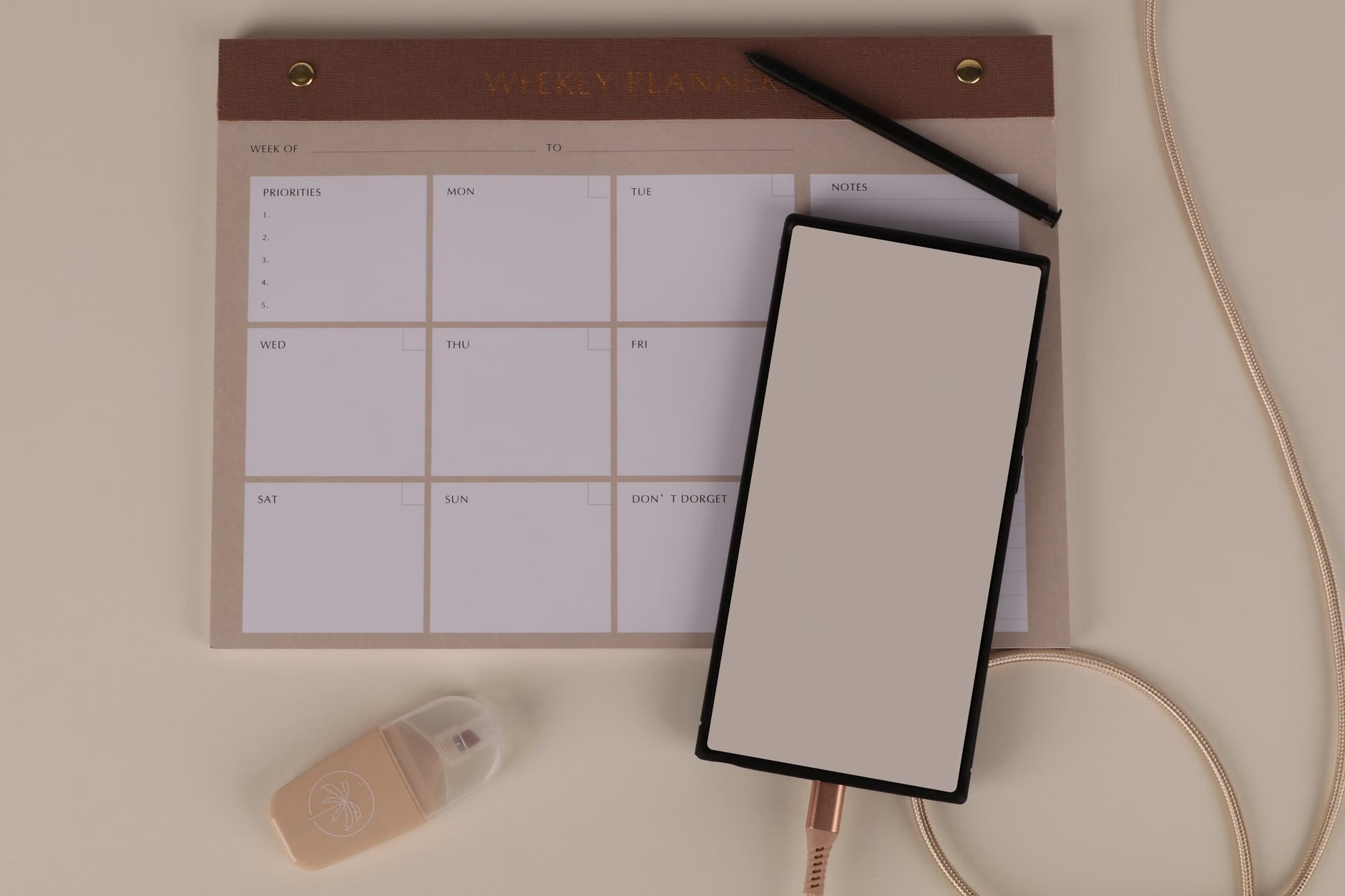
Phase 3: The Boundary Setting (15 Minutes)
The final 15 minutes of your ritual are for setting the “rules of engagement” for Monday. This is the most crucial step for parents. You need to explicitly define what a “successful” Monday looks like. If you have a high-stakes presentation, your goal for Monday is to survive that presentation and maintain your energy levels. If you have a busy household day, your goal is to keep the morning transition under 30 minutes.
By defining a “win” for the day, you prevent yourself from feeling like a failure because you didn’t accomplish an impossible list of tasks. This is about managing your own expectations as much as it is about managing your schedule.
The Hidden Costs of Skipping the Transition
When you skip the transition, you are essentially “debt-spending” your energy. You start Monday morning with an overdraft. This leads to a phenomenon known as “reactive mode.” You wake up, check your phone, see an urgent notification, and immediately start responding to other people’s priorities.
In our 30s and 40s, we are often the “anchor” for our families. If we are in reactive mode, the entire household feels it. The urgency you feel is projected onto your children and your partner. By taking 90 minutes on Sunday, you are not just helping yourself; you are creating a “buffer zone” for your entire family. A calm parent on Monday morning is the single best predictor of a smooth start for the entire household.
Furthermore, the physical act of preparing your environment—laying out clothes, setting the coffee machine, clearing the workspace—signals to your brain that the weekend is over and the work week has begun. This is a psychological “reset” that is vital for mental health. Without this boundary, the weekend bleeds into the work week, and you never truly feel like you are “off” or “on,” leading to chronic burnout.

Implementation Strategies for Different Life Stages
The “Gentle Transition” looks different depending on your specific situation. Here is how to adapt it:
- The Working Parent with Young Children: Your focus should be entirely on “Morning Logistics.” If the kids have their clothes laid out and their bags packed, you have already won 80% of the battle. Do not try to do complex work planning; you won’t have the bandwidth.
- The Remote Professional: Your focus should be on “Workspace Reset.” Ensure your desk is cleared of all weekend clutter. If your desk is covered in toys or coffee mugs from Sunday, you will struggle to find focus on Monday. A clean, “neutral” workspace is essential for shifting into professional mode.
- The Dual-Career Couple: Use the 90 minutes as a “synchronization” period. Spend 15 minutes at the end of the ritual to compare calendars. “Who is doing the school run?” “Who has the late meeting?” This prevents the “Who is doing what?” panic that typically happens at 7:30 AM on Monday.
Common Misconceptions and Troubleshooting
“I don’t have 90 minutes.” If you truly don’t have 90 minutes, start with 30. The ritual is scalable. The most important components are the Brain Dump and the Physical Reset. If you can do those two things, you will see a massive improvement in your Monday morning baseline.
“I find Sunday nights depressing.” That is exactly why you need the ritual. The depression often comes from a lack of control. When you take control of your Monday through the Gentle Transition, you regain your agency. You are no longer “waiting” for Monday to happen to you; you are preparing to meet it.
“I keep adding more tasks to the list.” This is a common trap. The goal of the Sunday ritual is to remove tasks from your immediate view, not to add to them. If you find yourself adding to-dos, stop. Use the Sunday night time for execution of small tasks, not for planning large, complex projects. If a task is too big to finish in 10 minutes, move it to a “to-do” list for later in the week.
Final Recommendations for a Better Week
The Gentle Transition is not a guarantee of a perfect week, but it is a guarantee of a better start. By moving the friction from Monday morning to Sunday evening, you are choosing to prioritize your own mental clarity and your family’s stability.
Start this coming Sunday. Set a timer for 90 minutes. Don’t aim for perfection; aim for “readiness.” Clear your desk, write down your worries, and prepare your logistics. When you wake up on Monday, notice the difference in your heart rate and your ability to focus. You will likely find that the “Sunday Scaries” are replaced by a quiet, steady sense of preparation. That is the feeling of reclaiming your time.
For more research on the impact of decision fatigue and cognitive load, visit Harvard Business Review or explore resources from the American Psychological Association on stress management techniques.
Frequently Asked Questions
Q: Is it better to do this on Sunday morning or Sunday night?
A: Sunday night is superior for the “Gentle Transition” because it is closer to the actual start of the work week. Doing it on Sunday morning leaves too much time for your brain to “reset” into weekend mode, which can lead to the same anxiety returning by Sunday evening.
Q: Can I use digital tools for the Brain Dump?
A: While digital tools are great for organization, physical writing is better for the Brain Dump. The act of writing by hand forces a slower cognitive process that helps with emotional regulation and “letting go” of worries, which is harder to achieve with the fast-paced nature of typing.
Q: What if my Monday schedule is completely unpredictable?
A: If your schedule is highly volatile, your Gentle Transition should focus on “Self-Care Logistics” instead of “Task Logistics.” Ensure you have healthy snacks ready, a workout outfit set out, and a clear plan for your first 30 minutes of the day. When work is unpredictable, your personal routine must be your anchor.
Note: This article is for informational purposes and does not constitute professional psychological or career advice. Always evaluate your specific work-life situation when implementing new productivity habits.