The secret to a successful family hike isn’t the distance you cover, but the number of discoveries you make along the way. If you are a parent in your 30s or 40s, you know that the traditional “conquer the summit” mentality often leads to tantrums, exhausted parents, and a general resentment toward the outdoors. Instead, the “slow-adventure” approach prioritizes engagement over elevation, turning a simple walk into a shared exploration where the goal is simply to be present.
- Redefine Success: Shift your metric from miles hiked to “curiosity units”—every rock, bug, or leaf found is a win that keeps children engaged.
- The 1:3 Rule: Allocate three times the amount of time you think you need for a trail to account for natural curiosity, snack breaks, and inevitable rest stops.
- Gear as a Safety Net: Focus on “low-friction” gear—shoes that don’t cause blisters and snacks that provide immediate energy—to prevent the most common causes of mid-hike meltdowns.

Why “Conquering” Trails Is the Wrong Goal for Families
Most of us grew up with the idea that hiking is a sport. We track steps, elevation gain, and pace. When you apply this “fitness-first” mindset to a five-year-old or even a toddler, you are effectively setting yourself up for a failure. Children do not experience nature as a linear path from Point A to Point B; they experience it as a series of sensory inputs. A puddle is not an obstacle to be bypassed; it is an ecosystem to be investigated.
For parents balancing work, school runs, and the mental load of managing a household, the weekend hike should be an antidote to the “fast-paced” week, not another checklist item. When you force a pace, you trigger the “hiker’s fatigue” in children, which manifests as whining, dragging feet, or the inevitable “carry me” request. By slowing down, you lower the cortisol levels for everyone involved. You aren’t just walking; you are regulating your family’s nervous system through exposure to green spaces—a concept often referred to as “forest bathing” or shinrin-yoku, which has been shown to reduce stress in both adults and children.
The “slow-adventure” philosophy requires a fundamental shift in your internal dialogue. Instead of thinking, “We need to reach the waterfall by noon,” change your thought to, “We will explore the trail until we get tired or find something interesting, then turn back.” This removes the pressure to perform and replaces it with the freedom to explore. If you end up only walking half a mile but finding a fascinating beetle and a perfect climbing tree, you have had a more successful hike than if you had marched three miles in silence.
Choosing the Right Trail: The “Micro-Adventure” Criteria
Not all trails are created equal. A trail that is “easy” for an adult can be a grueling slog for a child. When selecting a route, you need to look beyond the length and elevation. Use the following criteria to evaluate whether a trail is suitable for your family’s current capacity.
| Criteria | What to Look For | Why It Matters |
|---|---|---|
| Surface Texture | Packed dirt, grass, or boardwalks | Prevents trips and keeps shoes clean, reducing frustration. |
| “Anchor Points” | Bridges, logs, large rocks, stream crossings | Provides natural milestones that break up the distance. |
| Shade Coverage | At least 60% tree canopy | Prevents overheating and keeps the environment cooler. |
When you start looking at maps, look for “lollipop” or “loop” trails rather than “out-and-back” trails if possible. Loops provide a sense of progression, whereas out-and-back trails can feel repetitive to a child who realizes they have to walk the same path twice. If you live in an urban area, check municipal parks or nature preserves. These are often designed with “interpretive trails” that feature signage about local flora and fauna, which acts as a built-in curriculum for your hike.
Avoid “destination-based” hiking. If the entire point of the hike is to reach a viewpoint, the child will feel the journey is worthless if the view is obscured by clouds. Instead, choose a trail where the “value” is distributed throughout the path. A trail that follows a creek is inherently more engaging than a straight, flat path through a dry meadow because the creek offers constant auditory and visual stimulation.
Equipping Yourself for the “Slow-Adventure”
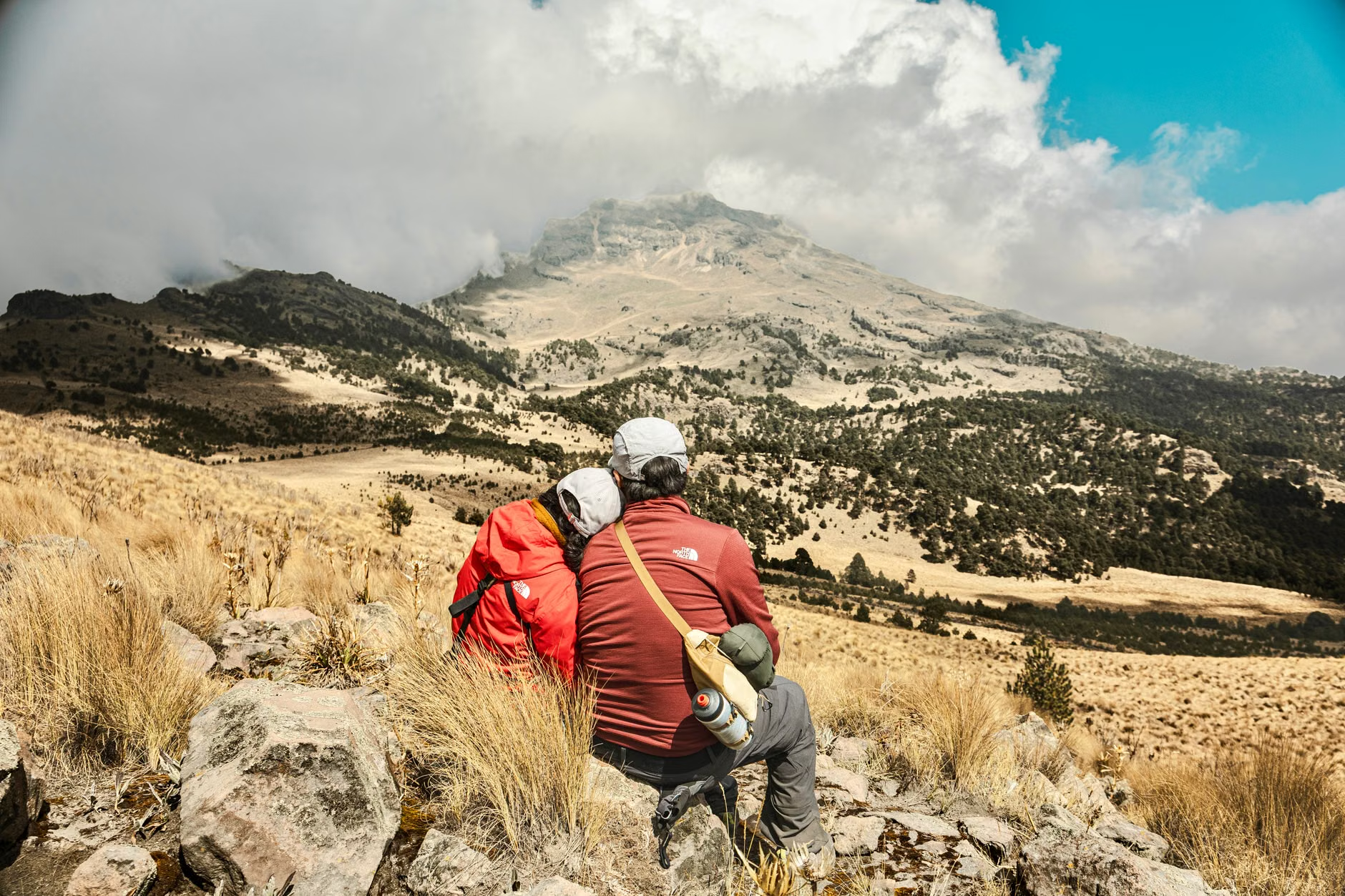
There is a fine line between being prepared and being weighed down. Many parents make the mistake of over-packing “just in case,” which results in a heavy, awkward load that slows you down. For a half-day slow-adventure, your gear should focus on three pillars: comfort, caloric maintenance, and safety.
Comfort is non-negotiable. Children are incredibly sensitive to physical discomfort. A tiny pebble in a shoe or a seam rubbing against an ankle can end a hike in minutes. Invest in proper hiking socks—wool blends are best because they wick moisture and provide cushioning. Avoid cotton, as it stays wet and cold if a child steps in a puddle or sweats. For your own footwear, wear what you are comfortable in, but ensure it has decent grip. If you are constantly slipping on mud, you’ll be too tense to enjoy the moment.
The “Snack-tical” Approach. Food is your most powerful negotiation tool. Do not wait for a scheduled “lunch time.” Use snacks as positive reinforcement. A small piece of dried fruit or a nut-free energy bite when you reach a “milestone” (like a big tree or a bridge) keeps the momentum going. Pack snacks that are low-mess and easy for small hands to manage. Avoid anything that requires elaborate preparation or creates a lot of trash that you have to carry out.
The “Safety Net” Kit. You don’t need a full mountaineering kit, but you do need a small, lightweight bag containing:
- First Aid: A few adhesive bandages (the fun ones work better for morale), antiseptic wipes, and a small tube of sting-relief cream.
- Sun/Bug Protection: Depending on the season, sunscreen and insect repellent are essential. Apply them before you start the trail.
- The “What-If” Layer: A lightweight, packable rain poncho or an extra fleece for each child. Even if the forecast is perfect, weather in nature can shift rapidly.
Managing the “I’m Bored” and “I’m Tired” Moments
Even with the best planning, there will come a moment when the novelty wears off. This is where the “slow” in slow-adventure becomes vital. Instead of pushing through, pivot your activity. This is your chance to engage in “nature-based play.”
If the kids are bored, change the mode of movement. Tell them they need to move like a specific animal for the next 50 meters—a “bear crawl” over a log, or a “deer trot” through the open grass. This turns the physical exertion into a game and resets their focus. If they are tired, stop immediately. Do not try to “make it to the next marker.” Find a comfortable spot, sit down, and have a “nature observation” session. Can you name three sounds you hear? Can you find five different shades of green? This shifts the brain from “task-oriented” mode to “sensory-oriented” mode.
A common mistake is assuming that children need a “destination” to feel a sense of accomplishment. They don’t. They feel accomplished when they master their environment. Let them lead the way for parts of the trail. If they want to stop and examine a rock for ten minutes, let them. That ten minutes is the whole point of the trip. Your role as a parent is not to be the guide, but to be the facilitator who keeps them safe while they explore.
The Hidden Benefits of Slow-Adventure for Parents
As a parent in your 30s or 40s, you are likely operating in a state of constant “task-switching.” You are managing calendars, emails, meal plans, and social obligations. This constant state of high-alert makes it difficult to truly switch off. Slow-adventure hiking acts as a forced “de-escalation” of your own internal pace.
When you commit to a slow-adventure, you are giving yourself permission to stop managing and start observing. You are no longer the “manager” of the family; you are a fellow explorer. This shift in role is incredibly therapeutic. Studies have shown that “active leisure”—leisure that involves physical movement and engagement with the environment—is more effective at reducing work-related stress than passive leisure like watching television or scrolling through social media.
Furthermore, this approach builds long-term resilience in your children. By allowing them to navigate the trail at their own pace, you are giving them agency. They learn to assess their own physical limits, they learn to navigate obstacles, and they learn that they are capable of interacting with the natural world without a digital interface. These are foundational skills that will serve them long after they outgrow the “hiking with parents” phase.
Common Pitfalls and How to Avoid Them
Even with the best intentions, things can go sideways. Here is how to handle the most common issues without letting them ruin your day:
- The “Too Much Too Soon” Trap: If you haven’t hiked with your kids before, start with a 30-minute walk in a local park. Do not jump straight into a three-hour mountain trek. Build their “hiking stamina” just as you would build any other skill.
- The “Gear Overload” Trap: As mentioned, don’t bring the kitchen sink. If you are struggling to carry the backpack, your children will sense your stress. Keep your load light enough that you can easily assist them if they trip or need a hand over a rock.
- The “Ignoring the Weather” Trap: Always check the local weather forecast, but also check the “trail conditions” if they are available online. A trail that is fine in dry weather can become a treacherous mud-pit after a rainstorm. If the conditions are poor, don’t be afraid to cancel. There is no shame in choosing a local playground instead.
- The “Digital Distraction” Trap: Keep your phone in your pocket. Use it only for navigation or taking a quick photo. If you are constantly checking emails or notifications, you are signaling to your children that the hike is secondary to your work. Be present.
The Practical Implementation Framework
To make this a sustainable routine, you need a system. Start by creating a “Go-Bag” for your car. This bag stays packed with your hiking essentials (first aid, extra snacks, sunscreen) so that when the opportunity for a hike arises, you don’t have to spend an hour preparing. This lowers the “activation energy” required to get out the door.
Plan your hikes for the “Golden Window”—the time of day when your children are typically most alert and least prone to hunger-induced meltdowns. For many, this is the mid-morning, shortly after a hearty breakfast. If you are planning a longer hike, aim for the afternoon, but ensure you have a solid post-hike plan, such as a favorite treat or a relaxing activity, to transition back to home life.
Finally, keep a “Trail Log.” It doesn’t have to be formal. Just a quick note in your phone or a shared family notebook about where you went and one interesting thing each person saw. This turns the hike into a shared family narrative. When you look back on these entries, you will see not just the distance covered, but the evolution of your children’s relationship with the outdoors.
Conclusion: The Value of “Just Enough”
The beauty of the slow-adventure approach is that it is infinitely scalable. Whether you are walking around a neighborhood park or exploring a national forest, the principles remain the same: put the relationship and the experience above the destination. You are not training athletes; you are cultivating a lifelong curiosity about the natural world.
As you incorporate these practices, you will find that the “hike” becomes less of a chore and more of a sanctuary. It is a place where the rules of the modern world—the deadlines, the notifications, the endless to-do lists—are replaced by the simple, grounding rhythm of footsteps on the earth. Start small, stay flexible, and remember that the best hike is the one where everyone comes home happy, even if you never made it to the summit.
Frequently Asked Questions
Q: At what age can I realistically start taking my child on “slow-adventure” hikes?
A: You can start as soon as your child is mobile. For infants and toddlers, use a high-quality, ergonomic child carrier. The “slow” part is even more important here, as you need to be mindful of the child’s comfort and temperature. By age 3 or 4, they can begin walking short distances on their own, provided the trail is flat and engaging.
Q: How do I handle it if my child refuses to walk halfway through the hike?
A: First, check for physical issues—blisters, fatigue, or hunger. If they are just “done,” don’t force it. Use this as a lesson in “exit strategy.” If you are close to the end, offer a small incentive (like a special snack at the car). If you are far out, sit down for a longer break, play a game, or pivot to a “piggyback ride” session for a while. Always have a “Plan B” in mind for when the energy runs out.
Q: Are there specific resources to find kid-friendly trails in my area?
A: Yes. Use apps like AllTrails and filter by “kid-friendly” or “easy.” Additionally, look for local government websites under “Parks and Recreation.” Many cities have dedicated “nature center” trails that are specifically designed for families, often featuring educational signage or scavenger hunt-style maps that make the hike feel like a game.
For further reading on the benefits of nature for children and families, see the resources provided by the Children & Nature Network.