- Sensory-integration workspaces prioritize managing your brain’s “input load” by intentionally limiting auditory, visual, and tactile distractions to preserve cognitive bandwidth for deep work.
- The “Transition Trigger” method uses physical cues—like a specific lamp or a dedicated desk mat—to signal to your brain that it is time to switch from “parent mode” to “professional mode.”
- Acoustic and visual zoning is more effective than physical isolation; use noise-canceling technology and visual barriers to create a “psychological boundary” even in shared living spaces.
If you have ever tried to lead a high-stakes Zoom meeting while your toddler is practicing their indoor percussion skills in the next room, you know that “working from home” is rarely just about having a laptop and an internet connection. It is a constant tug-of-war between your professional responsibilities and the unavoidable sensory input of family life.
For parents in their 30s and 40s, the challenge isn’t just time management; it is cognitive load management. Your brain is constantly processing the background noise of your household—the hum of the dishwasher, the distant sound of cartoons, the sudden crash of a toy. This is where the concept of a sensory-integration workspace becomes a necessity rather than a luxury. It is not about building a soundproof bunker; it is about curating an environment that protects your focus, reduces your mental fatigue, and allows you to transition between roles without the usual “brain fog” that comes from constant task-switching.

Why Your Brain Needs a Sensory-Integrated Environment
The term “sensory integration” is often used in child development to describe how we process information from our senses. However, it is just as relevant for adults. When you are working, your brain is constantly filtering out “background noise.” If your workspace is cluttered, noisy, or visually chaotic, your brain spends a significant portion of its energy just filtering out those distractions. This is known as cognitive load.
When you are a parent, your brain is already on “high alert” for your children’s needs. If you add a distracting workspace to that, you are essentially running a marathon while wearing a heavy backpack. By designing a workspace that acknowledges these sensory inputs, you can significantly lower the friction of starting your work day.
Consider the difference between a “chaotic” workspace and an “integrated” one:
| Factor | Chaotic Workspace | Sensory-Integrated Workspace |
|---|---|---|
| Visual Input | High clutter, toys in sight, open views of high-traffic areas. | Minimalist desk, visual barriers, soft color palette. |
| Auditory Input | Unpredictable noise, no buffer. | Active noise-canceling, white noise, soft furnishings. |
| Tactile/Physical | Uncomfortable chair, shared space with no boundaries. | Ergonomic support, dedicated “work-only” zone. |
The goal is to create a “Focus Buffer.” This does not mean you ignore your family; it means you minimize the involuntary processing of household stimuli so that you can dedicate your full mental capacity to your tasks. When you do this, you will find that you can finish your work faster, leaving you with more authentic, “present” energy for your family once the workday ends.
Managing Auditory Overload in a Busy Household
Auditory interruptions are the number one productivity killer for remote parents. Even if your children are playing quietly, the “anticipatory stress”—the feeling that you are waiting for a loud noise—is enough to fragment your concentration. This is known as attention residue. Every time you are distracted by a sound, it takes your brain an average of 23 minutes to regain full focus.
To combat this, you need a multi-layered approach to sound management:
1. Active vs. Passive Sound Control
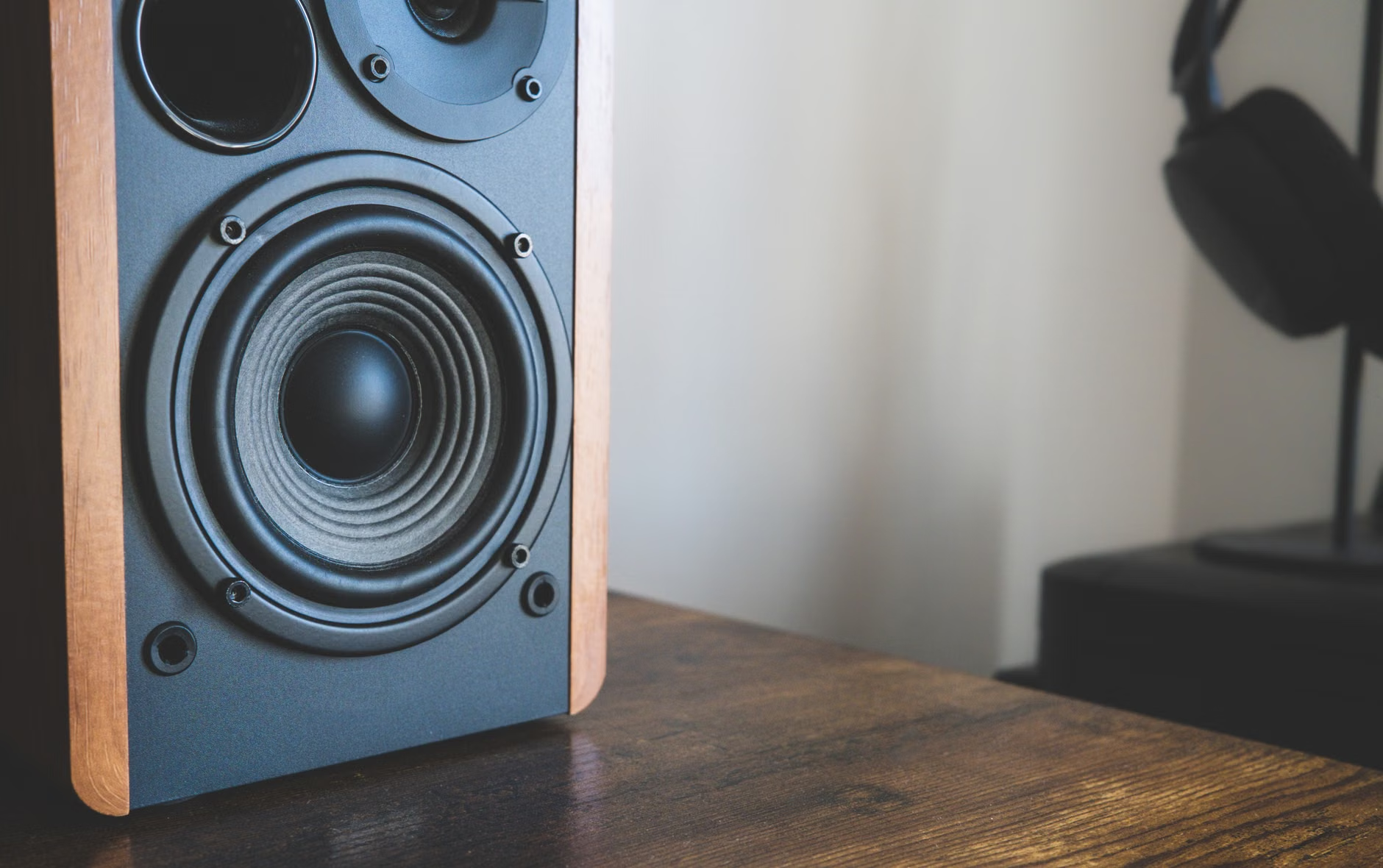
Passive control involves physical barriers. If you cannot close a door, use heavy curtains or acoustic panels. These are surprisingly effective at dampening high-frequency sounds, like children’s voices or toy noises. A simple curtain divider can act as a psychological “wall” that signals to the rest of the family that you are currently unavailable.
Active control involves technology. If you are in a high-traffic area, high-quality Active Noise Canceling (ANC) headphones are a professional requirement. However, don’t just rely on silence. Many people find that Brown Noise or Pink Noise is superior to white noise for blocking out human speech. Unlike white noise, which can be harsh, brown noise has a lower frequency that mimics the sound of a distant waterfall or heavy wind, which is excellent for masking the erratic sounds of a household.
Visual Zoning and the Power of Cognitive Cues
Visual clutter is a subtle but powerful drain on your focus. When you see a pile of laundry or a stack of toys while you are trying to write a report, your brain is subconsciously processing those items as “unfinished tasks.” This creates a background hum of anxiety that keeps you from entering a flow state.
To create a sensory-integrated workspace, you must use Visual Zoning. This is the practice of using physical objects to define the boundaries of your workspace. If you work at the dining table, your “zone” is the area reachable by your arms. Use a specific desk mat or a dedicated tray that holds all your work items. When you are done, you place your laptop in the tray and clear the space. This is a physical “closing” of your workday.
The “Transition Trigger” Method
One of the biggest struggles for remote parents is the lack of a commute. A commute is a sensory transition; it allows your brain to shift from “parent mode” to “professional mode.” Without it, you need to create your own Transition Trigger.
This could be as simple as a specific desk lamp that you only turn on when you are working, or a specific scent (like peppermint or rosemary) that you diffuse only during business hours. Over time, your brain will learn that these stimuli are the “on” switch for deep work. When you turn the lamp off, you are physically signaling to yourself—and your family—that you are “off the clock.”
Optimizing the Ergonomic-Sensory Interface
We often think of ergonomics as just “a good chair,” but for a parent, ergonomics must be sensory-informed. If your chair is uncomfortable, your body is sending “distress signals” to your brain, which competes with your work tasks for attention. You need to eliminate physical discomfort so that your body remains in a neutral, relaxed state.
Ensure that your screen height is at eye level. This prevents neck strain, which is a major source of fatigue. More importantly, consider the lighting. Harsh overhead fluorescent lights can increase cortisol levels. If possible, position your desk to face a window, but place a translucent shade over it to soften the light. Natural light is essential for regulating your circadian rhythm, which helps you stay sharp throughout the day.
Common mistakes in setting up this space include:
- The “Multi-Purpose” Trap: Trying to make your workspace look like a living room. It needs to look like a workspace so that your brain treats it as one. Keep it distinct.
- Ignoring Cable Management: Visible, tangled wires are a source of visual chaos. Use simple cable clips or a cable management box to hide them. A clean desk leads to a clean mind.
- Overloading the Desk: Only keep the tools you need for the current task on your desk. Put everything else in a drawer or a storage bin that is out of your direct line of sight.

Executing the Transition: From Work to Home Life
The most important part of a sensory-integrated workspace is knowing how to leave it. Parents often struggle with “work-life bleed,” where they are physically present with their children but mentally still at their desk. This is where your transition trigger works in reverse.
When you finish your work, perform a “Shutdown Ritual.” This should be a consistent, 3-to-5-minute process. Close all your browser tabs, organize your desk, turn off your “work lamp,” and physically move away from the desk. If possible, change your clothes. The act of changing from “work clothes” to “home clothes” is a powerful sensory signal that the workday has ended. This transition helps you reset your nervous system, allowing you to engage with your family with a clear, present mind.
Remember that this is not about perfection. You will have days where the house is chaotic and the sensory-integration plan fails. That is normal. The goal is to build a system that works 80% of the time, giving you a baseline of productivity that you can rely on even when the unexpected happens.
Practical Implementation: Where to Start Today
If you are feeling overwhelmed by your current setup, do not try to change everything at once. Start by identifying your biggest “sensory leak.” Is it the noise? The visual clutter? The lack of physical boundaries? Pick one to address this weekend.
If it is noise, invest in a good pair of noise-canceling headphones. If it is visual clutter, get a dedicated storage bin for your “work stuff” so you can clear your desk at the end of the day. If it is the lack of a boundary, establish a “work-zone” signal—like a specific lamp or even a sign on your chair—that the rest of the household understands means “do not disturb.”
By treating your workspace as a tool to manage your sensory input, you are not just making your work easier; you are making your life as a parent more sustainable. You are protecting your focus, which is the most valuable resource you have.
Frequently Asked Questions
How can I maintain a sensory-integrated workspace in a very small apartment?
In smaller spaces, focus on vertical and portable zoning. Use a folding room divider or a hanging curtain to block your visual field. Use a “work box”—a dedicated container that holds your laptop, mouse, and notepad—that can be stored out of sight at the end of the day. This creates a psychological “out of sight, out of mind” boundary that is essential for reclaiming your living space.
Is it really worth investing in high-end noise-canceling headphones for home use?
Yes, if your work requires deep focus. The cost is justified by the reduction in cognitive fatigue. Look for headphones with “multipoint” connectivity, which allows you to switch between your computer and phone seamlessly. This prevents the sensory shock of having to manually switch devices, which is a common source of frustration during a workday.
What if my children keep interrupting my “work zone”?
Children need to understand the visual cues of your workspace. If you use a “work lamp” as a signal, explain to them: “When the light is on, I am in my work zone and cannot be disturbed, but as soon as I turn it off, I am yours.” Consistency is key. It may take a few weeks for them to respect the boundary, but the visual cue makes the rule much easier for them to understand than a verbal one.
For more information on managing remote work environments, you can consult resources such as the American Psychological Association’s guide on remote work or research into environmental psychology regarding focus and productivity.
Building a sensory-integrated space is a journey of small, intentional adjustments. Start today by clearing one small corner, and notice how your focus shifts. You deserve a workspace that supports your professional goals while respecting your personal life.