The most effective way to reclaim your productivity as a remote-working parent is to move your professional life into a “third-space” hub—a location that is neither your home nor your traditional office—specifically designed to bridge the gap between childcare and deep work.
- Separation is essential: The psychological boundary created by leaving the home environment is the single biggest driver of sustained focus for remote parents.
- Choose by utility, not aesthetics: Prioritize spaces that offer integrated childcare or “family-friendly” hours, as these provide a measurable return on your investment by eliminating the “context-switching” fatigue of shifting between parent and employee roles.
- The community dividend: Beyond just a desk, the primary value of a third-space hub is the social network of peers who understand the unique pressure of balancing professional deadlines with school pickup schedules.
If you have ever tried to lead a high-stakes Zoom meeting while simultaneously preventing a toddler from dismantling the living room bookshelf, you already know that the “work-from-home” ideal often collapses under the weight of reality. The boundary between “office” and “home” has become dangerously porous. When your dining room table is your desk, your brain never quite clocks out, and you never quite clock in.
This is where the concept of the “third-space” hub becomes more than just a trend; it is a structural solution to a modern problem. A third-space is a neutral ground—a professional environment that acknowledges your status as a parent without demanding you leave that identity at the door. Let’s look at why this shift is necessary and how you can make it work for you.
The Psychology of the Third Space: Why Your Home Office is Failing You
When we talk about the “third-space,” we are referencing a sociological concept popularized by Ray Oldenburg, describing social surroundings separate from the two usual social environments of home (“first place”) and the workplace (“second place”). For the remote-working parent, however, the first and second places have collapsed into one.
The failure of the home office for parents isn’t about a lack of discipline; it is about cognitive load. Every time you glance at a pile of laundry while drafting an email, your brain performs a subtle, exhausting context switch. You are essentially trying to occupy two mental states simultaneously. A third-space hub acts as a physical “reset” button.
Research into environmental psychology suggests that “context-dependent memory” and focus are real phenomena. When you enter a space explicitly designed for output, your brain triggers a behavioral response associated with that environment. By moving to a dedicated hub, you are not just changing your location; you are outsourcing the mental energy required to maintain professional focus.

The Real-Life Cost of Context Switching
Consider the “interruptive cost.” Studies have shown that it can take an average of 23 minutes to return to a deep state of focus after a significant interruption. If you are working from home and get interrupted by a child, a delivery, or a household chore five times a day, you are losing nearly two hours of peak productivity. In a third-space hub, these specific, home-based interruptions are removed by default.
However, there is a trade-off. The cost of a third-space hub isn’t just the monthly membership fee; it is the “commute cost.” If your commute to a hub takes 45 minutes each way, you might be trading the frustration of home-work for the stress of travel. The goal is to find a balance where the time gained in focus exceeds the time lost in transit.
Evaluating Your Options: Coworking Spaces vs. Family-Centric Hubs
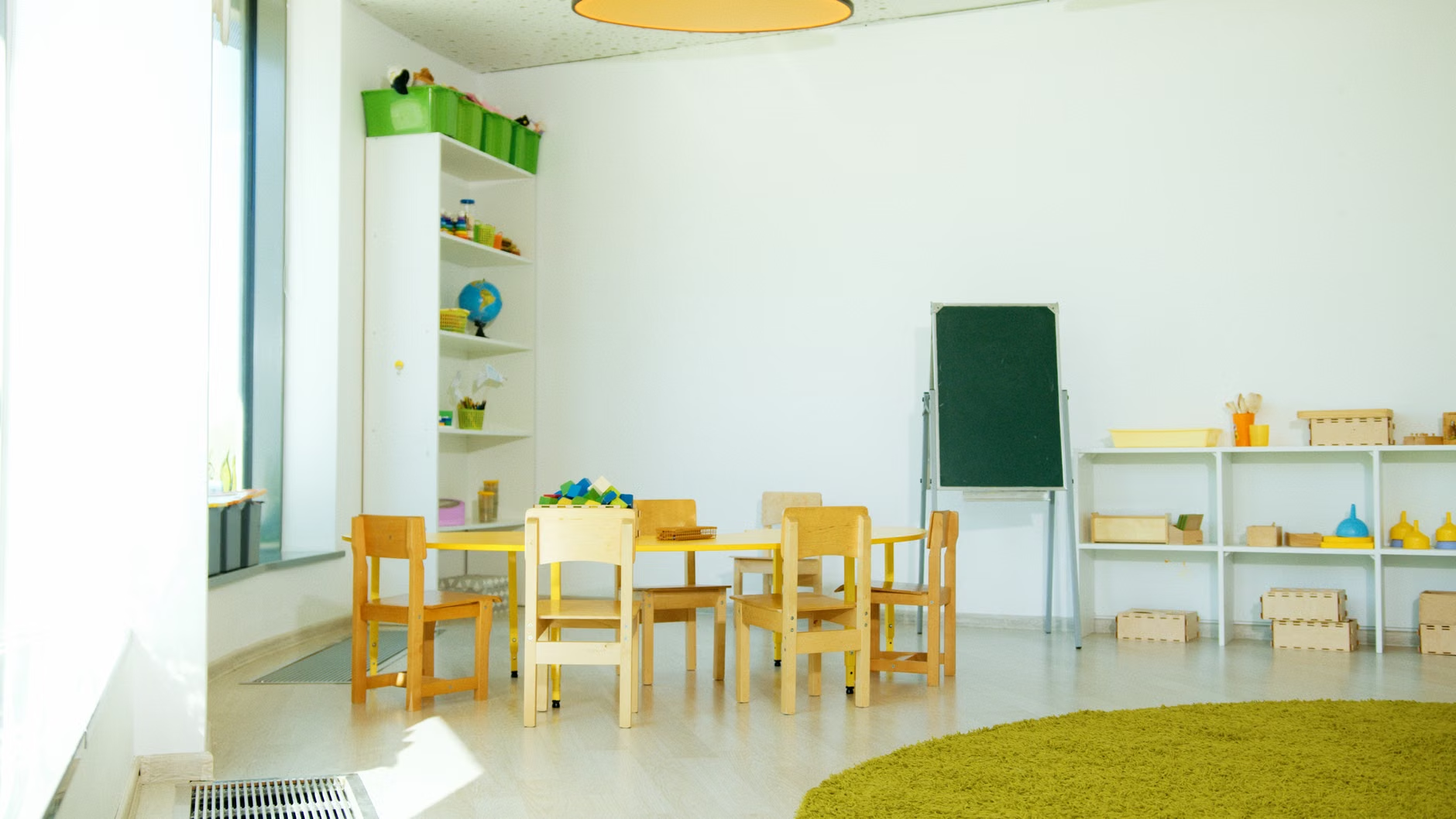
Not all third-space hubs are created equal. As the market has matured, we have seen a bifurcation in the industry: traditional coworking spaces that happen to be quiet, and modern “family-centric” hubs that integrate childcare or family-friendly amenities.
When choosing between these, you need to be honest about your current stage of life. If your children are school-aged, a standard, high-productivity coworking space might be perfect. You need high-speed internet, soundproof booths, and a professional atmosphere. If you have younger children, or if your care situation is flexible, you might prioritize a hub that offers “drop-in” care or a parent-friendly lounge.
| Feature | Standard Coworking | Family-Centric Hub |
|---|---|---|
| Primary Focus | Deep work, networking | Work-life integration |
| Childcare | Rarely | Often integrated/on-site |
| Noise Level | Low/Controlled | Moderate/Flexible |
| Ideal For | Focus-heavy tasks | Flexible schedules/toddlers |
The common mistake many parents make is selecting a space based on the “vibe” or the aesthetic of the interior design rather than the operational utility. If you need to take four hours of client calls, the “cool” open-plan lounge with loud music and networking events is your enemy. Look for “phone booth” availability and acoustic separation.
How to Transition: A Step-by-Step Guide for Parents
Transitioning to a third-space hub requires more than just signing a contract. It requires a recalibration of your household logistics. Here is how to make the move effectively.
1. Conduct a One-Week “Focus Audit”
Before you commit to a membership, track exactly when your productivity drops at home. Is it between 3:00 PM and 5:00 PM when the kids are home from school? Is it during the morning rush? Identify your “danger zones.” If your highest productivity needs fall within these zones, your third-space membership must align with them.
2. The “Trial Membership” Protocol
Never sign a long-term contract without testing the commute and the environment. Use a day pass or a weekly trial. During this time, test your most common tasks: Can you join a video call without background noise? Is the Wi-Fi stable for large file uploads? Does the space feel welcoming, or do you feel like an intruder in a “hustle-culture” environment?
3. Communicate the Boundary
This is the most overlooked step. Your family needs to understand that when you are at the hub, you are “at work.” This isn’t just about your schedule; it’s about setting clear expectations. Use a shared calendar to show when you are “at the office” and when you are “home.” This helps children visualize the separation, which makes the transition easier for them as well.
The Hidden Value: Community and Social Capital
Beyond the desk and the internet, the most significant benefit of a third-space hub is the community. As a remote-working parent, isolation is a genuine risk to both your mental health and your career progression. In a third-space hub, you are surrounded by other professionals who are balancing similar pressures.
This “peer-to-peer” support system is invaluable. You aren’t just networking for your next job; you are finding people who can share tips on local childcare, school districts, or even just how to handle a bad morning without losing your cool. This social capital is something you simply cannot replicate on a Slack channel or a Zoom call.

Mitigating the “Guilt Factor”
Many parents feel a sense of guilt when they leave the home to work. This is a common misconception that needs to be addressed. By choosing a space that allows you to be more focused and efficient, you are actually shortening your workday and increasing the quality of the time you spend with your family. You are trading “distracted presence” for “intentional presence.”
When you are at the hub, be entirely at the hub. When you are home, be entirely at home. This binary approach, enabled by the third-space, is the secret to sustainable long-term remote work.
Practical Considerations and Potential Pitfalls
It is important to be realistic about the trade-offs. Third-space hubs are not a panacea. If you are struggling with a rigid, high-pressure job that requires 10+ hours of screen time daily, simply changing your location won’t fix the underlying issue of burnout. You must ensure that your employer supports your remote-work setup, especially regarding data privacy and security if you are working in a public space.
Always verify the security protocols of any hub you join. Do they have private meeting rooms? Is there secure Wi-Fi? Are there policies in place regarding the privacy of your work? These are non-negotiable for anyone in a regulated industry like finance, law, or healthcare.
Furthermore, consider the “hidden costs” of membership. Beyond the monthly fee, factor in transportation costs, parking, and the potential for “convenience spending” (buying lunch or coffee instead of preparing it at home). Over a year, these can add up significantly. Compare these costs against the potential gain in your hourly productivity. If the hub allows you to complete in six hours what currently takes you eight, the investment is almost certainly worth it.
The Future of Work for Parents
As we look forward, the integration of family-friendly amenities into professional spaces is only going to increase. We are seeing a shift where office buildings are no longer just rows of desks, but community centers that serve the whole person. For parents, this is the beginning of a much-needed evolution in how we define “work-life balance.”
The most important takeaway is this: do not wait for the perfect environment to be built for you. Take control of your current situation by finding the space that fits your specific needs today. You are not failing by seeking a better environment; you are optimizing your life to ensure that you can be both a dedicated professional and an engaged parent. Start by identifying one or two local spaces, take a trial pass, and see how your focus—and your stress levels—shift when you have a dedicated third space to call your own.
If you find that even the best coworking space doesn’t solve your issues, it may be time to have a direct conversation with your employer about your output and your needs. Many organizations are more open to flexible arrangements than they were even three years ago. The third-space is a tool; it is up to you to use it to build a more sustainable way of living.
Frequently Asked Questions
How do I know if a coworking space is truly “family-friendly” or just “open to everyone”?
Look for explicit indicators: do they offer dedicated family hours, on-site childcare services, or at least a noise-tolerant area where parents can work without judgment? Contact the manager and ask directly about their policy regarding children in the space; a truly family-friendly hub will have a clear, welcoming answer, not a vague “we allow them but…” response.
What if I can’t afford a membership right now?
Look for local library “maker spaces” or community centers that offer free or low-cost desk access. Many cities are investing in public hubs that provide high-speed internet and quiet zones for free. While they may not have the amenities of a premium coworking space, they can still provide the essential psychological separation you need to shift your mindset into “work mode.”
How do I maintain the boundary if I have to bring a child with me on an emergency basis?
Most professional hubs have strict “no-child” policies for the main coworking floor to protect the focus of other members. If you anticipate emergencies, prioritize a space that has a designated “family room” or a private office that you can rent by the day. Always have a backup plan for childcare, and never assume that a public workspace can substitute for dedicated care during your working hours.
For further reading on the evolving landscape of remote work and workspace design, you may find the following resources useful: