The most effective way to reclaim your focus as a remote parent is not by seeking absolute silence, but by curating a “sensory-integrated” soundscape that filters out domestic chaos while keeping you connected to your environment.
- Selective Dampening: Use passive acoustic treatments (fabrics, panels) to reduce echo, while utilizing active noise-canceling (ANC) technology to manage unpredictable household spikes.
- The “Auditory Boundary” Strategy: Establish a predictable sound signal (like specific white noise or background music) that acts as a psychological “do not disturb” sign for your children.
- Frequency Management: Prioritize blocking mid-to-high frequency sounds—the human voice and sharp toys—which are the most disruptive to cognitive flow, rather than just focusing on low-end bass noise.
If you are a parent working from home, you know the specific, high-frequency “ping” of a toy or the sudden shout from the living room isn’t just annoying; it is a cognitive interrupt. When you are in the middle of a complex report or a high-stakes Zoom call, these interruptions force your brain to perform a “context switch,” which studies show can take up to 23 minutes to fully recover from. This article explores how to turn your home office into a sensory-integrated sanctuary, allowing you to be both a present parent and a productive professional.
Understanding the Physics of Your Home Office
Most home offices are acoustically hostile because they are designed for living, not working. Hard surfaces—drywall, hardwood floors, and glass windows—are “sound mirrors.” They bounce sound waves around the room, creating reverberation. This makes your voice sound tinny on conference calls and amplifies every sound coming from outside the room.
To fix this, you don’t need a professional recording studio. You need to manage two specific types of sound: External Noise (kids playing, the doorbell, the dishwasher) and Internal Reverberation (the bounce of your own voice). The goal is to reach a state of “sensory integration,” where your environment supports your task rather than competing with it.
The Hierarchy of Acoustic Control
Before you spend money on expensive gear, implement the hierarchy of control. You must address the room’s physical properties before relying on electronic solutions.
| Strategy | Implementation | Best For |
|---|---|---|
| Mass/Absorption | Heavy curtains, rugs, acoustic foam | Reducing echo and room reverberation |
| Decoupling | Isolation pads for speakers/towers | Stopping vibration transfer through desks |
| Active Management | ANC headsets, white noise machines | Masking unavoidable high-frequency spikes |
Passive Acoustic Treatments: The Foundation of Focus
Passive treatment is about stopping sound before it hits your ears. When you walk into an empty room, notice how your voice echoes. That echo is the enemy of focus. It forces your brain to work harder to filter out the “noise floor” of your own environment.
The Soft Surface Rule
If you cannot hear a difference in your room, you haven’t added enough “soft” materials. A common mistake is buying thin foam squares that do nothing to stop sound from entering the room. Instead, focus on density. A thick, heavy curtain over a window or a dense wool rug on the floor will absorb more energy than a dozen thin foam tiles.
If you have a home office with a glass door, that is your primary weakness. Glass is a poor sound insulator. Replacing it is often impossible, but hanging a heavy, sound-dampening blanket or a specialized acoustic curtain over the door can reduce sound transmission by up to 10-15 decibels. That is the difference between hearing a toddler’s tantrum clearly and hearing it as a dull, ignorable hum.
Active Noise Management: Choosing the Right Gear
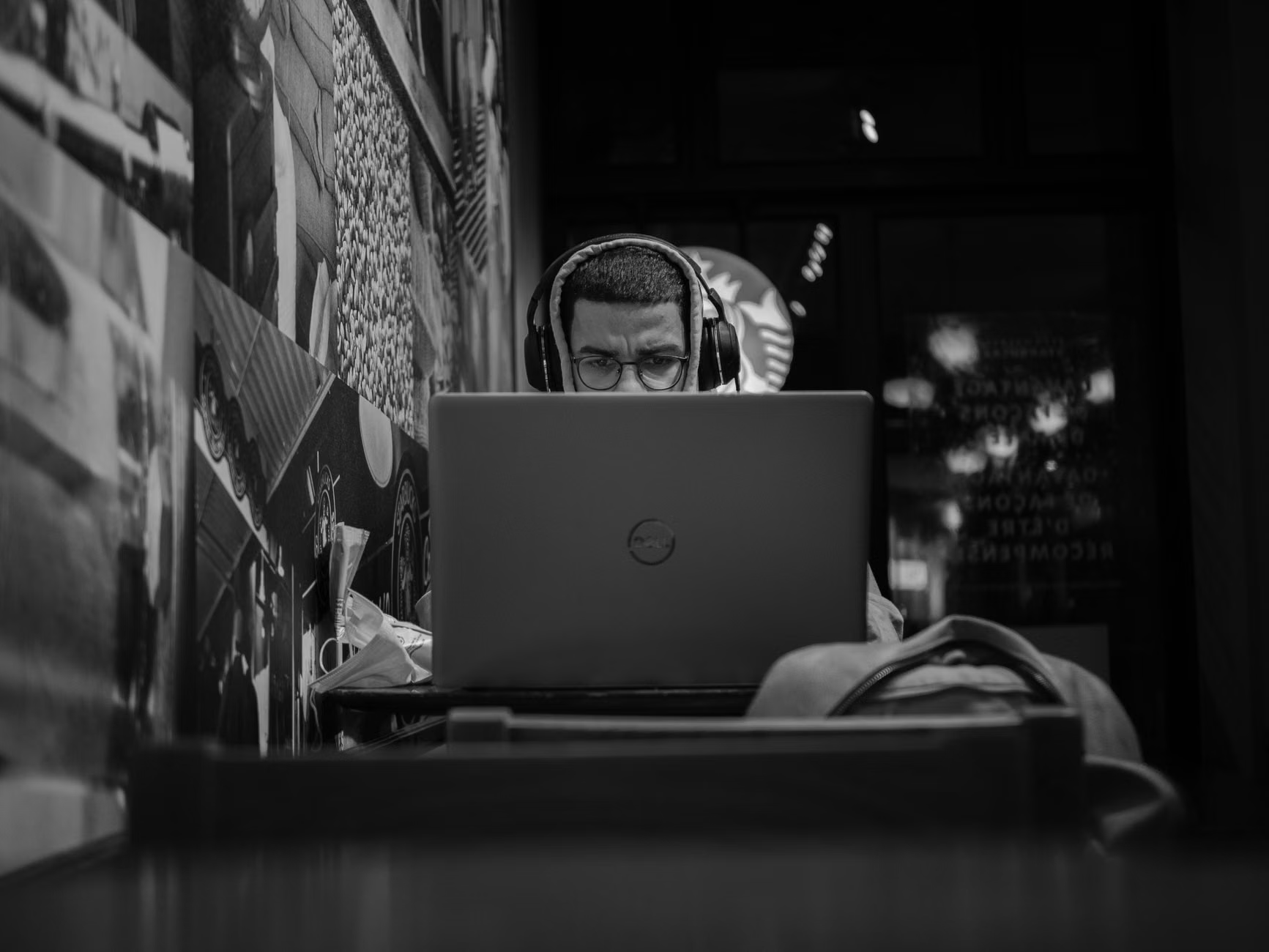
Passive treatments handle the room, but you still need to deal with the inevitable sounds of family life. This is where Active Noise Canceling (ANC) comes in. Not all ANC is created equal, and for parents, the requirements are specific.
The “Human Voice” Challenge
Most consumer-grade ANC headphones are excellent at blocking low-frequency engine drones (like a plane or a refrigerator). They are notoriously bad at blocking human speech—the exact sound you need to block when your children are playing nearby. When choosing a headset, look for Hybrid ANC, which uses both feedforward and feedback microphones to cancel a wider range of frequencies.
Decision Criteria for Parents:
- Comfort for Long Wear: You will be wearing these for hours. Prioritize over-ear models with memory foam and breathable fabric.
- Transparency Mode: You must be able to switch to “transparency” instantly. You need to hear if something goes wrong in the other room.
- Microphone Quality: If you are on calls, prioritize a headset with a dedicated boom mic or advanced beam-forming microphones that isolate your voice from the background noise of the house.
The Psychological Trigger: Soundscapes and White Noise
Sometimes, the best way to block noise is to introduce a steady, predictable background sound. This is called “sound masking.” The human brain is wired to pay attention to sudden changes in the environment. If you work in total silence, a sudden toy drop will trigger a startle response. If you work with a constant, gentle sound layer, that same toy drop becomes less jarring.
White, Pink, and Brown Noise: What Matters?
While “white noise” is the general term, Brown noise is often better for focus. It has more bass and less high-frequency hiss, making it feel more like a warm blanket of sound. It is less fatiguing over an eight-hour workday.
A Practical Setup:
- The Sound Source: A high-quality, dedicated white noise machine or a dedicated app. Avoid using your phone’s internal speakers; use a decent Bluetooth speaker to get a wider sound dispersion.
- The Placement: Do not place the sound source right next to your head. Place it near the door or the wall where the most noise enters. You want the sound to “fill” the room, not blast your ears.
- The Volume: It should be no louder than a soft whisper. The goal is to reach a volume just high enough to mask the ambient house noise, not to create a second source of distraction.
Integrating Parenting into Your Workflow
Acoustics are only half the battle. If you are constantly worried about the noise you are making, or the noise coming in, you are not focused. You need to create an “auditory contract” with your family.
The “Red Light” System
Use a visual cue that corresponds to your auditory environment. For example, when you are wearing your ANC headset, that is the “red light.” The children know that if the headphones are on, you cannot hear them, so they must use a signal (like a sticky note on the door or a specific knock) to get your attention. This removes the “anxiety of interruption” from your workspace.
The Hidden Cost: The “Listening Drain”
As a parent, you are constantly listening for “danger sounds”—a fall, a cry, or a crash. This is a survival mechanism. Even when you are working, part of your brain is “monitoring” the environment. This is why you feel exhausted at the end of the day. To mitigate this, schedule “check-in” breaks. If you know you will check on the kids every 90 minutes, your brain is more willing to “let go” and focus during the work blocks in between.
Advanced Troubleshooting: When the House is Too Loud
If you live in a small space where acoustic treatment is physically impossible, you must change your workflow to match your environment. This is the art of “temporal shifting.”
The “Sync” Method:
- Deep Work: Schedule your hardest tasks for when the house is naturally quiet—early mornings, nap times, or after the kids go to bed.
- Admin/Communication: Save emails, Slack messages, and low-cognitive-load meetings for times when the house is active.
- The “Quiet Room” Rotation: If you have a partner, rotate who gets the “quiet space” in the house. One person takes the desk, the other takes the kitchen table. Switch at lunch.
If you are struggling with your voice echoing during video calls, look at your desk surface. If it is a hard, reflective material, place a large desk mat under your keyboard and mouse. This small change can significantly reduce the amount of sound reflecting from your desk into your microphone.
Why “Perfect” is the Enemy of “Done”
There is a temptation to over-engineer your home office. You see influencers with sound-proof pods and studio-grade monitors. Do not fall into this trap. A parent’s home office needs to be flexible. You need to be able to pack up or pivot if a child suddenly needs you.
Focus on the 80/20 rule: 80% of your acoustic success will come from 20% of the effort. A heavy rug, a pair of high-quality ANC headphones, and a clear communication system with your family will get you 90% of the way to a professional, focused environment.
Common Misconceptions
- “Egg cartons stop sound.” They do not. They are a fire hazard and have zero acoustic value.
- “I need a silent room to work.” You don’t. You need a room with a consistent sound profile. Silence is actually quite distracting because your brain will amplify even the smallest creaks.
- “ANC will block everything.” ANC is a tool, not a magic shield. It works best when combined with passive isolation.
Ultimately, the goal of these acoustic strategies is to give you back your cognitive bandwidth. When you aren’t constantly fighting your environment, you have more mental energy for your work and, more importantly, more patience for your family when you step away from the desk.
Frequently Asked Questions
1. How do I know if my home office has an acoustic problem?
Do a simple “clap test.” Stand in the center of your office and clap your hands once. If you hear a ringing or metallic echo after the clap, your room has too many hard, reflective surfaces. This is an acoustic problem that will make your voice sound unprofessional on calls and increase your fatigue.
2. Can I use a white noise machine if I have a small child in the next room?
Yes, but keep it away from their sleeping area. Use a directional speaker or place the machine near your door. The goal is to mask the sound for you, not to create a wall of sound that disturbs the rest of the house. Always aim for a volume that is just enough to cover the background noise, not a volume that feels loud.
3. What is the single most effective upgrade for a parent working from home?
A pair of high-quality, over-ear noise-canceling headphones is the single best investment. It provides both a physical barrier (the ear cups) and an electronic barrier (the ANC). It also acts as a visual signal to your family, which is just as important as the actual noise reduction.
For further reading on acoustic standards for offices, you can refer to the ISO 22955 guidelines regarding acoustic quality in open offices, which provides a framework for understanding how sound impacts cognitive performance.
Final Action Plan: Start by adding soft textures to your room this weekend. Then, invest in a reliable pair of ANC headphones. Finally, sit down with your family and explain the “Headphone Rule.” Small, consistent adjustments will compound into a much more sustainable remote work experience.