The most effective way to manage a multi-generational household isn’t by enforcing rigid rules, but by adopting a “gentle-leadership” framework that treats every family member as a stakeholder in the home’s success.
Key Takeaways
- Defined Roles: Explicitly assign household responsibilities based on capacity rather than tradition to avoid resentment.
- The “Agenda-First” Rule: Never hold an impromptu high-stakes meeting; always circulate an agenda 24 hours in advance to allow for emotional preparation.
- Financial Transparency: Use a shared, transparent system for tracking common expenses to eliminate “hidden costs” that often trigger intergenerational friction.
If you are in your 30s or 40s, you are likely part of the “sandwich generation.” You are balancing the needs of your children, the evolving requirements of your aging parents, and your own professional and personal well-being. When all these generations share a roof, the house can quickly feel like a pressure cooker. The friction isn’t usually about big, dramatic events; it’s about the “small stuff”—who left the dishes in the sink, whose turn it is to drive the kids to soccer, or how to handle a rising utility bill.
Gentle-leadership is not about being passive or “soft.” It is a deliberate management style that prioritizes clarity, active listening, and collaborative problem-solving over top-down authority. It acknowledges that your parents have a lifetime of experience, your children have a need for autonomy, and you have the responsibility of keeping the ship afloat.

Establishing the “Household Board Meeting” Framework
In a professional setting, we wouldn’t dream of walking into a meeting without an agenda. Yet, in our homes, we expect complex family dynamics to resolve themselves over casual dinner table chatter. This is where most household conflict originates: the assumption that everyone is on the same page when, in reality, everyone is reading a different book.
To implement a gentle-leadership approach, you must formalize the way your household communicates. This doesn’t mean holding a corporate-style meeting with a slide deck, but it does mean creating a dedicated time and space for “family business.”
The 24-Hour Rule
Never spring a “we need to talk” conversation on your parents or spouse when they are tired or busy. This triggers defensiveness. Instead, adopt a 24-hour notice policy. If you need to discuss something significant—like a change in chore distribution or a shift in the monthly budget—send a simple message: “I’d like to catch up on the household schedule tomorrow at 7:00 PM. Is that time okay for everyone?”
Why this works: It gives family members the mental space to prepare. For an aging parent, this might mean having time to process a change in routine. For a partner, it means they can mentally shift gears from work to home life before the discussion begins.
The “Neutral Ground” Protocol
If the tension is high, move the meeting away from the scene of the crime. If the kitchen is the source of conflict, don’t hold the meeting at the kitchen table. Go to the living room or even take a walk. Physical distance creates psychological distance, allowing for a more objective conversation.
Mapping Roles: Moving Beyond “Tradition”
One of the most common mistakes in multi-generational living is relying on outdated assumptions. We often assume that because a parent “always handled the cooking,” they should continue to do so. Or, we assume that because we are the primary earner, we are exempt from domestic labor. These assumptions are the primary drivers of burnout.
A gentle-leader audits the household tasks objectively. Use a “Capacity-Based Assignment” model. Instead of asking “Who did this last year?”, ask “Who has the capacity to do this well right now?”
| Task Category | Traditional Assumption | Capacity-Based Reality |
|---|---|---|
| Meal Prep | The retired parent cooks. | The person with the most energy/interest at 5:00 PM cooks. |
| Finances | The primary earner manages it. | The person with the most organizational skill/time manages it. |
| Childcare | The grandparents are the default. | The grandparents contribute based on their physical and emotional bandwidth. |
When you shift to a capacity-based model, you remove the judgment. If your parent can no longer manage heavy grocery shopping, it isn’t a failure—it’s just a shift in capacity that requires a redistribution of labor. This prevents the “I shouldn’t have to ask” resentment that plagues many households.

Managing Financial Transparency Without Micromanagement
Money is the biggest taboo in many families, yet it is the most crucial element to manage when multiple generations live together. The goal of a gentle-leader is to create transparency without surveillance. You want everyone to feel secure, not scrutinized.
The “Common Pot” vs. “Individual Contribution”
Many families struggle because expenses are opaque. A simple, effective solution is to establish a “Household Operating Account.” Everyone contributes a set percentage based on their income or capacity. This account covers the “friction” items: groceries, utilities, internet, and common household supplies.
The Golden Rule: Keep personal expenses entirely separate. When you mix personal spending (like a parent’s hobby or your own subscription services) with the shared pot, you invite unnecessary conflict. By keeping the “common pot” strictly for communal needs, you create a neutral zone where no one is questioning anyone else’s personal financial choices.
Setting Thresholds for Decisions
Determine what requires a “Board Vote” and what can be decided autonomously. For example, replacing a broken toaster is a low-level decision that the person in charge of kitchen supplies can make independently. Replacing the refrigerator, however, is a high-level decision that requires a family consensus. Define these thresholds early to avoid “decision fatigue.”
Conflict Resolution: The “I-Statement” Technique
Even with the best systems, friction will occur. When it does, avoid the “You always” or “You never” trap. This is the fastest way to shut down productive communication. In a multi-generational home, you are dealing with different life stages, and what feels like a minor annoyance to you might feel like a personal attack to someone from a different generation.
Instead, use the “Observation-Impact-Need” formula:
- Observation: State the fact without judgment. (“I noticed the recycling bin was left overflowing this morning.”)
- Impact: State how it affects you or the household. (“When it overflows, it makes it difficult for me to manage the waste before the pickup truck arrives.”)
- Need: State what you need moving forward. (“Could we agree to empty the bin as soon as it reaches the top?”)
This approach keeps the focus on the *behavior* rather than the *person*. It is difficult to get defensive when you are simply discussing the state of a recycling bin.
The “Hidden Variable”: Emotional Bandwidth
One of the most overlooked variables in multi-generational living is the fluctuation of emotional bandwidth. You might have the capacity to lead the household on Tuesday, but be completely drained by Friday. A gentle-leader recognizes this in themselves and others.
If you notice a family member is uncharacteristically irritable or withdrawn, don’t push for a “meeting.” Instead, practice “check-in” leadership. Simply ask, “I’ve noticed you seem a bit overwhelmed lately. Is there anything off your plate that I can take on this week?”
This is not about being a martyr; it is about recognizing that the household is a team. When you support others during their low-bandwidth periods, they are far more likely to support you when you hit your own wall. This reciprocity is the foundation of long-term sustainability.
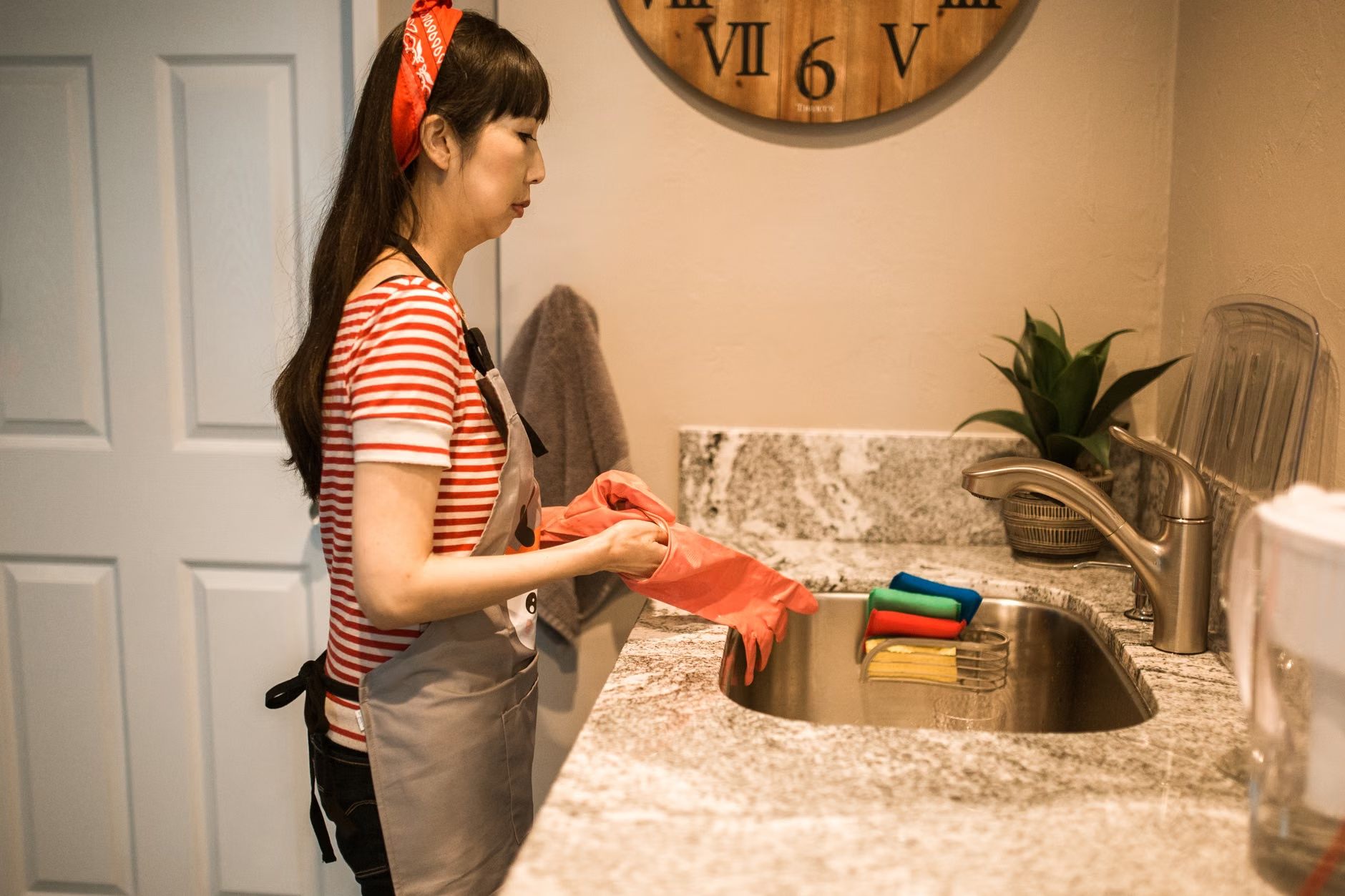
Practical Tools for the Modern Household
Technology can either be a source of frustration or a powerful tool for harmony. In a multi-generational home, the key is choosing tools that are accessible to everyone, regardless of their tech-savviness.
- Shared Digital Calendar: Use a platform like Google Calendar. Color-code it so that each person’s commitments are visible. This prevents the “I didn’t know you had a doctor’s appointment” confusion.
- Shared Shopping List: Apps like OurGroceries or even a simple shared note in your phone allow anyone to add an item when they notice it’s running low. This eliminates the “I thought you were buying milk” argument.
- The Physical “Command Center”: Even in a digital world, a physical whiteboard in a common area is invaluable. It’s where you post the weekly menu, the trash pickup schedule, and any upcoming visitors. It is a low-tech, high-visibility way to keep everyone aligned.
Addressing Common Misconceptions
There is a persistent myth that “gentle-leadership” means you have to be the one doing everything. This is a misunderstanding of what leadership actually is. Leadership is about *facilitating*, not *executing*. If you find yourself doing everything, you are not leading; you are enabling.
Another misconception is that the oldest person in the house should always be the “leader.” In a multi-generational home, leadership should be situational. Your parent might lead on matters of home maintenance due to their history with the property, while you lead on matters of digital security or modern financial management. Assigning “areas of authority” based on expertise, rather than age, is a hallmark of a healthy, modern household.
When to Seek External Mediation
Sometimes, despite your best efforts, the friction is too deep-seated. If you find that your meetings consistently devolve into shouting matches or long-term resentment, it is time to bring in a neutral third party. This could be a family therapist, or even a professional organizer who specializes in household dynamics.
Do not view this as a failure. View it as an investment in the longevity of your living arrangement. Having a professional mediator for a few sessions can provide the tools you need to reset your communication patterns and establish a new, healthier baseline.
Final Thoughts: The Long-Term View
Multi-generational living is a marathon, not a sprint. There will be days when the systems you’ve put in place fail, and that is perfectly normal. The success of your household won’t be measured by the absence of conflict, but by your ability to resolve that conflict without damaging the relationships that make a house a home.
Start small. Pick one area—perhaps the weekly calendar or the shared grocery list—and implement a “gentle-leadership” strategy there first. Once you see the reduction in friction, you can expand to more complex areas like finances and long-term planning. By leading with empathy, clarity, and intentionality, you can create a home environment where every generation feels valued, supported, and, most importantly, heard.
Frequently Asked Questions
1. How do I address a family member who refuses to participate in meetings?
If someone refuses to participate, don’t force it. Instead, focus on the “impact.” Explain: “I’ve noticed that when we don’t sync up, we end up buying duplicate groceries or missing appointments. I’m going to keep a calendar updated. If you don’t want to attend the meetings, could you at least check the calendar once a day?” This gives them autonomy while maintaining the necessary flow of information.
2. What if my parents feel like I’m “parenting” them?
This is a common reaction when you start implementing structures. The key is to emphasize that you are seeking a *partnership*, not control. Use phrases like, “I’m feeling overwhelmed by the household management and I need your help to make this work for all of us.” By framing it as a request for help rather than a set of demands, you shift the dynamic from authority to collaboration.
3. How do I handle sudden changes, like a health issue or a job loss, within this framework?
Sudden changes require an emergency “Board Meeting.” When a crisis hits, the usual rules of 24-hour notice can be waived, but the core principles remain: state the facts, discuss the impact, and collaboratively identify the new, temporary capacity of each person. The goal is to shift your “standard operating procedure” to a “crisis response mode” collectively, rather than having one person shoulder the burden alone.
Resources for further reading: