Heritage rail travel is the most effective way to reclaim your family’s vacation time from the exhausting cycle of airport security, cramped legroom, and the frantic pace of modern sightseeing. By choosing historic mountain routes, you aren’t just getting from point A to point B; you are stepping into a slower, more deliberate rhythm that allows children to explore safely and parents to actually decompress.
Key Takeaways
- Predictability over speed: Heritage rail eliminates the “hurry-up-and-wait” stress of airports, offering fixed, reliable schedules that are significantly easier to manage with young children.
- The sensory advantage: Unlike flying, train travel allows for physical movement, large windows for constant engagement, and a lack of motion sickness-inducing turbulence, making it superior for families.
- Economic reality: While heritage lines often cost more than budget regional trains, the “all-in” price is frequently lower than a car rental, fuel, tolls, and parking fees in mountainous terrain.
If you are in your 30s or 40s, you probably remember the feeling of a “vacation” being something you recovered from rather than something you enjoyed. Between managing school schedules, work deadlines, and the logistics of keeping a household running, the idea of adding a complex flight itinerary—with layovers, baggage claims, and rental car counters—often feels like a second job. This is where the “slow travel” movement, specifically through heritage-rail, becomes more than just a trend; it becomes a survival strategy.
Why Heritage Rail Beats the Rental Car in the Mountains
Mountain driving is inherently stressful. Navigating narrow passes, dealing with unpredictable weather conditions, and finding parking in historic villages can turn a scenic drive into a high-stakes endurance test. When you opt for a heritage railway, you shift the burden of navigation to a professional crew.
Consider the “mental load” tax. When you drive, one parent is usually “on duty” behind the wheel, unable to engage with the scenery or the kids. On a train, everyone is a passenger. The kids can move around, you can have a conversation without checking your blind spots, and the view is unobstructed. Most importantly, you avoid the “are we there yet?” cycle because the train itself is the attraction.
The Hidden Cost of Driving: Many families underestimate the “true cost” of mountain travel by car. Beyond fuel, you have to account for:
- Tolls and Vignettes: Many European and North American mountain regions require specific permits for road travel.
- Parking Fees: In popular mountain destinations, parking can cost upwards of $20-$40 per day.
- Vehicle Wear and Tear: Steep mountain grades put significant strain on your brakes and transmission, which is a hidden cost if you are using your own vehicle.
Understanding the “Heritage” Difference
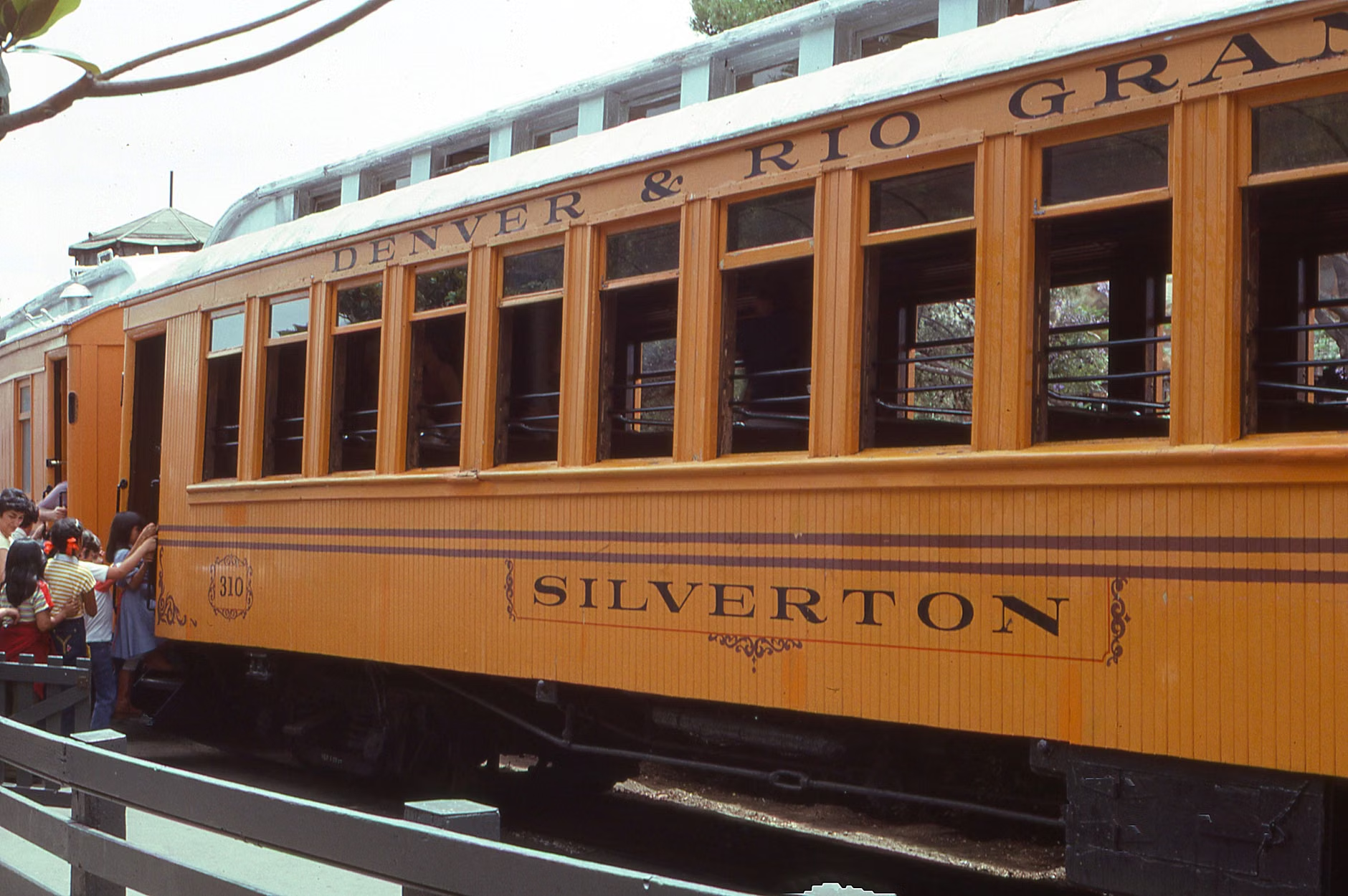
Not all trains are created equal. When we talk about heritage rail, we aren’t just talking about a commuter train that happens to go through the mountains. We are talking about preserved lines, vintage rolling stock, and routes that were engineered for beauty, not just efficiency. These lines were often built in the late 19th or early 20th century to open up remote valleys, meaning they take the most dramatic, picturesque routes possible—routes that modern highways often bypass in favor of tunnels.
What to look for when booking:
- Rolling Stock: Are these restored wooden carriages or modern panoramic coaches? Both have their charm, but heritage carriages offer an “experience” that feels like a time machine for children.
- The Route’s Purpose: Is it a “tourist loop” (starts and ends in the same place) or a “point-to-point” transit line? If you are planning a trip, prioritize point-to-point lines that connect to your destination villages.
- Safety Features: Modern safety regulations apply to all public rail, but check if the specific operator provides child-friendly amenities like changing tables or dedicated space for strollers.
Comparing Travel Methods for the Modern Family
To help you decide whether heritage rail is the right move for your next getaway, let’s look at the trade-offs compared to the traditional “fly-and-drive” model.
| Factor | Fly & Drive | Heritage Rail |
|---|---|---|
| Logistical Stress | High (Security, rental, navigation) | Low (Fixed schedule, no parking) |
| Engagement | Low (Screen time, car seat boredom) | High (Scenery, walking, socializing) |
| Flexibility | High (Go anywhere, anytime) | Low (Must adhere to train timetable) |
| Environmental Impact | High | Low |
The “flexibility” advantage of a car is often an illusion. In a mountain town, you often park your car and leave it there for three days anyway. In that specific scenario, the “flexibility” you paid for is just sitting in a parking lot losing value. If you know you’ll be based in one or two primary locations, the train wins on both price and experience.

Step-by-Step: Planning Your First Rail-Based Mountain Trip
Moving from “that sounds nice” to “we are actually doing this” requires a bit of logistical forethought. Here is the framework for planning your trip without the overwhelm.
Step 1: Identify the “Spine” Line
Every great rail region has a “spine”—the main line that connects the major transit hubs to the mountain foothills. Use sites like The Man in Seat 61 to identify the primary rail arteries in your destination of choice. Do not worry about the small, local branch lines until you have locked in your main transit route.
Step 2: The “Hub and Spoke” Strategy
Don’t try to change hotels every night. That is the quickest way to ruin a slow-travel experience. Pick one “base camp” town that is well-connected to your chosen heritage line. Use the train for day trips to neighboring valleys, and keep your luggage locked away safely at your home base. This is the single most effective way to reduce the stress of traveling with children.
Step 3: The Luggage Rule
If you can’t carry it comfortably while holding your child’s hand, you have brought too much. Train stations, especially older heritage ones, are often not optimized for oversized suitcases. Use a modular packing system—one backpack per person. This allows you to navigate stairs and narrow aisles without needing a porter or getting stuck in a bottleneck.
Step 4: Managing the “Down Time”
Even on a beautiful train, kids will eventually get restless. Prepare a “train kit.” This should include non-digital activities: sketchbooks, card games, or audiobooks. Avoid screen-heavy activities that might cause car-sickness or prevent them from seeing the very scenery you took the train to see.
Common Pitfalls and How to Avoid Them
The most common mistake families make is over-scheduling. You see a beautiful, complex rail map and try to hit four different lines in three days. This negates the “slow” in slow travel.
The “Missed Connection” Anxiety: In many mountain regions, heritage lines run on a “pulse” schedule, meaning trains might only run every two hours. If you miss your connection, you aren’t just late; you are stuck. Always aim to arrive at the station 20 minutes before departure. That extra 20 minutes is your buffer for a bathroom break, a quick snack, or just watching the engine pull in.
Food Logistics: Don’t rely on the buffet car. Heritage trains are charming, but their food service is often limited to snacks or is overpriced. Pack a “train picnic.” Local cheeses, fruits, and bread from a mountain village market are part of the cultural experience and are infinitely better than a pre-packaged sandwich.
The Deeper Value: Why This Matters for Parents
Beyond the logistical benefits, there is a psychological shift that happens on a train. In your 30s and 40s, you spend most of your life “managing.” You manage the calendar, the budget, the kids’ schedules, and your own professional output. When you are on a heritage train, you are forced into a state of “witnessing.” You are witnessing the landscape change, the seasons shift, and your family interacting with the world without the filter of a windshield.
There is also a profound environmental benefit. Mountain regions are particularly sensitive to the carbon output of heavy vehicle traffic. By choosing rail, you are directly contributing to the preservation of the delicate ecosystems that make these mountains worth visiting in the first place. You are participating in a system that values long-term sustainability over short-term convenience.
Furthermore, the physical act of being in a carriage with other people—local commuters, hikers, other families—creates a sense of community that you never get in a private car. You might end up chatting with a local about the best trail to hike, or your kids might make friends with the family in the next seat. These small, human moments are the ones that actually stick in your memory long after the photos have been archived.
Actionable Next Steps for Your Next Trip
If you are ready to book your first heritage rail experience, start by narrowing your scope. Don’t look at “European rail” as a whole; look at a specific line. For example, if you are heading toward Switzerland, look specifically at the Bernina Express or the Glacier Express. If you are in the US, look at the Durango & Silverton Narrow Gauge Railroad.
Once you have a line in mind, check their official website for “family packages.” Many heritage lines offer significant discounts for children or “family fare” tickets that include snacks or souvenirs. If you are traveling in the off-season (spring or autumn), check the schedule carefully, as some heritage lines switch to a reduced timetable when the peak tourist rush subsides.
Finally, remember that the goal is not to “complete” the route. If the weather turns, or if the kids are tired, it is perfectly acceptable to get off at a random village, grab a coffee, and wait for the next train. That is the beauty of the system. You are no longer racing against the clock; you are simply moving with the mountain.
Frequently Asked Questions
1. Is heritage rail travel really suitable for toddlers and infants?
Yes, but with caveats. Unlike airplanes, you have the space to move around, which is a lifesaver for toddlers. However, check if the specific train carriage is stroller-accessible. If not, a baby carrier is essential. Most heritage trains have enough space for gear, but it is always worth calling the operator to confirm their policy on bulky items before you arrive.
2. How do I handle transfers if I am carrying a lot of luggage?
The golden rule is to minimize your luggage. If you must have more than one bag per person, look for “luggage forwarding” services which are very common in mountain regions like Japan or parts of Europe. Alternatively, many stations offer secure lockers for a small daily fee. Never try to haul three large suitcases onto a historic train carriage; it will ruin your experience and irritate other passengers.
3. Are these trains actually reliable, or are they just for show?
Heritage lines that double as public transport are generally very reliable and follow strict maintenance schedules. However, if you are booking a “tourist-only” heritage line, be aware that they are susceptible to weather delays, especially in high mountain passes. Always have a “Plan B” route or an extra day in your itinerary to account for potential delays—this is just good practice for any mountain travel.
For further information on specific routes and schedules, you can consult resources such as Eurail for European connections or the Amtrak network for major scenic routes in North America. Always check the official website of the specific regional railway operator for the most up-to-date safety and operational guidelines.