By 2027, the way you purchase, maintain, and eventually discard your household electronics will be fundamentally different, shifting from a “buy-and-replace” cycle to a “repair-and-sustain” model mandated by new circular economy laws.
Key Takeaways
- Mandatory Repairability: Manufacturers will be legally required to design devices that are easier to open, repair, and upgrade, significantly reducing the “planned obsolescence” that forces frequent replacements.
- Digital Product Passports: You will gain access to transparent data about a device’s origin, repair history, and carbon footprint, allowing for smarter, value-based purchasing decisions.
- Extended Producer Responsibility (EPR): Companies will be held financially accountable for the entire lifecycle of their products, incentivizing them to design for durability rather than just initial sales volume.
The Reality of the 2027 Electronics Landscape
If you are in your 30s or 40s, you likely remember a time when a broken toaster or a sluggish smartphone didn’t immediately feel like a “total loss.” Today, we often face the frustration of a $500 device becoming a paperweight because a $10 battery is glued into the chassis or a specific software update has rendered the hardware obsolete. The shift toward a circular economy by 2027 aims to reverse this trend.
The “Circular Economy” isn’t just a corporate buzzword for environmentalists; it is a legislative framework currently being codified in regions like the European Union and adopted as a standard by multinational corporations globally. For the average family, this means the end of the “disposable tech” era. It is not just about being green; it is about reclaiming the value of the money you spend on technology.
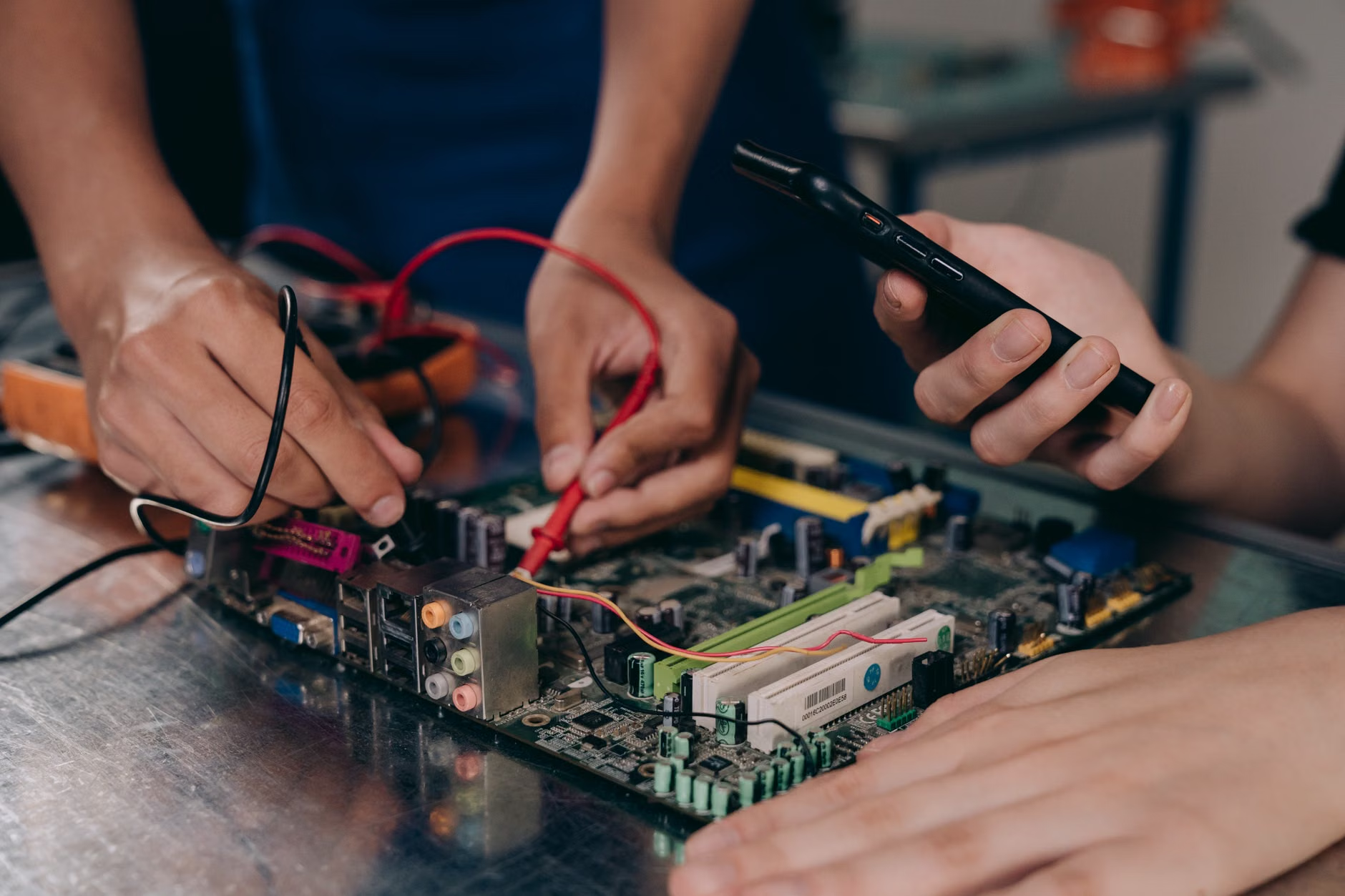
Why the Shift Matters Now
In the current market, the cost of repair often exceeds the cost of a new item. This is a deliberate design choice—a business model often referred to as “planned obsolescence.” By 2027, the legislative landscape will force a pivot. When a manufacturer is legally responsible for the recycling and disposal costs of a device, they have a direct financial incentive to make that device last longer. If they make it modular, they lower their long-term liability.
For a household managing a budget, this is a massive win. Imagine a laptop where you can swap out the RAM or the battery as easily as changing a lightbulb. You aren’t just buying a gadget; you are investing in a platform that can evolve with your needs. This shifts the focus from “how much does this cost today?” to “what is the cost per year of ownership?”
Understanding the Digital Product Passport
One of the most significant changes arriving by 2027 is the implementation of the “Digital Product Passport” (DPP). Think of this as a “Carfax” for your electronics. You will be able to scan a QR code or access a database to see exactly how a product was made, what materials are inside, and—crucially—how to repair it.
This transparency is a game-changer for parents and consumers who value longevity. Instead of guessing if a blender or a tablet is built to last, you will have access to standardized repair scores. If a manufacturer knows their “repairability score” is going to be public, they are going to work harder to make their products user-friendly. This will likely lead to a marketplace where durability is a primary competitive advantage, not just a niche feature.

What This Looks Like in Your Daily Life
Let’s look at a realistic scenario. You are shopping for a new dishwasher. Currently, you look at price, energy efficiency, and brand reputation. By 2027, you will also look at the “Circular Index.” You will see that Brand A provides spare parts for 10 years and offers a modular design that allows a technician (or you) to replace the heating element without dismantling the entire unit. Brand B, however, has a sealed pump system that requires a full unit replacement if one sensor fails.
This information allows you to make a rational economic decision. You might pay 15% more for Brand A, but if it lasts five years longer than Brand B, your actual cost of ownership drops significantly. This is the transition from passive consumption to active, informed asset management.
The Evolution of Repairability and DIY Maintenance
The “Right to Repair” movement has been gaining momentum for years, but by 2027, it will move from a grassroots campaign to a baseline requirement. This means manufacturers will be required to provide manuals, diagnostic tools, and affordable spare parts to both independent repair shops and consumers.
For the average family, this reduces the “repair anxiety” that currently keeps us from fixing our own devices. We’ve all been there: you drop your phone, the screen cracks, and the manufacturer quotes you a price that’s almost the cost of a new phone. By 2027, the law will demand that components like screens, batteries, and charging ports are standardized and accessible. You will no longer be locked into a proprietary repair ecosystem that holds your device hostage.
The Hidden Benefits of Modular Design
Modular design isn’t just about fixing things; it’s about upgrading. If you have a child who starts taking an interest in photography, a modular camera system or a tablet with an upgradable sensor module allows you to “level up” their tools without buying an entirely new device. This extends the life of the primary hardware while keeping the performance current.
Common mistakes in the current market include buying “budget” devices that are non-repairable, which end up costing more in the long run. By 2027, the market will likely split into two tiers: the “circular-ready” devices that are slightly more expensive upfront but cheaper to maintain, and the “legacy-style” disposable devices that will eventually become prohibitively expensive due to environmental taxes and waste management fees passed on to the consumer.
How to Prepare Your Household for the 2027 Transition
You don’t have to wait until 2027 to start adopting these habits. The transition is already happening. Here is how you can align your household budget and habits with the future of consumer electronics:
| Action | Why It Matters | When to Start |
|---|---|---|
| Prioritize Repairability Scores | Avoids “locked-in” hardware that cannot be serviced. | Today |
| Check Spare Part Availability | Ensures the device can be maintained for 5+ years. | Before every purchase |
| Learn Basic Diagnostics | Saves money on “no fault found” repair shop fees. | With your next device |
| Choose Modular Brands | Enables future-proofing through component upgrades. | Next major upgrade |
The table above serves as your decision framework. When you are standing in an electronics store—or browsing online—use these four criteria. If a device fails even one of these checks, you need to ask yourself if the short-term savings are worth the long-term cost of a disposable product.

Common Misconceptions about Circular Tech
One common misconception is that “circular” means “low-tech” or “recycled-looking.” In reality, the best circular products are often the most high-tech because they are built with precision, modularity, and high-quality materials that are designed to be disassembled. Another misconception is that you need to be an engineer to repair these devices. The new laws are pushing for “consumer-grade” repair, which means snap-fit components, standardized screws, and clear, accessible software interfaces.
The most significant overlooked variable is the software lock. Even if the hardware is repairable, some manufacturers use software to block third-party parts. The 2027 legislation specifically targets this “software pairing” practice. When buying new tech, look for brands that have explicitly committed to “no software pairing restrictions” in their repair policies.
Strategic Purchasing: A New Way to Shop
Moving forward, your shopping list should evolve. Instead of looking for the latest “version,” look for the most “durable architecture.” This requires a shift in mindset. We have been trained by marketing to crave the next big release. However, in a circular economy, the most valuable device is the one that lasts the longest while maintaining its utility.
Consider the “Total Cost of Ownership” (TCO) calculation for your family’s electronics. For a laptop, don’t just look at the $800 price tag. Look at the price tag plus the estimated cost of a battery replacement in year three and a storage upgrade in year four. If a $1,000 laptop is designed to be upgraded, it is actually cheaper than an $800 laptop that must be replaced in three years.
The Role of Second-Hand Markets
As circular economy laws take hold, the second-hand market will become more reliable. Today, buying used electronics is a gamble—you don’t know the state of the battery or if the device has been tampered with. With the advent of Digital Product Passports, you will be able to see the exact history of a used device. This will drive up the resale value of quality, modular electronics, giving you a better return on investment when you finally decide to upgrade.
Long-term Household Sustainability
The goal of these 2027 laws is to create a market where the most sustainable choice is also the most logical economic choice. This doesn’t mean you have to sacrifice performance or style. It means that the brands that win in 2027 will be the ones that respect your investment by making their products part of a long-term relationship rather than a fleeting transaction.
As a parent, this is a great lesson to pass on to the next generation. We are moving away from a culture of consumption and toward a culture of stewardship. By choosing products that are designed to be repaired, we are teaching our children the value of resources, the importance of maintenance, and the power of informed decision-making.
Final Practical Steps
To prepare for the 2027 transition, start by auditing your current electronics. Identify which devices are “repair-hostile” and commit to replacing them with modular alternatives when they inevitably fail. Look for brands that are already participating in “Right to Repair” programs—they are the ones most likely to be ahead of the curve when the new laws become mandatory.
Keep your manuals and receipts in a digital folder. When you see a “repairability score” on a website, take note of it. Start viewing your electronics as assets that require maintenance, just like your car or your home. This shift in perspective is the most important step in preparing for the future of the circular economy.
Remember: the goal isn’t to stop buying technology. It’s to buy technology that works for you, and for the planet, for years to come. Stay informed, demand transparency, and prioritize longevity in every purchase.
Frequently Asked Questions
1. Will these laws make electronics more expensive?
While the initial purchase price of modular, repairable electronics might be slightly higher due to the quality of materials and design, the total cost of ownership over 5-10 years is expected to be lower because you will not need to replace devices as frequently. You are paying for longevity rather than planned obsolescence.
2. How can I check if a product is ‘circular-ready’ before buying?
Look for companies that provide explicit repairability scores (often on a scale of 1-10), offer accessible spare parts on their official websites, and publish step-by-step repair manuals. If a company hides this information or uses proprietary tools to prevent access, it is likely not aligned with circular economy principles.
3. What if I am not tech-savvy enough to perform repairs myself?
The 2027 regulations require that manufacturers make parts and manuals available to independent repair professionals, not just the end-user. This means you will have more options than just the expensive, brand-authorized service centers. You will be able to take your device to a local, independent shop that can perform repairs at a competitive price using official parts.
For further reading on current regulations, you can monitor the progress of circular economy directives via the European Commission’s Circular Economy Action Plan or equivalent local consumer protection agency websites.