Key Takeaways
- The Subscription Model: A hyper-local micro-bakery thrives on a CSA (Community Supported Agriculture) style model where customers pay upfront, ensuring predictable cash flow and zero food waste.
- The Reality of Scale: This is not a “passive” side hustle; it requires strict adherence to local cottage food laws, often limiting production to specific types of non-hazardous baked goods.
- The Hidden Bottleneck: The primary constraint is not baking skill, but the logistics of “the last mile”—managing neighborhood distribution routes while balancing parenting duties.
The allure of the “micro-bakery” is undeniable. You’ve likely seen them on Instagram: a beautifully floured banneton, a steaming loaf of sourdough, and a caption about “feeding the neighborhood.” For many parents in their 30s and 40s, the dream of turning a hobby into a hyper-local, community-supported business feels like the perfect antidote to the 9-to-5 grind. But before you clear out your kitchen cabinets to make room for a commercial-grade mixer, it is vital to understand that this model is less about baking and more about logistics, regulatory compliance, and time management.
The “hyper-local” model relies on a subscription-based system. Instead of opening a storefront, you sell directly to neighbors who commit to a weekly or bi-weekly “bread share.” This shifts the risk from the producer to the community, mirroring the CSA model used by small farms. But does this transition actually work when your “office” is also your family’s kitchen?

The Mechanics of the Community-Supported Bread Subscription
At its core, a micro-bakery subscription is a pre-paid contract. Your customers pay for a month’s worth of bread in advance. This is the single most important feature of the model. By securing payment upfront, you solve the biggest issue in the food industry: inventory risk. You only bake what has been ordered.
However, the complexity lies in the “hyper-local” aspect. Unlike a bakery with a physical shop, you are responsible for the distribution. If you have 20 subscribers, you are essentially running a mini-logistics operation. You need a system to track who paid, when their bread is due, and—most importantly—how it gets from your cooling rack to their front door or designated pickup point.
The “Zero-Waste” Advantage: Because you know exactly how many loaves you need by Tuesday night, you purchase ingredients in bulk, reducing your cost per unit. This is the financial engine that makes the model viable. If you bake 20 loaves and sell 20, your profit margins are significantly higher than a retail bakery that might toss 15% of its inventory due to over-production.
Before you bake your first loaf for profit, you must understand your local “Cottage Food Laws.” These laws vary drastically by country and even by state or municipality. In the United States, for instance, the Forrager database is an essential resource for checking specific requirements in your state.
Most jurisdictions allow you to sell “non-potentially hazardous” foods from your home kitchen. This usually includes bread, cookies, and dry pastries. It rarely includes anything requiring refrigeration, like cheesecakes or meat-filled pies. If you try to scale beyond these limits, you will likely be required to rent space in a commercial commissary kitchen, which introduces a significant overhead cost—often $20 to $50 per hour.
Common Mistake: Many aspiring bakers ignore labeling requirements. Almost every jurisdiction requires clear, compliant labeling that lists ingredients, allergens, and your home address (or a registered business address). Failing to provide this is the quickest way to get a cease-and-desist letter from your local health department.
The Hidden Logistics: Time, Temperature, and Parenting
If you have children, the “work-from-home” aspect of a micro-bakery is a double-edged sword. Yes, you are home. But you are also tied to a fermentation schedule. Sourdough does not care that your toddler has a doctor’s appointment or that your school-aged child needs help with a project. It requires specific interventions at specific times.
The “hyper-local” nature of the model implies that your customers are likely your neighbors. This creates a unique social pressure. If a delivery is late or a loaf is under-baked, you aren’t just dealing with a customer complaint; you are dealing with a neighbor. This is why many successful micro-bakers limit their subscription pool to a manageable number—usually between 10 and 25 households—in the beginning.
The “Last Mile” Problem
How do you get the bread to your neighbors? You have three primary options:
| Distribution Method | Pros | Cons |
|---|---|---|
| Porch Pickup | Zero travel time; highly efficient. | Strangers coming to your home; requires porch management. |
| Neighborhood Drop-off | Builds community; predictable route. | Time-intensive; fuel and vehicle costs. |
| Partnered Pickup | Leverages other local businesses. | Requires coordination and potentially a revenue share. |
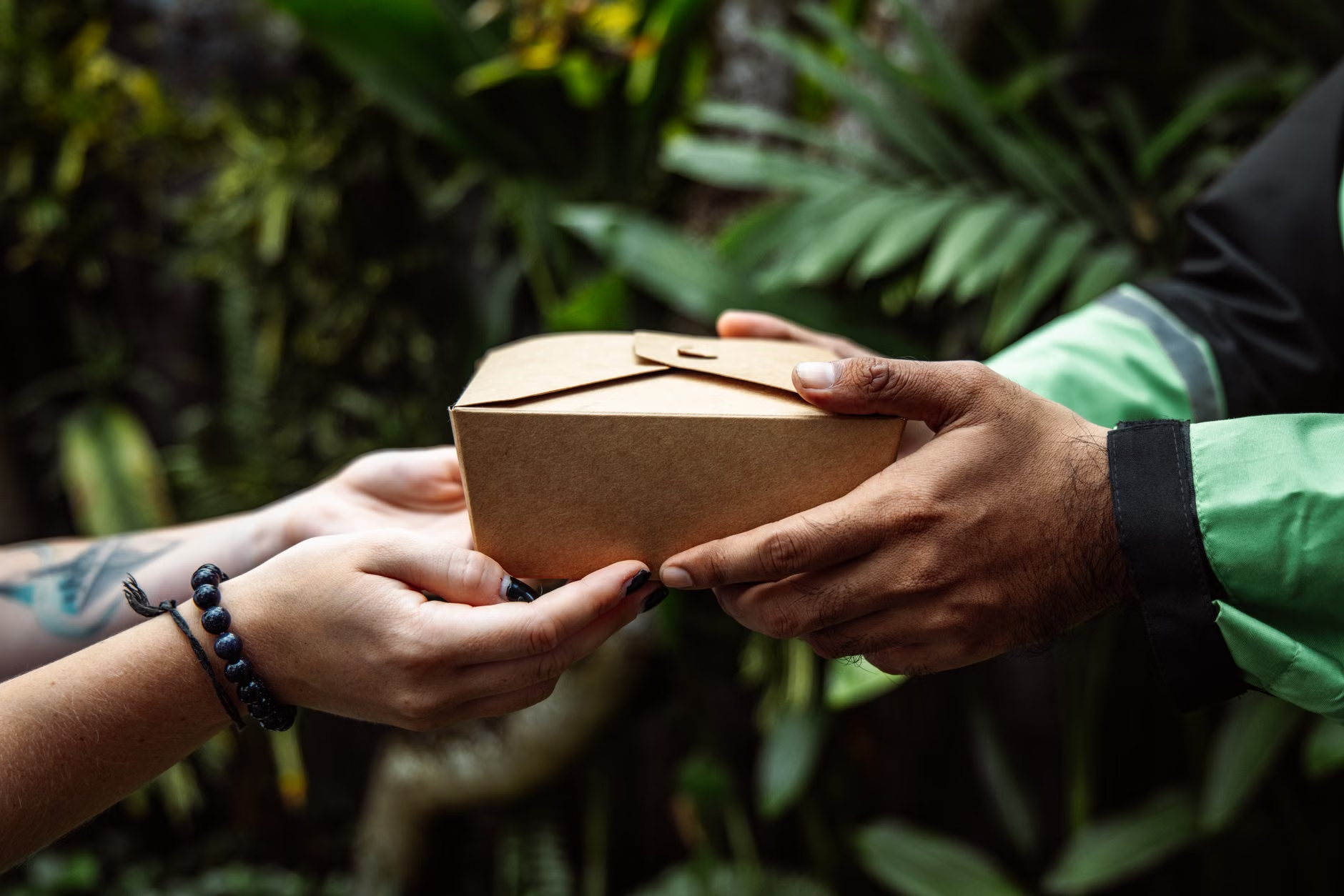
For most parents, Porch Pickup is the only sustainable option in the early stages. It allows you to maintain the “home” part of “home-based business.” However, you must be prepared for the social reality of having a steady stream of people visiting your driveway during your designated pickup window.
Financial Viability: Is the Effort Worth the Return?
Let’s look at the math. If you sell a loaf of sourdough for $8.00, your ingredient costs—flour, water, salt, electricity, and packaging—should ideally sit around $1.50 to $2.00. That leaves you with $6.00 per loaf.
If you bake 20 loaves a week, you have a gross profit of $120. Over a month, that’s $480. That might seem small, but if you treat it as a low-overhead side hustle, it covers a significant portion of a household utility bill or a child’s extracurricular activity fund. The danger arises when you try to scale this to a “full-time” income without moving into a commercial facility. The labor required to scale from 20 loaves to 100 loaves in a home kitchen is not linear—it is exponential.
The Hidden Cost of Time: Most people forget to factor in “non-baking” labor. This includes managing the email list, answering subscription questions, printing labels, cleaning the kitchen to commercial standards, and managing the logistics of the pickup window. If you spend 15 hours a week for $120 profit, you are earning $8.00 per hour. That is significantly below minimum wage in most developed economies.
To make this work, you must optimize your workflow. This means:
- Bulk fermentation: Baking in large batches to maximize oven capacity.
- Standardization: Limiting your menu to one or two types of bread. Do not offer a dozen different flavors.
- Automation: Using simple tools like Google Forms or specialized subscription software like Barn2Door or Harvie to manage recurring payments.
The “Lifestyle Trap” vs. Sustainable Business
The biggest risk here is the “lifestyle trap.” You start because you love baking, but you end up hating it because you are now a slave to a schedule. If you find yourself resenting the sourdough starter, it is time to pivot or stop. A micro-bakery should support your life, not consume it.
One way to avoid this is to implement “dark weeks.” Every six weeks, take a week off. Communicate this to your subscribers upfront. This allows you to have a life, travel, or simply focus on your family without the pressure of production. A transparent, honest communication style with your subscribers is your best defense against burnout.
When to Scale and When to Stop
You should consider scaling only when you have a waiting list. If you have 20 subscribers and 10 more people asking to join, you have a validated market. At this point, you have two choices: raise your prices or increase production. Raising prices is often the better path for a micro-bakery. It filters for customers who truly value artisan, local quality, and it allows you to maintain a manageable production volume while increasing your profit margin.
Practical Steps to Launch Your Micro-Bakery
If you have decided that this model fits your life, follow this sequence to minimize risk:
- Check the Law: Visit your local Department of Agriculture or Health website. Search for “Cottage Food Laws [Your State/Country].”
- Test the Recipe: Perfect one or two loaves. They must be consistent. Use a digital scale—do not bake by volume. Precision is the key to business consistency.
- Calculate Costs: Use a spreadsheet to track every gram of flour, salt, and piece of packaging. Do not guess.
- Create a “Soft Launch”: Offer bread to five friends or neighbors for free or at a discount in exchange for honest feedback on the ordering and pickup process.
- Set Up Simple Tech: Use a simple platform for ordering. Even a Google Form that triggers an email response is sufficient for the first ten customers.
- Establish Boundaries: Clearly state your pickup hours. If a customer misses their window, they forfeit the loaf. This is harsh, but necessary to keep your home life sane.
Final Verdict: The hyper-local micro-bakery is a fantastic way to build community and earn a modest side income, but it is not a path to easy wealth. It is a labor-intensive, time-sensitive commitment that requires the logistical skills of a supply chain manager and the patience of a teacher. If you can embrace the process as much as the product, it can be a deeply rewarding endeavor that integrates seamlessly into a family-focused life.
Frequently Asked Questions
Q: Can I run a micro-bakery if I have a full-time job?
A: It is difficult, but possible if you choose a “low-frequency” model. For example, baking only on Saturday mornings and limiting your subscriptions to a number you can comfortably handle on a Friday night/Saturday morning schedule. Avoid weekday production if you are working a traditional 9-to-5.
Q: How do I handle customers who want ‘custom’ orders?
A: Don’t. The success of the micro-bakery model relies on standardization. If you allow custom orders, your efficiency will plummet, and your costs will rise. Stick to a “Baker’s Choice” or a very limited, rotating menu. If they want custom, refer them to a commercial bakery.
Q: What happens if I get sick or need to take a vacation?
A: Build this into your business model from Day 1. Have a clear “No-Bake” schedule published on your website or order form. If you are a one-person show, the business stops when you stop. Your customers will understand, provided you communicate it clearly and in advance.
Resources for further research: