Trading the chaos of airport security queues for the rhythmic hum of a high-speed train is not just a trend—it is arguably the most practical way for families to traverse Europe today. By choosing rail over short-haul flights, you aren’t just lowering your carbon footprint; you are regaining control over your travel experience, allowing for space, movement, and a genuine connection to the landscapes you are crossing.
- Efficiency and Comfort: Trains take you from city center to city center, avoiding the “last mile” commute required by most airports.
- Sustainable Impact: Rail travel produces up to 80% less CO2 per passenger compared to short-haul flights, making it a guilt-free choice.
- Flexibility: Booking via multi-country rail passes or direct operator sites allows for spontaneous adjustments that are nearly impossible with budget airlines.
If you are in your 30s or 40s, you likely remember the days of chaotic backpacking, but traveling with children changes the calculus entirely. Suddenly, the three-hour “saved” time from a flight is negated by the two hours of pre-flight security, the hour of transit to a remote airport, and the inevitable meltdowns over restricted liquid sizes. Why do we keep doing this to ourselves?
The shift toward “slow travel” isn’t just about being eco-conscious; it’s about sanity. Let’s look at how to make the European rail network work for your family.
The Hidden Math of European Rail Travel
We often fall into the trap of comparing “base fares.” A budget airline might show a $40 ticket, while the train shows $120. However, this is a classic case of hidden costs. When you calculate the cost of a train to the airport, the baggage fees (which are often more than the ticket itself), and the high-priced airport snacks, the gap closes rapidly.
For a family of four, these costs multiply. With a train, you are generally allowed two large suitcases and a carry-on per person, with no liquid restrictions and—most importantly—no weigh-in. You can bring a stroller, a scooter for the toddler, and your own snacks without paying a premium.
Moreover, modern European trains are designed for human beings, not sardines. You have table seats, power outlets, and often dedicated family carriages or play areas. You can walk around, visit the bistro car, and actually talk to your partner without shouting over a jet engine. That is the true value proposition.
Europe’s rail system can seem like a daunting spiderweb of national operators. However, it is simpler than it looks if you break it down by region. You don’t need a single “European train company.” Instead, you use the national operator for the country where your journey starts or ends.
| Country | Primary Operator | Best For |
|---|---|---|
| France | SNCF (TGV) | High-speed, city-to-city travel |
| Germany | Deutsche Bahn (DB) | Extensive connections, punctuality |
| Italy | Trenitalia / Italo | Comfort and affordable luxury |
| Spain | Renfe (AVE) | Modern fleets, expansive geography |
The trick is using aggregator sites for planning, but booking directly on the operator’s website. Aggregators like Trainline or Omio are fantastic for comparing routes and times. Once you decide on a route, booking directly with the national carrier (like SNCF or DB) often saves you booking fees and makes it significantly easier to manage tickets if a delay occurs or if you need to exchange your seat.
Planning for the “Last Mile” and Luggage
One of the biggest anxieties for parents is the “last mile”—the transition from the train station to your accommodation. Unlike airports, which are often 30 to 60 minutes outside of the city, train stations are historically the heart of the city. This is a massive tactical advantage.
However, you need a strategy for your gear. If you are traveling with multiple kids, the “one-bag-per-person” rule is a necessity, not a suggestion. Invest in high-quality, lightweight luggage with 360-degree wheels. If you are bringing a stroller, ensure it is the “travel” variety—the kind that folds into a small square in seconds. You will be navigating escalators, cobblestone streets, and narrow train aisles.
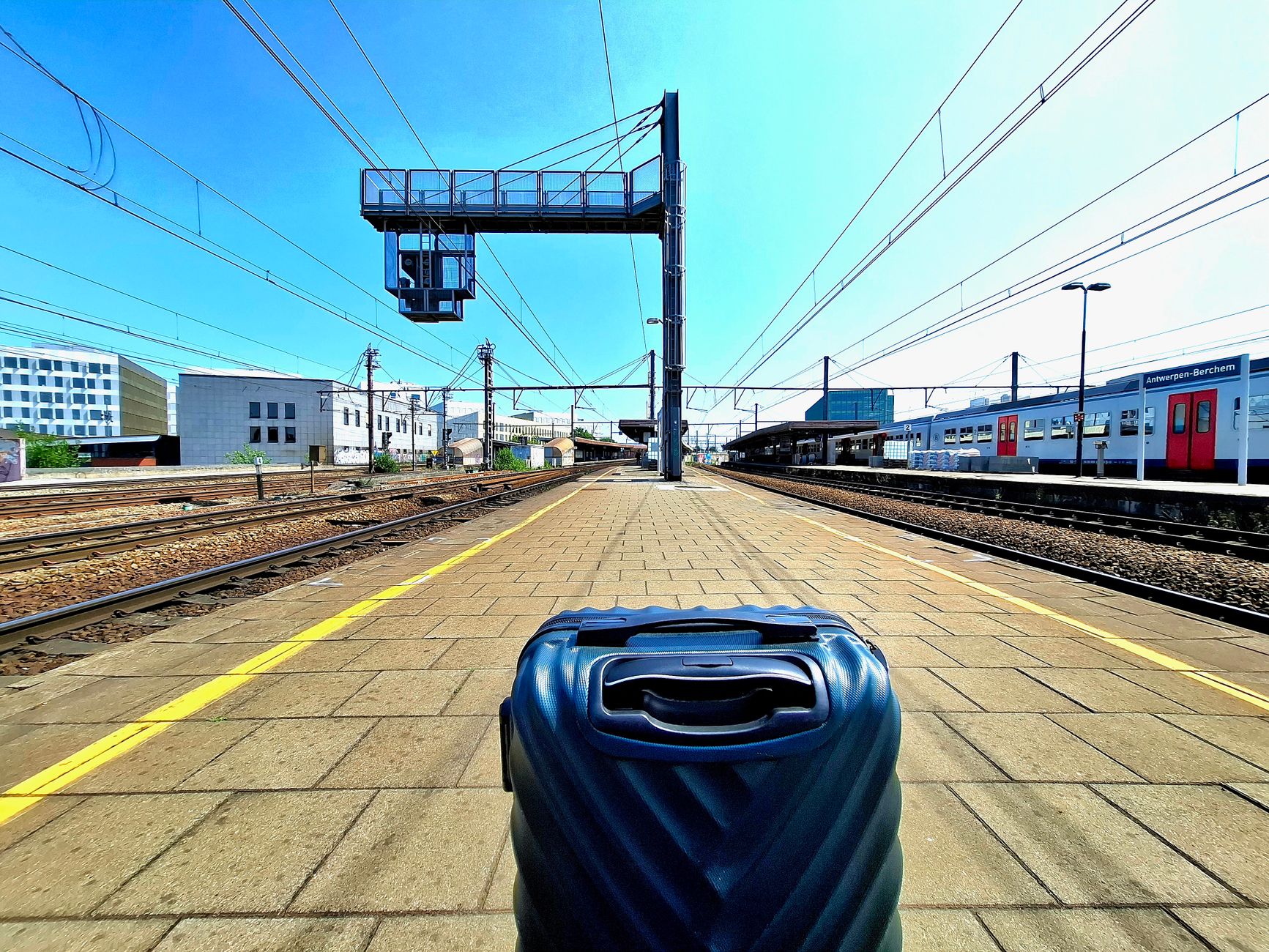
Consider using luggage forwarding services if you are planning an extended trip. Many major European stations offer “Left Luggage” services or lockers, allowing you to drop your bags and explore the city for a few hours before heading to your hotel. This turns a travel day into a sightseeing day.
Technology: Your Best Friend on the Tracks
You no longer need to print paper tickets, and in fact, you shouldn’t. Almost every major European rail operator now offers a comprehensive app. These apps provide real-time platform updates, seat assignments, and even QR codes for the conductor to scan.
If you are doing a multi-country trip, the Eurail/Interrail pass is a popular option. It’s a digital pass that you keep on your phone. However, be aware: while the pass covers the “fare,” some high-speed trains (like the TGV in France or the Frecciarossa in Italy) require a mandatory seat reservation for an additional small fee. Don’t let this catch you off guard; check the app for “Reservation Required” warnings.
Pro tip: Always download the offline maps of the cities you are visiting. Even with 5G, tunnels and remote stretches of track can kill your signal. Having your route to the hotel saved offline is a small detail that saves immense stress when you arrive in a new city with tired kids.
The “Slow Travel” Mindset for Families
We are conditioned to think that faster is better. But is a 90-minute flight really “faster” than a 4-hour train ride? When you account for the 2-hour arrival window, the boarding process, and the commute from the airport, the train is often more efficient. And the time spent on the train is usable time.
On a plane, you are trapped in a seat, often with a screen in front of your child. On a train, you can open a table, play a board game, draw, or read. The landscape changes constantly, providing a natural source of entertainment that a cloud-filled sky simply cannot match. It’s a chance to actually be present with your family instead of managing logistics.
Furthermore, train travel allows for “buffer stops.” If you see a town on the map that looks interesting, you can book a stopover. You can spend four hours in a small Swiss village, have lunch, and catch a later train. Airlines don’t offer that kind of flexibility without a massive financial penalty.
Common Pitfalls and How to Avoid Them
Even the best-laid plans can go sideways. Here are a few things to watch out for:
- The “Tight Connection” Trap: If you are changing trains, aim for at least 30 to 45 minutes between connections. While many European trains are punctual, a 10-minute platform change with two kids and four suitcases is a recipe for a meltdown.
- The Sunday/Holiday Schedule: Some regional lines run on reduced schedules during weekends or local holidays. Always check your dates on the national rail website before finalizing your hotel bookings.
- The “Quiet Car” Mistake: Many European trains have designated “Quiet Zones.” Do not book seats here if you have energetic children. Look for the “Family Area” or “Open Saloon” seating.
If you do encounter a cancellation, do not panic. Rail networks have much higher redundancy than airlines. There is almost always another train heading in your direction within an hour or two. Head to the customer service desk (often called “DB Information” or “SNCF Assistance”)—they are generally more empowered to help you rebook on the spot than an airline gate agent would be.
Is It Truly Sustainable?
The environmental argument for rail travel is clear, but it’s worth understanding the scale. According to the European Environment Agency, rail travel emits approximately 14 grams of CO2 per passenger-kilometer, compared to 285 grams for a short-haul flight. Even accounting for the energy used to power the trains (which is increasingly coming from renewable sources in countries like Sweden, Switzerland, and Austria), the difference is massive.
For parents in their 30s and 40s, this is often a significant factor. We want to show our children the world, but we are increasingly conscious of the footprint we leave behind. Rail travel allows us to align our travel habits with our values without sacrificing the quality of our holiday.
The Financial Reality
Let’s talk money. Are trains expensive? They can be, but they are also highly predictable. If you book early (usually 3 to 6 months in advance), you can secure “Sparpreis” or discounted fares that are significantly cheaper than the last-minute prices. Many operators also offer family discounts where children travel for free or at a steep discount when accompanied by an adult.
Compare this to flying, where prices fluctuate wildly based on baggage, seat selection, and last-minute demand. Train pricing is generally more stable. Use a spreadsheet if you are planning a multi-city trip. List the cost of the train vs. the cost of a flight + airport transfer + baggage fees. You will be surprised how often the train wins, especially once you account for the “hidden” cost of stress.
Final Thoughts on Your Rail Journey
Traveling by train in Europe is an invitation to slow down. It’s an invitation to stop treating travel as a logistical hurdle to be cleared and start treating it as part of the destination itself. You’ll see the shifting architecture, the changing dialects, and the evolving geography in a way that simply isn’t possible at 30,000 feet.
It requires a bit more research and a bit more planning than clicking “book” on a budget airline site. But for the reward of a calmer, more connected, and environmentally responsible trip, it is an investment in your family’s experience that pays dividends. Keep your gear light, your apps updated, and your schedule flexible. The rails are waiting.
Frequently Asked Questions
1. Do I need a Eurail pass or should I buy individual tickets?
If you are planning to travel to more than 3-4 countries in a short span, a Eurail/Interrail pass can be cost-effective and convenient. However, if you are doing a simple A-to-B trip or staying within one or two countries, buying individual tickets in advance through the national rail operator is usually cheaper and gives you more flexibility with seat reservations.
2. How do I handle luggage on a train with small children?
The golden rule is “if you can’t carry it, don’t bring it.” Use a stroller that folds compactly and try to limit yourself to one suitcase per person. Most modern trains have luggage racks at the ends of the carriages and overhead shelves for smaller bags. If you are worried, book a seat with a table or near the luggage rack so you can keep an eye on your belongings.
3. What happens if my train is delayed or cancelled?
European rail operators are generally very good about providing alternative routes. If your train is cancelled, check the operator’s app immediately for the next available connection. If you are at the station, go to the customer service counter. Under European law, if your train is delayed by more than 60 minutes, you are often entitled to compensation, so keep your tickets and check the operator’s website for their specific delay compensation policy.
Official Resources for Further Research: