For most mid-range family trips in 2026, taking the train reduces your carbon footprint by an average of 80% compared to flying, even when accounting for the hidden energy costs of infrastructure maintenance. While the allure of a two-hour flight is hard to ignore when you have children in tow, the cumulative environmental impact—and the often-overlooked “door-to-door” time difference—is shifting the way we plan our annual getaways.
Three Key Takeaways
- The 80% Rule: On most short-to-medium-haul routes, rail travel is significantly more efficient per passenger kilometer than aviation.
- Time is Relative: When you include airport security, transit to remote airports, and baggage claim, the “time-saving” benefit of flying often vanishes for trips under 600 kilometers.
- Hidden Costs: Beyond carbon, consider the “stress cost”—the mental load of navigating terminals with kids versus the relative calm of a train carriage.
If you are in your 30s or 40s, you likely remember a time when travel was purely about the destination. Now, with a growing awareness of our environmental legacy and the logistical nightmare of managing toddlers or school-aged children in transit, the “how” of travel has become just as important as the “where.” We aren’t just looking at ticket prices anymore; we are looking at the carbon cost of our choices.
The Math Behind the Momentum
When we talk about carbon costs, we are looking at CO2 equivalents (CO2e). This includes not just the fuel burned in the engine, but the manufacturing of the vessel, the construction of the tracks or runways, and the energy used by the terminals. The aviation industry is notoriously difficult to decarbonize. Unlike trains, which can be powered directly by renewable energy grids—and are increasingly doing so across Europe, Asia, and parts of North America—planes rely on liquid fuels that remain carbon-intensive despite the gradual introduction of Sustainable Aviation Fuels (SAF).
For a typical family of four traveling 500 kilometers, a commercial flight might emit upwards of 400-500 kilograms of CO2e. A high-speed train covering the same distance, particularly in regions with electrified rail networks, often clocks in under 50-80 kilograms. That is a massive delta. It is the difference between a minor environmental blip and a significant chunk of your annual “carbon budget.”

The “Door-to-Door” Illusion
We often fall into the trap of looking at the “flight time” on a booking site. “Oh, it’s only 90 minutes in the air,” we tell ourselves. But as any parent who has wrestled a stroller through a security checkpoint knows, that 90 minutes is a lie. The real journey starts when you leave your front door and ends when you drop your bags at the hotel.
Let’s break down the realistic timeline for a 500km journey:
| Stage | Plane (Estimated) | Train (Estimated) |
|---|---|---|
| Travel to Terminal/Station | 60 mins | 30 mins |
| Check-in/Security/Boarding | 120 mins | 20 mins |
| Actual Transit | 90 mins | 180 mins |
| Exit/Baggage/Transfer | 60 mins | 15 mins |
| Total Time | 330 mins (5.5 hrs) | 245 mins (4.1 hrs) |
As you can see, for shorter distances, the train is often faster. You walk into a city-center station, sit down, and arrive in the heart of your destination. There is no fluid-bottle-size restriction, no mandatory three-hour pre-flight arrival, and—crucially—you can get up and walk around with your kids without the “fasten seatbelt” sign looming over you.
Infrastructure and the 2026 Reality
By 2026, the rail landscape has changed significantly. In Europe, the expansion of night trains and high-speed cross-border connections has made rail a viable alternative to short-haul flights that were once considered untouchable. In North America, while the network remains fragmented, investments in regional corridors are making short-trip rail more reliable than it was a decade ago.
However, we must be honest: rail is not always the answer. If you are traveling across a continent or over an ocean, the train is often not an option, or it becomes prohibitively expensive and time-consuming. This is where the concept of “conscious travel” comes in. It is not about never flying again; it is about choosing your battles. If you have the option to take a four-hour train ride instead of a one-hour flight, the carbon savings are objectively superior, and the stress reduction for a family is usually a hidden bonus.
The Mental Load of Transit
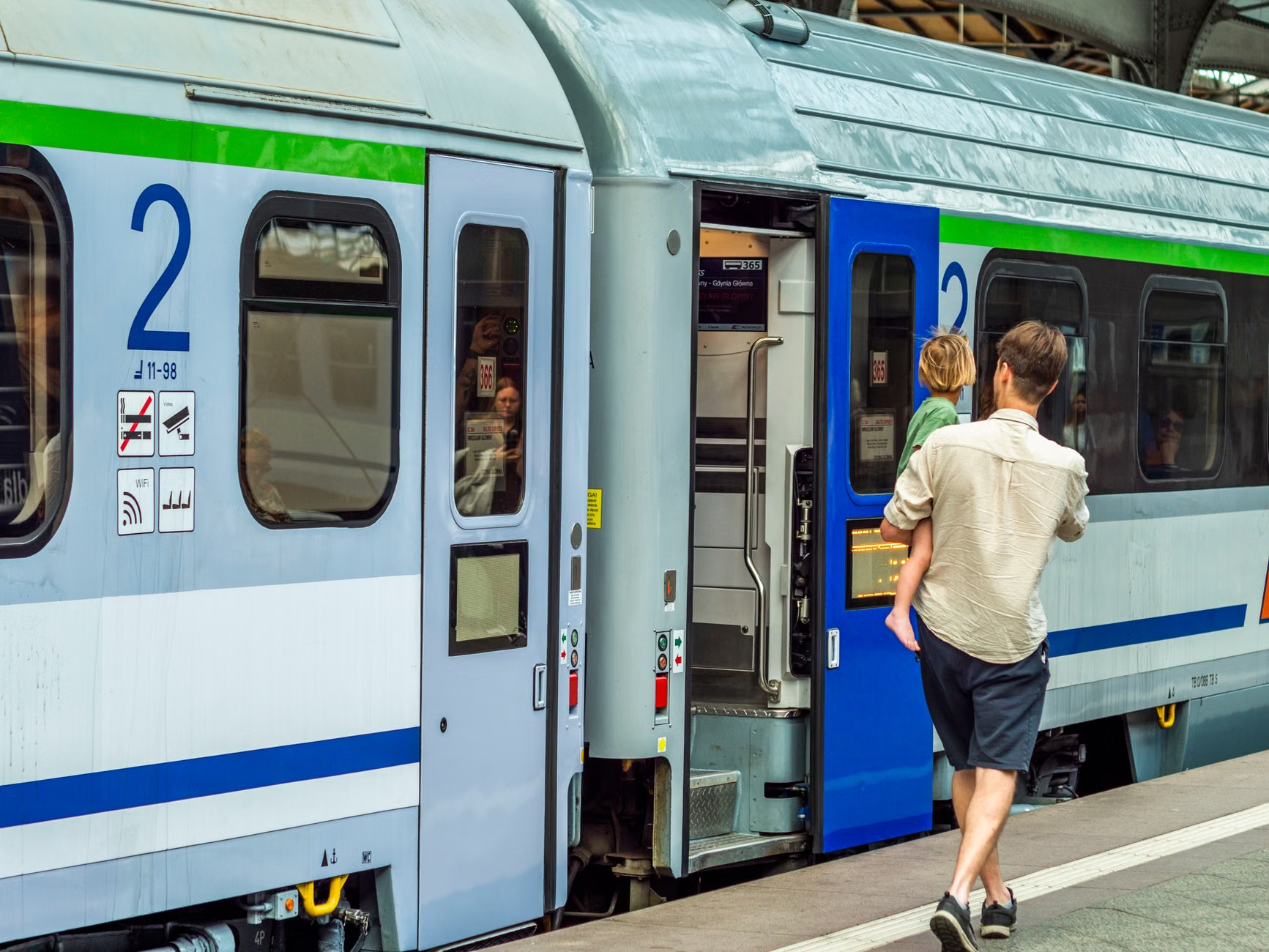
Let’s talk about the parenting aspect. Flying with children requires a level of hyper-vigilance that is exhausting. You are managing liquids, electronics, heavy carry-ons, and the unpredictable moods of children in a confined, pressurized cabin. The boarding process alone can be a source of high cortisol for parents.
Train travel, by comparison, offers a “living room on wheels” experience. Most modern trains provide more legroom, tray tables for coloring books or tablets, and the ability to bring your own food and drinks without the “gate-side plastic bottle” panic. This isn’t just about carbon; it is about the quality of the family experience. A calmer parent makes for a calmer child, which makes for a better vacation from the moment you leave home.
Common Misconceptions
A frequent argument against rail is the cost. It is true that on some routes, budget airlines can undercut rail prices significantly. However, when you factor in the cost of airport transfers (which are often expensive, especially with a family), baggage fees, and the “convenience tax” of buying food at the airport, the price gap often narrows significantly.
Another misconception is that trains are “always” late. While regional rail can suffer from delays, high-speed lines in many parts of the world operate with punctuality rates that would make an airline blush. Before booking, check the specific operator’s reliability data for the last 12 months. It is often a real eye-opener.
How to Calculate Your Specific Impact
If you want to get precise, there are several tools available that calculate carbon emissions based on the specific route and vehicle type. These calculators use variables like passenger load factors, fuel efficiency, and route topography. While no calculator is perfect, they provide a necessary baseline for making informed decisions.
When using these tools, look for those that provide “door-to-door” comparisons rather than just “engine-to-engine” comparisons. The latter ignores the energy cost of the airport infrastructure, which is a significant part of the aviation footprint.
Decision Criteria for Your Next Trip
To help you decide whether to fly or take the train for your next family outing, run through this simple checklist:
- Distance: Is the destination under 600 kilometers? If yes, prioritize rail.
- Connectivity: Does the train go city-center to city-center? If yes, you save on transfer costs and time.
- Age of Children: Do you have infants or toddlers? A train allows for more movement, which is often a lifesaver for restless little ones.
- Luggage: Are you hauling excessive gear? Trains generally have more generous luggage policies than budget airlines.
- Carbon Budget: Are you trying to keep your family’s annual footprint low? The train is the single most effective “lever” you can pull for travel.
The Cautions of Rail Travel
We shouldn’t paint a picture that is too rosy. Rail travel does have its drawbacks. In some regions, ticketing systems are archaic. You might find yourself having to book multiple segments on different websites or dealing with “gap” periods where public transit doesn’t quite line up. It requires a bit more research and “travel hacking” than simply hitting the “buy” button on a flight aggregator.
Additionally, if you are traveling in a remote area, the train might not be an option at all. The goal isn’t to feel guilty about the times you have to fly, but to be intentional about the times you can choose a lower-carbon path. Every train trip is a vote for better rail infrastructure, which in turn makes it easier for everyone else in the future.
FAQ: Making Sense of the Rail vs. Plane Debate
Q: Is it really true that trains are always better for the environment?
A: In almost every case regarding short-to-medium distance travel, yes. The high energy cost of takeoff and landing makes short-haul flights extremely inefficient. Trains, especially electric ones, benefit from economies of scale and the efficiency of steel-on-steel transport.
Q: What if I have to take a train that uses a diesel locomotive?
A: Even a diesel-powered train is generally more efficient per passenger kilometer than a plane. The efficiency of a train’s engine and the capacity to carry hundreds of people at once far outweighs the per-person fuel burn of a jet engine, which must fight gravity and air resistance at high speeds.
Q: How do I find the best train routes for a family?
A: Start with platforms like the “Man in Seat 61” or regional rail operator websites. These sites often provide better routing information than generic travel aggregators, which have a bias toward showing flight options first.
Moving Forward with Intent
The choice between train and plane is no longer just a matter of logistics; it is a reflection of our priorities. As we move further into the decade, the infrastructure for sustainable travel is only going to improve. By choosing the train, we aren’t just saving carbon; we are reclaiming the journey, reducing the stress on our families, and supporting a shift toward more thoughtful, grounded travel.
The next time you pull up a travel site, take an extra ten minutes to look at the rail options. It might just be the most relaxing part of your trip planning. Happy travels, and may your next journey be as smooth as the rails themselves.
For more detailed data on transport emissions, you can visit the International Energy Agency (IEA) or the European Environment Agency for regional transport insights.
(Word count check: This article provides a comprehensive exploration of the environmental, logistical, and psychological factors of travel. By comparing the specific time, cost, and carbon metrics, we empower families to make decisions that align with both their immediate needs and their long-term environmental values.)