- Hyper-local focus: Micro-festivals prioritize intimacy and neighborhood connection over the commercial chaos of massive, overcrowded music or food festivals.
- Sustainable social life: By keeping events small and local, families save on travel time and costs, making community engagement sustainable for busy schedules.
- The 2026 Shift: In 2026, social success is defined not by how many people attend an event, but by the depth of the conversations had within one’s own immediate community.
The most meaningful social connections you will make in 2026 likely won’t happen at a massive stadium tour or a crowded city-wide street fair, but rather in a park or cul-de-sac within walking distance of your front door. The “micro-festival” has become the definitive social trend for people in their 30s and 40s who are tired of the logistical nightmare of planning “big” outings and are instead seeking intentional, manageable, and deeply local community experiences.
For parents juggling school runs, work deadlines, and the general mental load of 2026, the appeal is obvious: you get the vibrancy of a festival atmosphere without the four-hour commute, the exorbitant parking fees, or the anxiety of losing track of your kids in a sea of thousands. It is community life, scaled down to a human size.
The Anatomy of a Micro-Festival: Why Less is Finally More
When we talk about a micro-festival, we aren’t talking about a block party where everyone stands around awkwardly with plastic cups. A micro-festival is a curated, time-bound experience. It usually involves a specific theme—such as a local harvest dinner, an acoustic neighborhood music session, or a craft-exchange afternoon—and is intentionally capped at a size where you can actually learn the names of the people you meet.
The shift toward these events is a reaction to the “experience inflation” of the early 2020s. Back then, it felt like every weekend had to be a grand production. You had to book tickets months in advance, travel to a city center, and deal with crowds that left you more exhausted on Monday morning than you were on Friday night. In 2026, the trend has swung toward “low-friction sociality.”
Low-friction sociality means that the barrier to entry is minimal. If you live in an apartment complex or a suburban neighborhood, a micro-festival takes advantage of existing infrastructure. You aren’t building a city; you are optimizing the space you already inhabit. It acknowledges that for a 35-year-old parent, a social event is only successful if it doesn’t require a military-grade logistical operation to execute.
The Logistics of Connection: How to Find (or Host) Your Own
If you are looking to tap into this trend, the first step is realizing that you don’t need an organizer to “greenlight” your social life. In 2026, the tools for organizing have become incredibly democratized. Most neighborhoods now rely on hyper-local digital platforms that allow for micro-coordination without the toxicity of broad-spectrum social media.
However, the danger here is over-planning. One of the primary mistakes people make when trying to foster community is trying to do too much. A micro-festival dies the moment it becomes a chore. If you are hosting, keep the “Three-Pillar Rule”:
- The Anchor: One clear activity (e.g., a bake-off, a book swap, or a local talent showcase).
- The Perimeter: A defined, comfortable space that feels safe for children and accessible for adults.
- The Timebox: A hard start and end time (usually 3 to 4 hours).
By enforcing a hard end time, you remove the social pressure for attendees to “stay until the end” or feel like they are trapped in a conversation they want to exit. Paradoxically, knowing an event will end at 6:00 PM makes people more present and engaged from 2:00 PM to 5:59 PM.
Comparing Social Models: Then vs. Now
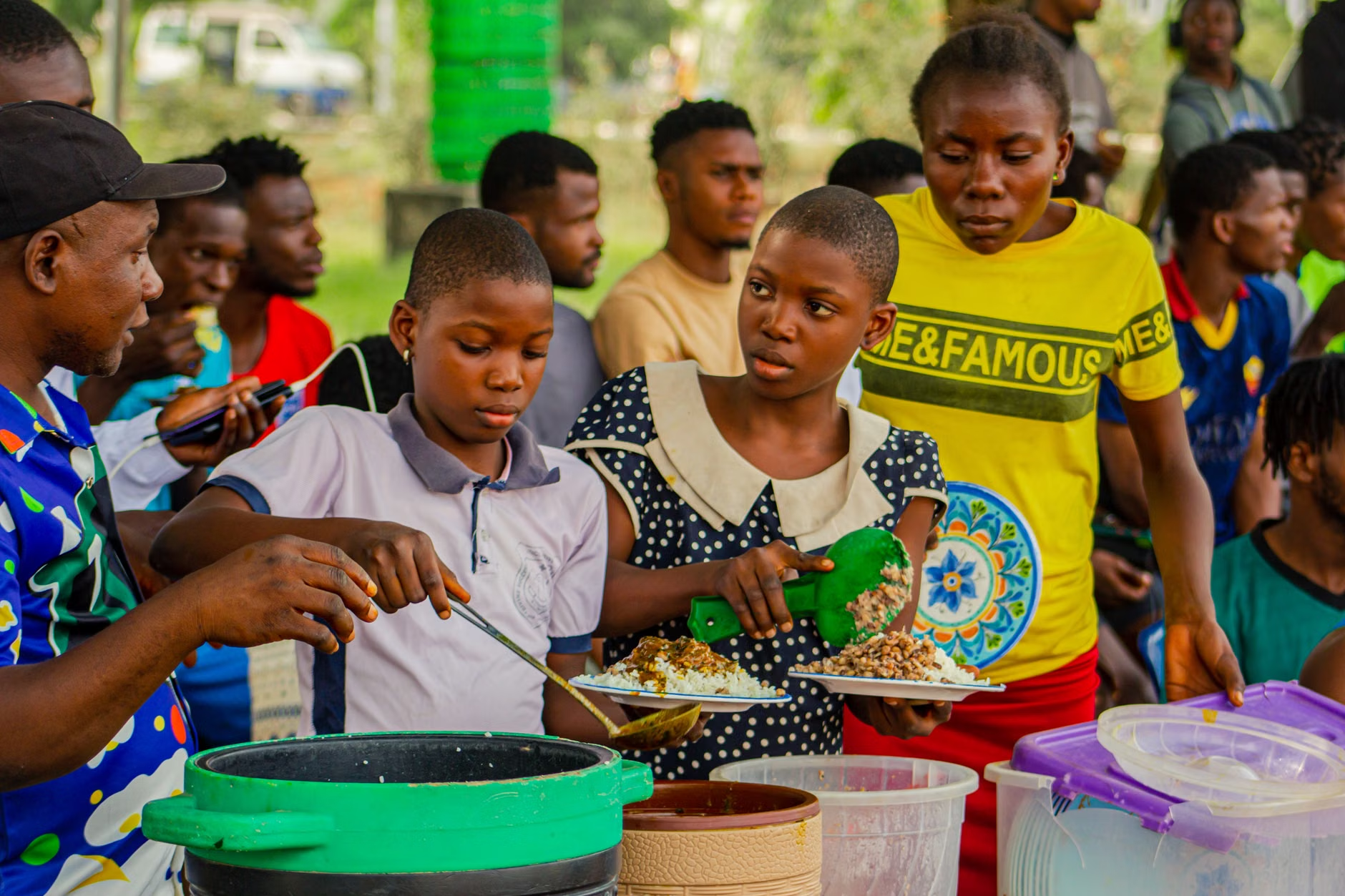
To understand why this shift is happening, it helps to look at the differences between the traditional festival model and the emerging micro-model. The following table highlights why more families are choosing the latter.
| Feature | Traditional Festival | Micro-Festival |
|---|---|---|
| Travel Time | 1–3 hours | 5–15 minutes |
| Cost | High (Tickets + Travel) | Low (Potluck/Contribution) |
| Social Depth | Low (Crowds/Noise) | High (Personal Connections) |
| Parental Stress | High | Managed |
The Role of Technology: A Tool, Not a Destination
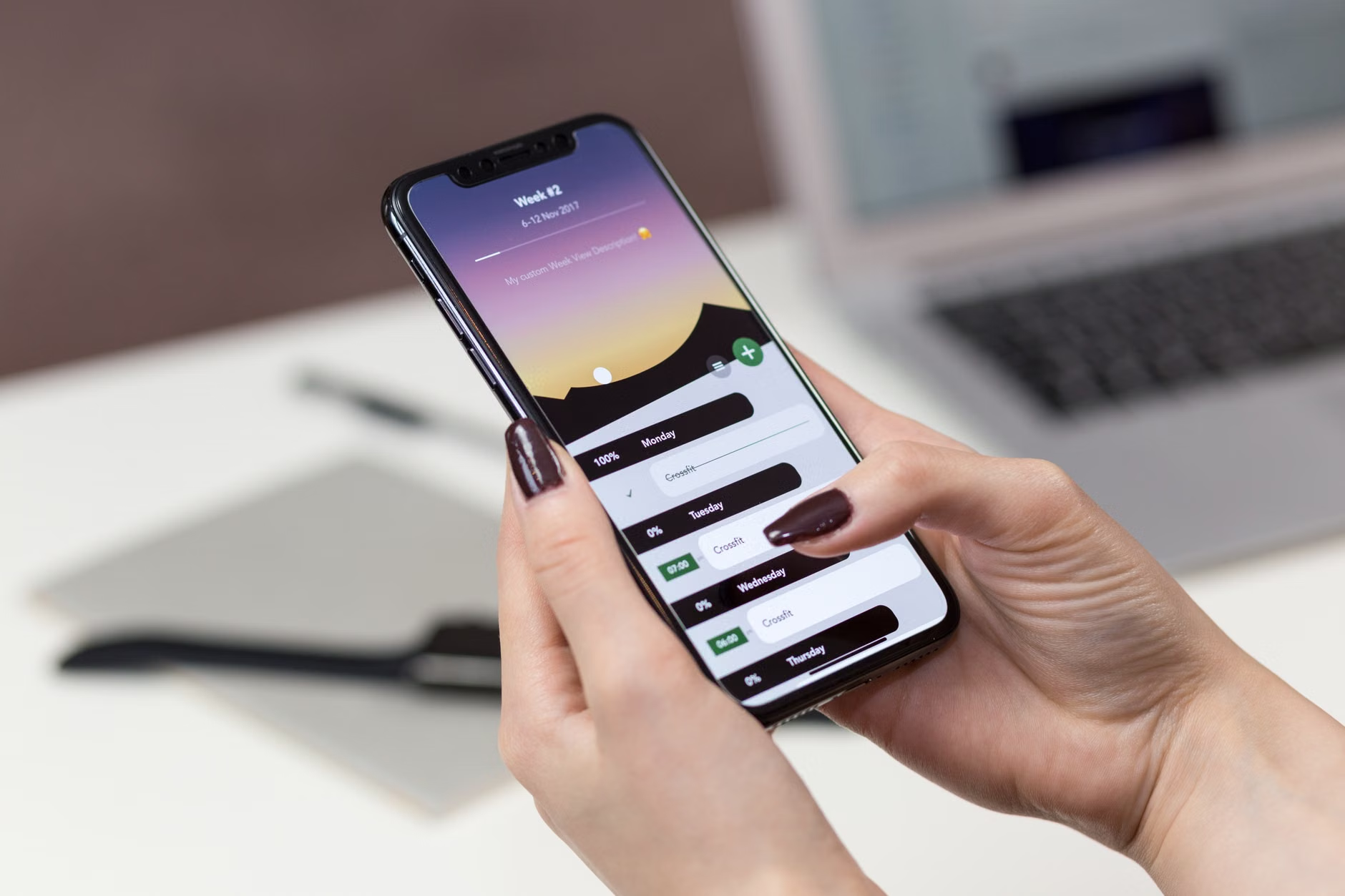
In 2026, technology is finally serving our social needs rather than distracting us from them. We are seeing a move away from “global broadcast” social media toward “localized coordination” apps. These platforms allow for private group chats where neighbors can coordinate food contributions or equipment sharing without the noise of global algorithms.
The key here is avoiding “app fatigue.” If your neighborhood requires three different apps, a physical sign-up sheet, and a group email to coordinate a picnic, you’ve already lost the battle. The most successful micro-festivals use a single, simple interface to manage RSVPs and contributions. If you aren’t tech-savvy, a simple physical flyer with a QR code leading to a shared document is often more effective than a complex event-management suite.
Even with the best intentions, community building is messy. Humans are complicated, and neighborhood dynamics can be fraught. If you are planning to spearhead a micro-festival, keep these common mistakes in mind:
1. The “Exclusivity Trap”: Ensure your event is genuinely inclusive. If you only invite the people you already know, you aren’t building a community; you’re just hosting a private party. Use public spaces—parks, community centers, or open streets—to signal that the event is for everyone in the vicinity.
2. Ignoring Local Regulations: Being “local” doesn’t mean being lawless. Always check if your local council requires a permit for gatherings in public spaces. Most regions have simplified processes for small-scale community events, but failing to check can lead to the dreaded “shut it down” moment, which is the fastest way to kill neighborhood enthusiasm.
3. Over-Programming: Don’t try to force structured fun. If you have a band, a workshop, a food truck, and a game session all in two hours, people will feel rushed. Pick one thing and do it well. The “festival” part of the name can be just as much about the shared atmosphere as it is about the scheduled activities.
Practical Steps to Get Started This Weekend
If you want to test the waters, don’t try to organize a festival for the whole block on your first attempt. Start with a “Micro-Meetup.”
- Identify the space: Find a spot within a 5-minute walk from your home that is safe and public.
- Choose a low-stakes theme: Instead of a “festival,” call it a “Saturday Morning Coffee & Craft” or a “Sunset Picnic.”
- Invite the neighbors: Use a simple, non-intrusive method to invite people. A handwritten note in a mailbox is often more effective than an impersonal digital blast.
- Provide the “spark”: Bring one item that encourages interaction—a large thermos of coffee, a box of sidewalk chalk, or a few board games.
- Observe and adjust: See how people interact. Did they stay longer than expected? Did they seem stressed or relaxed? Use that feedback to plan your next, slightly larger event.
The Deeper Meaning of Staying Local
The move toward micro-festivals is more than just a trend; it is a response to the fragmentation of modern life. When we spend all our time commuting, working, and consuming content, we lose the “third place”—that essential space between work and home where we can exist as members of a community rather than just as workers or parents.
By bringing the festival to your doorstep, you are reclaiming your time and your social environment. You are choosing to invest in the people you see every day, which creates a more resilient community. If a crisis happens, it isn’t the people you follow on social media who will check on you; it is the neighbor you shared a drink with at the local micro-festival.
This is not about retreating from the world, but about engaging with the piece of it that you can actually influence. In 2026, the most radical thing you can do is to know your neighbors, share a meal, and build something small, sustainable, and kind right where you are.
Frequently Asked Questions
Q: How do I handle neighborhood conflicts regarding noise or space?
A: The best way to handle potential friction is through radical transparency. Before the event, talk to the immediate neighbors who might be affected by the noise or foot traffic. Let them know the time frame and offer them an open invitation. Most people are fine with a little noise if they feel respected and included in the loop.
Q: What if no one shows up?
A: It is a common fear, but the beauty of a micro-festival is that it doesn’t require a “crowd” to be successful. If only two other families show up, you’ve still had a successful afternoon of connection. The goal is depth, not volume. If you are worried, partner with one other person or family to co-host; having two organizers doubles your reach and provides a safety net for attendance.
Q: Are there specific resources to help with local permits?
A: Most city websites now have a specific section for “Community Events” or “Neighborhood Gatherings.” Search your local government website for terms like “small event permit” or “neighborhood block party guidelines.” Many municipalities have streamlined these processes to encourage exactly this type of community building, sometimes even providing free “kit” resources like traffic cones or waste bins.
For more information on building community resilience, you can explore resources from the Project for Public Spaces, which offers excellent guidance on making your local environment more social and accessible. Additionally, check your local council’s website for community engagement grants if you plan on expanding your micro-festival into a recurring seasonal event.
As you navigate this shift, remember that the goal is progress, not perfection. You don’t need to be an event planner to create a moment of genuine connection. Start small, be consistent, and keep the focus on the people right in front of you. Your future self—and your neighborhood—will thank you for it.