The 2026 Global-Energy-Grid update is essentially the largest infrastructure shift in decades, moving your home from a passive energy consumer to an active participant in a decentralized, data-driven power network.
- Real-time optimization: New meters allow for dynamic pricing, meaning you can save money by shifting heavy appliance use to off-peak hours.
- Grid resilience: Decentralized communication helps prevent large-scale blackouts by balancing local loads automatically.
- Data privacy: While smart meters collect granular data, strict international regulations are being updated to ensure your household habits remain private.
If you are in your 30s or 40s, you’ve likely noticed the slow creep of “smart” technology into every corner of the house. From the thermostat that learns when you leave for the school run to the fridge that tells you the milk is low, our homes are becoming increasingly chatty. Now, the utility companies are joining the conversation with the 2026 Global-Energy-Grid initiative. It sounds like something out of a science fiction novel, but it is actually a very practical, if slightly complex, upgrade to the electrical infrastructure that powers your coffee maker and your child’s nightlight.
Understanding the Shift: Why Now?
For most of the 20th century, the electrical grid operated on a simple “push” model. Power plants generated electricity, and it traveled in one direction: to your house. You used what you needed, and at the end of the month, you received a bill based on an estimated or manually read meter. It was simple, but it was also incredibly inefficient.
The 2026 update represents a pivot to a “bidirectional” grid. With the rise of home solar panels, electric vehicle (EV) batteries, and heat pumps, many homes are now producing power or storing it. The grid needs to be smart enough to handle this two-way flow. Imagine your house as a small power plant. When your solar panels are producing excess energy during the day, the grid needs to be able to “take” that energy and send it to your neighbor who just turned on their air conditioning. Smart meters are the digital gatekeepers that make this exchange possible.
Why is this happening in 2026? It isn’t a random date. Many aging grid components across the globe are reaching the end of their operational lifespan. Replacing them with “dumb” hardware would be a missed opportunity. Governments are mandating this transition to meet net-zero carbon goals, as a more efficient, balanced grid is the only way to integrate large amounts of intermittent renewable energy like wind and solar.
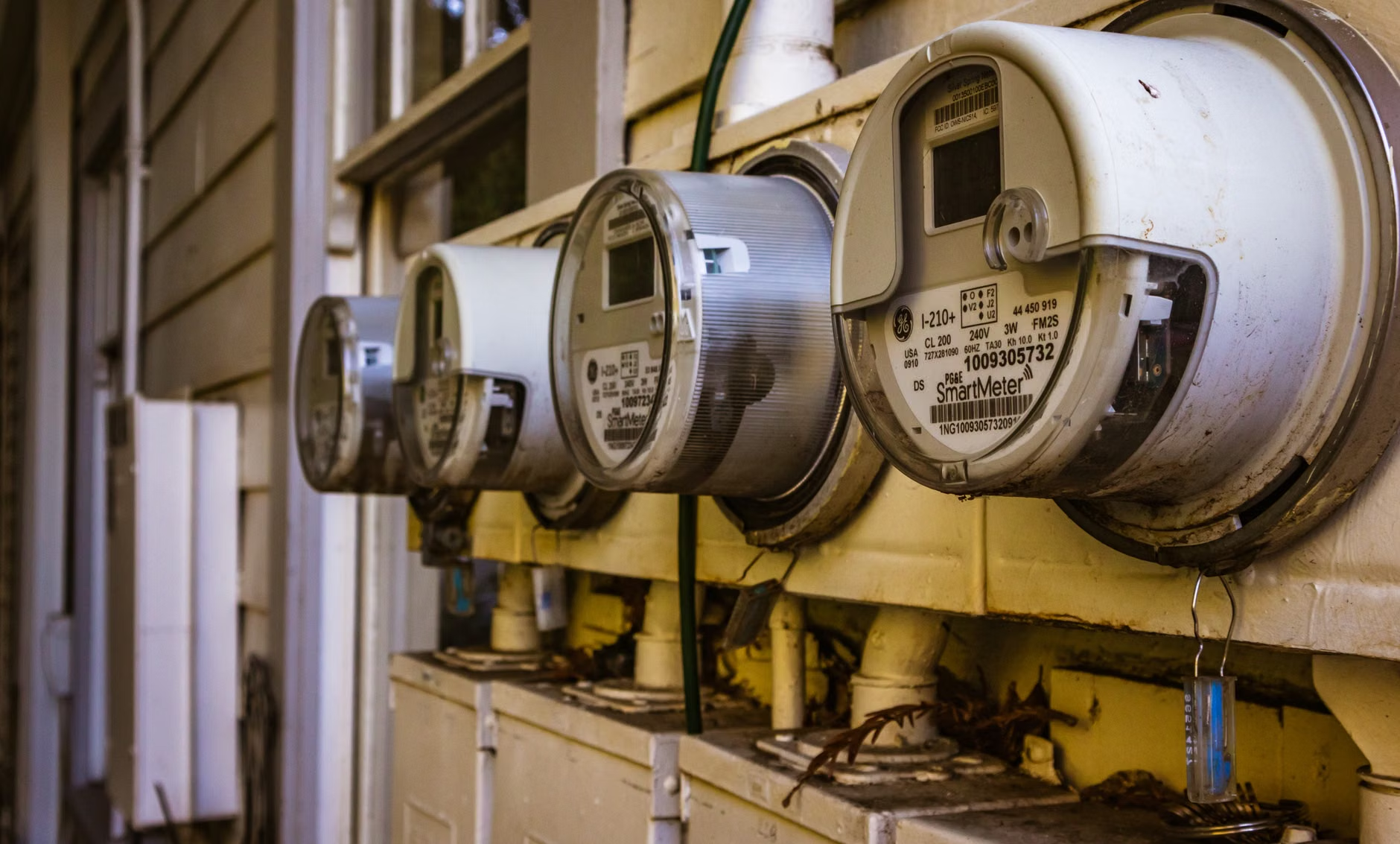
How Your Daily Routine Will Change
You might be wondering, “Does this mean I need to become an energy trader?” Not necessarily. However, your relationship with your utility bill will likely change. The most significant shift is the move toward Time-of-Use (TOU) pricing. Under the new grid standards, electricity prices will fluctuate based on real-time demand. When everyone in your neighborhood turns on their ovens at 6:00 PM, the price per kilowatt-hour will rise. When the wind is blowing at 3:00 AM and demand is low, the price will drop.
For a busy household, this sounds like another chore to manage. But here is the trick: automation. Modern smart appliances are designed to “talk” to these meters. You won’t need to stay up until 2:00 AM to run the dishwasher. Instead, you will set your appliance to “eco-mode” or “smart-delay,” and it will automatically communicate with the grid to start the cycle when electricity is cheapest. This isn’t just about saving a few cents; it is about reducing the strain on the grid during peak hours, which helps keep the entire system stable.
The Role of Smart Home Integration
Your home energy management system (HEMS) will become the central hub for this transition. If you have an electric vehicle, the smart meter update is a game-changer. Through a process called V2G (Vehicle-to-Grid), your car’s battery can act as a backup power source for your home or the grid during peak demand. You get paid (or receive credits) for the energy you provide. It turns your biggest liability—a parked car—into a functional asset.
| Feature | Old Meter (Legacy) | Smart Meter (2026 Standard) |
|---|---|---|
| Data Access | Monthly (estimated) | Real-time (15-minute intervals) |
| Grid Communication | None (passive) | Two-way (active) |
| Pricing Model | Flat rate | Dynamic (Time-of-Use) |
| Outage Detection | Manual reporting | Automatic notification |
Privacy and Data: The Elephant in the Room
Whenever we talk about “smart” devices, the conversation inevitably turns to privacy. If your meter is sending data every 15 minutes, does the utility company know exactly when you are watching Netflix or when you are out of the house? It is a valid concern, and one that regulators have been working hard to address ahead of the 2026 rollout.
The data collected is typically “load profile” data. While it can theoretically be used to infer household habits, most jurisdictions have implemented strict “data minimization” laws. This means utility providers can only use the data for grid balancing and billing, not for marketing or selling to third parties. Furthermore, end-to-end encryption is now standard for the transmission of this data. If you are particularly concerned, most regions offer an “opt-out” or “data-masking” service, though this often comes with a small fee or prevents you from participating in incentive programs that reward energy efficiency.

Practical Steps to Prepare Your Home
You don’t need to renovate your home to be ready for the 2026 update, but a few strategic upgrades can help you maximize the benefits. First, take a look at your major appliances. If you are planning to replace your washing machine or dryer in the next year or two, look for models with “Smart Grid Ready” certification. These machines have built-in logic to interface with the new meters.
Second, consider your home’s connectivity. Smart meters often use a mesh network or cellular signals to communicate. If your utility closet is in a concrete basement with poor signal strength, you might experience intermittent data transmission, which can lead to estimated billing. Ensuring your home has a stable Wi-Fi or local network bridge can help your smart devices stay connected to the grid’s control center.
Finally, look into your local utility’s “demand response” programs. Many providers are already rolling out pilot programs ahead of the 2026 mandate. By signing up now, you can often get subsidies for smart thermostats or EV chargers, and you’ll get a head start on understanding how your household energy usage patterns align with grid demand.
The Impact on Reliability
One of the biggest frustrations for families is the power outage. Whether it is a summer thunderstorm or a winter freeze, losing power is more than just an inconvenience—it’s a massive disruption to school, work, and safety. The 2026 smart grid update is designed to drastically improve “self-healing” capabilities. In the past, if a branch fell on a power line, the entire neighborhood stayed dark until a technician could physically locate the fault.
With the new grid architecture, sensors detect the fault instantly and reroute power around the damaged section. This means that instead of a neighborhood-wide blackout, only a few houses near the immediate damage might lose power. For families, this translates to significantly shorter and less frequent outages. It is a quiet, behind-the-scenes upgrade that makes the infrastructure much more robust against extreme weather events.

Common Misconceptions
There is a lot of misinformation circulating about smart meters, particularly regarding health and cost. Let’s clear a few things up. First, the radio frequencies emitted by smart meters are well within international safety standards—typically lower than those emitted by your smartphone or microwave. They are designed to operate at very low power levels, only sending short bursts of data periodically.
Second, the myth that “smart meters increase your bill” usually stems from the fact that old, analog meters often become less accurate as they age, typically under-reporting usage. When a new, highly accurate digital meter is installed, households suddenly see their true energy usage, which can feel like a price hike. However, the meter itself is not “charging more”; it is simply measuring accurately. The benefit is that you now have the tools to actually control that usage, whereas, with an old meter, you were flying blind.
Planning for the Future
As we approach 2026, the best approach is one of informed patience. Your utility provider will likely reach out with specific instructions for your region. Don’t feel pressured to buy every piece of “smart” tech on the market today. Focus on the basics: insulation, efficient LED lighting, and appliances that are actually nearing the end of their life. Energy efficiency is always the most cost-effective upgrade.
If you have the budget, investing in a home energy monitor—a small device that clamps onto your electrical panel—can give you a preview of the data the new smart meters will provide. It allows you to see which devices are “vampire loads” (devices that draw power while off) and helps you build better energy habits before the dynamic pricing models become the norm.
Final Thoughts
The 2026 Global-Energy-Grid update is a massive engineering undertaking, but for the average person, it is a move toward a more transparent, efficient, and resilient energy future. It is not about surveillance or complicated tech hurdles; it is about creating a grid that can handle the realities of the 21st century. By understanding how these changes affect your home, you can move from being a passive payer of bills to an active manager of your own energy footprint. Keep an eye on your local utility’s portal, stay informed about your regional rollout schedule, and remember that small, incremental changes in your usage habits will yield the biggest long-term savings.
Frequently Asked Questions
- Will I be forced to pay higher rates for electricity after 2026?
Not necessarily. While dynamic pricing changes when electricity is expensive, it also provides significant opportunities to pay lower rates during off-peak hours. By shifting heavy tasks like laundry or EV charging to these times, many families can actually reduce their overall monthly energy costs. - Can the utility company turn off my power remotely with a smart meter?
In most jurisdictions, yes, the capability exists for remote disconnection. However, this is strictly regulated and is generally reserved for situations such as moving out, non-payment after extensive notices, or emergency safety protocols. It is not used for arbitrary grid management. - Do I need to upgrade my home’s electrical wiring for a smart meter?
In the vast majority of cases, no. Smart meters are designed to fit into existing meter bases. Unless your home has very outdated electrical infrastructure that fails to meet current safety codes, the installation of a smart meter is a straightforward swap that takes less than an hour.
For more detailed information on your specific regional rollout, you can visit the following resources: