The most effective way to help children manage big emotions isn’t through complex therapy sessions or expensive gadgets, but through the simple, consistent act of naming feelings within the safe environment of your own home. By using an “Emotional-Vocabulary Jar,” you create a tangible bridge between a child’s internal experience and their ability to express it, which is the cornerstone of lifelong emotional intelligence.
Three Key Takeaways
- Naming is calming: Research shows that labeling an emotion (affect labeling) reduces activity in the amygdala, the brain’s “alarm system,” helping children regulate their reactions.
- Consistency over intensity: The jar works because it is a low-pressure, daily habit, not a “fix-it” tool used only during a meltdown.
- Modeling matters: When parents use the jar to share their own complex emotions, they validate that experiencing a range of feelings is a universal human experience.
We have all been there. It is 6:00 PM on a Tuesday. You are trying to finish one last email, dinner is simmering on the stove, and your child walks into the room, clearly distressed, but unable to tell you why. They might be stomping, crying, or just shutting down entirely. When you ask, “What’s wrong?” the answer is inevitably, “I don’t know,” or “Nothing.”
This “emotional vacuum” is a common source of frustration for parents in their 30s and 40s. We know our children are feeling something—frustration, jealousy, anxiety, or perhaps just exhaustion—but because they lack the vocabulary to articulate it, the emotion manifests as a behavioral problem instead. This is where the emotional-vocabulary jar comes in.
What exactly is an emotional-vocabulary jar?
At its core, this is a simple, analog tool. You take a physical jar—a mason jar, a recycled pasta sauce container, or a decorative box—and fill it with slips of paper. Each slip contains a word describing a specific emotion. The goal is to move beyond the “big four” (happy, sad, mad, scared) and introduce nuanced feelings like “frustrated,” “overwhelmed,” “apprehensive,” “content,” or “disappointed.”
The jar serves two functions. First, it is a teaching tool. It helps children learn that there is a vast spectrum of human emotion. Second, it acts as a conversation starter. By pulling a word out of the jar, you remove the pressure of the child having to come up with a word on their own when they are already stressed.
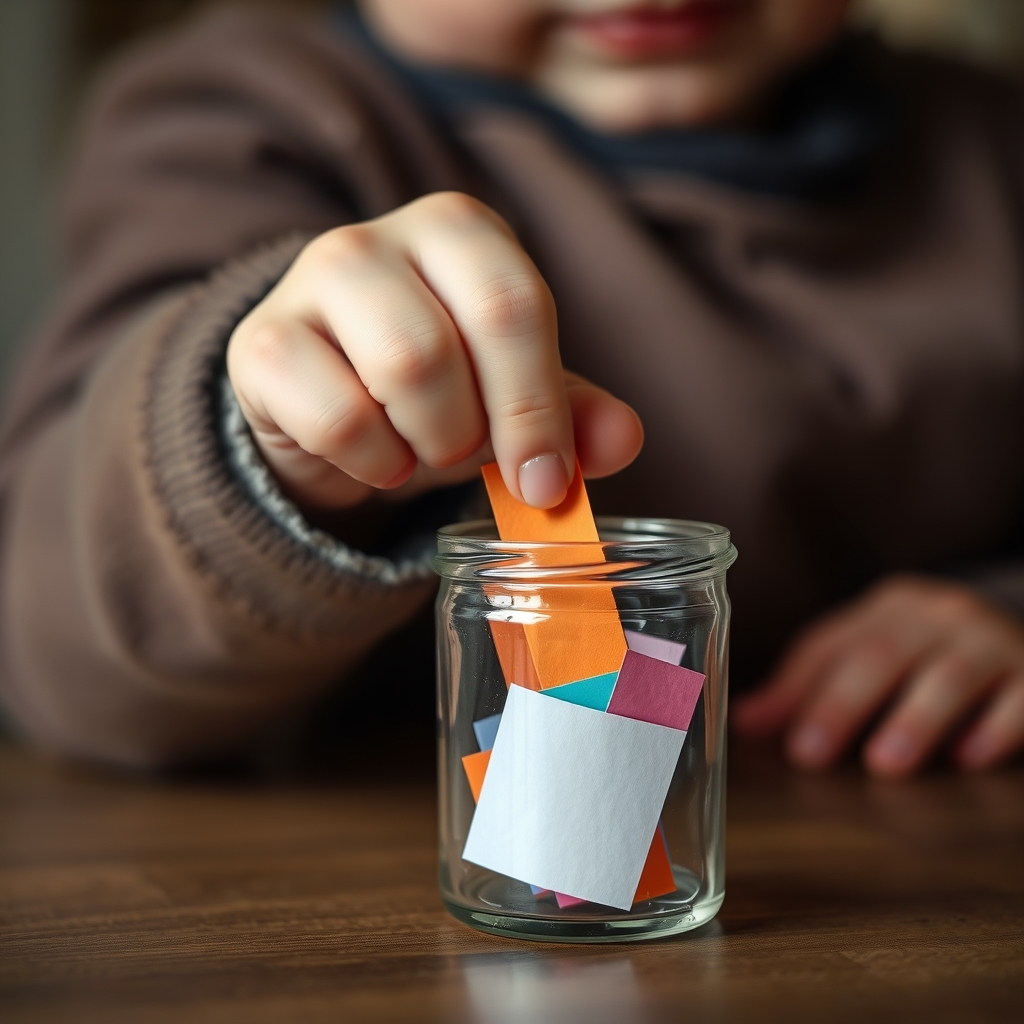
Think of it as building a muscle. You wouldn’t expect a child to run a marathon without training; similarly, you cannot expect a child to navigate complex social-emotional situations if they don’t have the lexicon to identify what they are experiencing. When a child can say, “I feel left out,” rather than throwing a toy, the entire dynamic of the interaction changes from a behavioral correction to an empathetic connection.
Setting up your jar: The practical logistics
You don’t need to be a Pinterest-level crafter to make this work. In fact, the more “lived-in” the jar looks, the better. If your kids see you putting effort into it, they will value it more. Here is the step-by-step process for getting started.
1. Sourcing the container
Choose something durable. If you have younger children, a plastic container is safer than glass. The size doesn’t matter, but it should be large enough that your hand—and theirs—can easily reach inside.
2. Creating the vocabulary list
Start with a manageable list of 20 to 30 words. If you overwhelm them with too many, they will tune out. Focus on a mix of high-energy feelings (excited, nervous, hyper) and low-energy feelings (bored, lonely, calm, tired).
3. Writing the slips
Use different colored paper if you want to categorize them. For example, blue for “calm/sad” feelings, red for “high-energy/angry” feelings, and yellow for “positive” feelings. This visual cue helps children understand that feelings have different “temperatures.”
Common Mistakes to Avoid:
- Don’t make it a punishment: Never force a child to use the jar as a consequence for bad behavior. It should be a tool for connection, not a detention center for emotions.
- Don’t lecture: When a child picks a word, don’t turn it into a five-minute lesson on why they shouldn’t feel that way. Listen first.
- Don’t stop at the word: The word is just the start. The conversation happens when you ask, “Have you ever felt [word] before?”
Why this works: The neuroscience of naming feelings
There is a body of research in clinical psychology known as “affect labeling.” A study conducted by Dr. Matthew Lieberman at UCLA showed that when people put feelings into words, it decreases the response in the amygdala—the part of the brain that processes fear and stress—and increases activity in the prefrontal cortex, the area responsible for logic and decision-making.
Essentially, by asking your child to name their emotion, you are physically shifting their brain from a state of “fight or flight” to a state of “think and reflect.” This isn’t just a parenting tip; it is a physiological intervention that helps the brain return to a state of equilibrium.

When you are in your 30s and 40s, balancing work deadlines and the mental load of running a household, it is easy to default to “quick fixes.” We tell our kids to “calm down” or “don’t be sad.” But those phrases are instructions, not tools. They don’t give the child a path forward. The jar provides that path. It says, “I see you are struggling, and we have a language for this.”
Integrating the jar into your daily routine
The biggest hurdle for most parents is consistency. If the jar sits on a shelf collecting dust, it won’t help anyone. You need to anchor this activity to an existing habit.
The “Dinner Table” Routine
Dinner is often the only time everyone is in the same room. Before you start eating, have everyone pull one word from the jar. Go around the table and share a time you felt that way during the day. If you pull “frustrated,” you might share how the traffic jam made you feel. This shows your child that even adults—whom they view as all-knowing—also struggle with these same, difficult emotions.
The “Pre-Bedtime” Routine
Bedtime is when children often hold onto the worries of the day. If they are having trouble settling down, ask them to pull a word. It might be “anxious” or “excited.” It gives them a way to release the tension of the day before they try to sleep.
The “Meltdown” De-escalation
If you see a tantrum brewing, don’t pull out the jar immediately—that will likely make it worse. Wait for the peak to pass. Once they are breathing more steadily, ask, “Do you think you were feeling [word from the jar]?” This helps them retroactively process what just happened.
Table: Building Your Emotional Vocabulary
To help you get started, here is a categorized list of words you can add to your jar. Start with these and add more as your child’s emotional range expands.
| Category | Vocabulary Words |
|---|---|
| High Energy/Anger | Frustrated, Jealous, Aggravated, Furious, Defiant |
| Low Energy/Sadness | Lonely, Disappointed, Bored, Gloomy, Withdrawn |
| Anxiety/Fear | Nervous, Apprehensive, Worried, Overwhelmed, Startled |
| Positive/Joy | Content, Proud, Excited, Relieved, Inspired |
Notice that “Happy” and “Mad” are not on this list. That is intentional. Those are “umbrella” words. They are too big and too vague. By using more specific words like “aggravated” or “content,” you are forcing the brain to do more work to pinpoint the exact state, which leads to better self-regulation.
Addressing common implementation challenges
You might find that your child refuses to participate. This is normal. Children often reject “therapeutic” activities if they feel like they are being analyzed or tested. If they refuse, don’t push. The best way to get a child interested is to model the behavior yourself.
If you are struggling with a difficult day at work, go to the jar, pick a word, and say, “I felt really ‘overwhelmed’ today with my project. I’m going to put this in the jar so I can let it go.” Your child will see that the jar is a tool for *you*, and they will eventually want to try it themselves. Curiosity is a powerful motivator.
Another challenge is the “I don’t know” response. When you pull a word like “lonely,” your child might just shrug. That is okay. You don’t need a deep, soul-searching conversation every time. Sometimes, just naming the word is enough. It plants a seed. Next time they feel lonely, they might remember that word and use it on their own accord. You are building a library of words, and you don’t need to read every book at once.

Expanding the concept: Beyond the jar
Once your family is comfortable with the jar, you can expand the concept. Some families create an “Emotional Poster” where they group these words on a wall. Others use a “Feelings Thermometer” to track the intensity of an emotion—is it a 2 on the scale or a 10? These are all variations of the same goal: moving from impulsive behavior to cognitive awareness.
As children enter their pre-teen years, the vocabulary should shift. You can introduce words like “insecure,” “ambivalent,” “conflicted,” or “empowered.” The emotional landscape of a 10-year-old is significantly more complex than that of a 5-year-old, and their tools should evolve alongside them.
It is also important to remember that this is not a permanent fix. There will still be meltdowns. There will still be slammed doors and silent treatments. This tool does not eliminate human emotion; it merely provides a map for navigating it. When your child is in the middle of a storm, the jar won’t stop the rain, but it might help them realize that the storm has a name and that it will eventually pass.
The long-term impact on family dynamics
By fostering this level of communication, you are changing the culture of your home. Instead of a home where feelings are ignored or suppressed, you are building a home where feelings are acknowledged as data. When your child learns to identify their own emotions, they also become better at identifying the emotions of others. This is the foundation of empathy.
In your 30s and 40s, you are likely dealing with your own set of stressors—aging parents, career pressures, and the general uncertainty of the modern world. Giving yourself permission to use the jar as well can be a surprisingly grounding experience. It reminds you that we are all, regardless of age, still learning how to articulate the messy, complicated experience of being human.
Stay patient with the process. If you forget to use it for a week, don’t worry. Just pick it back up. The goal is not perfection; the goal is a consistent, reliable effort to understand one another better. Your kids don’t need a perfect parent; they need a parent who is willing to learn alongside them.
Frequently Asked Questions
1. My child is very young (under 5). Is this appropriate for them?
Yes, but keep the vocabulary very simple. Focus on basic states like “tired,” “hungry,” “excited,” and “sad.” Use pictures alongside the words if they are not reading yet. The goal at this age is simply to link a physical sensation to a name.
2. What if my child picks a word that doesn’t fit how they are acting?
Accept it. If they are clearly angry but pick the word “excited,” they might be trying to mask their anger or they might be confused. You can gently say, “Oh, you chose ‘excited.’ That’s interesting. Sometimes when I’m angry, I feel a lot of energy, too. Is that how you feel?” Always validate their choice before offering your own perspective.
3. Can I use this for adults only?
Absolutely. Many couples find that an emotional-vocabulary jar can help de-escalate arguments. When you’re in the middle of a conflict, it’s easy to get stuck in a “you vs. me” loop. Picking a word can help you both step back and look at the actual emotion—like “insecure” or “disappointed”—rather than focusing on the surface-level grievance.
For further reading on the science of emotional intelligence and childhood development, you may find these resources helpful:
- UCLA Health: Understanding the Brain and Emotions
- The Gottman Institute: Emotion Coaching for Parents
- American Psychological Association: Developing Emotional Intelligence in Children
Communication is a lifelong practice. By starting small with a simple jar, you are laying the groundwork for a lifetime of healthy, honest, and resilient relationships. Keep the jar accessible, keep the tone light, and remember that every word identified is a step toward a more connected family.